
Wireless Charging Trends in 2026 can create a real planning problem for importers and distributors. New designs appear every season, but not every attractive sample becomes a stable bulk SKU. If buyers only chase wattage, price, or appearance, they may face inventory risk, certification gaps, and after-sales issues.
Wireless Charging Trends in 2026 point toward multifunctional lifestyle devices1, not just simple charging pads. For B2B buyers, the better question is which products combine real user value, regional compliance, manufacturable design, stable heat control, and channel fit. The strongest candidates often include 3-in-1 stations, lamps, speakers, car mounts, and power banks.
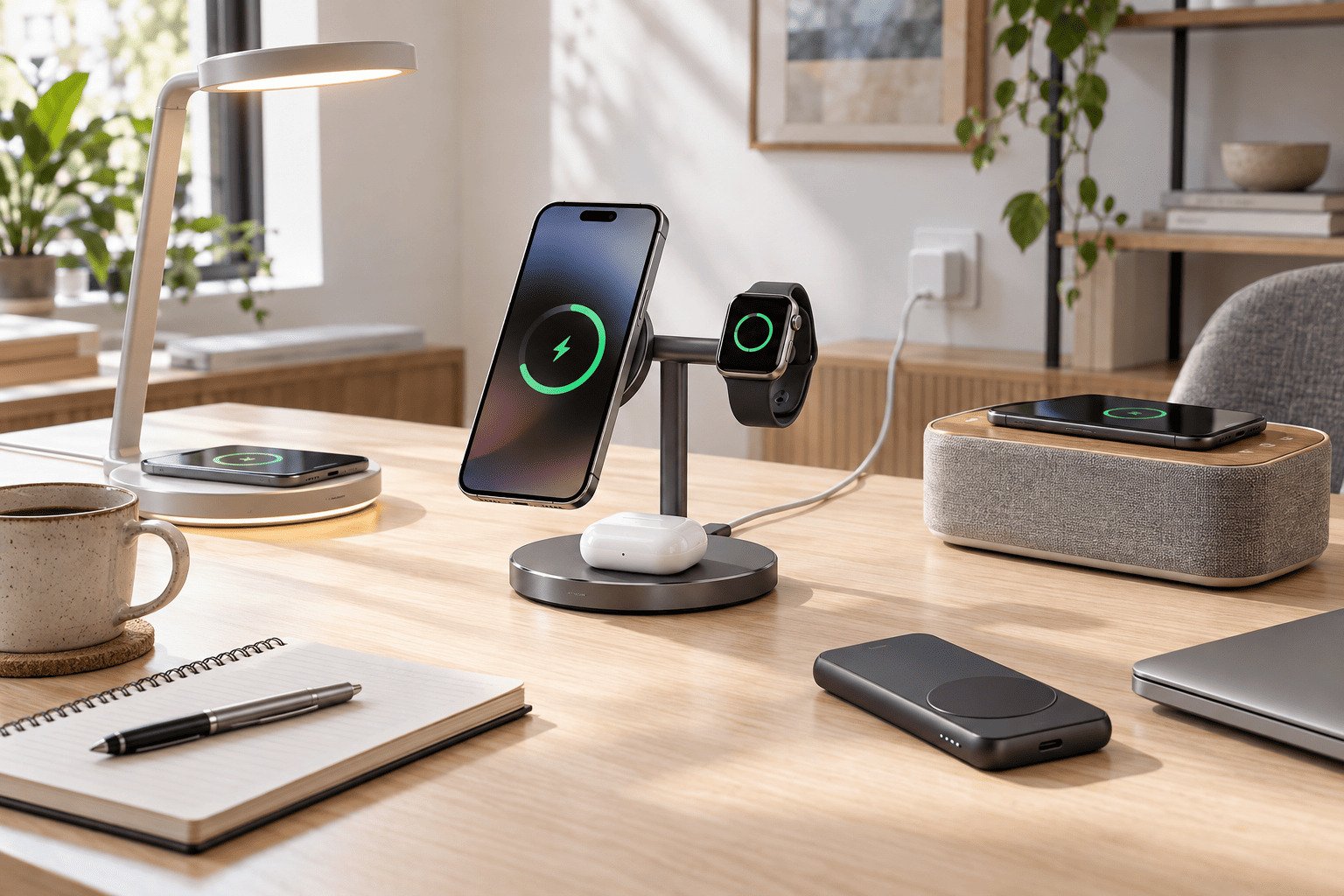
From our manufacturing and export experience, buyers are becoming more careful. They still ask about price and charging speed, but they also ask whether a product can pass local compliance checks, ship on time, and reduce after-sales pressure. That is where trend evaluation becomes a procurement decision.
Which Wireless Charging Trends in 2026 Matter Most for B2B Buyers?
Trend lists can look exciting, but they often create confusion. A buyer may see a lamp charger, speaker charger, and 3-in-1 stand and wonder which one is truly worth sampling. The risk is simple: a “hot” product can fail if it does not match the channel.
Wireless Charging Trends in 2026 matter most when they help buyers reduce SKU failure, inventory pressure, compliance uncertainty, and costly product return rates. The most practical directions are not only new-looking products. They are multifunctional devices that solve daily charging problems while staying stable in mass production.
Dive deeper
We often see buyers shift from “What is the newest wireless charger?” to “Which model can sell for several months without causing trouble?” This is a healthier question. A wireless charger is no longer only a technical accessory. It is becoming part of a desk, bedside table, car, travel bag, or retail display.2
The main product directions worth watching include:
- Desktop 3-in-1 wireless charging stations for phones, earbuds, and watches
- Wireless charging lamps and ambient lights for bedrooms, offices, and gift channels
- Wireless charging Bluetooth speakers for lifestyle and promotional categories
- Car wireless charging mounts for drivers who need navigation and charging together
- Wireless charging power banks for travel, outdoor, and emergency use
However, these products should not be judged by feature count alone. A 3-in-1 station must manage power distribution well. A lamp charger must control heat near the lighting module. A speaker charger must avoid interference between audio, battery, and charging parts. A car mount must hold the phone firmly while managing vibration and temperature.
For procurement teams, we suggest reviewing each product through four questions:
| Buyer question | Why it matters |
|---|---|
| Does the usage scenario feel natural? | Features should support real daily behavior. |
| Can the structure stay stable in mass production? | Complex products create more assembly risks. |
| Are test reports and certifications available for the target market? | Buyers should verify documents before bulk orders. |
| Is the product suitable for the intended channel? | Online, retail, telecom, and gift channels need different positioning. |
In short, the most useful trend is not the flashiest one. It is the one that can be sampled, certified, customized, produced, shipped, and supported with fewer surprises.
How Should Multifunctional Wireless Charging Devices Be Evaluated?
Multifunctional chargers look attractive because they combine several selling points. But more functions also mean more parts, more testing, and more possible failure points3. If a buyer only checks the outside design, the real risks may appear after bulk delivery.
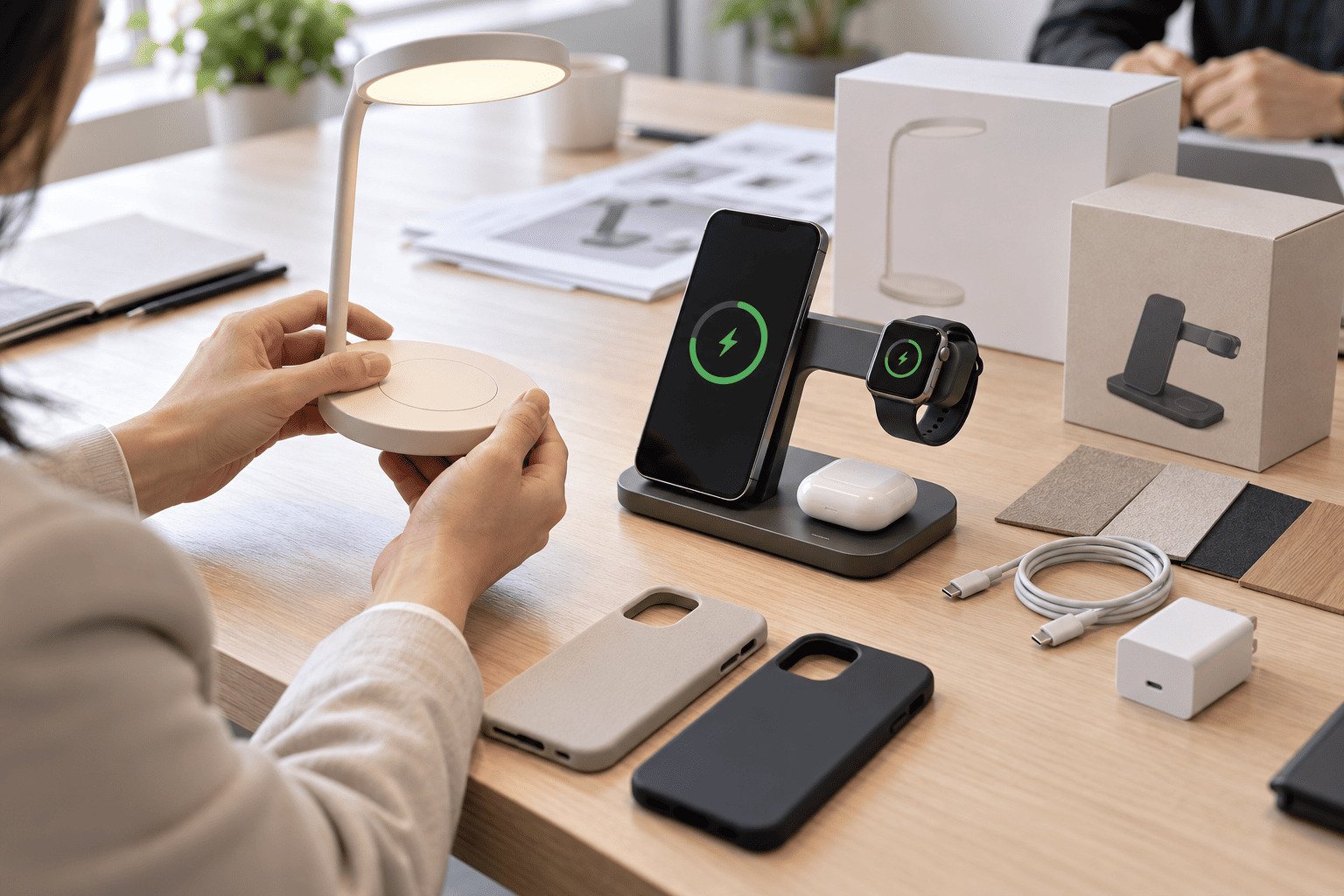
A multifunctional wireless charging device should be evaluated by usage logic, heat control, power management, structural reliability, compatibility, compliance documents, and after-sales exposure. Buyers should treat each added function as both a selling point and a risk point that needs verification before mass production.
Dive deeper
Feature stacking is not the same as product development. A charger with a lamp, speaker, stand, car mount, or power bank must make sense in a real situation. If the user does not understand the benefit in three seconds, the product may be hard to sell, even if the design looks modern.
We usually recommend checking these areas before placing a large order:
-
Power design
The product should provide stable charging under normal use. Buyers should ask how power is distributed when several devices charge at the same time. -
Heat management
Heat is a common concern in wireless charging.4 Multifunctional products may include LEDs, batteries, speakers, magnets, or moving parts, so thermal design deserves extra attention—especially with modern Qi2 thermal monitoring and Foreign Object Detection (FOD)5. -
Mechanical structure
Stands, hinges, lamp arms, clips, and car mounts must survive repeated use. A beautiful sample is not enough. Buyers should ask about aging tests, drop tests, and production inspection points. -
Compatibility
Phone size, camera bump, magnetic alignment, watch module type, and earbud case shape can affect the user experience.6 Buyers should test with common regional phone models. -
Compliance and documentation
Certifications such as CE, FCC, RoHS, UL, PSE, Qi, or other required documents should be checked based on the destination market.7 Products must align with strict hazard-based safety benchmarks like UL 62368-1 safety standards8to avoid import or recall issues.
For example, a wireless charging lamp may work well for bedroom retail channels, but the packaging, plug type, brightness level, and compliance requirements may differ by region. A car wireless charger may fit online channels, but it needs strong clamping force, stable mounting, and clear compatibility communication.
This is why procurement teams should not ask only, “What is the best trend?” They should ask, “Which product can our channel explain, certify, stock, and support?”
Which Wireless Charging Trends in 2026 Fit Different Sales Channels?
A common mistake is assuming one global bestseller can fit every market. This creates pressure when packaging, certification, pricing, plug type, language, and user expectations differ9. A product may perform well in one region but need adaptation in another.
Wireless Charging Trends in 2026 should be matched to the sales channel and destination market. Importers, wholesalers, and distributors should compare product positioning, certification needs, packaging style, after-sales risk, and customer habits before deciding which multifunctional wireless charging SKUs to buy in bulk.
Dive deeper
Different channels reward different product strengths. A retail buyer may prefer a giftable design with clear packaging. An online seller may need strong photos, simple claims, and low return rates. A distributor may care more about stable replenishment, spare parts, and regional compliance. A brand owner may require ODM changes and consistent quality control.
A practical channel view may look like this:
| Product type | Better-fit channels | Key buyer checks |
|---|---|---|
| 3-in-1 charging station | Mobile accessory retail, online, brand programs | Watch compatibility, power adapter needs, heat control |
| Wireless charging lamp | Home, office, gift, lifestyle retail | Lighting quality, plug type, safety documents |
| Wireless charging Bluetooth speaker | Gift, lifestyle, promotional channels | Audio quality, battery safety, wireless charging stability |
| Car wireless charging mount | Auto accessory, online, telecom add-on | Mounting strength, vibration, heat in vehicle use |
| Wireless charging power bank | Travel, outdoor, mobile accessory wholesale | Battery compliance, capacity labeling, transport documents |
From our export communication experience, buyers often overlook packaging until late in the project. This can cause delays. A multifunctional charger may need more explanation than a simple pad. The box should show the use case clearly, not just list features. Manuals, warning labels, adapter requirements, and certification marks should match the market.
Pricing also needs careful thought. The lowest price may increase risk if it reduces coil quality, magnet strength, plastic stability, battery quality, or inspection time, leading to defect-driven warranty claims. At the same time, the highest-spec product may not suit every distributor if the target market is price sensitive.
The safer approach is to build a balanced product line:
- One stable entry model for volume
- One multifunctional mid-range model for margin
- One design-led lifestyle model for differentiation
- One region-specific model when certification or packaging requires adaptation
This approach helps buyers avoid overcommitting to one trend before market feedback is clear.
Frequently Asked Questions
Are higher wattage wireless chargers the main trend in 2026?
Not necessarily. Higher wattage can be useful, but buyers should also check heat control, device compatibility, adapter requirements, and certification documents. Industry standards governed by the Wireless Power Consortium focus as much on precise magnetic alignment and thermal safety as headline wattage. For many channels, stable charging and low after-sales risk matter more than raw speed claims.
Are multifunctional wireless chargers harder to manufacture?
They can be harder to manufacture because they combine more components and functions. A lamp, speaker, battery, stand, or car mount adds structure, thermal, and quality control requirements. Buyers should sample carefully and review production stability before bulk orders.
Which wireless charging products are worth sampling first?
Many buyers start with 3-in-1 charging stations, wireless charging lamps, car wireless charging mounts, and power banks. The best choice depends on the sales channel, target price, certification requirements, and whether the product solves a clear user scenario.
What certifications should buyers verify?
Buyers should verify documents based on the destination market. Common requirements may include CE, FCC, RoHS, UL, PSE, Qi, and battery-related documents for power banks. Professional compliance review is recommended for application-specific decisions.
Conclusion
Wireless Charging Trends in 2026 should be evaluated through procurement value, not appearance alone. Multifunctional lifestyle devices can create better shelf appeal and stronger channel differentiation, but only when they match real usage scenarios, regional compliance needs, and stable mass production. Before placing bulk orders, buyers should compare samples, verify documents, test compatibility, and discuss customization requirements with an experienced wireless charging manufacturer.
"Wireless Charging Market Size, Share and Analysis, 2026- ...", https://www.coherentmarketinsights.com/market-insight/wireless-charging-market-3585. Market and technology analyses describe wireless charging as increasingly integrated into consumer-electronics accessories and multi-use devices, supporting the contextual claim that the category is moving beyond stand-alone charging pads. Evidence role: general_support; source type: research. Supports: A neutral market or research source should support that wireless charging is increasingly integrated into broader consumer-electronics and lifestyle products.. Scope note: The source may support the broader integration trend without specifically forecasting every 2026 product category named in the article. ↩
"Consumer Adoption, Interest in Wireless Charging ...", https://www.wirelesspowerconsortium.com/media/5q5hx4t0/consumer-adoption-interest-in-wireless-charging-continues-to-surge-new-international-survey-shows.pdf. Research on consumer wireless-power applications identifies mobile devices, automotive environments, furniture, and portable accessories as common contexts for wireless charging integration. Evidence role: general_support; source type: research. Supports: A source should show that wireless charging is used across multiple consumer contexts and is increasingly integrated into everyday environments.. Scope note: This supports the general context of multi-environment use rather than proving the author's specific channel observations. ↩
"Reliability engineering", https://en.wikipedia.org/wiki/Reliability_engineering. Reliability-engineering literature generally treats additional components and interfaces as sources of added failure modes and verification requirements in complex electronic systems. Evidence role: mechanism; source type: paper. Supports: A reliability-engineering paper should support the mechanism that more components and interfaces can increase reliability risk and verification burden.. Scope note: The evidence explains the engineering mechanism broadly and may not measure failure rates for multifunctional wireless chargers specifically. ↩
"Inductive charging", https://en.wikipedia.org/wiki/Inductive_charging. Studies of inductive wireless power transfer report that conversion losses, coil alignment, and loading conditions can produce temperature rise, making thermal management a recurring design concern. Evidence role: mechanism; source type: paper. Supports: A peer-reviewed paper should explain that inductive wireless charging can generate heat due to power-transfer losses and alignment or loading conditions.. ↩
"Qi (standard)", https://en.wikipedia.org/wiki/Qi_(standard). The Wireless Power Consortium describes Qi wireless charging specifications as including safety-related controls such as foreign-object detection and temperature-related protections. Evidence role: definition; source type: institution. Supports: A Wireless Power Consortium or standards source should confirm that Qi/Qi2 wireless charging includes safety-related requirements or features concerning temperature and foreign object detection.. Scope note: Public summaries may describe these requirements at a high level without exposing the full proprietary technical specification. ↩
"Modeling and optimization of angular misalignment effects ...", https://www.academia.edu/165221827/Modeling_and_optimization_of_angular_misalignment_effects_in_resonant_inductive_wireless_power_transfer_for_electric_vehicle_charging. Wireless power-transfer studies show that coil misalignment, separation distance, and device geometry can reduce transfer efficiency and affect charging performance. Evidence role: mechanism; source type: paper. Supports: A technical paper should support that coil alignment, separation distance, and device geometry affect wireless charging efficiency and usability.. Scope note: The source may directly address coil alignment and distance while only indirectly supporting specific examples such as camera bumps or earbud case shape. ↩
"Act on Product Safety of Electrical Appliances and Materials", https://en.wikipedia.org/wiki/Act_on_Product_Safety_of_Electrical_Appliances_and_Materials. Government compliance guidance shows that electronic products are subject to jurisdiction-specific requirements, including EU CE/RoHS obligations, U.S. FCC equipment authorization for radio-frequency devices, and Japan's PSE electrical-safety framework. Evidence role: general_support; source type: government. Supports: Government sources should support that electronic products are subject to market-specific compliance regimes such as CE/RoHS in the EU, FCC authorization in the United States, or PSE in Japan.. Scope note: No single source is likely to cover every listed mark; the citation may need to rely on multiple official sources for different markets. ↩
"IEC 62368-1 Testing and Certification", https://www.ul.com/services/iec-62368-1-testing-certification. UL and IEC describe 62368-1 as a hazard-based safety standard for audio/video, information, and communication technology equipment. Evidence role: definition; source type: institution. Supports: A standards source should confirm that UL/IEC 62368-1 applies hazard-based safety engineering to audio/video, information, and communication technology equipment.. ↩
"Mains electricity by country", https://en.wikipedia.org/wiki/Mains_electricity_by_country. International electrical and trade references document country-level differences in plug types, electrical systems, and market-entry requirements, supporting the need for regional adaptation of consumer electronics. Evidence role: general_support; source type: institution. Supports: Institutional sources should show that electrical plug types, voltage systems, and product labeling or compliance expectations vary across countries.. Scope note: This supports regional variation in formal requirements and electrical interfaces, but user expectations and pricing sensitivity may require separate market research. ↩