
A Qi2.2 magnetic power bank matters because iPhone 18 Pro users now expect portable charging that feels simple, stable, and safe. The problem is that many magnetic batteries look similar. This creates confusion, returns, and compliance risk. The solution is to evaluate protocol support, certification status, heat control, and supplier reliability1 before buying.
A Qi2.2 magnetic power bank is useful for iPhone 18 Pro users because it can improve magnetic alignment, daily charging convenience, and product consistency when properly certified and well designed. Buyers should not judge only by advertised wattage. They should verify Qi2.2 support, WPC certification, safety documents, cell quality, thermal behavior, and real-use portability.
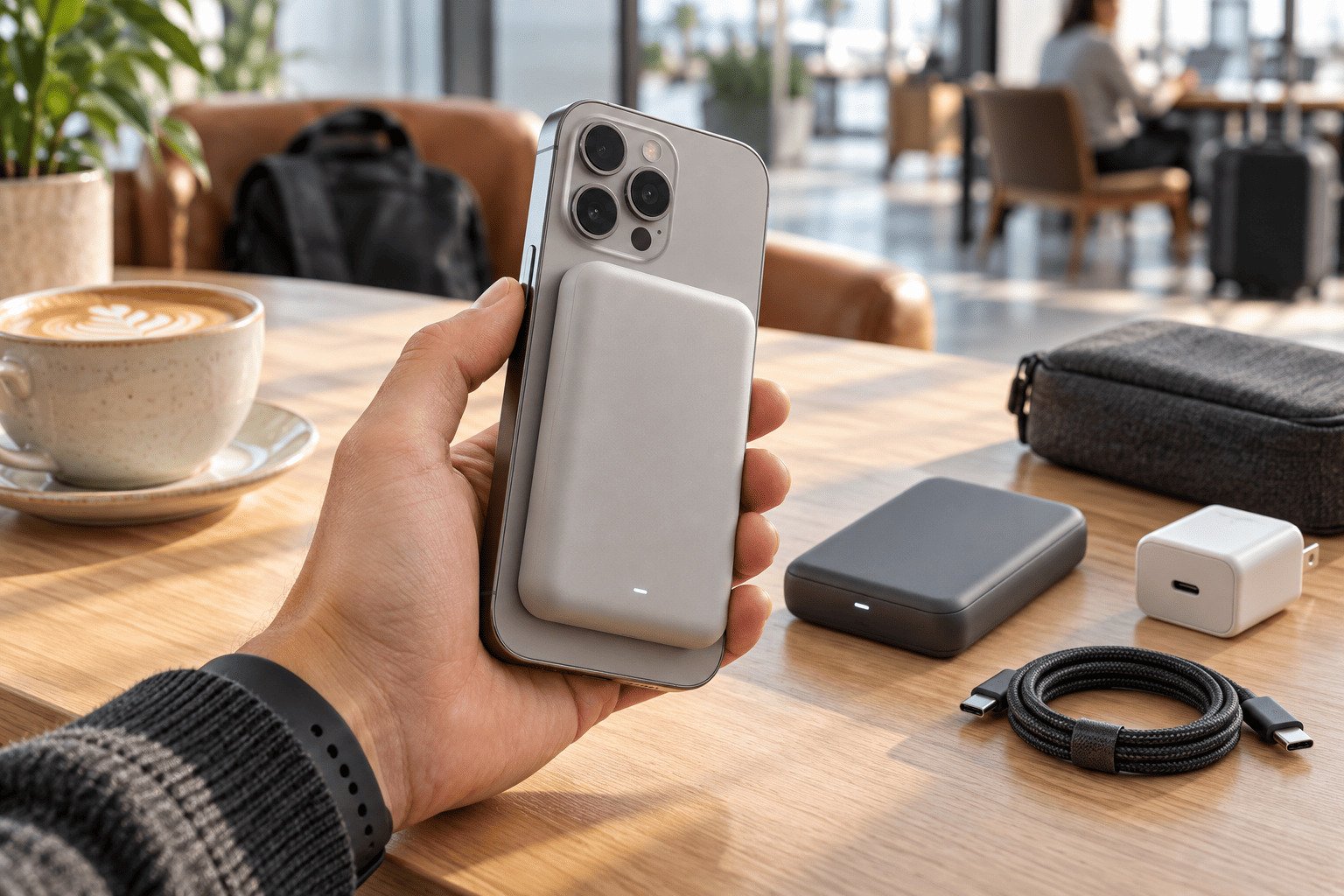
A good magnetic battery is not just a small box with magnets. It is a product where the charging protocol, magnetic structure, battery cell, PCB protection, casing design, and compliance documents must work together. We have seen many sourcing projects succeed or fail because of these details.
Why does a Qi2.2 Magnetic Power Bank matter for iPhone 18 Pro users?
A Qi2.2 magnetic power bank matters because mobile users want fewer charging interruptions. Poor magnetic alignment, unstable output, excess heat, or unclear protocol claims can turn a convenient accessory into an after-sales problem. For iPhone 18 Pro users, the right product should support daily mobility without adding new risk.
A Qi2.2 magnetic power bank matters because it combines magnetic positioning with a newer wireless charging protocol, when verified correctly. This can help improve charging consistency, user experience, and compatibility confidence. However, magnetic attachment, Qi2.2 protocol support, and certified charging performance are separate points that buyers must check.
Magnetic does not automatically mean Qi2.2
We often remind buyers that “magnetic” is a mechanical feature, while Qi2.2 is a charging protocol and certification matter2. A power bank may attach magnetically to the back of an iPhone 18 Pro, but that alone does not prove Qi2.2 support.
Buyers should separate four checks:
-
Magnetic alignment
The phone should attach firmly and align correctly during normal handheld use. -
Wireless charging protocol
The supplier should clearly state whether the product supports Qi, Qi2, Qi2.2, or other modes. -
Certification status
Buyers should request WPC listing details or related documentation instead of relying only on packaging claims.3 -
Actual charging behavior
The product should remain stable during normal use, not only during a short sample demonstration.
Wattage is not the whole story
A high watt number looks attractive on a product page, but it does not guarantee a better user experience.4 In real use, a wireless power bank must manage heat, battery drain, output stability, and hand feel.
| Evaluation point | Why it matters |
|---|---|
| Advertised wattage | Shows claimed output, but needs verification |
| Heat control | Affects comfort, throttling, and battery safety |
| Capacity | Impacts number of charges and product weight |
| Thickness | Affects pocketability and daily use |
| Magnetic hold | Reduces misalignment and charging interruption |
| Certification | Supports market access and buyer confidence |
For consumers, the right choice is usually not the thinnest or the highest-watt model. It is the model that balances capacity, weight, magnetic strength, thermal design, and practical features.
For B2B buyers, the decision is even broader. A distributor or importer is not buying one sample. They are buying repeatability. That means every batch should meet the same standard in casing fit, battery cell quality, PCB protection, labeling, packaging, and compliance documents.
How should buyers choose the right Qi2.2 Magnetic Power Bank?
Choosing the right Qi2.2 magnetic power bank starts with verification, not appearance. Many products use similar shells and marketing terms. The risk appears later, when customs asks for documents, channels request compliance proof, or customers complain about heat, weak magnets, or slow charging.
Buyers should choose a Qi2.2 magnetic power bank by checking certification documents, protocol claims, battery cell quality, protection circuit design, heat control, capacity, thickness, magnetic strength, and supplier batch consistency. For B2B procurement, supplier reliability and after-sales support are as important as the sample itself.
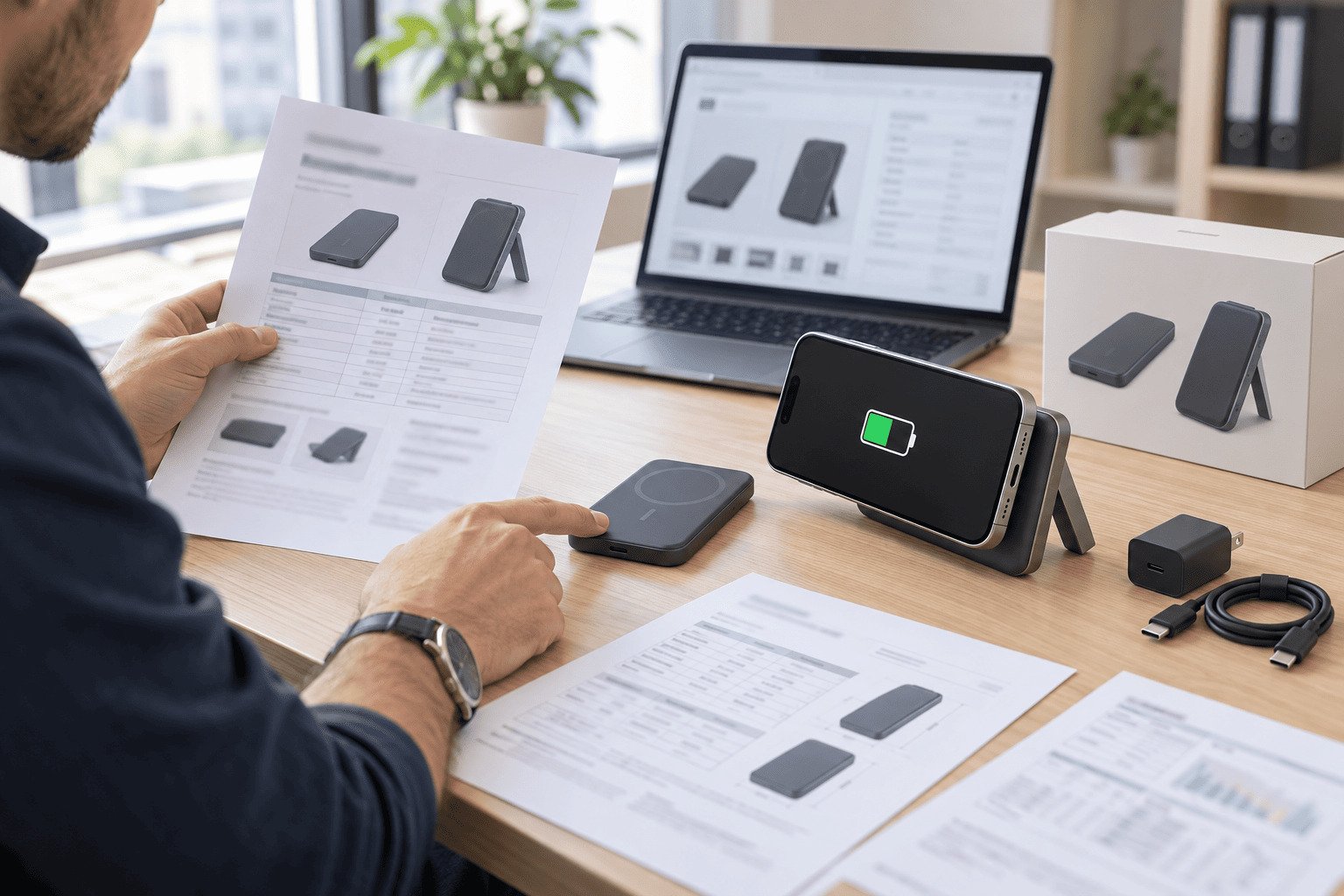
Start with documents before price
We usually suggest that procurement teams ask for documents early. A low price is not useful if the product cannot enter the target market or creates channel risk.
Important documents may include:
- WPC / Qi2.2 certification information, where applicable
- CE, FCC, RoHS, UL, PSE, KC, or other market-related reports
- UN38.3 and MSDS for battery shipping
- Battery cell specifications
- Product safety test reports
- User manual, rating label, and packaging files
- Factory quality system documents, such as ISO 9001 or social compliance records, if required by the buyer
Certifications should always be treated as documents to verify. Buyers should check certificate numbers, model numbers, applicant names, report dates, and whether the tested model matches the product being purchased.
Evaluate real-use design
A Qi2.2 magnetic power bank should be judged as a daily-use accessory. The best design depends on the sales channel and user profile.
For premium iPhone 18 Pro users, practical design points include:
- Capacity: Common options may include 5,000mAh, 10,000mAh, or higher. Higher capacity gives more energy but increases size and weight.5
- Thickness: A thinner model feels better on the phone, but it may limit battery size or heat dissipation.
- Magnetic hold: Stronger magnetic structure can improve alignment, but the product should still be easy to remove.
- Heat management: The casing, PCB layout, coil design, and charging strategy all influence temperature.
- Stand function: A foldable stand can improve video calls, travel use, and desk charging.
- Cable integration: Built-in USB-C cable design may help users who still need wired backup charging.
- Surface material: Soft-touch, silicone, aluminum, or PC+ABS housings each create different cost and feel.
For B2B buyers, sample approval is only the first step
A sample can look good, but mass production is the real test. Importers, wholesalers, and brand owners should look at the supplier’s process control.
A practical procurement checklist includes:
| B2B check | What to confirm |
|---|---|
| Factory capability | Production lines, capacity, export experience |
| Engineering support | OEM/ODM design, tooling, firmware, packaging support |
| Incoming quality control | Battery cells, magnets, PCB, casing materials |
| In-process control | Assembly checks, alignment checks, aging tests |
| Final inspection | Charging test, appearance test, packaging test |
| Compliance support | Market documents and test report coordination |
| After-sales handling | Defect analysis, replacement policy, spare parts support |
We have learned from buyer communication that many problems are preventable. Clear specifications, confirmed artwork, approved materials, and written inspection standards reduce misunderstanding. This is especially important when a brand plans repeat orders or regional distribution.
Frequently Asked Questions
Is every magnetic power bank compatible with iPhone 18 Pro?
No. A magnetic power bank may attach to iPhone 18 Pro, but attachment does not prove correct wireless charging performance. Buyers should check Apple’s official compatibility details, the charger’s protocol support, Qi2.2 documentation, output behavior, and safety certifications before making a purchase decision.
Is Qi2.2 the same as MagSafe-style magnetic charging?
No. Magnetic alignment and Qi2.2 protocol support are different checks. A product may have magnets but not certified Qi2.2 support. Buyers should verify WPC-related certification information and confirm whether the product’s tested model matches the model being sold.
Should I choose 5,000mAh or 10,000mAh?
A 5,000mAh model is usually lighter and easier to carry. A 10,000mAh model usually provides more backup power but adds thickness and weight. The right choice depends on travel frequency, pocket comfort, expected runtime, and whether the user also wants wired backup charging.
What should importers check before bulk ordering?
Importers should check certification documents, battery shipping documents, cell supplier information, protection circuit design, sample performance, packaging accuracy, inspection standards, and batch consistency. They should also confirm after-sales responsibility before placing a large purchase order.
Conclusion
A Qi2.2 magnetic power bank for iPhone 18 Pro should be chosen with care, not hype. The most important checks are protocol support, certification clarity, magnetic alignment, thermal stability, battery quality, practical design, and supplier consistency. For consumers, the right model should feel reliable every day. For B2B buyers, the right supplier should support repeatable quality and market compliance. If you are planning OEM, ODM, or bulk sourcing, start with a clear specification sheet and verified documents before confirming production.
"Qi Certified Products", https://www.wirelesspowerconsortium.com/knowledge-base/testing-and-certification/qi-certified-products/. Standards and conformity-assessment materials for wireless charging and portable lithium-battery products identify protocol compliance, certification status, thermal safety, and production controls as relevant factors in evaluating charger reliability and market readiness. Evidence role: general_support; source type: institution. Supports: A neutral standards or safety source should support that wireless chargers and battery products are assessed through protocol conformity, certification, thermal safety, and manufacturing controls.. Scope note: This would support the evaluation framework generally, not prove that any specific Qi2.2 magnetic power bank meets those criteria. ↩
"Qi (standard)", https://en.wikipedia.org/wiki/Qi_(standard). The Wireless Power Consortium describes Qi-family products as wireless-power standard implementations subject to conformity and certification processes, which distinguishes certified protocol support from the presence of magnets alone. Evidence role: definition; source type: institution. Supports: A WPC or neutral technical source should define Qi/Qi2 as a wireless charging standard with certification requirements and distinguish it from mere magnetic attachment.. Scope note: If the source discusses Qi2 rather than Qi2.2 specifically, it provides contextual support for the protocol-versus-magnet distinction rather than direct evidence about Qi2.2. ↩
"Products", https://www.wirelesspowerconsortium.com/products/. The Wireless Power Consortium maintains certification and product-listing resources for Qi products, supporting the practice of checking model-level certification information rather than relying solely on packaging statements. Evidence role: general_support; source type: institution. Supports: A WPC source should show that Qi-certified products are listed or verifiable through an official certification or product database.. ↩
"Inductive charging", https://en.wikipedia.org/wiki/Inductive_charging. Research on inductive wireless power transfer shows that charging performance is affected by alignment, coupling efficiency, power-control design, and thermal losses, so nominal wattage alone is an incomplete indicator of user experience. Evidence role: mechanism; source type: paper. Supports: A technical paper should explain that wireless charging performance depends on factors such as coil alignment, conversion efficiency, heat generation, and control strategy, not only nominal wattage.. Scope note: Most studies address wireless power transfer mechanisms generally and may not test consumer magnetic power banks specifically. ↩
"Lithium-ion battery", https://en.wikipedia.org/wiki/Lithium-ion_battery. Lithium-ion batteries have finite gravimetric and volumetric energy densities, so increasing stored energy in a portable charger generally requires additional cell material, increasing product mass or volume. Evidence role: mechanism; source type: research. Supports: A research or educational source should explain that lithium-ion cells have finite gravimetric and volumetric energy density, so higher capacity generally requires more cell mass or volume.. Scope note: Packaging, cell chemistry, and electronics design can change the exact size and weight difference between individual products. ↩