
iPhone 18 Pro battery health is becoming a serious sourcing question before buyers even have stable market data. The problem is simple: higher wireless charging power creates more heat1. The risk is after-sales complaints. The better solution is to evaluate Qi2 25W wireless charging2, thermal design, and active cooling by use scenario, not by wattage alone.
Active cooling may matter for iPhone 18 Pro battery health in some Qi2 25W wireless charging products, but it should not be treated as a guaranteed battery-protection feature. Until real iPhone 18 Pro testing is available, buyers should focus on heat control, sustained output, magnetic alignment, certification, noise, reliability, and user scenario.
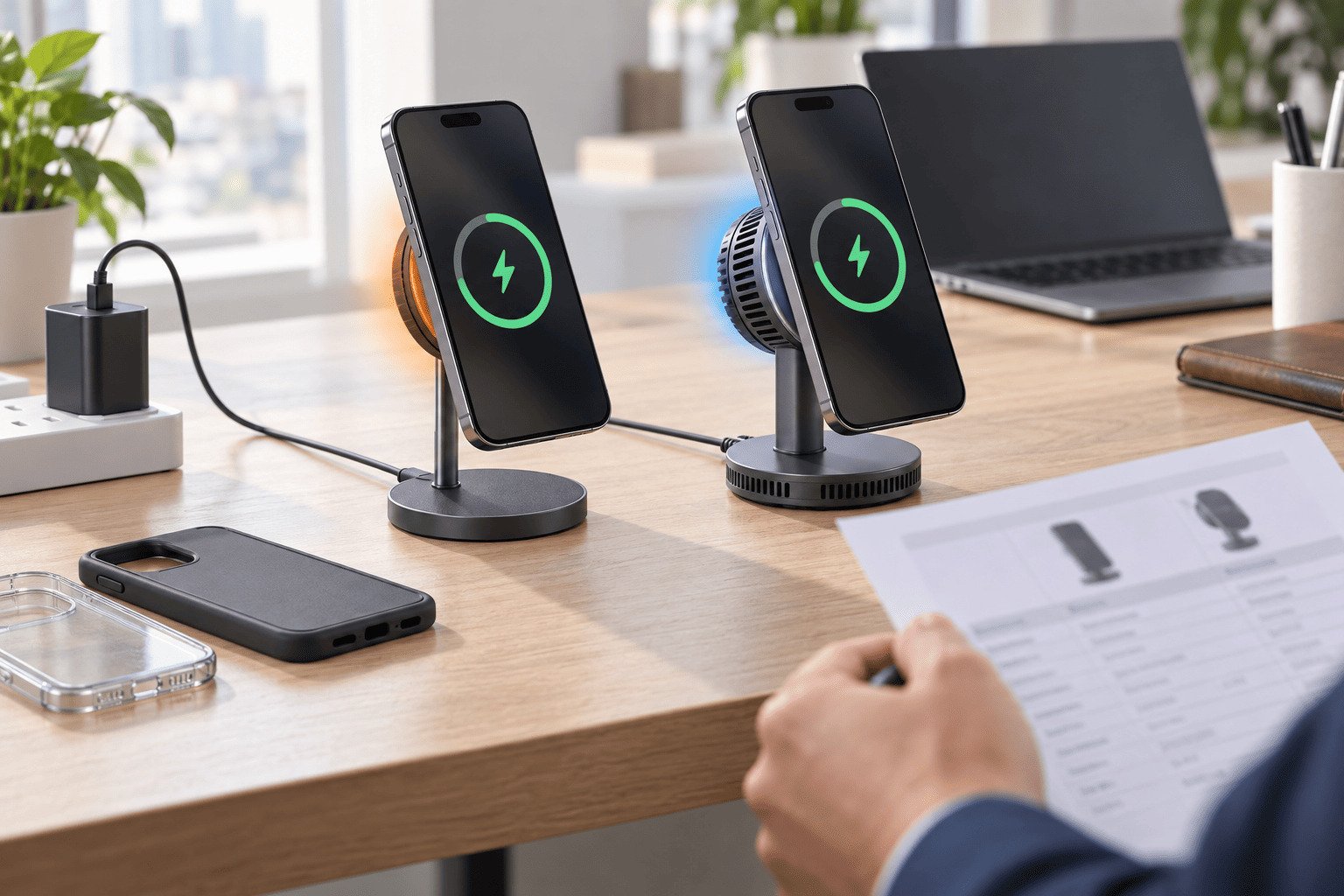
The key question is not “fan or no fan?” The real question is whether the charger can deliver stable, safe, and commercially acceptable performance in the target market. For OEM and ODM buyers, this is a product-definition decision as much as a technical decision.
Does iPhone 18 Pro Battery Health Depend Only on Qi2 25W Wireless Charging Power?
Higher power looks attractive in product listings, but it can create buyer confusion. If a charger advertises 25W yet quickly throttles because of heat3, users may see little real benefit. That gap can lead to returns, bad reviews, and distributor pressure.
Qi2 25W wireless charging should be evaluated by sustained charging behavior, not only peak power. For iPhone 18 Pro battery health, no supplier should claim confirmed results before real device testing. Buyers should ask how the charger manages temperature, alignment, and output stability under realistic conditions.
What Buyers Should Check First
In specification discussions, we often see buyers focus on the headline wattage first. That is understandable, because “25W” is easy to sell. However, wireless charging performance depends on several linked factors:
- Coil alignment: Poor magnetic alignment increases energy loss and heat.4
- Temperature rise: Heat affects charging stability and user comfort.
- Sustained output: Peak power may last only a short time.
- Device case thickness: Thick or metal-influenced cases can reduce efficiency.5
- Ambient temperature: A charger that works well at 22°C may perform differently at 35°C.
- Certification plan: Buyers should verify Qi2-related documents, test reports, and regional compliance.
| Evaluation Item | Why It Matters for Buyers | What to Ask Suppliers |
|---|---|---|
| Peak power | Useful for marketing | How long can 25W be maintained? |
| Surface temperature | Affects user experience | What is the temperature rise under load? |
| Magnetic alignment | Impacts efficiency | What magnet structure is used? |
| Thermal strategy | Controls throttling risk | Passive, active, or hybrid cooling? |
| Compliance | Reduces import risk | Which reports can be verified? |
For iPhone 18 Pro battery health, we should be careful with wording. Battery behavior is controlled by the phone, charging protocol, temperature, and software strategy.6 Without verified iPhone 18 Pro test data, it is better to say: a well-designed charger may reduce thermal stress compared with a poorly designed charger, but it should not be marketed as extending battery lifespan.
Can Active Cooling Improve iPhone 18 Pro Battery Health in Real Use?
Active cooling solves a real problem, but it also creates new ones. Buyers may hope a fan makes Qi2 25W wireless charging safer, faster, and more premium. The concern is that a fan can add cost, noise, thickness, dust sensitivity, and moving-part failure risk.
Active cooling can help manage heat and stabilize output in demanding conditions, but it does not automatically improve iPhone 18 Pro battery health. Its value depends on charger design, fan quality, airflow path, noise control, charging duration, ambient temperature, and the user’s charging habits.
When Active Cooling Makes More Sense
Active cooling is most useful when the product is designed for higher thermal pressure. Examples include:
- Premium desktop chargers where users expect faster wireless charging.
- Gaming or video scenarios where the phone may be warm before charging starts.
- Hot-climate markets where room temperature is often high.
- Long workday charging where the phone stays on the stand for hours.
- Multi-device stations where heat from several coils can accumulate.
However, active cooling should not be added only for marketing. In procurement, we would check:
- Fan noise level: A quiet office charger has different limits than a gaming accessory.
- Fan lifespan: Buyers should ask for rated hours and supplier test methods.
- Air duct design: A fan without effective airflow may add noise without much cooling.
- Dust management: Open vents can collect dust over time.
- After-sales risk: Moving parts can create more complaint points.
- Product thickness: Slim designs may be harder with active cooling.
For iPhone 18 Pro battery health, we should avoid simple claims such as “active cooling protects the battery.” A more accurate buyer-facing statement is: active cooling may help reduce charger-side heat buildup7and support more stable wireless charging under certain conditions.
How Should OEM and ODM Buyers Source Qi2 25W Chargers for iPhone 18 Pro Battery Health?
Procurement teams face a practical problem. They must launch products before every phone model has complete third-party test data. If they guess wrong, they may face certification delays, unstable performance, or customer complaints after shipment.
OEM and ODM buyers should treat Qi2 25W wireless charging as a complete system decision. For iPhone 18 Pro battery health concerns, they should request test plans, thermal data, certification documents, sample validation, and clear positioning before choosing active cooling or passive cooling.
A Practical Supplier Evaluation Checklist
Before placing bulk orders, buyers should request a structured validation process. We usually recommend checking both the product and the supplier’s engineering discipline.
Product questions:
- What charging protocol and Qi2 certification path are planned?
- What is the expected sustained output after 10, 20, and 30 minutes?
- What surface temperature is measured at normal and high ambient temperatures?
- Does performance change with common phone cases?
- Is active cooling always on, temperature-triggered, or user-controlled?
- What happens if the fan fails or is blocked?
Supplier questions:
- Can the supplier provide test reports for review?
- Does the factory have quality management documents that buyers can verify?
- Are incoming materials, magnets, PCBA, and coils controlled by inspection standards?
- Can the supplier support OEM packaging, manuals, regional plugs, and labeling?
- What is the after-sales handling process for noise, heat, or charging complaints?
Passive vs Active Cooling for Product Planning
| Product Type | Passive Cooling Fit | Active Cooling Fit |
|---|---|---|
| Basic bedside charger | High | Low |
| Premium desktop stand | Medium | High |
| Gaming-focused charger | Low | High |
| Travel charger | High | Medium |
| Multi-device charging station | Medium | Medium to High |
This comparison is not a rule. It is a starting point. A poor active-cooling design can perform worse commercially than a strong passive design. A good passive charger can be more reliable, quieter, and easier to certify. A good active-cooling charger can support a premium story if thermal design, noise control, and validation are strong.
For iPhone 18 Pro battery health, the safest sourcing message is restraint: buyers should not approve claims that cannot be proven. Instead, they should position the product around Qi2 alignment, thermal management, verified compliance, and stable charging experience.
Frequently Asked Questions
Does Qi2 25W wireless charging damage iPhone 18 Pro battery health?
There is no confirmed public device-specific test basis here. Buyers should not claim Qi2 25W damages or protects iPhone 18 Pro battery health. The better approach is to evaluate heat control, sustained output, alignment, and verified charging behavior once real devices are available.
Is active cooling necessary for every Qi2 25W charger?
No. Active cooling is scenario-based. It may help in premium, warm, or heavy-use environments, but it adds noise, cost, thickness, and moving-part risk. Basic overnight chargers may perform better commercially with a strong passive thermal design.
What should procurement teams ask suppliers before ordering?
Procurement teams should ask for thermal test data, sustained power curves, noise levels, fan lifespan details, certification plans, sample validation reports, and compatibility checks. They should also verify quality system documents and regional compliance reports before mass production.
Can suppliers promise better battery lifespan with active cooling?
Suppliers should avoid that promise unless supported by qualified, device-specific evidence. Active cooling may reduce charger-side heat buildup, but battery health depends on the phone, software control, temperature, usage habits, and charging environment.
Conclusion
iPhone 18 Pro battery health should be handled as a careful sourcing topic, not a marketing shortcut. Qi2 25W wireless charging is not only about peak wattage. Buyers should compare sustained output, heat control, magnetic alignment, certification readiness, and after-sales risk. Active cooling can be valuable in the right scenario, but it is not automatically required. For OEM or ODM projects, request samples, verify documents, test real use cases, and choose the thermal design that fits your market positioning.
"Inductive charging", https://en.wikipedia.org/wiki/Inductive_charging. Peer-reviewed wireless power-transfer research describes heat generation as a consequence of resistive, conversion, and coupling losses during inductive charging; this supports the general mechanism that higher wireless charging power can increase thermal load. Evidence role: mechanism; source type: paper. Supports: The source should explain that resistive losses, conversion losses, and imperfect coupling in wireless power transfer generate heat, with higher transferred power generally increasing the thermal load.. Scope note: The evidence is general to wireless power transfer and does not quantify heat for the iPhone 18 Pro or any specific Qi2 25W charger. ↩
"Qi (standard)", https://en.wikipedia.org/wiki/Qi_(standard). Wireless Power Consortium documentation establishes the technical and certification context for Qi2 wireless charging, including the relevant power profile when applicable; it does not demonstrate the performance of any particular charger or phone. Evidence role: definition; source type: institution. Supports: The source should identify Qi2 as a wireless charging standard and clarify whether a 25W power profile is included in the relevant Qi specification or certification program.. Scope note: This supports the standards context rather than real-world iPhone 18 Pro charging behavior. ↩
"Power Bank Thermal Throttling Explained", https://www.anker.com/blogs/power-banks/power-bank-thermal-throttling. Studies of thermal management in charging and power-electronic systems report that output power can be reduced when temperature limits are approached, supporting the claim that peak wattage may not be sustained under heat stress. Evidence role: mechanism; source type: paper. Supports: The source should show that charging systems or power electronics may reduce output power under high-temperature conditions to maintain safe operation.. Scope note: This supports the thermal-control mechanism generally and is not direct evidence of throttling in a particular iPhone 18 Pro accessory. ↩
"Inductive charging", https://en.wikipedia.org/wiki/Inductive_charging. Wireless power-transfer studies report that transmitter-receiver coil misalignment lowers coupling efficiency and increases power losses, which can contribute to additional heat generation. Evidence role: mechanism; source type: paper. Supports: The source should show that coil misalignment reduces coupling efficiency and increases losses that can appear as heat.. Scope note: The mechanism is well established, but the magnitude of loss depends on charger geometry, magnets, control electronics, and device design. ↩
"Inductive charging", https://en.wikipedia.org/wiki/Inductive_charging. Institutional guidance on wireless charging notes that intervening materials, added distance, or metal objects can interfere with wireless power transfer, supporting the claim that some cases can reduce charging efficiency. Evidence role: mechanism; source type: institution. Supports: The source should explain that material or distance between the transmitter and receiver coils can interfere with wireless charging efficiency or reliability.. Scope note: This supports the general interference mechanism and does not measure every case design or Qi2 charger configuration. ↩
"Batteries - Maximizing Performance", https://www.apple.com/batteries/maximizing-performance/. Device-manufacturer battery guidance explains that lithium-ion charging and battery aging are influenced by temperature, charge-management software, and device controls, supporting the claim that charger hardware alone does not determine battery health. Evidence role: mechanism; source type: institution. Supports: The source should explain that lithium-ion charging is managed by device hardware and software and is affected by temperature and charging conditions.. Scope note: Manufacturer guidance is general and does not provide independent test data for the iPhone 18 Pro. ↩
"Thermal management (electronics)", https://en.wikipedia.org/wiki/Thermal_management_(electronics). Heat-transfer research shows that fan-assisted forced convection can increase heat removal from electronic components relative to passive cooling when airflow paths are properly designed. Evidence role: mechanism; source type: paper. Supports: The source should show that fan-assisted or forced-convection cooling can improve heat removal from electronic systems compared with passive cooling in suitable designs.. Scope note: This supports charger-side thermal management generally and does not prove improved iPhone battery lifespan. ↩