
A shaky phone is annoying. A hot phone is worse. When both happen during navigation, drivers lose comfort, charging speed, and trust in the mount.
The most balanced wireless charging car mount is often a short-arm air vent magnetic design. It keeps the phone close to the fixing point, reduces shaking, and lets air move around the phone. Yet the best choice still depends on the car vent, phone weight, case thickness, road condition, and heat level.
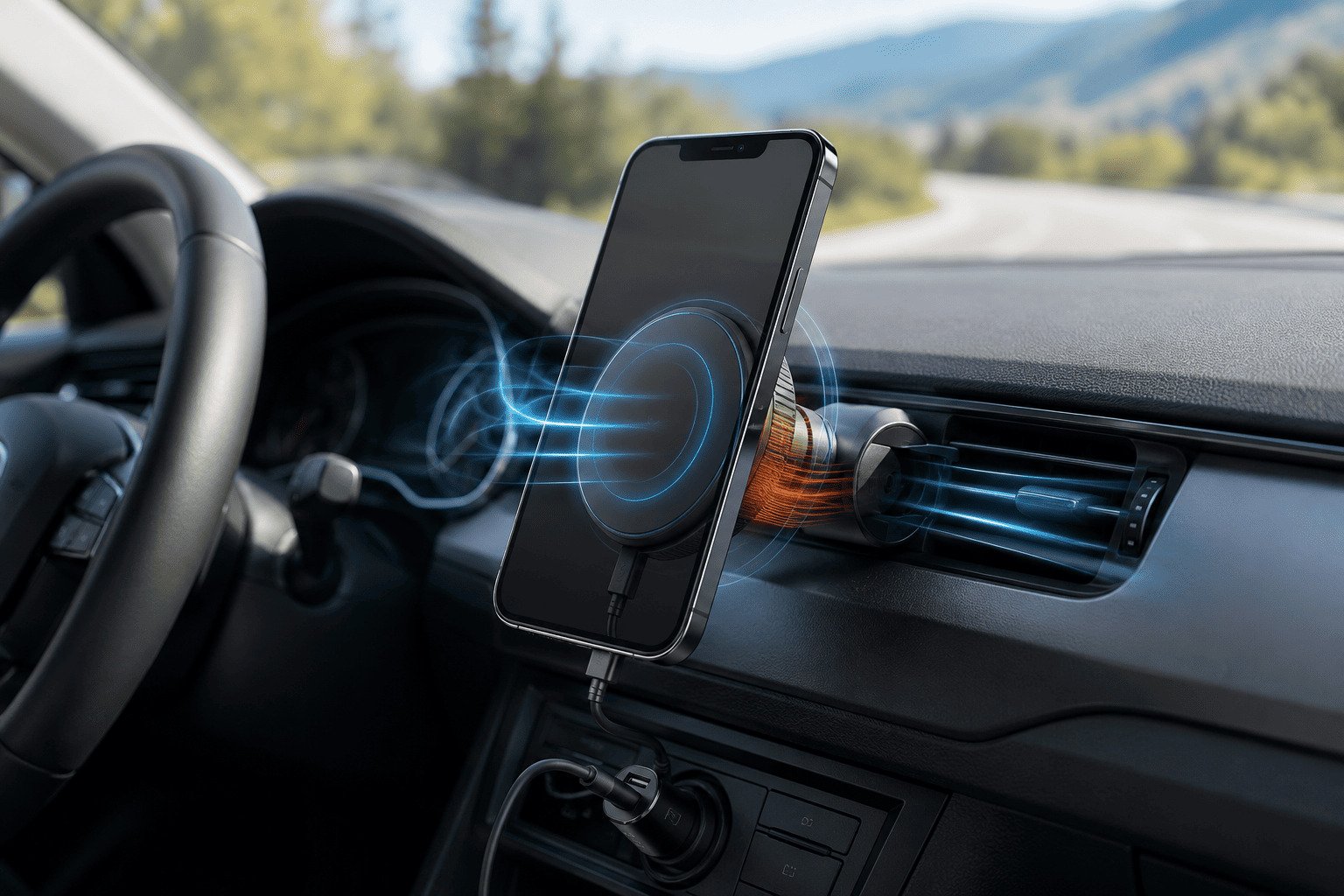
We do not see car mount design as a simple contest between air vent, dashboard, windshield, and cup holder styles. In real cars, stability and airflow always work together. A mount can hold very firmly but trap heat behind the phone. Another mount can cool well but shake on rough roads. We need to judge the whole driving scene, not only the product photo. This is the same way we look at wireless charging products during design and sourcing work. A good mount must hold the phone, align the charging coil, control heat, protect visibility, and stay useful every day.
Why is a short-arm air vent magnetic mount often the best balance?
A long mount looks flexible, but it can shake more. A hot phone charges slower. Many drivers feel this problem only after buying the wrong design.
A short-arm air vent magnetic wireless charging mount often gives the best balance because it reduces leverage1, keeps the phone near the fixing point, and allows AC airflow to help cool the phone during wireless charging and navigation2.
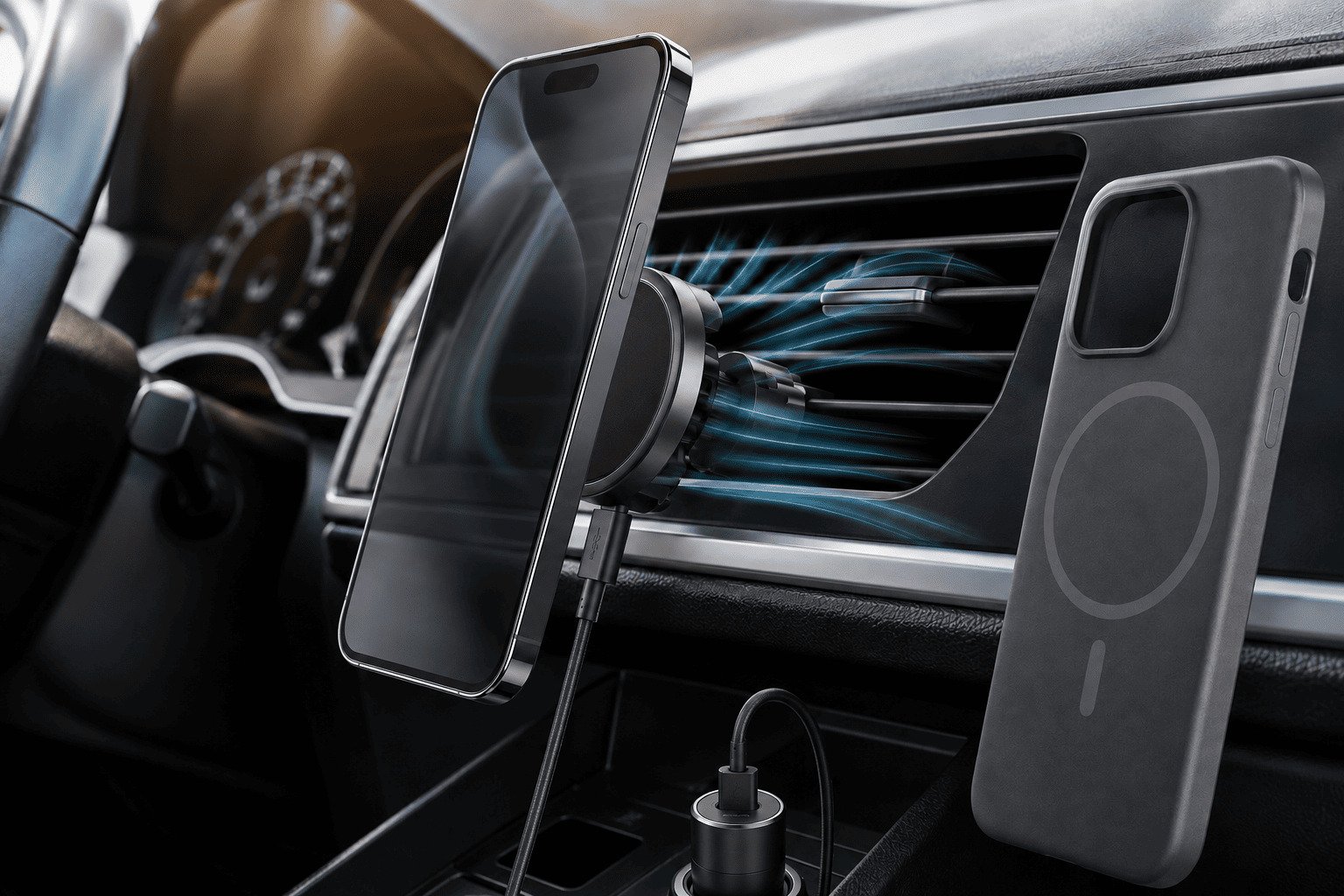
Short-arm air vent designs solve two common problems at the same time. First, they reduce movement. When the phone sits close to the vent clip, the mount has less arm length to bend or bounce. This matters more when the phone is heavy, such as large iPhone Pro Max models weighing up to 227 grams or large Android phones. Second, the phone stays near the air outlet. When the AC is on, airflow can pass around the phone and help reduce surface heat. Wireless charging already creates heat.3 Navigation, GPS, 5G, screen brightness, and summer weather add more heat.4
Key points to check
| Check point | Why it matters | Better choice |
|---|---|---|
| Arm length | Long arms shake more | Short arm |
| Vent shape | Weak vents may drop | Strong horizontal vent |
| Magnet alignment | Poor alignment adds heat | Centered magnetic ring |
| Case thickness | Thick cases reduce charging | Thin magnetic case |
| AC airflow | Air helps cooling | Air can reach phone |
We usually see this design work best in normal city driving, delivery routes, daily commuting, and highway trips with AC on. It is not perfect for every car. Some vents are round, soft, loose, or too low. Some vents move down under weight. In those cars, the best airflow design may not be the most stable design. We should test the vent before choosing the mount.
When is an air vent mount not the right choice?
Many buyers think air vent mounts fit all cars. That belief creates returns. A weak vent can turn a good wireless charger into a bad user experience.
An air vent mount is not the right choice when the vent blades are weak, round, loose, vertical, blocked by controls, or placed too low. Heavy phones and thick cases can also overload the vent and reduce charging alignment.
Air vent mounts depend on the car more than many people expect. The charger may be well built, but the vent still decides a large part of the result. If the vent blade is thin, the clip may move. If the vent is round, the mount may rotate. If the vent is low, the driver may need to look down. If the vent is close to a gear lever or screen, the phone may block controls. We need to treat the car as part of the mounting system.
Practical vent test before buying
| Test | What we do | Good sign | Risk sign |
|---|---|---|---|
| Finger pull test | Pull vent blade gently | Blade feels firm | Blade bends easily |
| Weight test | Hold phone near vent | Vent stays level | Vent drops down |
| Position test | Sit in driver seat | Screen is easy to see | Phone blocks view |
| Air test | Turn on AC | Air reaches phone | Air misses phone |
| Rotation test | Touch phone sides | Mount stays centered | Mount twists |
We also need to consider phone case design. A thick case, wallet case, metal plate, pop grip, or non-magnetic case can affect charging and holding force. Magnetic wireless charging works best when the magnetic ring and charging coil line up.5 If the phone sits slightly off center6, a mere 3mm coil misalignment can slash charging efficiency by over 20% and double the thermal losses, causing heat to rise and charging to slow down. This is why stable mounting is not only about the clip. It is also about the phone, the case, and the charging module. For heavy phones, we may choose a vent mount with a bottom support foot or a stronger hook-style vent clamp.
Do dashboard and windshield mounts give better stability?
A strong suction base feels safe at first. But heat, sunlight, and long arms can create new problems that are easy to miss.
Dashboard and windshield mounts can give stronger physical support than weak air vents, but they often expose the phone to more heat.7 Dashboard mounts may trap heat behind the phone, and windshield mounts may place the phone in direct sunlight.
Dashboard mounts are useful when the car vent is weak or badly placed. A good adhesive pad or suction cup can provide a solid base. This can help with heavier phones and rougher roads. Yet many dashboard mounts use longer arms. The longer the arm, the more the phone can shake. The dashboard also gets hot under sunlight.8 A wireless charging phone sitting above a hot dashboard may become warm quickly, especially during long navigation.
Windshield mounts can place the phone closer to eye level. This may help visibility in some cars. But the windshield area often receives direct sunlight. Sunlight, wireless charging, navigation, and screen brightness can easily push the device past its safe ambient limits. When that happens, the phone triggers built-in thermal protections that automatically slow down or completely pause wireless charging to protect the battery.
Dashboard and windshield trade-offs
| Design | Main benefit | Main risk | Best use case |
|---|---|---|---|
| Dashboard mount | Strong base | Heat from dashboard | Cars with poor vents |
| Windshield mount | High viewing angle | Direct sunlight | Cooler climates |
| Long arm mount | Flexible position | More shaking | Light phones only |
| Short arm suction mount | Better stability | Less reach | Fixed driving position |
We should also think about legal and safety rules. A mount must not block the road view.9 It must not cover the car screen, airbag area, hazard button, or main controls. A stable mount in the wrong place is still a poor choice. For procurement teams and brands, this point matters because customer complaints often come from real installation limits, not only charger defects.
When should we choose active cooling or another special design?
A normal wireless car charger may work in spring. The same charger may struggle in summer traffic with navigation running for two hours.
Active-cooling wireless charging mounts are better for hot climates, long navigation sessions, high charging power, or phones that heat easily. A fan can help move heat away, but it also adds cost, noise, thickness, and one more part that must stay reliable.
Active cooling is not just a marketing feature. It can be useful when the heat load is high. Many drivers use maps, music, calls, mobile data, and wireless charging at the same time. In summer, the car cabin can be hot before the AC lowers the temperature. A fan inside the charger can help keep the phone surface cooler.10 This can support more stable charging over a longer time. It may also reduce the chance of thermal slowdown.
When active cooling makes sense
| Driving scene | Heat level | Suggested design |
|---|---|---|
| Short city trips | Low to medium | Short-arm vent mount |
| Long navigation | Medium to high | Vent mount or active cooling |
| Hot climate | High | Active-cooling mount |
| Windshield use | High | Avoid if sunlight is strong |
| Heavy gaming or video | Very high | Active cooling, or wired charging |
Still, active cooling is not always better. A fan can make sound. Dust can enter the fan area. The product needs better structure design and better quality control. For wholesale and brand projects, we should check fan life, noise level, air path, heat test data, and charging performance with real phones. We should also test with common cases. A cooling fan cannot fix poor magnetic alignment or an unstable clamp.11 The full system still matters.
How should we choose by real driving scenario?
Product claims can sound perfect. Real driving is less perfect. The right choice becomes clear when we match the mount to the car, phone, and climate.
We should choose a wireless charging car mount by checking phone weight, case thickness, vent strength, mount arm length, magnetic alignment, heat exposure, AC direction, road condition, and whether the mount blocks visibility or controls.
The best buying method is simple. We start with the car. We check where the mount can sit safely. We check whether the air vent is strong enough. We check whether the phone will block controls. Then we check the phone. Large phones need stronger support. Thick cases need better magnetic design or a compatible magnetic case. Then we check the driving condition. Smooth city roads allow more options. Rough roads need shorter arms and stronger clamps. Hot areas need airflow or active cooling.
Simple selection guide
| Situation | Better choice | Reason |
|---|---|---|
| Strong vent and normal phone | Short-arm vent magnetic mount | Best balance |
| Weak vent and heavy phone | Dashboard short-arm mount | Stronger base |
| Very hot climate | Vent mount with airflow or fan | Better heat control |
| Long highway navigation | Short-arm stable mount | Less shaking |
| Round vent | Dashboard or cup holder mount | Vent may rotate |
| Need no windshield block | Vent or dashboard low mount | Better safety |
Cup holder mounts can be useful for some cars, but they are usually farther from eye level. They may also need a longer neck, which can shake. They can work for fleet vehicles or cars with poor vents and limited dashboard space. Yet they are not our first choice when airflow and quick viewing matter.
For product sourcing, we should ask suppliers for real test details. Useful tests include vibration testing, high-temperature charging tests, magnetic holding force tests, charging alignment checks, and case compatibility checks. Certifications also matter because wireless charging products must meet safety and market rules. A reliable design is not only one that looks strong. It must stay stable, charge safely, and perform across many real cars.
Conclusion
We prefer short-arm air vent magnetic mounts for balance, but we choose the final design by car structure, phone weight, heat, airflow, and real driving use.
"[PDF] BEAM DEFLECTION FORMULAS", https://home.engineering.iastate.edu/~shermanp/STAT447/STAT%20Articles/Beam_Deflection_Formulae.pdf. A mechanics reference on cantilever beams supports that longer unsupported arms experience greater bending effects and deflection under load, which contextualizes why a shorter phone-mount arm would tend to shake less; it is not a direct test of this specific mount design. Evidence role: mechanism; source type: education. Supports: The source should explain that increasing the unsupported length of a cantilever increases bending moment and deflection under load.. Scope note: Contextual engineering support rather than direct product testing. ↩
"Convection heat transfer in electronic equipment cooling - ADS", https://ui.adsabs.harvard.edu/abs/1988ATJHT.110.1097I/abstract. Research on forced-convection cooling supports that moving air can increase heat removal from electronic devices, which explains why vent airflow may reduce phone surface temperature during charging and navigation; the source may not measure in-car phone mounts specifically. Evidence role: mechanism; source type: research. Supports: The source should support that moving air increases convective heat transfer from electronic devices or heated surfaces.. Scope note: Mechanistic support, not direct evidence for every vehicle vent layout. ↩
"Wireless Power Transfer Efficiency Optimization Tracking Method ...", https://pmc.ncbi.nlm.nih.gov/articles/PMC11086091/. Studies of inductive wireless power transfer describe conversion and coupling losses that are dissipated as heat, supporting the claim that wireless charging itself adds thermal load. Evidence role: mechanism; source type: paper. Supports: The source should explain that inductive wireless charging has conversion losses that are dissipated as heat.. ↩
"[PDF] Characterizing Power Consumption of Dual-Frequency GNSS of ...", https://arxiv.org/pdf/1910.13041. Smartphone power-consumption and thermal studies report that radios, GPS/location services, display use, and ambient temperature can increase device power draw and heat, supporting the article’s list of added thermal loads. Evidence role: general_support; source type: paper. Supports: The source should show that GPS, cellular radios, display brightness, and ambient temperature influence smartphone power consumption or heat generation.. ↩
"Energy Efficiency Analysis through Misalignment on New Design of ...", https://www.academia.edu/92386713/Energy_Efficiency_Analysis_through_Misalignment_on_New_Design_of_Hexagonal_Coil_Array_in_Wireless_Power_Transfer. Wireless power-transfer research shows that transmitter-receiver coil alignment affects magnetic coupling and charging efficiency, supporting the claim that magnetic alignment is important for wireless charging performance. Evidence role: mechanism; source type: paper. Supports: The source should support that coil alignment affects coupling, efficiency, and heat in inductive wireless charging.. ↩
"[PDF] Design and Performance Analysis of Misalignment Tolerant ...", https://repository.aus.edu/bitstreams/5c9d09a5-0276-4d65-8dfc-fc66909568fb/download. Peer-reviewed work on inductive power transfer reports that lateral coil misalignment reduces coupling and efficiency, which can increase loss-related heating; the source may not confirm the article’s exact 3 mm and 20% figures. Evidence role: mechanism; source type: paper. Supports: The source should support that lateral coil misalignment reduces wireless power-transfer efficiency and can increase losses.. Scope note: Supports the direction of the effect, not necessarily the precise numerical values in the article. ↩
"Evaluating the impact of solar radiation on pediatric heat balance ...", https://pmc.ncbi.nlm.nih.gov/articles/PMC6204985/. Vehicle thermal studies document elevated temperatures on dashboards and in sun-exposed cabin areas, supporting the thermal-risk side of the comparison between dashboard/windshield and vent-mounted phone placement; they do not evaluate mount stability directly. Evidence role: general_support; source type: research. Supports: The source should support that dashboard and windshield-adjacent areas receive strong solar radiation and can reach high temperatures.. Scope note: Supports heat exposure, not the physical-support comparison. ↩
"Evaluating the impact of solar radiation on pediatric heat balance ...", https://pmc.ncbi.nlm.nih.gov/articles/PMC6204985/. Measurements from vehicle-heating studies show that sun-exposed cabin surfaces, including dashboards, can reach high temperatures, supporting the claim that dashboard placement adds heat risk. Evidence role: statistic; source type: paper. Supports: The source should provide measured dashboard or vehicle-interior temperatures under sunlight.. ↩
"Authorized Windshield Area for the Installation of Vehicle Safety", https://www.regulations.gov/document/FMCSA-2021-0037-0001. Government vehicle-safety or traffic regulations commonly restrict objects that obstruct the driver’s view, supporting the statement that a phone mount should not block the road view; exact requirements vary by jurisdiction. Evidence role: general_support; source type: government. Supports: The source should support that objects mounted in a vehicle should not obstruct the driver’s field of view.. Scope note: Legal details differ across countries, states, and provinces. ↩
"Experimental investigation of forced convection heat transfer for ...", https://pmc.ncbi.nlm.nih.gov/articles/PMC10758812/. Studies of forced-air cooling in electronic devices show that fan-driven airflow can reduce surface temperatures by increasing convective heat transfer, supporting the claim that a charger fan can help keep a phone cooler; effects depend on charger geometry and airflow path. Evidence role: mechanism; source type: paper. Supports: The source should support that fan-driven airflow can lower device or charger surface temperature by increasing convective heat transfer.. Scope note: Mechanistic support; performance varies by product design. ↩
"[PDF] Design and Performance Analysis of Misalignment Tolerant ...", https://repository.aus.edu/bitstreams/5c9d09a5-0276-4d65-8dfc-fc66909568fb/download. Wireless power-transfer studies show that coil alignment governs coupling and efficiency, supporting the claim that cooling alone cannot correct misalignment-related charging losses; separate mount-specific stability evidence would be needed for the clamp portion. Evidence role: mechanism; source type: paper. Supports: The source should support that coil alignment and mechanical positioning affect charging efficiency independently of thermal cooling.. Scope note: Directly supports the alignment issue, but only indirectly supports clamp stability. ↩