
Fast wireless charging looks simple. Heat makes it less simple. We risk slower charging, battery stress, and customer complaints when we ignore the full system.
Qi2 25W wireless charging protects phone batteries through live power control1. We see the phone, battery, software, and charger adjust power together, based on temperature, battery level, usage load, coil alignment, and safety signals.
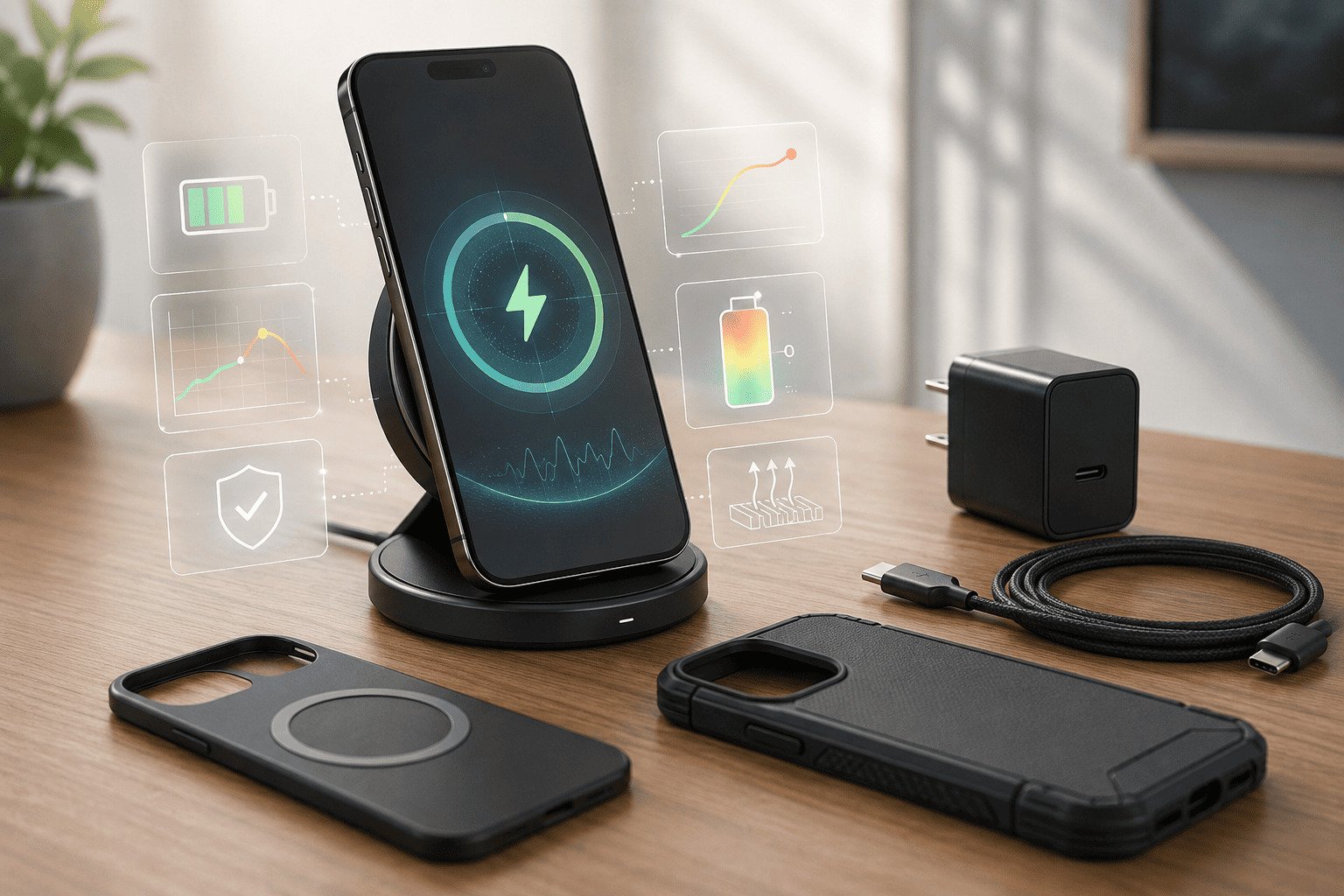
We should not treat Qi2 25W as only a higher watt number. We should treat it as a controlled charging process. The phone does not take full power all the time. The charger also cannot promise full speed in every use case. We need to understand this point before we judge charging speed, product quality, or supplier claims.
Why Does A Phone Slow Down During Qi2 25W Wireless Charging?
A buyer may think slower charging means a bad charger. We see a different risk. The phone may slow down because it is protecting the battery.
Qi2 25W charging speed changes because the phone controls the charging curve2. We see faster charging at lower battery levels, then reduced power when temperature rises, battery level increases, or the user runs heavy apps.
The Phone Is Not A Passive Receiver
In our product tests, we often see the same charger behave differently with different phones. One phone may hold higher power longer. Another phone may reduce power earlier. This does not always mean one charger is poor. It often means each phone brand uses its own battery protection rule.
A phone checks more than one signal during wireless charging. It checks battery temperature, charging state, operating system load, battery age, and the power received from the charger3. When one value becomes risky, the phone reduces power. When heat keeps rising, the phone may pause charging.
| Phone-side signal | What we often see | Why it matters |
|---|---|---|
| Battery temperature | Power drops when heat rises | The battery needs lower stress |
| Battery percentage | Speed slows near high levels | The battery is less tolerant near full |
| App load | Charging slows during gaming or navigation | The phone produces its own heat |
| Coil position | Power may change if alignment is poor | Bad alignment wastes energy as heat |
| Battery condition | Older phones may charge slower | The system protects aged cells |
We should explain this clearly to customers. A Qi2 25W charger is not a promise that the phone will accept 25W from 0% to 100%. It is a power ceiling inside a managed system.
Why Does Heat Increase During Wireless Charging?
Heat is easy to blame on the charger. We know that is not always fair. We also know that charger design can make heat better or worse.
Heat during Qi2 25W wireless charging comes from power conversion, coil transfer loss, phone operation, case thickness, air flow, and room temperature. We see the best results when the full system is designed and tested together.
Heat Has More Than One Source
Wireless charging moves power through magnetic coupling4. This process has loss. Loss becomes heat. If the phone and charger coils are aligned well, the transfer is more efficient. If alignment is poor, the system wastes more energy.5
Qi2 improves alignment through magnetic positioning.6 This is useful. Still, it does not remove every heat source. The phone may be running video, maps, hotspot, or games. The battery may already be warm. The user may charge inside a car in summer. A thick case may trap heat. A metal ring or wrong accessory may also cause unsafe heating, so foreign object detection matters7.
| Heat source | Common user case | Product lesson |
|---|---|---|
| Power conversion loss | Fast wireless charging at high wattage | Use efficient ICs and stable layout |
| Coil mismatch | Phone not centered well | Improve magnet and coil design |
| Phone workload | Gaming, navigation, video calls | Test under real use cases |
| Case insulation | Thick case or poor material | Give clear case guidance |
| Hot environment | Car dashboard or summer room | Run high-temperature tests |
We have learned that heat control cannot depend on one feature. The phone protects itself, but the charger must reduce waste heat from the start. A cooler charger gives the phone more room to hold useful power.
How Does The Phone Protect The Battery In Real Time?
Some people describe phone heat protection like a magic switch. We do not see it that way. We see many small control steps.
A modern smartphone protects its battery by checking temperature, battery level, current, voltage, and software load. We see it reduce power, flatten the charging curve, stop charging for a time, or restart when temperature falls.
The Control Is Step By Step
The charging system works like a live conversation. The charger offers power. The phone asks for what it can safely use. The battery management system checks the cell condition. The operating system checks device load. Then the phone changes its power request.
This is why the same user may see different results on different days. A phone can charge quickly in a cool office. The same phone can slow down in a car mount during navigation. The charger may still be working normally. The phone is making a protection decision.
| Protection action | When it may happen | What the user sees |
|---|---|---|
| Power reduction | Temperature starts to rise | Charging speed becomes slower |
| Charging curve control | Battery level gets higher | Fast start, slower finish |
| Temporary pause | Heat becomes too high | Charging stops for a while |
| Restart at lower power | Temperature falls again | Charging resumes slowly |
| Screen or app guidance | System detects heat risk | Warning message or charge limit |
We should also remember that battery health is a long-term issue. High heat can speed up battery wear.8 The phone maker wants to protect user safety and battery life. Because of this, the phone may choose a lower charging speed even when the charger can supply more power.
What Does This Mean For Qi2 25W Charger Suppliers?
Phone-side protection is important. It is not an excuse for weak charger design. We believe B2B buyers should ask suppliers for real data.
A reliable Qi2 25W charger still needs good coil alignment, efficient power design, thermal structure, foreign object detection, adapter matching, and test records across phones, cases, temperatures, and usage scenarios.
Supplier Responsibility Still Matters
For wholesalers, importers, and brand owners, the risk is not only whether the charger can reach 25W in a lab. The real risk is whether the product stays stable after mass production and daily use. A charger that runs hot may trigger phone power reduction often. Customers may then think the product is slow.
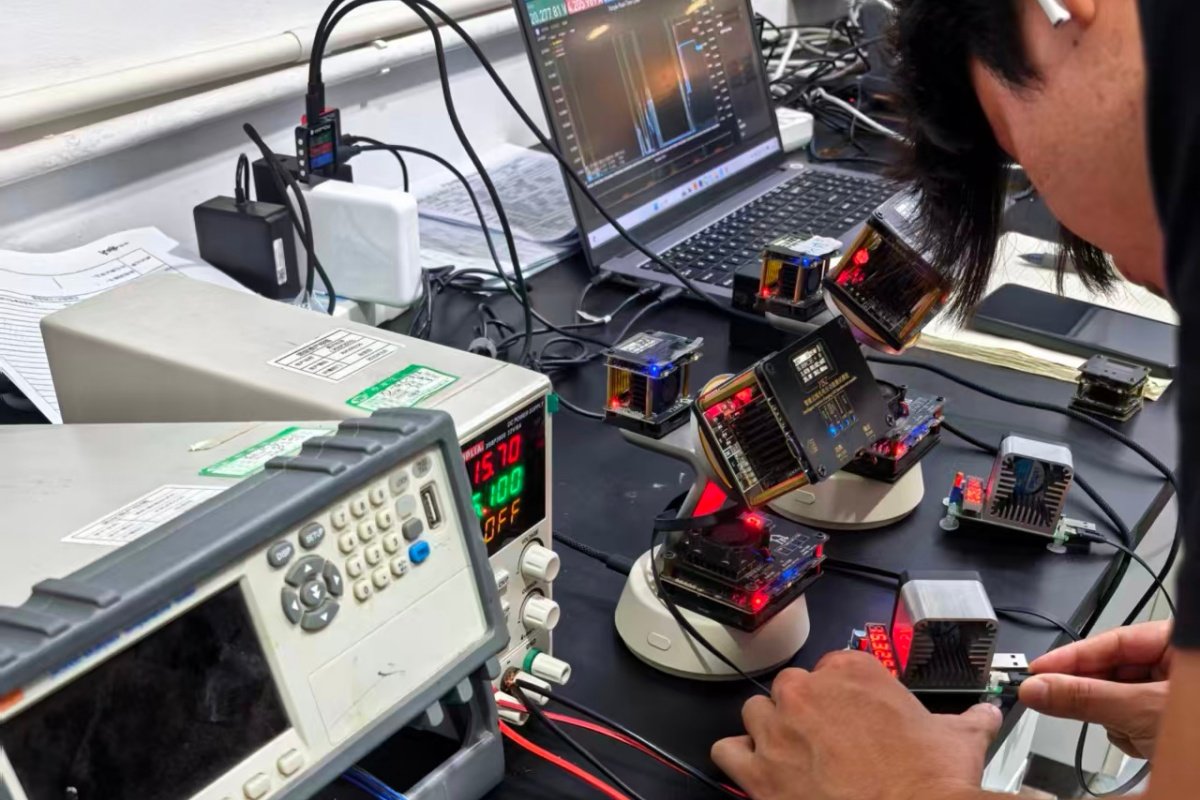
In our factory work, we pay close attention to coil position, magnetic force, PCB layout, IC choice, thermal pads, shell material, and ventilation path. These small design points affect the final user experience. Certification also matters. Qi2, FCC, CE, RoHS, UL, PSE, KC, and other reports help buyers reduce compliance risk. Still, certification is not a replacement for practical thermal testing.
| Supplier item | What buyers should check | Why it protects the project |
|---|---|---|
| Qi2 certification | Valid model and test scope | Confirms standard compliance |
| Thermal test report | Multiple phones and room conditions | Shows real heat control |
| FOD function | Metal object detection result | Reduces safety risk |
| Adapter compatibility | PD adapter list and limits | Prevents unstable input power |
| Aging test | Long-time charging record | Reduces after-sales issues |
| Mass production control | QC plan and sampling method | Keeps quality stable |
We should not sell Qi2 25W as a simple speed slogan. We should sell it as a complete power system. That message is more honest and more useful for serious buyers.
What Should B2B Buyers Ask Before Bulk Ordering Qi2 25W Chargers?
A low unit price can hide a large after-sales cost. We see buyers lose margin when they skip thermal and compatibility questions.
Before bulk ordering Qi2 25W chargers, buyers should ask for certification proof, phone compatibility tests, temperature data, adapter requirements, case-use guidance, FOD records, production capacity, and quality control documents.
A Simple Buying Checklist Helps Reduce Risk
A procurement team needs clear evidence. A sample that works once is not enough. We should test samples with popular phone models in the target market. We should test in normal rooms and warmer spaces. We should test with thin cases and common magnetic cases. We should also test while the phone is doing real tasks, such as video playback, calls, maps, or game use9.
The supplier should explain when charging speed may slow down. This is not a weakness if the explanation is true and supported by data. It is a sign that the supplier understands phone-side battery protection.
| Question | Good supplier answer | Warning sign |
|---|---|---|
| Which phones were tested? | Clear phone model list | Only one unknown phone |
| What temperature was recorded? | Data at charger and phone points | No numbers provided |
| Which adapter is required? | Clear PD power recommendation | Vague “any adapter” claim |
| Does it support FOD? | Test proof available | No FOD record |
| Can the design be customized? | OEM and ODM process offered | No engineering support |
| Can production scale? | Capacity and QC plan shared | Unclear delivery promise |
As a manufacturer, we believe buyers should connect product design with market use. A charger for office desks may need a different structure from a car charger. A 3-in-1 charging station must handle more heat sources than a single pad. A wireless charger with speaker or lamp also needs more careful internal layout, because extra functions add heat and power demand.
Conclusion
Qi2 25W fast charging is safe when the phone, charger, software, testing, and supplier quality work together as one controlled system.
"Qi (standard) - Wikipedia", https://en.wikipedia.org/wiki/Qi_(standard). A Wireless Power Consortium or comparable technical source describes Qi charging as a managed transmitter-receiver system in which the receiver communicates power requirements and control information rather than passively accepting a constant maximum output. Evidence role: mechanism; source type: institution. Supports: A standards or technical source should support that Qi wireless charging uses communication and control between transmitter and receiver to regulate delivered power.. Scope note: This would support the general Qi/Qi2 control mechanism, not prove the behavior of every individual Qi2 25W phone and charger combination. ↩
"Temperature and voltage effects on the charge and health of lithium ...", https://pmc.ncbi.nlm.nih.gov/articles/PMC13003025/. Battery-management references describe lithium-ion charging as a controlled current-voltage process in which charge current is reduced or limited according to cell voltage, temperature, and state of charge. Evidence role: mechanism; source type: education. Supports: A battery-management source should explain that lithium-ion charging is controlled by current, voltage, state of charge, and temperature limits.. Scope note: This supports the charging-control principle generally and may not document the exact firmware rules used by a specific smartphone brand. ↩
"Research on fast-charging battery thermal management system ...", https://pmc.ncbi.nlm.nih.gov/articles/PMC10359346/. Research on mobile-device power and thermal management shows that charging behavior is constrained by battery temperature, state of charge, electrical limits, and device operating conditions. Evidence role: mechanism; source type: paper. Supports: A technical paper should support that mobile devices use battery and system-state variables to manage charging and thermal limits.. Scope note: The source may discuss mobile thermal and battery management broadly rather than enumerate the same full list of phone-side signals. ↩
"Wireless power transfer - Wikipedia", https://en.wikipedia.org/wiki/Wireless_power_transfer. Reference sources define inductive wireless charging as the transfer of electrical energy through magnetic coupling between a transmitting coil and a receiving coil. Evidence role: definition; source type: encyclopedia. Supports: A neutral reference should define wireless inductive charging as power transfer through magnetic fields between coils.. ↩
"Energy Efficiency Analysis through Misalignment on New Design of ...", https://www.academia.edu/92386713/Energy_Efficiency_Analysis_through_Misalignment_on_New_Design_of_Hexagonal_Coil_Array_in_Wireless_Power_Transfer. Studies of inductive wireless power transfer report that transmitter-receiver coil misalignment weakens magnetic coupling and lowers transfer efficiency, which increases power loss that can appear as heat. Evidence role: mechanism; source type: paper. Supports: A wireless power transfer study should show that coil misalignment reduces coupling efficiency and increases losses.. Scope note: The exact magnitude of loss depends on coil geometry, distance, frequency, and device design. ↩
"Qi (standard) - Wikipedia", https://en.wikipedia.org/wiki/Qi_(standard). The Wireless Power Consortium describes Qi2 as incorporating a Magnetic Power Profile that uses magnets to align compatible devices with charging transmitters. Evidence role: definition; source type: institution. Supports: A standards-body source should support that Qi2 includes a Magnetic Power Profile intended to improve alignment between device and charger.. Scope note: This supports the design intent and standard feature, not the measured alignment performance of a specific charger. ↩
"[PDF] A review of foreign object detection (FOD) for inductive ... - Chris Mi", https://chrismi.sdsu.edu/publications/170.pdf. Wireless charging safety guidance and Qi technical materials identify foreign object detection as a mechanism for detecting conductive objects that may absorb energy and heat during inductive power transfer. Evidence role: mechanism; source type: institution. Supports: A standards or safety source should explain that foreign object detection is used in wireless charging to reduce heating risks from metal objects.. Scope note: This supports the general safety function of FOD and does not verify the FOD performance of any individual product. ↩
"Predictive Models of Li-ion Battery Lifetime - NLR Research Hub", https://research-hub.nlr.gov/en/publications/predictive-models-of-li-ion-battery-lifetime-nrel-national-renewa/. Lithium-ion battery aging studies consistently identify elevated temperature as a major factor that accelerates capacity fade and other degradation processes. Evidence role: expert_consensus; source type: paper. Supports: A peer-reviewed or institutional battery source should support that higher operating or storage temperatures accelerate lithium-ion aging.. Scope note: The degradation rate varies by cell chemistry, temperature profile, state of charge, and charge-discharge conditions. ↩
"(PDF) Thermal management of mobile devices - Academia.edu", https://www.academia.edu/4742147/Thermal_management_of_mobile_devices. Research on smartphone thermal management shows that computational, display, radio, and navigation workloads increase device power dissipation and temperature, providing context for testing charging under active-use conditions. Evidence role: mechanism; source type: paper. Supports: A mobile-device thermal management paper should support that active workloads increase power dissipation and heat, which can affect thermal control during charging.. Scope note: The source may not evaluate Qi2 charging specifically, but it supports the thermal relevance of phone workload. ↩