
A logo on a wireless charger can look safe. Yet a wrong document can hide real risk, delay customs, and damage your brand.
CE, FCC, and RoHS show different compliance controls. CE supports EU market access, FCC covers U.S. electromagnetic and radio-frequency rules, and RoHS restricts hazardous substances.1 They are important starting points, but they do not alone prove charging performance, heat control, Qi compatibility, or production quality.
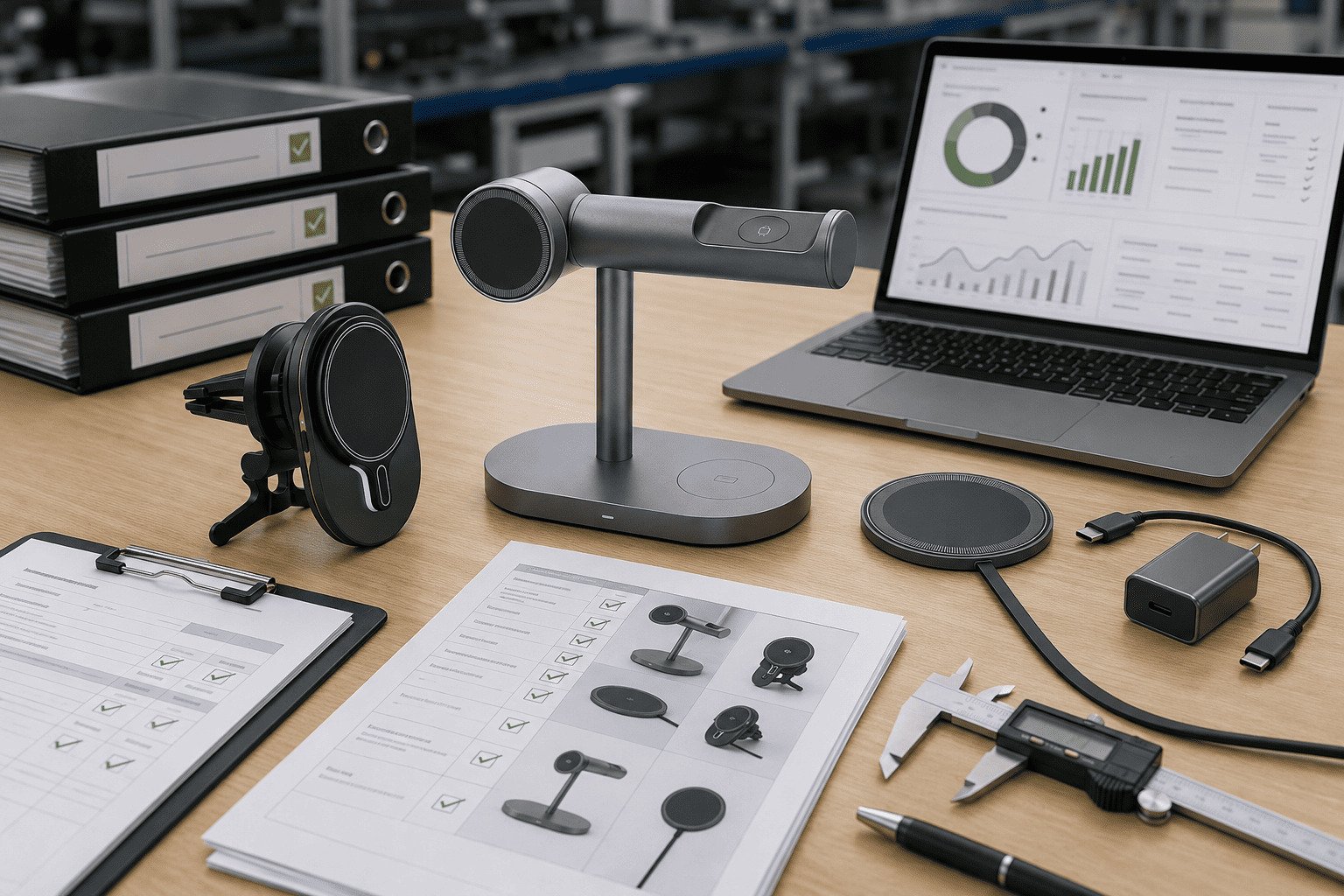
We have seen many buyers check only the printed marks on a housing or gift box. We understand why. It is fast. It feels clear. It also feels like a simple pass-or-fail answer. But wireless charger sourcing is not that simple. A mark must connect to a real product, a real test report, a real model number, and a real production process. If these links break, the mark loses much of its value.
What Does CE Mean for Wireless Charger OEM Projects?
A CE mark can help a product enter the EU. But if we treat CE as a universal safety promise, we may miss important product risks.
CE means the product is declared to meet applicable EU requirements.2 For wireless chargers, this may involve electromagnetic compatibility, radio equipment rules, safety-related standards, and substance requirements. Buyers should check the declaration, test reports, model numbers, and applied standards.
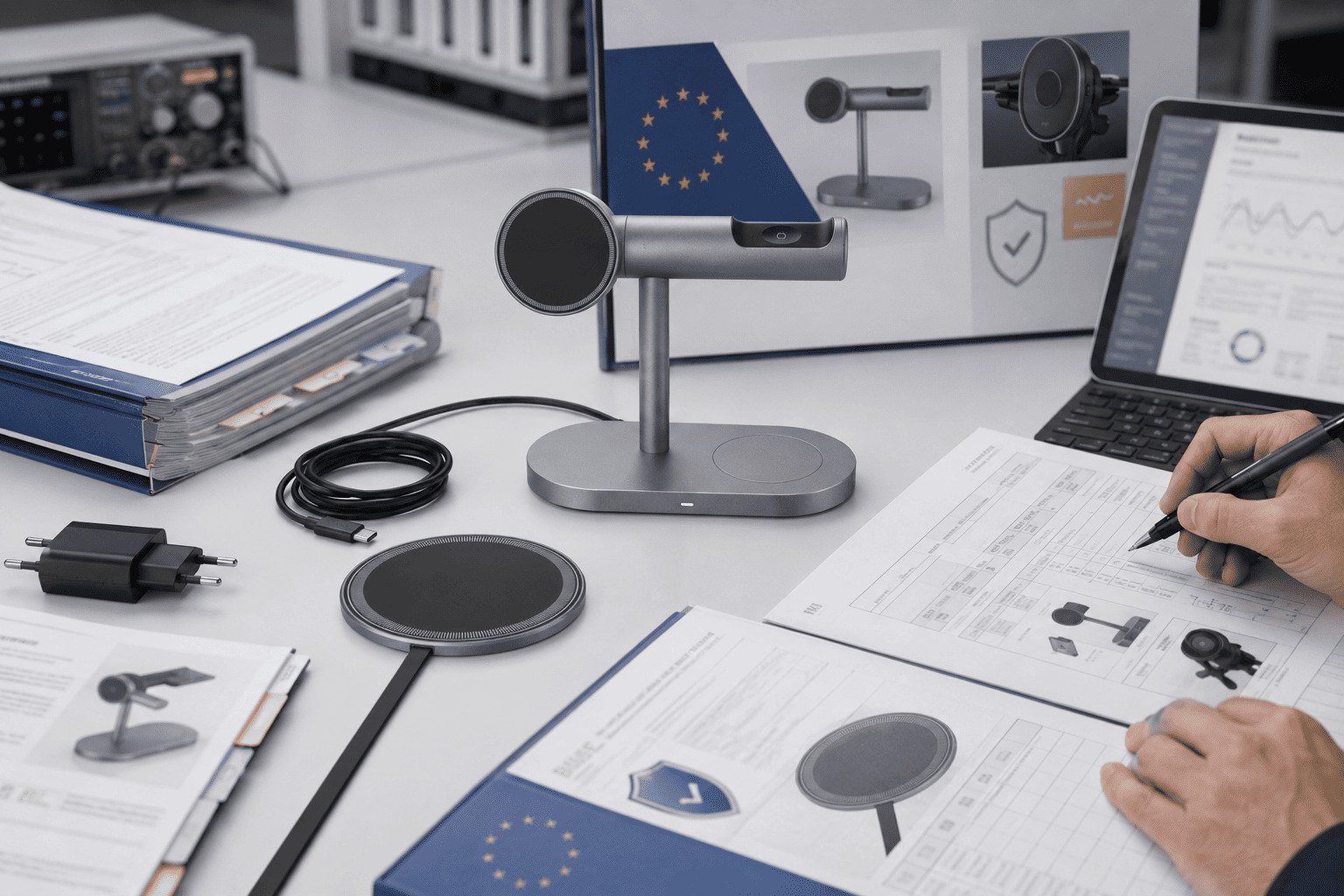
CE is not one single test. It is a system of responsibility. In many cases, the manufacturer or importer issues a Declaration of Conformity based on test evidence. We should not only ask, “Do you have CE?” We should ask, “Which EU directives and standards does this model follow?” We should also check whether the report model is the same as the product we plan to buy.
For wireless chargers, CE-related review often touches many design details. Coil layout can affect electromagnetic noise. PCB routing can affect emissions. The adapter and cable can change test results. Housing material can affect heat. Firmware can affect charging behavior. So we need to link CE documents with the actual design.
| Buyer Checkpoint | Why It Matters | What We Ask For |
|---|---|---|
| Model number match | Avoid using another product’s report | Report, label, BOM, product photo |
| Applied standards | Know what was actually tested | EN standards list and test scope |
| Lab details | Reduce fake document risk | Lab name, address, report number |
| Valid document set | Support customs and market review | DoC, test report, product label |
| Product consistency | Keep mass production aligned | Golden sample and production control |
We also should remember one clear point. CE does not automatically prove Qi or Qi2 performance.3 It does not prove good foreign object detection. It does not prove low temperature rise in every home or office use case. It only covers certain legal requirements for the EU market. We still need performance tests, aging tests, thermal tests, and compatibility checks.
What Does FCC Mean on Wireless Chargers for the U.S. Market?
A wireless charger can pass visual inspection and still cause radio interference. If we ignore FCC risk, we may face shipment delays or complaints.
FCC compliance mainly controls electromagnetic and radio-frequency behavior for the U.S. market.4 Wireless chargers can produce electromagnetic energy, so buyers should review FCC reports, product classification, test setup, frequency data, and model coverage before bulk orders.
FCC is very important for wireless chargers because the product works through electromagnetic induction or magnetic alignment5. Even a small change in PCB layout, coil design, shielding, or cable length can change emission behavior.6 We have seen projects where a sample passed a test, but the mass production version used a different coil supplier. That change looked small on paper. It still created new risk.
We should also check whether the report covers the full model family. Some suppliers use one report for several products. This can be acceptable only when the differences are clearly listed and technically justified7. If a 15W stand, a 3-in-1 station, and a charger with lamp all share one document without clear model difference notes, we should slow down and ask more questions.
| FCC Review Point | Good Sign | Risk Sign |
|---|---|---|
| Report model | Same as offered SKU | Similar but not identical name |
| Product photos | Match housing and PCB | Old sample photo |
| Test setup | Adapter and cable listed | Missing accessory details |
| Frequency data | Clear operating range | Vague technical description |
| Model family | Differences explained | Many models grouped loosely |
FCC also does not prove full product safety. It does not prove the charger will stay cool beside a bed. It does not prove stable charging with iPhone, Samsung, earbuds, or Apple Watch style modules. It does not prove the adapter is safe. If we sell in the U.S., we may also need other safety expectations, retailer requirements, or customer-specific test plans. FCC is one necessary layer. It is not the whole quality system.
What Does RoHS Tell Us About Wireless Charger Materials?
A clean-looking charger can still contain restricted substances. If we ignore RoHS, we may create legal, brand, and recall risk.
RoHS restricts certain hazardous substances in electrical and electronic products.8 For wireless chargers, buyers should check material declarations, test reports, supplier control, solder material, PCB parts, plastic housing, cables, magnets, and packaging-related requirements when needed.
RoHS is different from CE and FCC because it focuses on what the product is made from. It is about restricted substances such as lead, mercury, cadmium, certain chromium compounds, and certain flame retardants and phthalates9 under applicable rules. For wireless charger OEM projects, this matters because the product includes many parts. A charger may include PCB, solder, coils, magnets, plastic housing, rubber feet, cable, connector, paint, glue, and gift box materials.
We should not accept a simple “RoHS passed” sentence without support. We should ask whether the report covers the actual materials. We should ask whether the supplier controls incoming materials. We should ask whether the same approved material will be used in mass production. A test on one black housing cannot always cover a white housing with a different pigment. A test on one cable may not cover another cable from a different supplier.
| Material Area | RoHS Risk | Control Method |
|---|---|---|
| PCB and solder | Lead or other restricted content | Approved PCB supplier and solder spec |
| Plastic shell | Pigment and flame retardant risk | Material report and resin grade |
| Cable and connector | Plasticizer risk | Supplier declaration and test report |
| Magnets and metal parts | Coating-related risk | Plating and coating records |
| Glue and rubber | Additive risk | Material safety and RoHS data |
RoHS also does not prove the charger works well. It does not prove charging speed. It does not prove heat balance. It does not prove long life. A RoHS-compliant charger can still be poorly designed. So we treat RoHS as a material compliance layer, not as a performance certificate. It belongs inside a wider supplier control plan.
How Should Buyers Verify CE, FCC, and RoHS Before Bulk Orders?
If we only check marks after production, we may find problems too late. Then the cost becomes much higher.
Buyers should verify documents before deposit, confirm model matches before tooling or packaging, test pre-production samples, and compare mass production units with certified samples. Compliance review should become part of the OEM project timeline.
In our work with wireless charger buyers, we prefer to build a simple document-and-product chain. First, we confirm the target market. EU, U.S., Japan, Korea, and other markets may need different documents. Next, we confirm product configuration. A 3-in-1 wireless charging station, a car wireless charger, and a wireless charger with Bluetooth speaker may need different test scopes. Then we confirm the exact SKU, input rating, output rating, adapter option, cable option, coil solution, and packaging label.
We also recommend checking documents like a buyer, not like a collector. A thick folder is not enough. Each report should answer a real question. Does this lab exist? Does the report number look traceable? Does the product photo match? Does the label match? Does the report cover the adapter or only the charger body? Does the Declaration of Conformity list the correct company and standard?
| Project Stage | What We Verify | Why We Do It |
|---|---|---|
| RFQ stage | Target market and required marks | Avoid wrong quotation |
| Sample stage | Reports, photos, model numbers | Confirm document match |
| Pre-production | BOM, PCB, coil, adapter, cable | Keep sample and production aligned |
| Mass production | Inspection and spot checks | Reduce batch variation |
| Shipment | Label, manual, carton, document set | Support customs and buyer records |
We also look beyond CE, FCC, and RoHS. We check Qi or Qi2 status when the project needs interoperability claims. We check FOD performance with coins, keys, and metal objects. We check temperature rise under common phone cases. We check charging stability with different phone models. We check aging, drop, plug-in, and burn-in results. This is where a real OEM supplier shows value. The supplier connects compliance, design, sourcing, production, and after-sales risk control.
Conclusion
CE, FCC, and RoHS are useful starting points. We still need matched reports, stable production, and real wireless charging tests before we trust an OEM supplier.
"Equipment Authorization – RF Device | Federal Communications ...", https://www.fcc.gov/oet/ea/rfdevice. Regulatory guidance from the European Commission and FCC describes CE marking, FCC equipment authorization, and RoHS as separate compliance frameworks addressing EU conformity, U.S. RF/EMC controls, and hazardous-substance limits, respectively; this supports the regulatory distinction but does not assess any particular charger. Evidence role: general_support; source type: institution. Supports: Authoritative regulatory sources should distinguish CE marking, FCC equipment authorization or Part 15 controls, and RoHS substance restrictions.. Scope note: Contextual support only; separate sources may be needed for each regime. ↩
"Compliance FAQs: CE Marking | NIST", https://www.nist.gov/standardsgov/compliance-faqs-ce-marking. European Commission guidance defines CE marking as the manufacturer’s indication that a product complies with applicable EU legislation, supporting the statement that CE is a declaration of conformity rather than a universal product-quality guarantee. Evidence role: definition; source type: institution. Supports: The source should define CE marking as an indication that a product conforms to applicable EU legislation and that the manufacturer assumes responsibility.. ↩
"Qi (standard) - Wikipedia", https://en.wikipedia.org/wiki/Qi_(standard). Wireless Power Consortium materials describe Qi and Qi2 certification as separate interoperability and conformance programs for wireless charging, supporting the point that CE marking alone does not establish Qi or Qi2 performance. Evidence role: general_support; source type: institution. Supports: The source should show that Qi or Qi2 is a separate certification or interoperability program administered by the Wireless Power Consortium, not a CE requirement.. Scope note: This is contextual support; the cited source would not prove whether a particular CE-marked charger is or is not Qi certified. ↩
"Equipment Authorization Procedures | Federal Communications ...", https://www.fcc.gov/general/equipment-authorization-procedures. FCC rules and equipment-authorization guidance regulate radio-frequency devices, including devices subject to Part 15 emission limits, supporting the statement that FCC compliance addresses electromagnetic and RF behavior in the U.S. market. Evidence role: definition; source type: government. Supports: The source should identify FCC regulation of radio-frequency devices and equipment authorization or Part 15 requirements relevant to products that emit RF energy.. ↩
"Inductive charging - Wikipedia", https://en.wikipedia.org/wiki/Inductive_charging. Technical reviews of wireless power transfer describe inductive coupling and magnetic-field alignment as core mechanisms for short-range wireless charging, supporting the article’s description of how wireless chargers operate. Evidence role: mechanism; source type: paper. Supports: The source should explain that common wireless charging systems transfer power through inductive coupling or magnetic resonance/alignment mechanisms.. Scope note: The mechanism source may describe the technology generally and may not address every branded implementation or accessory design. ↩
"Radiated Emission Modeling of a Wireless Power Transfer System", https://scholarsmine.mst.edu/ele_comeng_facwork/6773/. EMC engineering literature shows that PCB geometry, cable configuration, shielding, and inductive components can materially affect radiated and conducted emissions, supporting the claim that apparently small charger-design changes can alter emission behavior. Evidence role: mechanism; source type: paper. Supports: The source should show that PCB layout, wiring, shielding, coils, or cabling can influence electromagnetic interference or emissions.. Scope note: The evidence is likely general EMC support rather than a direct test of the specific charger models discussed in the article. ↩
"Equipment Authorization | Federal Communications Commission", https://www.fcc.gov/engineering-technology/laboratory-division/general/equipment-authorization. FCC equipment-authorization guidance requires sufficient identification of the device under authorization and addresses changes or variants that may affect compliance, supporting the need to document and justify model differences when one filing is used for related products. Evidence role: general_support; source type: government. Supports: The source should support that FCC filings or authorizations require adequate identification of equipment, variants, or changes that may affect compliance.. Scope note: FCC procedures are technical and fact-specific, so the source may not state the article’s wording exactly for every model-family scenario. ↩
"RoHS - Wikipedia", https://en.wikipedia.org/wiki/RoHS. Directive 2011/65/EU and European Commission RoHS guidance define RoHS as restricting specified hazardous substances in electrical and electronic equipment, directly supporting the article’s description of RoHS scope. Evidence role: definition; source type: government. Supports: The source should define the RoHS Directive as restricting certain hazardous substances in electrical and electronic equipment.. ↩
"RoHS Directive - Environment - European Commission", https://environment.ec.europa.eu/topics/waste-and-recycling/rohs-directive_en. Annex II of the RoHS framework lists restricted substances including lead, mercury, cadmium, hexavalent chromium, PBB, PBDE, and several phthalates, supporting the article’s summary of RoHS substance categories. Evidence role: definition; source type: government. Supports: The source should list the substances restricted by RoHS, including heavy metals, brominated flame retardants, and phthalates.. ↩