
A wireless charger can look fast on paper. It can still charge slowly, run hot, or stop often when the adapter does not match it.
To choose the right USB power adapter, we need to match the phone, wireless charger, USB-C PD/PPS adapter, cable, charging protocol, magnetic alignment, and heat control. Qi2 25W makes this match more important because faster wireless charging needs stable input power, not just a bigger watt number.
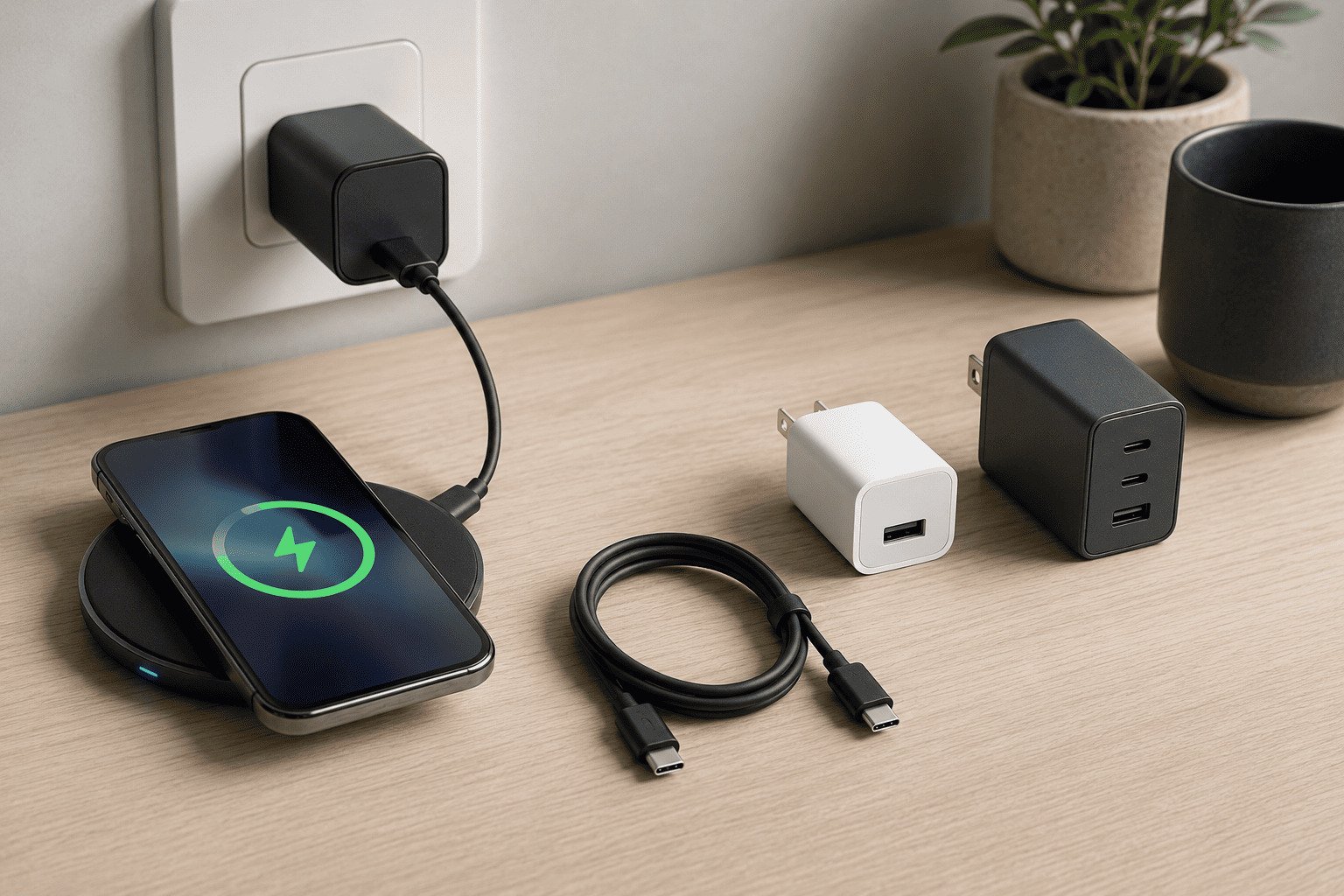
Many buyers ask us one simple question: “What watt adapter should we use?” We understand why. It sounds easy. Yet wireless charging is a system. The adapter is only one part of it. If one part is weak, the whole system slows down.
Why Can’t Adapter Wattage Alone Decide Wireless Charging Speed?
A 30W adapter sounds stronger than a 20W adapter. Yet the phone may still charge at the same speed if the protocol or voltage is wrong.
Adapter wattage alone does not decide wireless charging speed. The real speed depends on the phone’s supported wireless power, the charger’s Qi or Qi2 standard, USB-C PD/PPS support, output voltage, cable quality, coil alignment, and heat control.1
We have seen this many times in product testing. A buyer used a high-watt travel adapter with a magnetic wireless charger. The label said 65W. The charger still worked like a slow 5W pad. The reason was simple. The port used by the charger did not offer the right 9V output when other ports were also used.
Wireless charging has power loss. A charger may receive 20W from the adapter and deliver only around 15W to the phone.2 The rest becomes heat and system overhead. This is normal. It is not always a product defect, as industry data confirms that standard inductive power transfer generally maintains a 70% to 80% system efficiency threshold(https://en.wikipedia.org/wiki/Qi_(standard)) under optimal alignment and coil positioning.
| Part of the system | What it controls | What can go wrong |
|---|---|---|
| Phone | Maximum wireless input | Phone limits power |
| Wireless charger | Qi, Qi2, Qi2 25W output | Charger cannot use higher input |
| Adapter | Stable USB-C power | Wrong voltage or weak port |
| Cable | Power and data path | Loss, heat, unstable charging |
| Alignment | Coil position | Low speed and more heat |
We should read adapter specs in detail. A good adapter for wireless charging should show clear USB-C output profiles, such as 5V, 9V, 12V, or PPS ranges. A large total watt number is not enough.
What Adapter Power Do Qi, Qi2, and Qi2 25W Chargers Need?
A 15W charger often needs more than a 15W adapter. A 25W wireless charger needs even more stable input because wireless transfer is not 100% efficient.
For common wireless chargers, we usually need a USB-C PD adapter above the wireless output level. A 15W charger often needs 20W or higher input.3 A Qi2 25W charger often needs a stronger PD adapter, based on the charger design and device load.4
Qi2 changed user expectations.It gives magnetic alignment and a more reliable charging position5 Qi2 25W raises the expectation again. It is officially established via the Qi v2.2.1 specification by the WPC as a faster, next-generation Qi-certified wireless charging standard6. This means adapter choice becomes more important.
Here is a practical guide we use when we discuss projects with buyers, aligned with the latest multi-platform device compatibility and power profiles:
| Wireless charger type | Typical wireless output | Suggested adapter range | Notes |
|---|---|---|---|
| Basic Qi pad | 5W to 10W | 10W to 18W | Old USB-A may work, but slowly |
| Qi 15W pad or stand | Up to 15W | 20W to 30W USB-C PD | 9V support is often needed |
| Qi2 magnetic charger | Up to 15W | 20W to 30W USB-C PD | Alignment is more stable |
| Qi2 25W charger | Up to 25W | 30W to 45W USB-C PD/PPS | Check product spec |
| 3-in-1 station | Phone, watch, earbuds | 30W to 45W or higher | Total load matters |
We should not tell users to buy the biggest adapter. That advice is too rough. A clear 30W PD adapter can perform better than a misleading 65W multi-port adapter if the 30W adapter gives the right single-port output. For 3-in-1 stations, we also need to count all charging positions. A phone, watch, and earbuds case draw power at the same time, so the adapter must support the full station design.
Why Do USB-C PD, PPS, and Output Profiles Matter?
Many old adapters can only give 5V output. That is often not enough for modern fast wireless charging, even if the connector fits.
USB-C PD and PPS matter because they allow the adapter and charger to agree on suitable voltage and current.7 Output profiles such as 9V or 12V help wireless chargers run faster and more steadily than old 5V USB-A adapters.8
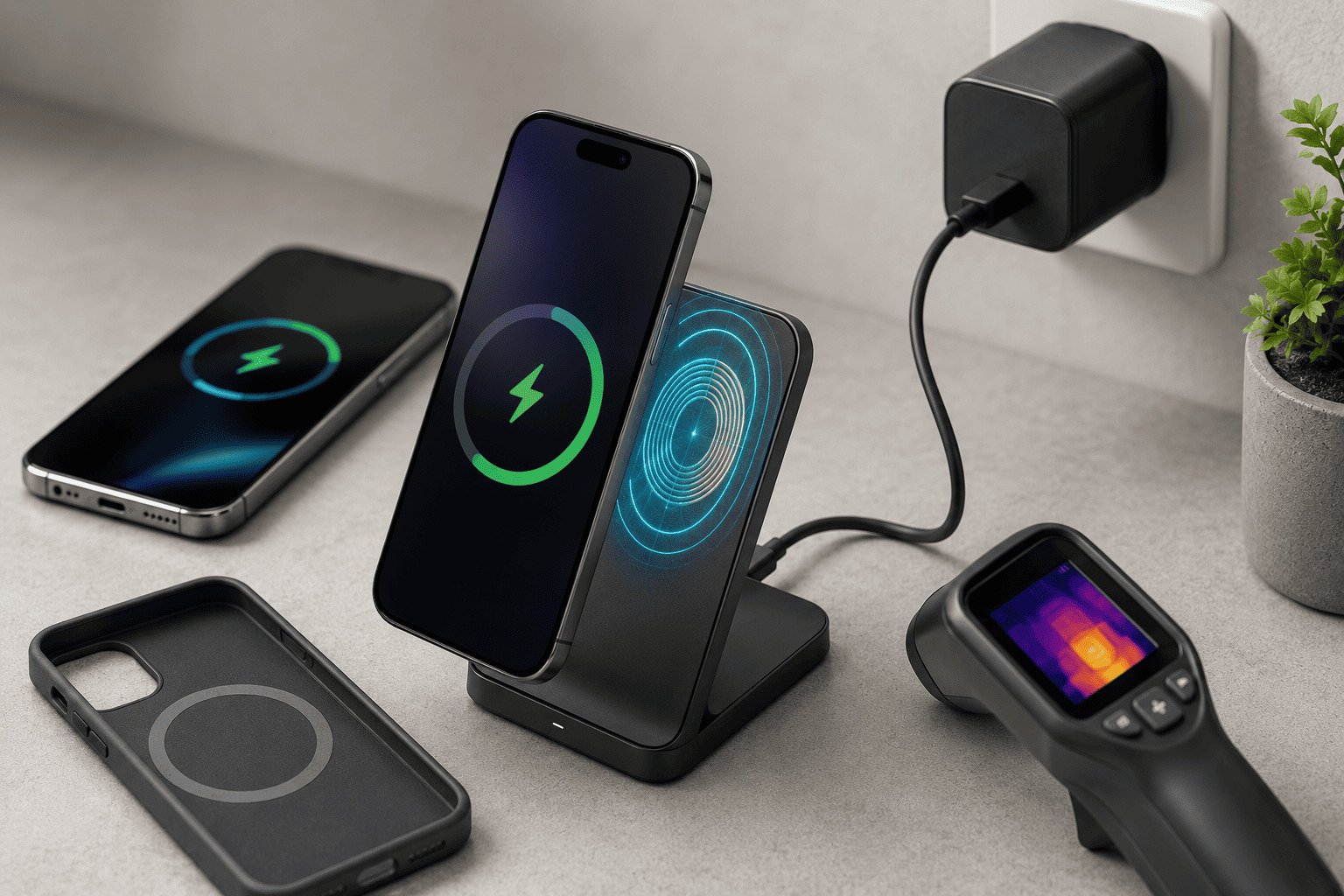
USB-IF positions USB Power Delivery and PPS as important parts of modern USB-C fast charging. We do not need to make this hard for end users. The key idea is simple. The charger and adapter talk to each other. If they share the right power mode, charging is faster and more stable. If they do not, the system falls back to a lower mode.
| Adapter spec to check | Why it matters | Better buying choice |
|---|---|---|
| USB-C PD | Supports modern fast power negotiation | Choose PD for Qi2 and fast chargers |
| PPS | Allows granular voltage adjustment and real-time thermal tracking | Helpful for heat and stability |
| 9V output | Common for 15W wireless charging | Check printed adapter label |
| 12V output | Often useful for higher power designs | Check charger requirement |
| Single-port output | Shows real power per port | Do not rely on total wattage only |
We should be careful with multi-port adapters. A label may say 100W total. Yet one USB-C port may drop to 15W when another device is connected.9 This can make a wireless charging station restart or slow down. We always suggest checking the power power split chart. If the seller does not show it, we should ask before buying in bulk.
How Do Cables, Magnetic Alignment, and Heat Affect Adapter Choice?
A good adapter cannot fix a poor cable, a weak magnetic position, or bad heat design. These problems can make fast charging slow.
Cables, alignment, and heat affect wireless charging because they change how much power reaches the phone safely. A certified cable, correct magnetic position, and good heat control help the adapter supply stable power without frequent power drops.10
In our factory tests, we often compare the same wireless charger with different cables. One cable may pass 30W input well. Another lower-grade cable may cause high internal resistance and a severe voltage drop11(https://en.wikipedia.org/wiki/Voltage_drop), forcing the charging system to aggressively step down its current to ensure safety. The user sees only slow charging. The real issue may be the cable, not the charger or adapter.
Magnetic alignment also matters. Qi2 improves this because the phone sits in a better coil position. This reduces wasted energy.12 Less waste means less heat. Less heat helps the phone keep a higher charging level for longer. This is one reason Qi2 25W is not only about peak power. It is also about stable real-world charging.
| Factor | Good condition | Bad condition |
|---|---|---|
| Cable | USB-C cable rated for needed power | Thin cable, high loss, unstable input |
| Alignment | Magnetic lock keeps coils centered | Phone slips or coil is off-center |
| Heat | Venting and smart control work well | Phone reduces charging speed |
| Case | Thin magnetic-compatible case | Thick case blocks efficiency |
| Surface | Open desk or ventilated area | Soft bed or hot dashboard |
We should tell customers that heat control is normal, not a failure. Phones reduce power when temperature rises. A better adapter can help only when the charger can use that power safely. A poor heat path will still limit charging speed.
What Mistakes Should Buyers Avoid With Multi-Device and Travel Use?
The most common mistake is using an old USB-A adapter or a weak travel charger with a modern magnetic wireless charger.
Buyers should avoid old 5V USB-A adapters, unknown travel chargers, low-quality cables, and multi-port adapters that hide the real single-port output. These choices can cause slow charging, heat, restarts, and unstable performance.
We often see this problem with 3-in-1 wireless charging stations. The buyer tests the product with an old phone adapter from a drawer. The station charges the earbuds but not the phone. Then the buyer thinks the station is defective. In many cases, the adapter is the problem.
Here is the checklist we suggest before shipment, retail listing, or home use:
| Checklist item | What we should confirm |
|---|---|
| Phone support | Does the phone support Qi, Qi2, or Qi2 25W? |
| Charger support | What is the maximum certified wireless output? |
| Adapter protocol | Does it support USB-C PD or PPS? |
| Output profile | Does it list 9V or 12V if needed? |
| Port power | What is the power from one port during real use? |
| Cable rating | Can the cable carry the needed power? |
| Certification | Does the product show CE, FCC, UL, PSE, KC, Qi, or other needed marks? |
| Heat environment | Is the charger used in a cool and open place? |
For importers and distributors, this checklist is also a risk control tool. It reduces return rates. It makes user instructions clearer. It also protects the brand from bad reviews caused by the wrong adapter. We should include adapter guidance in the product manual, online listing, and sales training material. This small step can save many after-sales problems.
Conclusion
We should choose the adapter as part of the wireless charging system. The right PD/PPS adapter, cable, alignment, and heat control create faster and safer charging.
"Qi (standard) - Wikipedia", https://en.wikipedia.org/wiki/Qi_(standard). Wireless Power Consortium and USB-IF technical documentation describe wireless charging as a coordinated system involving transmitter-receiver power limits, negotiated input supply, alignment, and thermal protection controls; this supports the article’s multi-factor framing, although it does not verify the behavior of any specific adapter or charger model. Evidence role: mechanism; source type: institution. Supports: Wireless charging performance depends on transmitter and receiver capabilities, negotiated power input, alignment, and thermal or safety controls.. Scope note: Contextual support for the mechanism rather than a model-specific performance test. ↩
"Inductive charging - Wikipedia", https://en.wikipedia.org/wiki/Inductive_charging. Research on inductive wireless power transfer reports that practical charging systems experience losses from coil coupling, power conversion, and thermal dissipation, supporting the statement that a 20 W input may correspond to a lower delivered wireless output; the cited study should be treated as contextual unless it tests the same Qi charger configuration. Evidence role: mechanism; source type: paper. Supports: Inductive wireless charging has conversion and transfer losses, so adapter input power can exceed delivered battery-side power.. Scope note: The 20 W-to-15 W figure is illustrative unless the source reports that exact operating condition. ↩
"Qi (standard) - Wikipedia", https://en.wikipedia.org/wiki/Qi_(standard). Qi-related technical materials and product compliance documentation distinguish wireless output power from input supply requirements, supporting the claim that a 15 W wireless output often requires an adapter rated above 15 W; the exact 20 W threshold remains device-dependent. Evidence role: general_support; source type: institution. Supports: Qi wireless output ratings do not imply identical adapter input wattage because charger electronics and inductive transfer losses require additional input power.. Scope note: Supports the principle and common practice, not a universal rule for every 15 W charger. ↩
"Wireless Power Consortium: Home", https://www.wirelesspowerconsortium.com/. Wireless Power Consortium materials on Qi2 25 W and USB-IF materials on USB Power Delivery support the need for sufficient negotiated input power when wireless output increases; this supports the adapter-sizing rationale, while actual adapter requirements remain specific to each charger design. Evidence role: general_support; source type: institution. Supports: Qi2 25 W wireless charging increases transmitter output relative to 15 W classes and therefore typically requires adequate negotiated input power.. Scope note: Contextual support because individual products may specify different input ratings. ↩
"Qi (standard) - Wikipedia", https://en.wikipedia.org/wiki/Qi_(standard). Wireless Power Consortium descriptions of Qi2 and the Magnetic Power Profile identify magnetic alignment as a feature for consistent transmitter-receiver positioning, directly supporting the statement that Qi2 provides a more reliable charging position. Evidence role: definition; source type: institution. Supports: Qi2 incorporates a magnetic alignment feature intended to position devices consistently on compatible chargers.. ↩
"Qi (standard) - Wikipedia", https://en.wikipedia.org/wiki/Qi_(standard). Wireless Power Consortium documentation on Qi2 25 W and the Qi specification supports the statement that 25 W Qi2 represents a newer certified Qi wireless charging class; the source establishes standards status rather than real-world charging speed for every phone. Evidence role: historical_context; source type: institution. Supports: The WPC has defined Qi2 25 W within the Qi specification as a certified wireless charging power class beyond earlier 15 W Qi2 charging.. Scope note: Standards support does not prove that all devices will achieve 25 W in use. ↩
"USB Charger (USB Power Delivery) - USB-IF", https://www.usb.org/usb-charger-pd. USB-IF documentation on USB Power Delivery and Programmable Power Supply describes source-sink negotiation of voltage and current, directly supporting the explanation that PD and PPS allow an adapter and charger to agree on suitable power levels. Evidence role: mechanism; source type: institution. Supports: USB Power Delivery defines negotiation between a power source and sink, and PPS allows adjustable voltage and current within supported ranges.. ↩
"Does USB PD support 12V? : r/UsbCHardware - Reddit", https://www.reddit.com/r/UsbCHardware/comments/1bimvrd/does_usb_pd_support_12v/. USB-IF specifications identify fixed Power Delivery supply profiles such as 9 V and 12 V, and Qi charger documentation commonly distinguishes higher-power operation from 5 V legacy input; this supports the claim for chargers designed to use higher-voltage PD input. Evidence role: mechanism; source type: institution. Supports: USB Power Delivery supports fixed voltage profiles above 5 V, and wireless chargers designed for higher output often require those higher input profiles.. Scope note: The source should not be read as proving that every wireless charger is faster at 9 V or 12 V. ↩
"USB Charger (USB Power Delivery) - USB-IF", https://www.usb.org/usb-charger-pd. USB Power Delivery documentation explains negotiated power contracts between a source and each sink, supporting the warning that a multi-port charger’s total rating does not guarantee full wattage on one port during simultaneous use; the 100 W and 15 W values are illustrative unless documented for a specific charger. Evidence role: mechanism; source type: institution. Supports: USB-C PD power is negotiated per connected port or device, and total charger wattage does not necessarily equal power available from each port simultaneously.. Scope note: Supports the per-port allocation principle, not the exact example values. ↩
"Energy Efficiency Analysis through Misalignment on New Design of ...", https://www.academia.edu/92386713/Energy_Efficiency_Analysis_through_Misalignment_on_New_Design_of_Hexagonal_Coil_Array_in_Wireless_Power_Transfer. Technical literature on USB-C cable current ratings and inductive wireless power transfer shows that conductor capacity, coil alignment, and thermal management affect delivered power stability; this supports the combined claim, although no single source may cover all three factors in one experiment. Evidence role: mechanism; source type: research. Supports: Stable charging depends on cable current capacity, coil coupling or alignment, and thermal control mechanisms that can reduce power when conditions are unfavorable.. Scope note: Contextual synthesis across related mechanisms. ↩
"USB-C Cable Voltage Drop - LTT Labs : r/UsbCHardware - Reddit", https://www.reddit.com/r/UsbCHardware/comments/1r5t5es/usbc_cable_voltage_drop_ltt_labs/. Electrical engineering references on Ohm’s law and cable voltage drop explain that voltage loss increases with conductor resistance and load current, supporting the claim that a high-resistance charging cable can reduce delivered voltage; the source establishes the mechanism rather than testing the specific factory cables described. Evidence role: mechanism; source type: education. Supports: Voltage drop across a cable increases with current and conductor resistance, which can reduce voltage available to the charger.. Scope note: Mechanistic support, not a test of the article’s particular cable examples. ↩
"Design and implementation of a high misalignment-tolerance ... - PMC", https://pmc.ncbi.nlm.nih.gov/articles/PMC11161604/. Studies of inductive wireless power transfer show that coil misalignment reduces coupling efficiency and increases losses, supporting the statement that improved magnetic positioning can reduce wasted energy; the evidence is contextual unless the study specifically evaluates Qi2 hardware. Evidence role: mechanism; source type: paper. Supports: Better alignment between transmitter and receiver coils improves coupling and can reduce transfer losses in inductive wireless charging.. Scope note: Supports the physics of alignment, not necessarily measured Qi2 product performance. ↩