
Wireless charging looks simple, but one small label can create risk. A buyer may assume both terms mean the same thing, then face returns.
“Qi Compatible” means a charger is designed to work with Qi-enabled devices. “Qi-certified” means the product should have passed the Wireless Power Consortium certification process and should be verifiable in official certification records.1 Compatibility is a function claim. Certification is proof through a formal test and listing process.
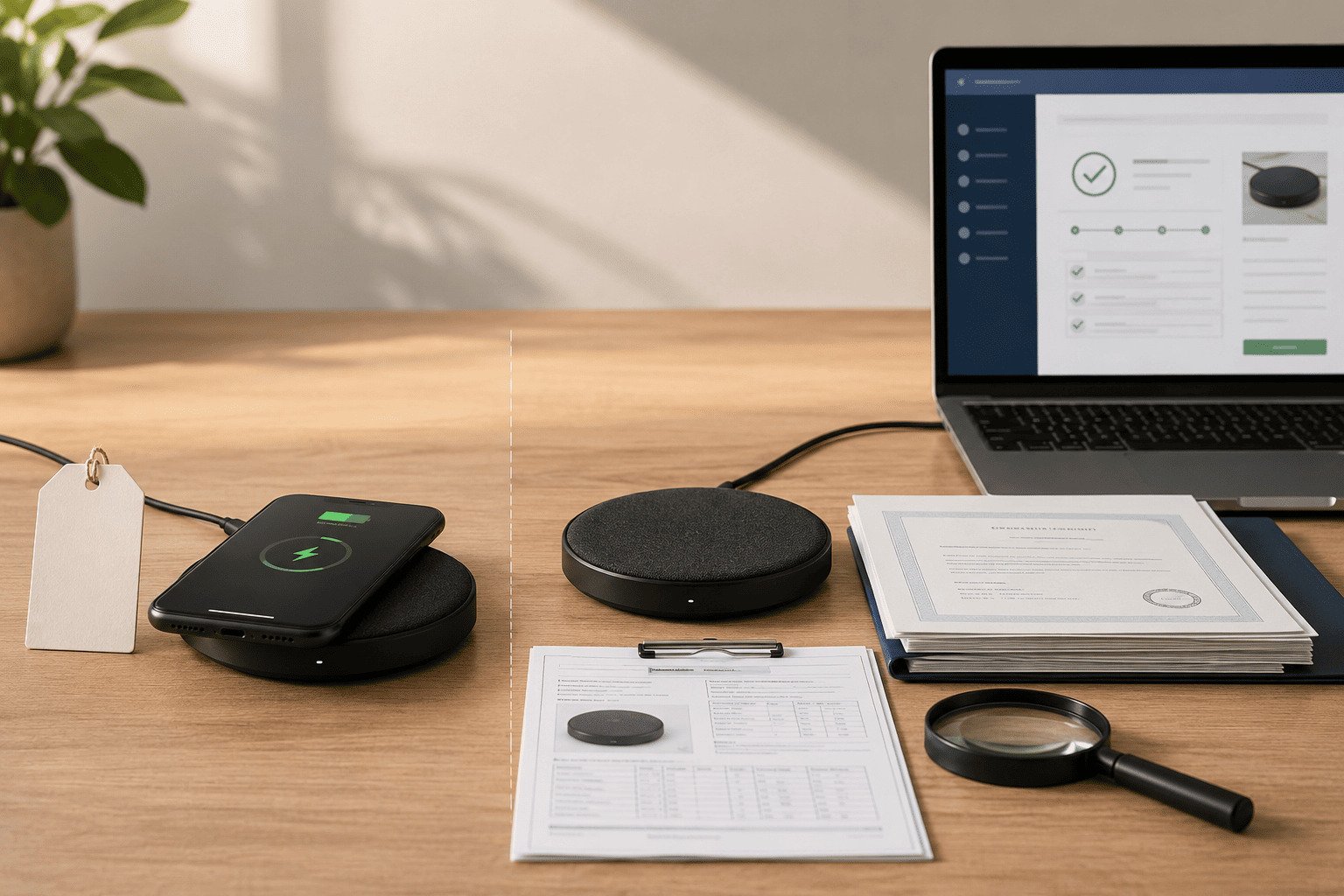
We see this question often in wireless charger sourcing. It comes from consumers, brand owners, importers, and distributors. The two terms look close. They also appear in product pages, cartons, user manuals, retail listings, and sales decks. But they do not carry the same weight. If we treat them as equal, we may make weak decisions. If we understand the difference, we can ask better questions before we buy, list, or sell.
What does “Qi Compatible” really mean?
A charger may work with many phones, but the label alone may not prove formal testing. That gap can create wrong expectations and claims.
“Qi Compatible” usually means the charger is designed to charge Qi-enabled devices.2 It does not, by itself, prove that the exact product model has passed official WPC certification testing or appears in the official product database.3
The practical meaning
When we read “Qi Compatible,” we should read it as a compatibility statement. The seller is saying the charger can work with devices that support the Qi wireless charging standard. This can be an honest and useful statement. Many products are built around common wireless charging control chips, coil designs, and charging protocols. They may charge iPhone, Samsung, Google Pixel, earbuds, or other Qi-enabled devices in daily use.
But we should not read “Qi Compatible” as certification proof. The phrase does not automatically show that the finished product passed the official certification process. It also does not show that the tested sample is the same as the mass-production unit.
| Term on product page | What it usually means | What it does not prove |
|---|---|---|
| Qi Compatible | Designed to work with Qi-enabled devices | Official certification |
| Works with Qi devices | Basic function support | WPC database listing |
| Qi wireless charging | Uses Qi-type wireless charging technology | Tested final model |
| Qi-certified | Passed formal certification and listed | Perfect quality in all conditions |
Why the difference matters in daily use
A consumer may only care whether the charger charges a phone. That is fair. But charging is not only about starting power transfer. We also care about heat, alignment, foreign object detection, power control, and stable performance with different adapters.
For a B2B buyer, the meaning is wider. We must think about packaging language, online listing rules, retail audits, customer support, and long-term return rate. If our product says “Qi-certified” but we cannot provide a valid record, we create avoidable risk.4 If we say “Qi Compatible,” we must still make sure the claim is accurate, clear, and not overstated.
What does “Qi-certified” actually prove?
A product claim can look strong, but proof matters more. Without proof, buyers may face listing delays, claim disputes, and trust loss.
“Qi-certified” should mean the product has completed the WPC certification process and can be checked through official records. A buyer should be able to confirm the model, brand information, product type, and certification details.
The basic certification idea
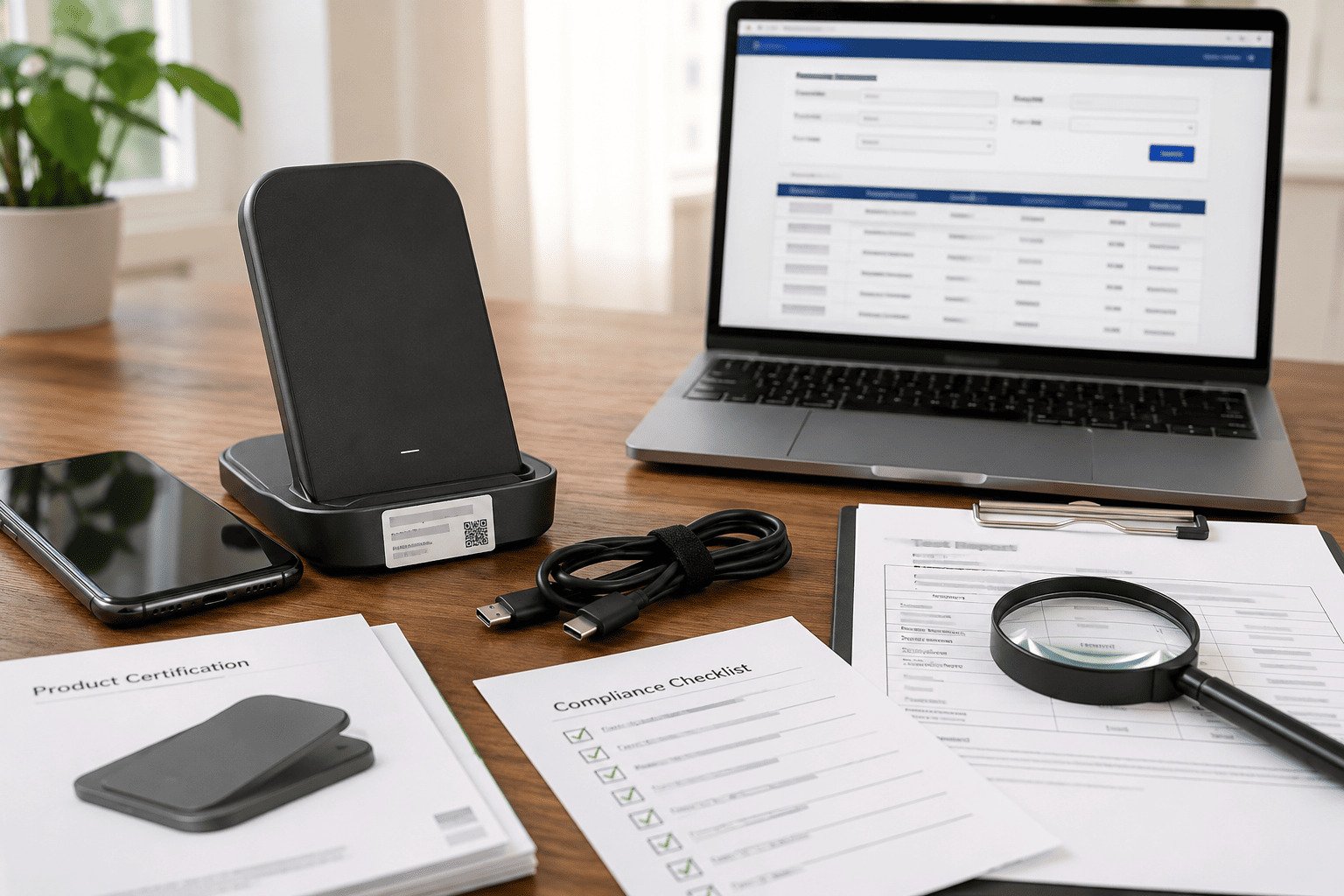
Qi certification is managed by the Wireless Power Consortium, often called WPC.5 The goal is to make sure products meet the relevant Qi standard requirements. The test process is not only a simple phone charging test. It covers items such as power transfer, communication, safety-related behavior, and interoperability.6 It also checks how the transmitter and receiver work together under defined conditions.
For buyers, the most useful point is simple. Certification should leave a trace. We should not only receive a logo file or a sentence on a quotation. We should ask for a valid certification reference, such as a WPC ID or official listing information.7 Then we should check whether the record matches the product being sold.
| Check point | Why we check it | Buyer action |
|---|---|---|
| Official WPC record | Confirms certification status | Search the database or ask supplier for link |
| Product model | Prevents model mixing | Match record with quotation and sample |
| Brand or applicant | Confirms claim owner | Check if it matches sales claim |
| Product type | Avoids using one record for another item | Compare pad, stand, station, or module type |
| Power level | Checks claim accuracy | Match listed watts with packaging claim |
Certification is not a full business guarantee
We should also keep the meaning balanced. Qi certification is important, but it is not the only quality control step.8 A certified product can still perform poorly if mass production is not controlled well. A charger can have packaging problems, adapter mismatch, weak magnetic alignment, unstable heat control, or poor cable quality. Certification gives us strong proof for standards compliance. It does not replace factory audits, sample tests, life tests, or incoming inspection.
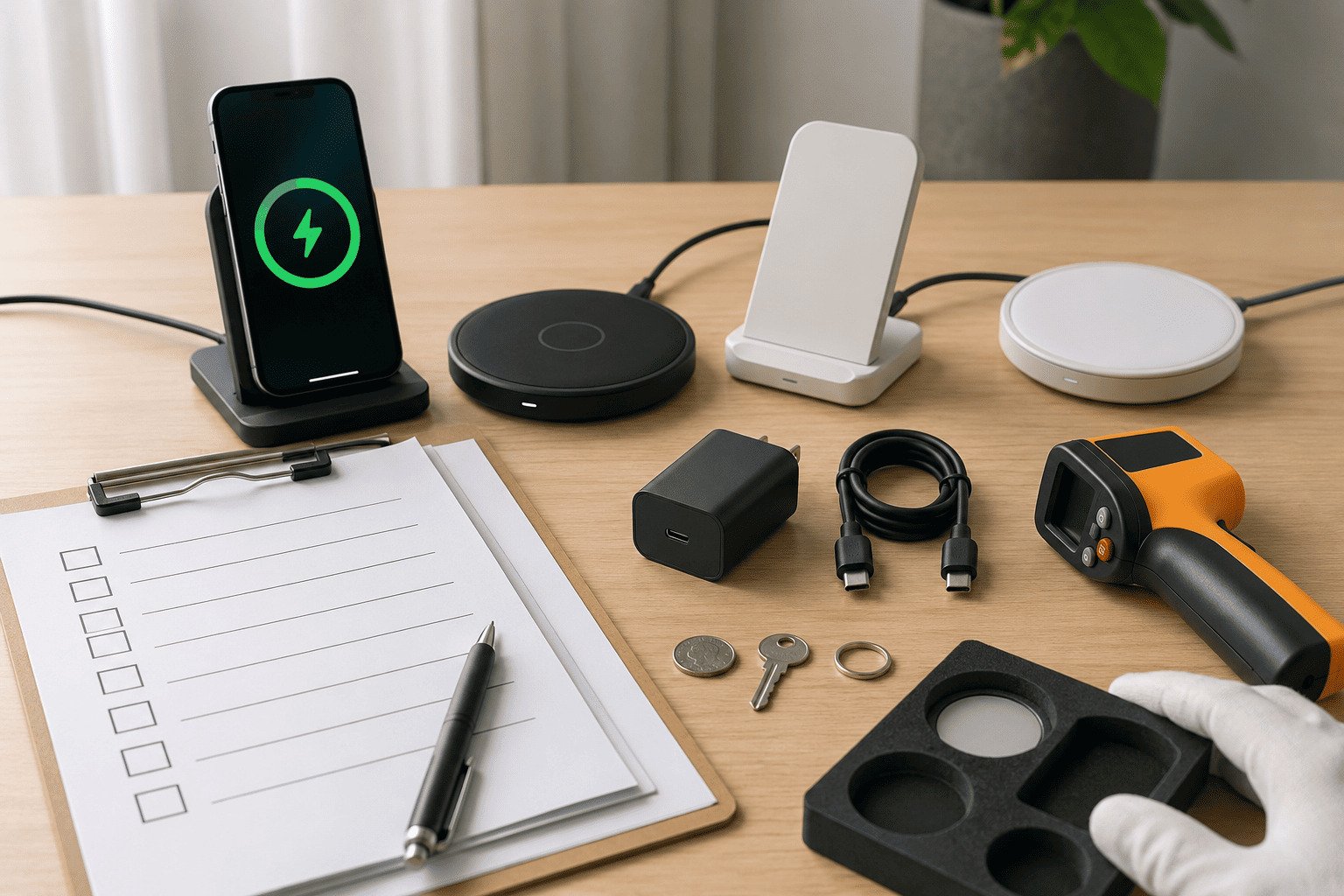
This is why professional sourcing should not stop at one certificate. We should combine certification review with practical tests. We should charge different phones. We should test with the required adapter. We should check temperature rise. We should place keys or coins near the coil to check foreign object detection behavior. We should also compare pilot-run units with golden samples. This gives a safer view than any single label.
Why should B2B buyers care more than ordinary consumers?
A consumer may lose one charger. A distributor may face hundreds of returns, blocked listings, or retail questions across several markets.
B2B buyers should care because certification affects product claims, packaging, platform listings, retail compliance, customer trust, and return risk. The cost of a wrong claim becomes larger when the order quantity and sales channels increase.
The commercial risk is not only technical
For a wholesaler or importer, wireless charger sourcing is not only about unit price. We also manage risk. A charger that works in a short demo can still create trouble if the product claim is not supported. Retail chains may request documents. E-commerce platforms may ask for proof. A brand owner may need to protect its public promise. A distributor may need to answer after-sales questions in several languages.
The gap between “compatible” and “certified” becomes important at this point. If the product is only compatible, the packaging should not suggest official certification unless proof exists. If the product is certified, the buyer should keep the certification record and match it with the production model.
| Business area | If only “Qi Compatible” | If “Qi-certified” is required |
|---|---|---|
| Product page | Use careful wording | Add verifiable certification claim |
| Packaging | Avoid unsupported logo or claim | Use approved language and artwork |
| Retail entry | May need extra explanation | Easier document review |
| Platform listing | Claim may be limited | Stronger support for keyword and badge use |
| After-sales | More questions may appear | More trust, but still needs testing |
| Brand value | Depends on user experience | Supported by standard proof |
Volume increases small problems
When we buy 100 pieces, a small issue may stay hidden. When we buy 10,000 pieces, the same issue becomes a real cost. A small temperature problem can create many complaints. A weak alignment design can cause users to wake up with an uncharged phone. A poor adapter match can make a 15W claim unrealistic. If certification is missing but the claim says certified, the problem may spread to legal, channel, and trust issues.
We have seen buyers ask only one question: “Does it support Qi?” That question is not enough for bulk orders. Better questions are: “Is this model Qi-certified?” “Can we verify the WPC record?” “Is the tested model the same as the production model?” “What adapter is required for the rated output?” These questions are simple. They also save time before shipment.
Is a Qi-compatible charger unsafe or low quality?
It is easy to judge too fast, but that is not fair. A compatibility claim does not automatically mean poor quality or unsafe design.
A Qi-compatible charger is not automatically unsafe, fake, or low quality. It may be a normal product that supports Qi devices but has not gone through official certification for that exact model.
We should judge by evidence, not by label only
A balanced view helps both buyers and suppliers. Some sellers use “Qi Compatible” because they want to describe basic device support. They may not intend to mislead. Some products are made for price-sensitive channels where formal certification is not required by the buyer. Some brands may certify only selected models, while other models are sold with compatibility claims only.
But buyers should not treat the two labels as equal. A non-certified product can still be acceptable for some markets if the claim is clear, the quality tests are strong, and the buyer understands the channel rules. A certified product may be a better fit for formal retail, brand programs, and markets with strict document checks.
| Question | Why it matters | Good buyer practice |
|---|---|---|
| Does it charge target phones? | Checks basic function | Test iPhone, Samsung, earbuds, and cases |
| Does it control heat? | Protects user experience | Run long charging tests |
| Does FOD work? | Reduces risk with metal objects | Test coins, keys, and other objects carefully |
| Is the adapter specified? | Prevents weak performance | Confirm PD, QC, or fixed-voltage needs |
| Is the claim accurate? | Protects listing and packaging | Match wording with documents |
| Is certification verified? | Supports “Qi-certified” claim | Check official records |
Practical quality items still matter
For any wireless charger, we should check more than one label. Thermal performance is very important. A charger may pass a short test but get hot after one or two hours. Foreign object detection is also important. The charger should react safely when metal objects are placed in the wrong area.9 Phone compatibility also matters. Some phones have different coil positions, cases, camera bumps, or charging limits.10 A 3-in-1 wireless charging station adds more checks because the phone, watch, and earbuds may charge at the same time.
Mass-production consistency is another key point. The sample may perform well, but later batches may change coil position, PCB components, magnets, cable quality, or plastic structure. We should use a clear approved sample, a bill of materials control process, and batch inspection. This is true for both compatible and certified products.
What questions should buyers ask before ordering?
If we ask only about price and lead time, we may miss the real risk. Better questions make the buying decision much clearer.
Buyers should ask whether the model is in the official WPC database, whether a valid WPC ID is available, whether the tested model matches production, and whether heat, FOD, compatibility, adapter needs, and batch consistency are checked.
A simple decision checklist
We can use a direct checklist before we confirm an order. This helps procurement teams, brand managers, and distributors make the same decision from the same facts.
| Buyer question | Best evidence to request | Risk if ignored |
|---|---|---|
| Is this exact model Qi-certified? | WPC listing link or ID | Unsupported certification claim |
| Is the certified model the same as production? | Model photos, BOM, drawing, sample label | Certificate mismatch |
| What power output is supported? | Test report and adapter requirement | Overstated charging speed |
| What adapter is needed? | PD or QC specification | Slow or unstable charging |
| Has heat been tested? | Temperature test data | Returns and complaints |
| Does FOD work well? | FOD test result | Safety concern and user distrust |
| Which phones were tested? | Compatibility list | Poor user experience |
| Is mass production controlled? | QC plan and inspection standard | Batch variation |
How we can compare sourcing options
A buyer may receive three quotations for the same product type. One supplier may offer a lower price and say “Qi Compatible.” Another supplier may offer a higher price and provide a WPC certification record. A third supplier may provide certification for a similar model but not the exact model quoted. The best choice depends on channel needs, claim needs, and risk level.
If the product will be sold through strict retail channels, we should give more weight to certification proof. If the product will be part of a brand program, we should protect the brand claim. If the product will be used for a basic promotion, compatibility plus strong internal testing may be enough, as long as the claim is not overstated.
A practical decision table
| Sales situation | Suggested claim level | Suggested proof level |
|---|---|---|
| Premium retail product | Qi-certified, if true | Official WPC record plus test reports |
| Online brand listing | Qi-certified only with proof | WPC ID, listing link, compliance files |
| Distributor bulk item | Compatible or certified based on market | Samples, reports, and clear wording |
| Low-cost promotion | Qi Compatible may be enough | Function, heat, FOD, and adapter tests |
| Private label product | Depends on packaging and channel | Model match, artwork review, QC plan |
The main point is not to choose the most expensive option every time. The main point is to match the claim with proof. If we sell a compatible product, we should present it as compatible. If we sell a certified product, we should keep proof ready. This keeps the business clear and reduces conflict later.
How should we write product claims in a clear way?
Weak wording can create strong problems. A small line on packaging may become a customer complaint or a platform review issue.
We should use “Qi-certified” only when the exact product has verifiable WPC certification. We can use “Qi Compatible” when the product is designed to work with Qi-enabled devices, but we should not make it look like official certification.
Clear wording protects both sides
Good wording is not only a legal task. It is also a trust task. Customers do not like vague claims. Retail buyers do not like unsupported marks. Procurement teams do not like late surprises. Clear wording makes the product easier to sell and easier to support.
For example, if a charger is not certified, a safe claim may be: “Compatible with Qi-enabled devices.” This tells the buyer what the product is designed to do. It does not claim official certification. If the product is certified, a stronger claim may be: “Qi-certified wireless charger,” with proper logo use and a verifiable WPC record. We should also follow logo and trademark rules from the relevant authority or brand owner.
| Claim wording | When it may be suitable | Caution |
|---|---|---|
| Compatible with Qi-enabled devices | Product supports Qi device charging | Do not present as certified |
| Qi wireless charging supported | Product uses Qi-type charging function | Avoid official logo unless allowed |
| Qi-certified wireless charger | Exact model has WPC certification | Keep record and ID ready |
| Certified for Qi standard | Only with valid proof | Make sure wording matches approval |
| Fast wireless charging up to 15W | Only if tested with required adapter | State adapter needs clearly |
Claims should match real use
Wireless charging speed depends on many things. The phone model matters. The adapter matters. The cable matters. The case thickness matters. The coil position matters.11 A charger may support 15W in design, but a certain phone may charge at 7.5W or 10W due to phone limits or adapter limits.12 So packaging and listing pages should avoid giving users the wrong idea.
We also need to be careful with 3-in-1 stations. The total input power may be different from the output to each charging area. A station may charge a phone, earbuds, and watch at the same time, but the adapter must supply enough power. If the box does not include the adapter, we should state the required adapter clearly. This reduces after-sales pressure.
Conclusion
We should treat “Qi Compatible” as a function claim and “Qi-certified” as verifiable proof. Better questions help us buy and sell with less risk.
"Products | Wireless Power Consortium", https://www.wirelesspowerconsortium.com/products/. Wireless Power Consortium documentation describes Qi certification as a formal product certification and listing process, supporting the distinction between a certified product and a general compatibility claim. Evidence role: definition; source type: institution. Supports: The source should explain that Qi certification is administered by the Wireless Power Consortium and that certified products are listed or searchable through official records.. ↩
"Qi (standard) - Wikipedia", https://en.wikipedia.org/wiki/Qi_(standard). Wireless Power Consortium materials define Qi certification as a specific standards-based process, which supports treating “Qi Compatible” as a functional statement unless certification records are provided. Evidence role: definition; source type: institution. Supports: The source should clarify that Qi certification is a specific WPC process, while compatibility language alone does not establish certified status.. Scope note: The source may not define every marketplace use of the phrase “Qi Compatible,” so the support is strongest for the certification distinction rather than for all seller wording. ↩
"Products | Wireless Power Consortium", https://www.wirelesspowerconsortium.com/products/. The Wireless Power Consortium’s certified product database provides model-level records for Qi-certified products, supporting the need to verify certification against the exact product being sold. Evidence role: general_support; source type: institution. Supports: The source should show that Qi-certified products can be checked through an official WPC product database and that certification is tied to listed product records.. ↩
"FTC Policy Statement Regarding Advertising Substantiation", https://www.ftc.gov/legal-library/browse/ftc-policy-statement-regarding-advertising-substantiation. Federal Trade Commission guidance on advertising substantiation states that objective product claims should be supported by appropriate evidence, which contextualizes the risk of making an unverifiable “Qi-certified” claim. Evidence role: expert_consensus; source type: government. Supports: The source should support the principle that objective product claims, including certification-related claims, should be backed by evidence before being used in marketing.. Scope note: FTC guidance is jurisdiction-specific to the United States, but it provides a widely cited consumer-protection framework for substantiating marketing claims. ↩
"Wireless Power Consortium - Wikipedia", https://en.wikipedia.org/wiki/Wireless_Power_Consortium. The Wireless Power Consortium identifies itself as the body responsible for the Qi wireless charging standard and its product certification program. Evidence role: definition; source type: institution. Supports: The source should identify WPC as the organization responsible for the Qi standard and related certification program.. ↩
"[PDF] A review of foreign object detection (FOD) for inductive ... - Chris Mi", https://chrismi.sdsu.edu/publications/170.pdf. Wireless Power Consortium certification materials describe Qi product certification as involving conformance and interoperability testing, supporting the article’s claim that certification is broader than a simple charging demonstration. Evidence role: mechanism; source type: institution. Supports: The source should describe the technical scope of Qi certification testing, including conformance and interoperability requirements.. Scope note: Public WPC pages may summarize the test scope rather than disclose the full proprietary test specification. ↩
"FCC ID Search | Federal Communications Commission", https://www.fcc.gov/oet/ea/fccid. The Wireless Power Consortium’s certified product search enables verification of Qi-certified products through official listing information, supporting the practice of requesting a WPC ID or listing link. Evidence role: general_support; source type: institution. Supports: The source should show that WPC-certified products have searchable records or identifiers that can be used for verification.. ↩
"[DOC] EQA_Exh5.docx - DOE Office of Science", https://science.osti.gov/-/media/SCMS/Management-Systems/QUAL/EQA/EQA_Exh5.docx. ISO quality-management guidance treats production control, monitoring, inspection, and corrective action as continuing requirements for product conformity, supporting the point that certification should be supplemented by manufacturing quality controls. Evidence role: general_support; source type: institution. Supports: The source should show that product conformity depends on production controls, monitoring, inspection, and quality management processes, not only product certification.. Scope note: ISO quality-management sources support the general manufacturing principle rather than addressing Qi-certified chargers specifically. ↩
"[PDF] A review of foreign object detection (FOD) for inductive ... - Chris Mi", https://chrismi.sdsu.edu/publications/170.pdf. Technical literature on inductive wireless power transfer describes foreign object detection as a safety-related mechanism for detecting conductive objects that may heat in the charging field. Evidence role: mechanism; source type: research. Supports: The source should explain that wireless power systems use foreign object detection to identify metal objects that may heat or interfere during power transfer.. Scope note: Research sources may discuss inductive wireless power systems generally; application to a specific charger model would still require product testing. ↩
"[PDF] Design and Performance Analysis of Misalignment Tolerant ...", https://repository.aus.edu/bitstreams/5c9d09a5-0276-4d65-8dfc-fc66909568fb/download. Studies of inductive wireless power transfer show that coil alignment and separation affect coupling efficiency and delivered power, supporting the relevance of phone geometry and case thickness to charging compatibility. Evidence role: mechanism; source type: paper. Supports: The source should show that coil alignment, distance, and coupling affect inductive wireless charging performance.. Scope note: Such studies support the underlying physics; they may not directly evaluate every phone feature named in the article, such as camera-bump geometry. ↩
"Wireless Power Transfer: Systems, Circuits, Standards, and Use ...", https://pmc.ncbi.nlm.nih.gov/articles/PMC9371050/. Wireless power transfer research shows that delivered power depends on input power and coupling conditions such as alignment and distance, providing technical context for why charging speed varies by device setup. Evidence role: mechanism; source type: research. Supports: The source should support that wireless charging output is affected by receiver limits, input power, coupling efficiency, alignment, and separation distance.. Scope note: The source may support the physical factors generally; device-specific wattage limits still require manufacturer or standards documentation. ↩
"Qi (standard) - Wikipedia", https://en.wikipedia.org/wiki/Qi_(standard). Wireless Power Consortium materials on Qi power profiles indicate that charging power depends on supported transmitter and receiver capabilities, supporting the point that a charger’s maximum design rating may not be the power delivered to every phone. Evidence role: mechanism; source type: institution. Supports: The source should show that Qi includes defined power profiles and that supported output depends on both transmitter and receiver capabilities.. Scope note: The source supports the standards-based reason for variable power; exact 7.5 W or 10 W limits may require device-specific documentation. ↩