
Many car chargers look fast on paper. Then heat, bumps, and weak alignment turn that promise into slow charging and user complaints.
Qi2.2 will revolutionize car mounts by turning them into [certified 25W in-car charging systems](https://en.wikipedia.org/wiki/Qi_(standard))1. The change demands precise magnetic alignment2, better heat control, stable mounting, safe detection, USB-C PD input3, and mass-production consistency under real driving conditions.
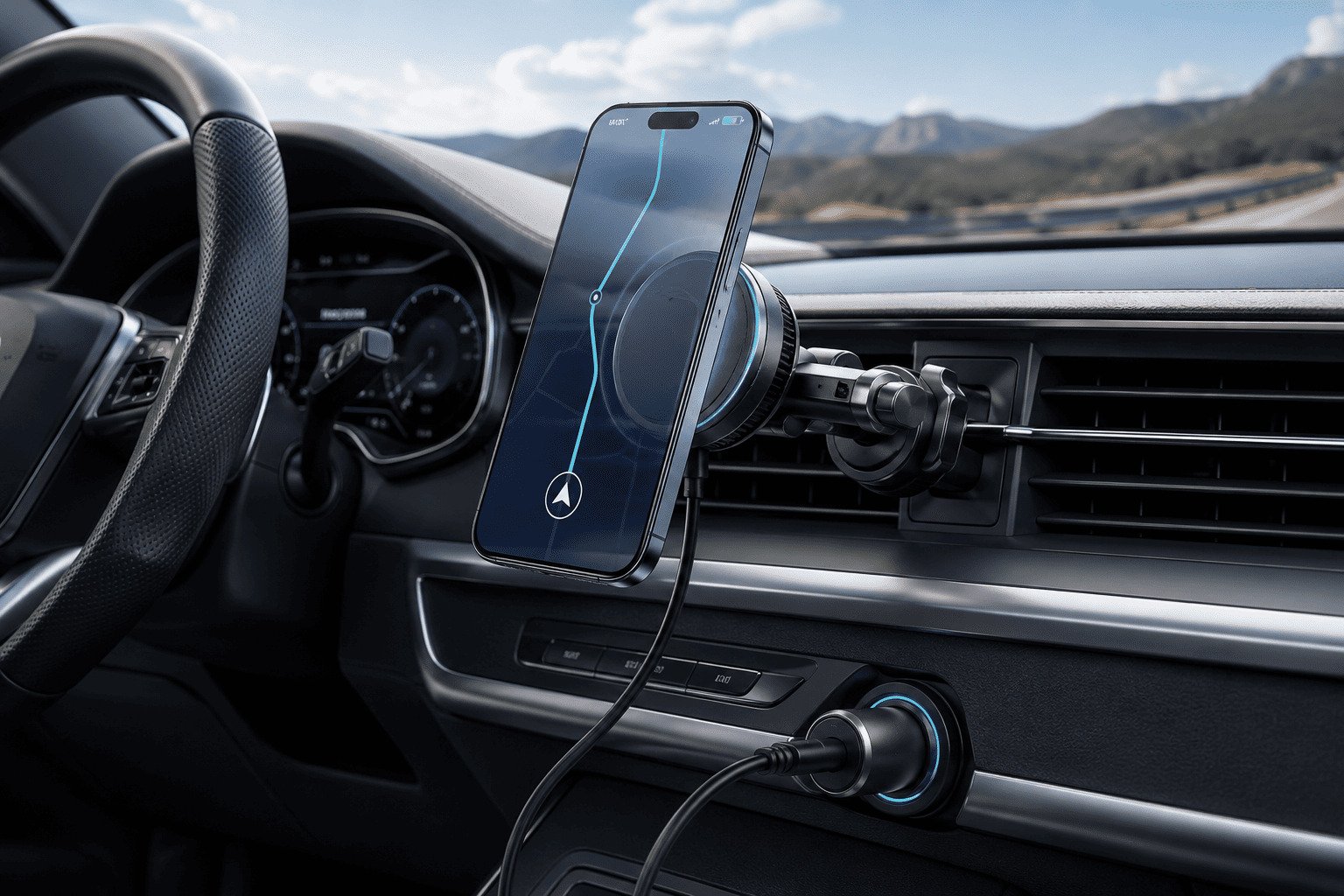
We have seen many buyers focus on one simple question first. They ask if the car mount can reach 25W. This question is fair, but it is not enough. A car is not a clean lab. A driver may use navigation, Bluetooth, music, and mobile data at the same time. The sun may heat the dashboard. The road may shake the phone for hours. The phone case may be thick. The USB-C input may not give enough power. The magnetic ring may be slightly off. Each small issue can reduce the real charging result. So we think Qi2.2 is not only a higher wattage standard. It is a push toward a more complete and more professional product standard. For B2B buyers, the core question should be clear. Can this product charge safely and steadily in real driving, not only in a short test on a desk?
Why is Qi2.2 more than a 25W number?
A 25W claim can attract buyers fast. The problem starts when real cars expose heat, misalignment, weak input power, and unstable holding force.
Qi2.2 is more than a 25W upgrade because it raises the full system requirement. A good Qi2.2 car mount needs certified performance, correct magnetic alignment, stable USB-C PD input, thermal control, safe detection, and reliable structure for long driving use.
The real change is system thinking
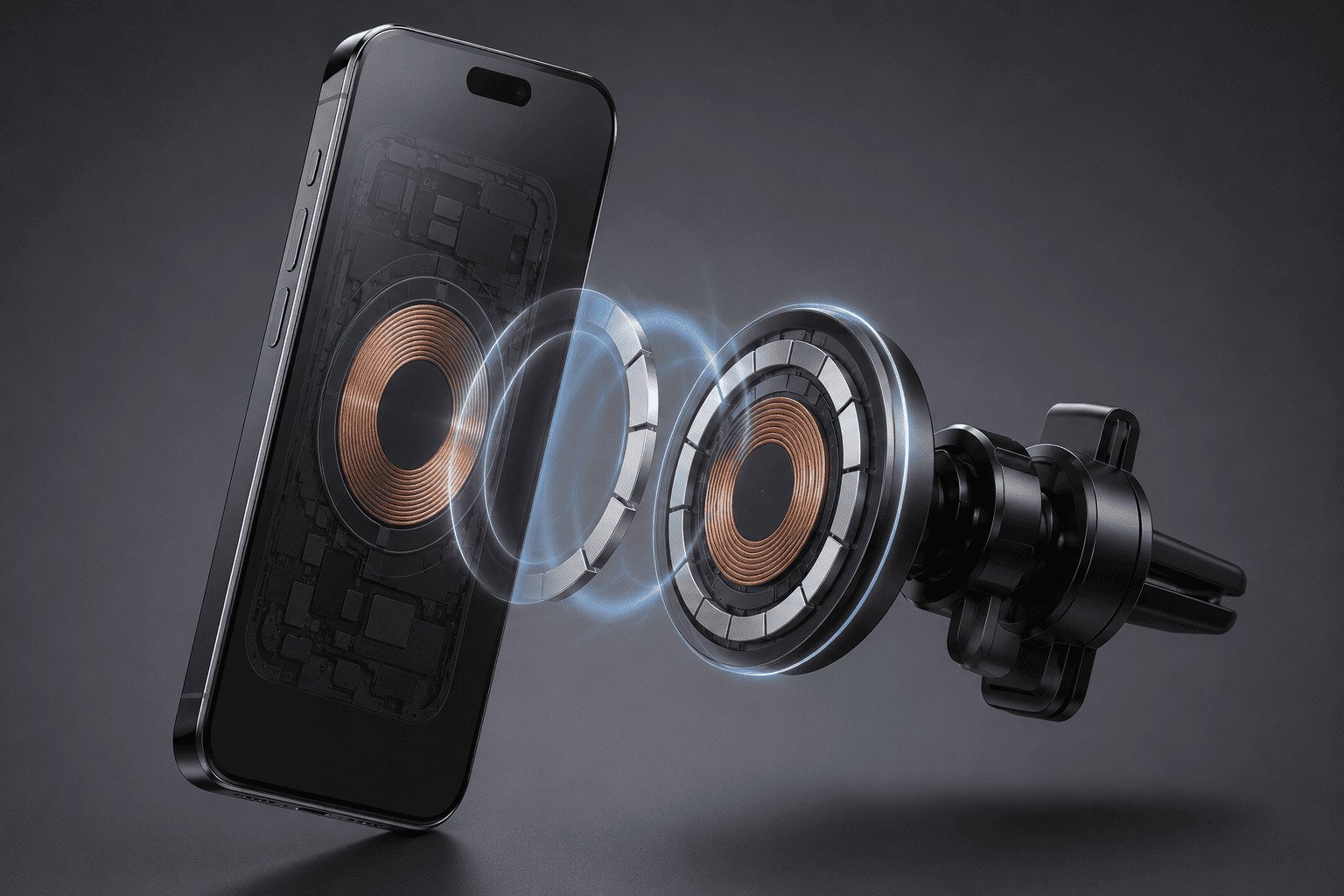
We treat Qi2.2 as a system change, not a label change. In a normal wireless charging pad, the phone often stays flat on a table. In a car mount, the product has to hold the phone, charge the phone, resist vibration, and stay safe inside a changing temperature environment. These needs happen at the same time. That makes the design much harder.
A car mount that supports Qi2 25W needs the right coil position. It also needs the right magnetic layout. If the magnetic force is too weak, the phone may move when the car turns. If the force is too strong, the user may feel it is hard to remove the phone. If the coil is not aligned well, the charger may create more heat and deliver less real power.4
What changes from older car mounts?
| Area | Older car mount thinking | Qi2.2 car mount thinking |
|---|---|---|
| Main value | Hold the phone and charge it | Build a stable in-car charging system |
| Power claim | Focus on peak wattage | Focus on stable real power |
| Alignment | General coil position | Magnetic guided alignment |
| Heat | Basic surface control | Full thermal design under car use |
| Safety | Basic protection | Better foreign object detection5 and certified control |
| Buyer concern | Price and appearance | Certification, stability, safety, and production quality |
We have learned that a product can pass a short power test and still fail in daily use. A driver may start navigation, place the phone in a case, drive under strong sunlight, and keep the screen on for one hour. This is where the product proves its real quality. Qi2.2 brings the market closer to this real-use standard. It makes the car mount less like a simple accessory and more like a reliable charging device.
What must a reliable Qi2.2 car mount prove in a moving vehicle?
Many products look stable in photos. The problem is that a real vehicle adds heat, shaking, phone weight, cable limits, and user habits.
A reliable Qi2.2 car mount must prove stable 25W charging under real driving conditions. It needs proper USB-C PD input, strong magnetic alignment, safe foreign object detection, thermal control, secure mounting, and consistent performance with common phone cases.
The car is a difficult charging environment
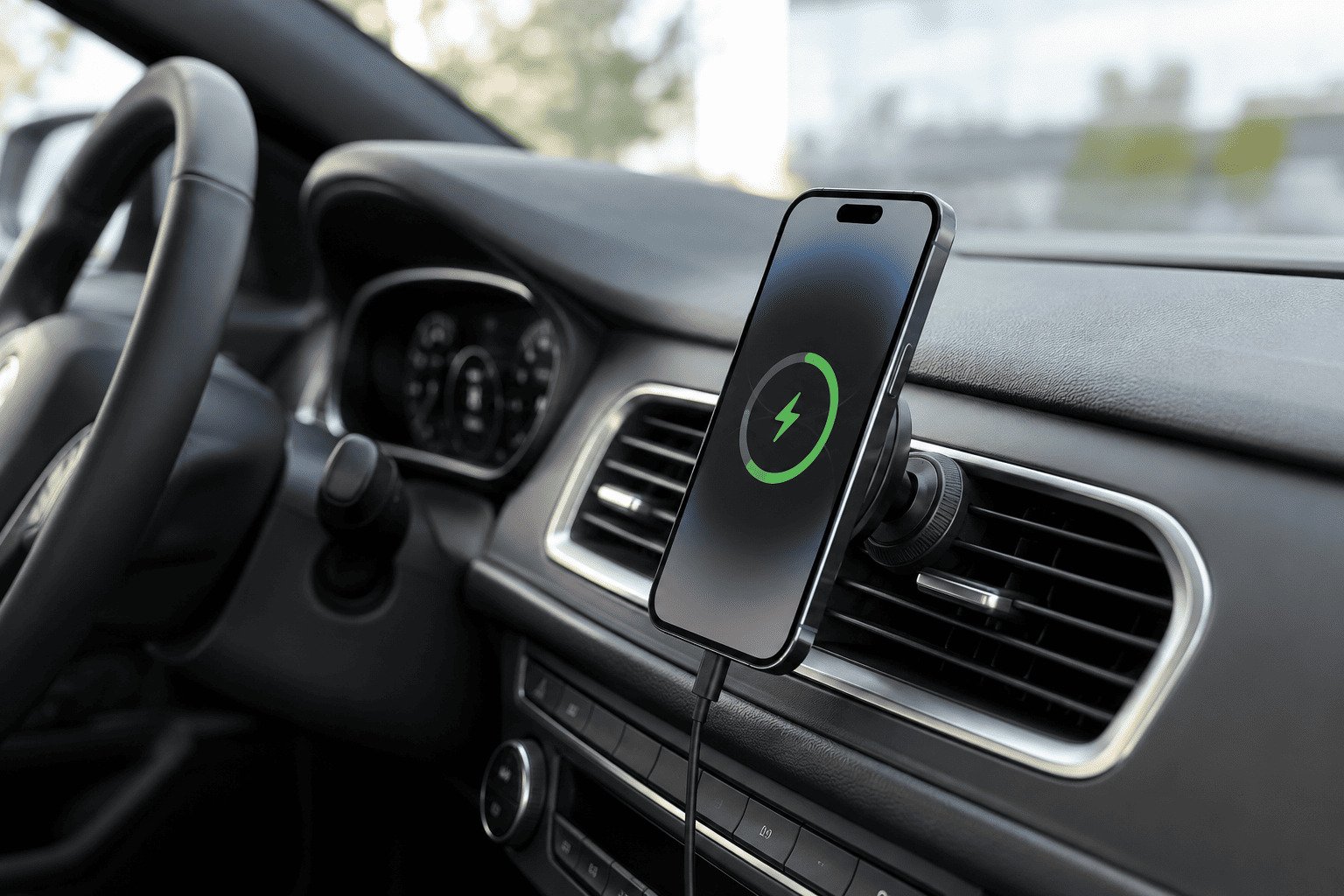
We need to think about the car as a moving test machine. The dashboard may become hot.6 The air vent may be cold. The road may shake the mount many times in one minute.7 The phone may be heavy, and the case may add more distance between the coil and the receiver8. The driver may touch the screen often. The product may also face sudden braking or sharp turns.
Qi2.2 25W can create more heat than low-power charging.9 This does not mean 25W is unsafe. It means the product design must control heat better. A good design needs a smart power control plan. It also needs good materials, a clear heat path, and stable firmware. If the product only pushes power without control, the phone may reduce charging speed by itself. The user then sees no real benefit.
The main proof points for a serious product
| Proof point | Why it matters in a car | What B2B buyers should check |
|---|---|---|
| Qi2 certification | It shows the product follows the standard | Ask for certification status and test evidence |
| USB-C PD input | 25W wireless output needs enough input power10 | Check adapter and cable requirements |
| Magnetic force | The phone must stay in place during turns | Test with heavy phones and cases |
| Coil alignment | Bad alignment reduces power and creates heat | Test repeated placement accuracy |
| Thermal control | Heat can lower speed and hurt user trust | Test long navigation use |
| Mount structure | Vibration can loosen the product | Test air vent, dashboard, and windshield versions |
| FOD safety | Metal objects may cause risk | Check foreign object detection behavior |
| Mass production | Samples can be better than bulk goods | Check factory process and QC records |
A short test is not enough
We often see buyers test a sample for ten minutes. This can show if the product works, but it cannot show if the product is ready for market. We believe a better test should include long charging, navigation, screen-on use, phone case use, and vibration. It should also include different phone models. The charging curve matters more than the peak number. If a product reaches 25W for a short time and then drops fast, the user may still feel disappointed.
A reliable car mount should also stay easy to use. The driver should place the phone with one hand. The mount should guide the phone into the correct position. The phone should not slide down. The product should not block the air vent controls or the car screen. These details affect repeat sales and after-sales cost. For wholesalers and distributors, user complaints often come from these small real-life issues.
How should B2B buyers judge Qi2.2 car mounts before bulk orders?
A low unit price can look safe at first. The risk appears later through returns, poor reviews, unstable supply, and failed compliance checks.
B2B buyers should judge Qi2.2 car mounts by certification, real driving stability, thermal performance, magnetic holding force, input power design, production consistency, and supplier engineering support. The best question is whether the product stays safe, stable, and user-friendly in daily car use.
We should check more than the sample appearance
We think B2B buyers need a buying method that fits the new standard. Qi2.2 car mounts are not only plastic housings with a coil inside. They are electronic charging systems with mechanical parts. The supplier must understand wireless charging, magnetic design, heat control, tooling, firmware, and export compliance. If one part is weak, the whole product can fail in the market.
A good sample is important, but it is only the first step. Buyers should ask how the sample will match mass production. We have seen cases where a golden sample performs well, but later batches use different magnets, weaker cables, or changed internal parts. This can change charging speed, heat, and holding force. For this reason, clear specifications and strict incoming material control matter11.
A practical buyer checklist
| Buyer question | Good sign | Risk sign |
|---|---|---|
| Is the product Qi2 or Qi2.2 certified? | The supplier provides clear certification evidence | The supplier only says “compatible” |
| Can it support stable 25W charging? | The supplier shows charging curves and test setup | The supplier only shows peak wattage |
| What input is needed? | The product has clear USB-C PD requirements | The input requirement is unclear |
| How is heat controlled? | The supplier explains structure, materials, and firmware | The supplier says heat is “normal” without data |
| Is the magnet design balanced? | The phone is easy to attach and remove | The phone drops or is hard to remove |
| Can it pass case testing? | Common case thickness is tested | Only bare phone testing is shown |
| Is FOD reliable? | Metal object behavior is tested | Safety behavior is not explained |
| Is production controlled? | QC steps, aging tests, and reports are available | The factory cannot explain process control |
Supplier capability becomes part of the product
For importers, distributors, and brand owners, the supplier is not only a price source. The supplier becomes part of the product risk. We believe a serious Qi2.2 car mount supplier should have R&D support, design ability, production control, and export experience. The team should understand standards like UL, CE, RoHS, FCC, PSE, KC, and Qi. The supplier should also provide test reports when needed.
This matters because Qi2.2 will raise buyer expectations. A customer who buys a 25W car mount expects faster charging. The customer also expects the phone to stay stable while driving. If the product becomes hot, drops the phone, or charges slowly during navigation, the market will not blame the standard. The market will blame the brand printed on the product.
What we would ask before placing an order
We would ask for certification status first. We would ask for a real charging curve next. We would test the product with navigation running. We would test it with a phone case. We would test it on rough roads if possible. We would also check how the mount holds after repeated placement and removal. Then we would review packaging, cable quality, adapter suggestions, user manual wording, and after-sales spare parts.
This process may look strict, but it protects both sides. It helps the buyer avoid returns. It helps the supplier reduce unclear complaints. It also helps the end user get the real value of Qi2.2. In our view, the strongest suppliers will not sell Qi2.2 as only “25W faster charging.” They will sell it as a complete in-car charging experience.
Why will Qi2.2 change product design and market competition?
Many sellers can copy a shape. The real challenge is building a product that stays stable, safe, and consistent after thousands of units.
Qi2.2 will change competition because buyers will compare complete performance, not only design and price. Product teams must improve charging control, magnetic layout, heat design, mount strength, certification readiness, and factory quality control.
The design target becomes higher
We believe Qi2.2 will force product design teams to work in a more connected way. The ID design cannot only focus on beauty. The mechanical design cannot only focus on holding parts together. The electronic design cannot only focus on reaching high power. These teams must work around one real target. The product must charge well in a car and remain easy to use every day.
For example, a slim body may look premium, but it may have less space for heat control. A strong magnet may feel secure, but it may make one-hand removal harder. A cheap vent clip may reduce cost, but it may shake during driving. A low-grade cable may limit input power. Each choice affects the whole user experience.
Market competition will move toward proof
| Competition point | Old market habit | New Qi2.2 market habit |
|---|---|---|
| Sales message | “Fast wireless car charger” | “Certified Qi2 25W in-car charging system” |
| Buyer proof | Product photo and sample | Certification, test data, and long-use checks |
| Main risk | Appearance mismatch | Heat, stability, safety, and mass quality |
| Supplier value | Low price and fast quote | Engineering support and reliable production |
| User review focus | Looks and basic function | Charging speed, heat, holding, and daily use |
This change is good for professional suppliers and serious buyers. It reduces the value of empty claims. It increases the value of real engineering. It also helps brands build trust with end users. When users see that the phone charges steadily, stays secure, and does not overheat, they can feel the difference.
We also think Qi2.2 will create better product lines. Some buyers may need air vent models. Some may need dashboard mounts. Some may need suction cup designs. Some may need foldable or adjustable arms. The charging core must stay stable across these versions. This is where ODM and OEM work becomes important. A buyer may want a special housing, logo, color, package, or retail bundle. The supplier must keep the Qi2.2 performance stable while changing the outside design.
For B2B buyers, this is the real revolution. Qi2.2 does not only add wattage. It raises the cost of weak product thinking. It rewards suppliers who can design, test, certify, and produce with control.
Conclusion
Qi2.2 will make car mounts faster, but its real value is safer, steadier, and more professional in-car wireless charging.
"Qi (standard) - Wikipedia", https://en.wikipedia.org/wiki/Qi_(standard). Wireless Power Consortium documentation defines Qi certification as a standards-based conformity program for wireless power products and identifies the Qi 25W class as a higher-power certified wireless charging category; this supports the article’s description of certified 25W systems, although it does not independently verify any individual car mount model. Evidence role: definition; source type: institution. Supports: The source should define the Qi2.2 or Qi 25W certification framework and explain that certified products are tested against Wireless Power Consortium requirements.. Scope note: Contextual support for the standard category, not proof that a specific product is certified. ↩
"Inductive charging - Wikipedia", https://en.wikipedia.org/wiki/Inductive_charging. Studies of inductive wireless power transfer show that lateral or angular misalignment between transmitter and receiver coils reduces magnetic coupling and can lower power-transfer efficiency, supporting the need for precise alignment in high-power charging systems. Evidence role: mechanism; source type: paper. Supports: The source should explain that transmitter-receiver coil alignment materially affects coupling efficiency, delivered power, and losses in inductive wireless charging.. Scope note: Mechanistic support from wireless power transfer research; the exact tolerances for Qi2.2 car mounts must come from the applicable standard or product tests. ↩
"USB Implementers Forum - Wikipedia", https://en.wikipedia.org/wiki/USB_Implementers_Forum. USB Implementers Forum materials describe USB Power Delivery as a negotiated power protocol that enables higher power delivery over USB-C, supporting the article’s statement that a 25W wireless charger requires a defined and sufficient input-power arrangement. Evidence role: definition; source type: institution. Supports: The source should describe USB Power Delivery as a standard for negotiating higher voltage/current power over USB-C.. Scope note: The standard explains input power capability; it does not prove a given charger’s power-path efficiency or sustained wireless output. ↩
"Inductive charging - Wikipedia", https://en.wikipedia.org/wiki/Inductive_charging. Peer-reviewed work on inductive wireless power transfer reports that coil misalignment reduces coupling efficiency and increases loss components that may appear as heat, supporting the claim that poor alignment can reduce delivered power and worsen thermal performance. Evidence role: mechanism; source type: paper. Supports: The source should support the relationship between coil misalignment, reduced coupling efficiency, higher losses, and thermal effects.. Scope note: The source would establish the physical mechanism, not the measured heat rise of the article’s specific car-mount design. ↩
"Foreign Object Detection for Wireless Power Transfer", https://available-inventions.umich.edu/product/foreign-object-detection-for-wireless-power-transfer. Wireless charging standards and technical literature describe foreign object detection as a safety function intended to detect conductive objects that can absorb energy and heat during inductive power transfer, supporting the article’s inclusion of FOD as a car-mount safety requirement. Evidence role: mechanism; source type: institution. Supports: The source should explain that Qi systems use foreign object detection to identify conductive objects that may heat in the magnetic field.. Scope note: This supports the safety rationale for FOD; it does not verify the detection threshold or behavior of any individual product. ↩
"Study: Hot cars can hit deadly temperatures in as little as one hour", https://news.asu.edu/20180516-discoveries-asu-study-hot-cars-can-hit-deadly-temperatures-within-one-hour. University and public-safety studies of parked vehicles have measured rapid increases in cabin and surface temperatures under solar exposure, supporting the article’s point that a dashboard-mounted charger may operate in a much hotter environment than a laboratory bench. Evidence role: statistic; source type: education. Supports: The source should provide measured cabin or dashboard temperatures in vehicles exposed to sunlight.. Scope note: The measurements are environmental context and may vary by vehicle, climate, color, ventilation, and mounting position. ↩
"[PDF] Measurement and Analysis of Vehicle Vibration for Delivering ...", https://digitalcommons.calpoly.edu/cgi/viewcontent.cgi?article=1065&context=it_fac. Automotive environmental testing standards such as ISO 16750 include vibration conditions for road-vehicle electrical and electronic equipment, supporting the article’s view that in-car chargers and mounts must be evaluated under repeated mechanical vibration. Evidence role: general_support; source type: institution. Supports: The source should show that road vehicles impose vibration loads on installed electrical/electronic equipment and that vibration testing is part of automotive validation.. Scope note: This supports the relevance of vibration testing generally, not the exact vibration amplitude experienced by a particular mount or road surface. ↩
"(PDF) Improved Transfer Efficiency of Wireless Power Transmission ...", https://www.academia.edu/35496305/Improved_Transfer_Efficiency_of_Wireless_Power_Transmission_System_featuring_Coil_Size_Disparity. Wireless power transfer studies show that greater separation between transmitting and receiving coils weakens magnetic coupling and can reduce transfer efficiency, supporting the article’s concern that phone cases may affect charging performance by increasing coil spacing. Evidence role: mechanism; source type: paper. Supports: The source should show that increasing separation between transmitter and receiver coils reduces coupling and can reduce efficiency or delivered power.. Scope note: The source supports the distance mechanism; the effect of a particular case depends on its thickness, materials, and alignment. ↩
"[PDF] Thermal Design and Optimization of High-Power Wireless Charging ...", https://www.osti.gov/servlets/purl/1871896. Thermal analyses of wireless charging systems show that power-transfer losses are dissipated as heat and that higher charging power increases the importance of thermal management, supporting the article’s claim that 25W operation poses greater heat-control demands than lower-power charging. Evidence role: mechanism; source type: paper. Supports: The source should explain that higher transferred power and imperfect efficiency increase thermal load in wireless charging systems.. Scope note: The source supports the general thermal mechanism, not the absolute temperature of a specific Qi2.2 car mount. ↩
"Wireless Power Transfer: Systems, Circuits, Standards, and Use ...", https://pmc.ncbi.nlm.nih.gov/articles/PMC9371050/. Research on inductive wireless power transfer documents that coupling, coil resistance, control electronics, and conversion stages introduce efficiency losses, supporting the claim that a 25W wireless output requires input power greater than the delivered wireless power. Evidence role: mechanism; source type: paper. Supports: The source should show that wireless chargers have conversion and coupling losses, so input power must exceed delivered output power.. Scope note: The source supports the engineering principle; the exact input wattage depends on the charger architecture and efficiency. ↩
"NIST Quality System - National Institute of Standards and Technology", https://www.nist.gov/nist-quality-system. Quality-management references from standards bodies and public technical resources describe documented specifications, supplier controls, and incoming inspection as core methods for maintaining production consistency, supporting the article’s claim that material control affects bulk product quality. Evidence role: expert_consensus; source type: government. Supports: The source should support the role of specifications, inspection, and process control in maintaining consistent manufacturing quality.. Scope note: This is general manufacturing-quality support and does not provide failure-rate data for Qi2.2 car mounts specifically. ↩