
The iPhone 18 Pro and iPhone 18 Pro Max charger question can create real procurement risk. Buyers need speed, safety, and clear labeling. But wrong claims about USB-C, MagSafe, or Qi2 25W can cause returns, channel complaints, and compliance problems. The practical solution is a balanced charger product mix.
The iPhone 18 Pro and iPhone 18 Pro Max need USB-C charging as the baseline1, while MagSafe or Qi2 25W magnetic wireless charging should be treated as convenience and premium accessory options. Buyers should verify Apple’s official technical specifications before making model-specific claims, because real charging performance depends on adapter output, certification, thermal design, alignment, and compatibility.
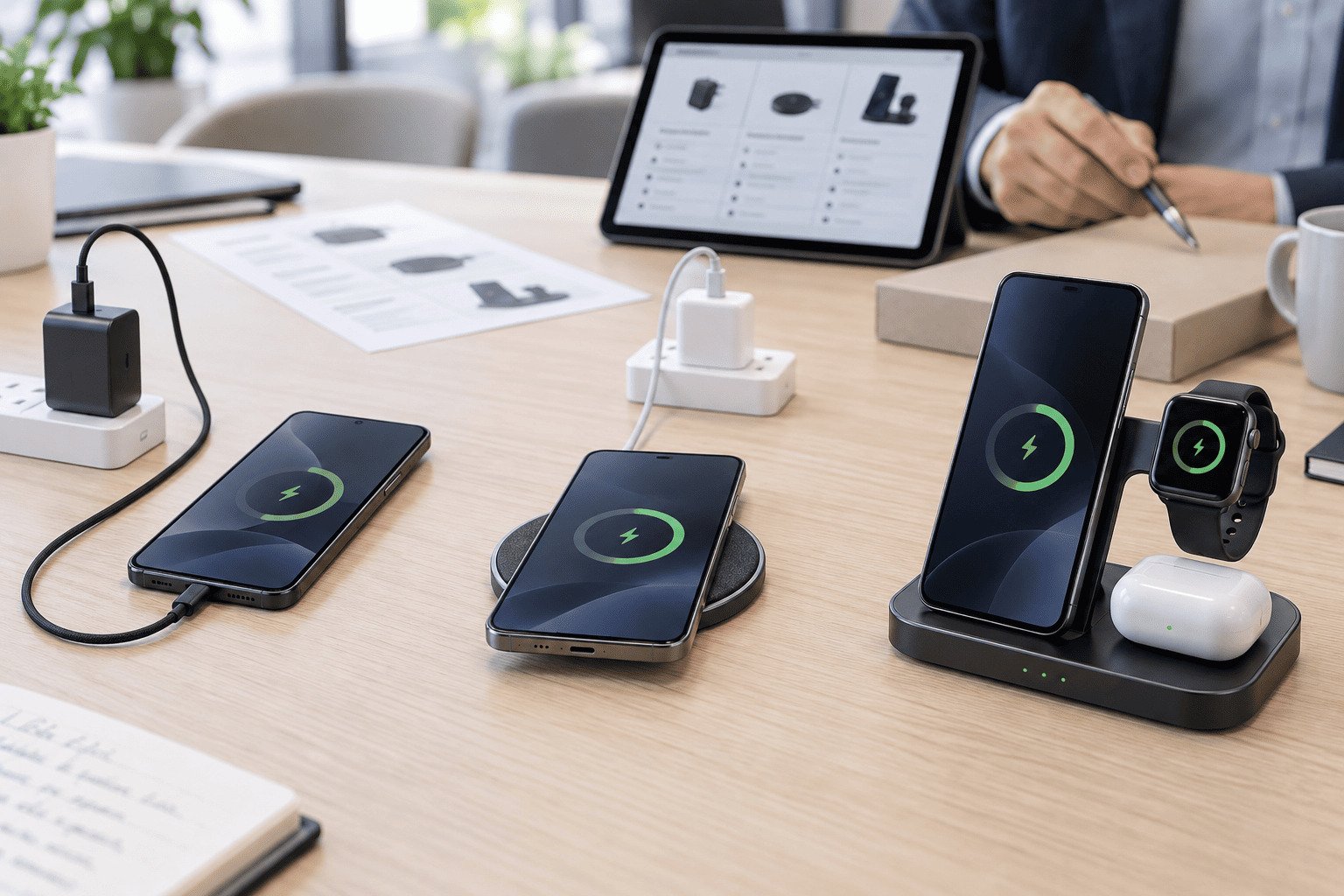
For wholesalers and distributors, this is not only a consumer charging question. It is an inventory planning question. We need to decide what to stock, how to describe it, which certifications to request, and how to reduce after-sales disputes.
What should an iPhone 18 Pro and iPhone 18 Pro Max charger include?
Many buyers start with one question: “Which charger is best?” That is too narrow. If we choose only one charging format, we may miss different user scenarios. If we overstate performance, we create avoidable customer complaints.
The safest iPhone 18 Pro and iPhone 18 Pro Max charger mix should include USB-C PD wall chargers, USB-C cables, certified or protocol-compatible magnetic wireless chargers2, and selected multi-device charging stations. USB-C covers speed and stability. Magnetic wireless charging covers convenience, premium positioning, and desk, car, and nightstand use.
Start with official Apple specifications
Before a purchase order, we recommend checking Apple’s official Tech Specs page for the exact iPhone 18 Pro and iPhone 18 Pro Max charging language. If Apple has not published final charging specifications in your procurement window, suppliers should not present 25W wireless charging as a confirmed device capability.
For B2B buyers, the key is to separate:
| Item | What buyers should verify |
|---|---|
| USB-C charging | PD protocol, adapter wattage, cable rating |
| MagSafe | Apple official compatibility and licensing language |
| Qi2 | WPC certification status and version3 |
| Qi2 25W | Whether the charger, phone, adapter, and protocol all support it |
| Generic magnetic charging | Magnet alignment only, not equal to MagSafe or Qi2 |
In quotation discussions, we often see buyers ask for “MagSafe Qi2 25W” as one combined term. That is risky. MagSafe, Qi2, Qi2 25W, and generic magnetic wireless charging4are not the same category. The difference affects packaging, online listings, customs documents, compliance review, and customer expectations.
For product-line planning, we usually divide chargers into three levels:
- Basic line: USB-C PD charger and cable bundles.
- Mid-range line: Qi or Qi2 magnetic wireless chargers for desk and car use.
- Premium line: 3-in-1 magnetic stations, higher-quality thermal design, stronger packaging, and verified certification files.
This structure helps buyers avoid relying on one product type. It also makes channel pricing easier.
Is USB-C still the baseline iPhone 18 Pro and iPhone 18 Pro Max charger?
Some buyers focus heavily on wireless charging because it looks premium. That is understandable. But if we ignore USB-C, we lose the most stable charging method for users who care about speed, travel, and emergency power.
Yes. USB-C should remain the baseline iPhone 18 Pro and iPhone 18 Pro Max charger option because it is simple, efficient, and predictable. For procurement, a USB-C PD charger is usually the lowest-risk product to stock, provided the adapter, cable, safety design, and certification documents match the target market.
What to check in USB-C procurement
A USB-C charger looks simple, but bulk purchasing still needs discipline. We suggest checking these points before confirming mass production:
- Power output: Common retail choices include 20W, 30W, 35W, and higher multi-port models.
- Protocol support: USB Power Delivery matters more than vague “fast charge” wording5.
- Cable quality: A weak cable can reduce performance and increase complaints.
- Temperature control: Compact chargers need stable thermal design.
- Regional compliance: Buyers should verify UL, CE, FCC, RoHS, PSE, KC, or other documents depending on the market.
- Packaging claims: Avoid exact iPhone 18 charging-speed claims unless Apple’s official data and test conditions support them.
For wholesalers, USB-C products also solve a practical problem: they are easier to explain to retail staff and online customers. A 20W or 30W PD charger can be positioned as a dependable everyday charger. A multi-port GaN charger can target travelers, office users, and premium channels.
However, buyers should not assume “higher wattage always means faster iPhone charging6.” The phone controls charging intake based on battery level, temperature, system status, and internal limits. This is why we prefer conservative wording such as “USB-C PD fast charging compatible” instead of unrealistic promises.
Does MagSafe or Qi2 25W make a better iPhone 18 Pro and iPhone 18 Pro Max charger line?
Magnetic wireless charging is attractive because it sells convenience. But it also creates confusion. Buyers may hear “25W wireless” and assume the charger will deliver stable 25W in every case. That assumption is not safe.
MagSafe or Qi2 25W can make a strong premium iPhone 18 Pro and iPhone 18 Pro Max charger line, but only when the product is correctly certified, labeled, powered, and thermally designed. Actual wireless charging speed can change because of adapter output, cable loss, coil alignment, heat, case thickness, battery state, and system limits.
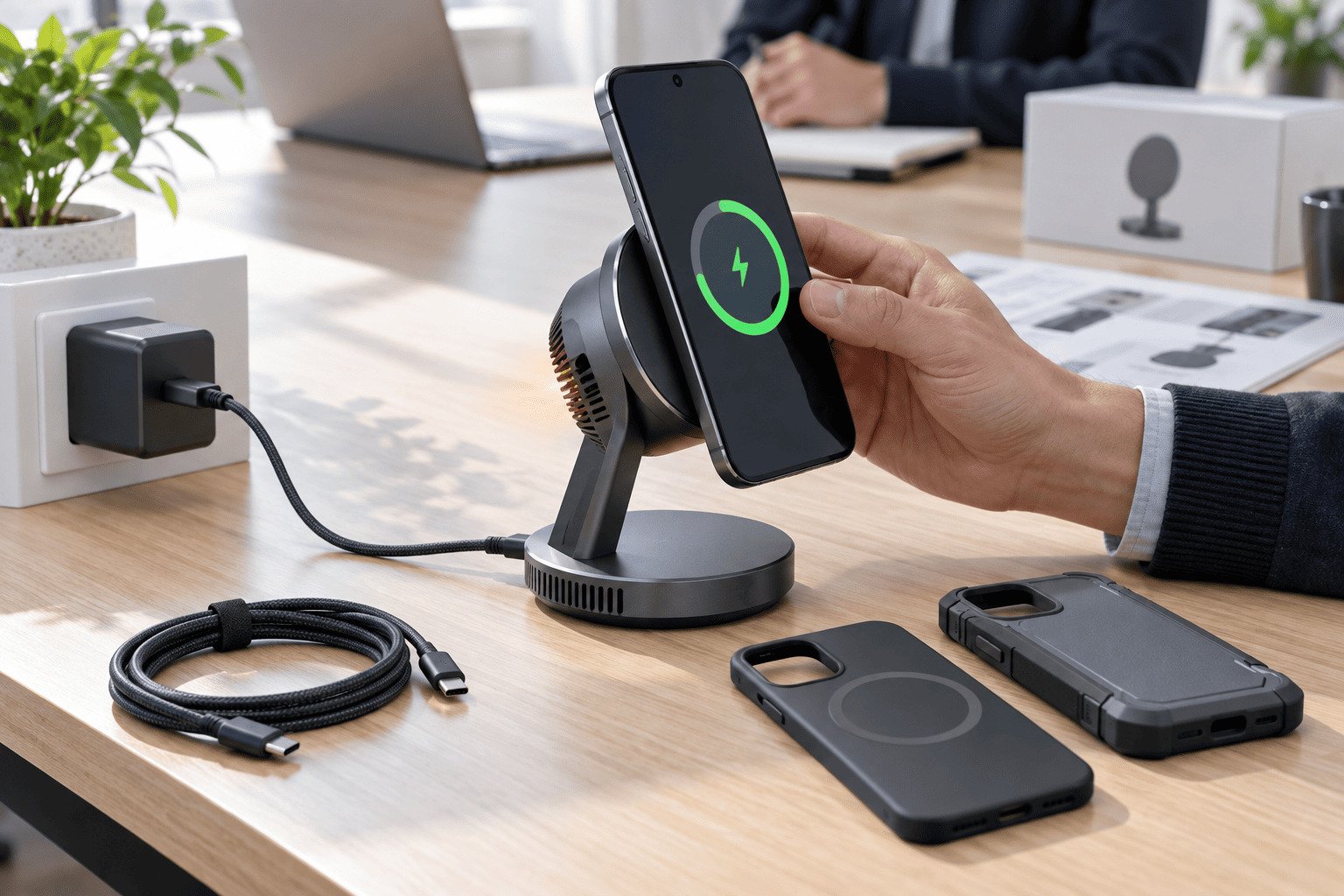
Why 25W claims need careful control
In OEM and wholesale projects, we often see return risk come from one sentence on the package. If a box says “25W for iPhone,” customers may expect 25W from 1% to 100%. Real wireless charging does not work that way.
Several factors affect real performance:
- Adapter requirement: A magnetic wireless charger may need a higher-wattage PD adapter to reach peak output.
- Cable quality: Thin or non-compliant cables can reduce input power.
- Coil alignment: Magnetic structure improves alignment, but mechanical accuracy still matters.
- Thermal design: Heat can trigger power reduction.
- Phone condition: Battery percentage, background activity, and temperature affect charging.
- Protocol support: Qi, Qi2, Qi2 25W, and MagSafe claims need separate verification.
For B2B buyers, this means the better question is not “Can it do 25W?” The better question is:
“Under what adapter, cable, phone model, temperature, certification, and test method was this output measured?”
A strong supplier should provide test reports, certification files, product specifications, and clear packaging wording. Buyers should verify these documents before import or channel launch.
How should buyers build the charger product mix?
If we buy only low-cost USB-C chargers, we miss premium accessory margin. If we buy only magnetic charging stations, we increase price pressure and compatibility questions. A better approach is segmentation.
A practical charger product mix should combine USB-C baseline products, magnetic wireless convenience products, and premium multi-device charging stations. This lets distributors serve budget, mainstream, and premium users while reducing the risk of one technology trend affecting the whole inventory plan.
Suggested B2B product mix
| Channel tier | Recommended products | Buyer focus |
|---|---|---|
| Entry market | USB-C PD chargers, USB-C cables | Price, safety, stable supply |
| Mainstream retail | Magnetic wireless pads, car chargers | Compatibility, packaging clarity |
| Premium channel | 3-in-1 stations, stand chargers, lamp or speaker chargers | Design, heat control, certification |
| Brand/private label | ODM magnetic chargers | Differentiation, tooling, MOQ, testing |
We recommend buyers prepare different packaging claims for different markets. For example, a conservative European retail package may need stronger compliance wording and verified CE/RoHS files7. A North American channel may require FCC and safety documentation. Japan and South Korea buyers often pay close attention to PSE or KC-related requirements8.
Supplier evaluation should include:
- Factory capacity and delivery control
- R&D support for magnetic structure and thermal design
- Certification document availability
- Clear test conditions for charging output
- OEM/ODM support for packaging and regional labeling
- After-sales parts and defect-handling process
This approach keeps the discussion commercial and measurable. It also helps procurement teams compare suppliers beyond unit price.
Frequently Asked Questions
Can buyers label a product as a 25W iPhone 18 wireless charger?
Only if the claim is supported by Apple’s official device specifications, the charger’s certification status, and valid test conditions. Buyers should avoid wording that suggests stable 25W charging in every situation, because wireless charging can reduce power due to heat, battery state, adapter output, and alignment.
Is generic magnetic charging the same as MagSafe or Qi2?
No. Generic magnetic charging usually means the charger has magnets for alignment. MagSafe refers to Apple’s ecosystem and official compatibility language. Qi2 is a Wireless Power Consortium standard. Qi2 25W should be verified separately by certification version, protocol support, and test documentation.
Should wholesalers stock USB-C or wireless chargers first?
Wholesalers should usually stock USB-C first because it is the baseline charging need. Wireless chargers should be added for convenience, car, desk, nightstand, and premium gift channels. A mixed product line reduces risk and improves coverage across price tiers.
What documents should importers request from suppliers?
Importers should request product specifications, test reports, certification documents, safety files, packaging artwork, and adapter requirements. Depending on the market, buyers may need UL, CE, RoHS, FCC, PSE, KC, Qi, or other relevant documentation. All certificates should be verified before shipment.
Conclusion
The best iPhone 18 Pro and iPhone 18 Pro Max charger strategy is not one product. It is a low-risk product mix. USB-C PD should be the baseline for speed and stability. MagSafe, Qi2, and Qi2 25W magnetic chargers can add premium value when certification, adapter requirements, thermal design, and labeling are handled correctly. For OEM, wholesale, or distributor projects, send us your target market, price tier, and packaging claims, and we can help evaluate a suitable charger lineup.
"Radio Equipment Directive (2022)", https://en.wikipedia.org/wiki/Radio_Equipment_Directive_(2022). Apple support documentation identifies USB-C charging with compatible adapters for recent iPhone models, providing contextual support for treating USB-C as the default wired charging baseline in procurement planning. Evidence role: general_support; source type: institution. Supports: Recent iPhone models use USB-C charging, and official support materials describe charging via USB-C cable and compatible power adapter.. Scope note: This is contextual support unless the cited Apple page explicitly covers iPhone 18 Pro and iPhone 18 Pro Max. ↩
"Qi (standard)", https://en.wikipedia.org/wiki/Qi_(standard). Wireless Power Consortium materials describe Qi certification as a standards-based process for confirming conformance and interoperability, supporting the article’s distinction between certified and merely compatible magnetic chargers. Evidence role: definition; source type: institution. Supports: Qi/Qi2 certification is administered by the Wireless Power Consortium and is used to identify products tested against the relevant wireless charging standard.. ↩
"Qi (standard)", https://en.wikipedia.org/wiki/Qi_(standard). The Wireless Power Consortium’s certification resources and product database provide a basis for checking whether a wireless charger is certified under a stated Qi or Qi2 version. Evidence role: general_support; source type: institution. Supports: WPC certification and product information can be used to verify whether a charger is certified under a particular Qi/Qi2 standard version.. Scope note: The source supports verification practice; it does not establish that any specific supplier’s product is certified. ↩
"MagSafe (wireless charger)", https://en.wikipedia.org/wiki/MagSafe_(wireless_charger). Apple support materials define MagSafe compatibility within Apple’s accessory ecosystem, while Wireless Power Consortium materials define Qi2 as a standards-based wireless charging specification, supporting the article’s distinction among these labels. Evidence role: definition; source type: institution. Supports: MagSafe is Apple-specific terminology, Qi2 is a WPC standard, and generic magnetic alignment alone does not necessarily indicate either certification or Apple compatibility.. Scope note: The distinction between Qi2 and any 25 W Qi2 implementation depends on the exact WPC version and certification documents cited. ↩
"USB hardware", https://en.wikipedia.org/wiki/USB_hardware. USB-IF documentation describes USB Power Delivery as a formal specification for negotiated power transfer over USB-C, supporting the article’s preference for protocol-based claims over vague fast-charging language. Evidence role: definition; source type: institution. Supports: USB Power Delivery is a defined USB charging specification for negotiated power delivery, unlike nonstandard marketing claims such as “fast charge.”. ↩
"About iPhone charge speeds", https://support.apple.com/en-us/120619. Apple battery and charging support materials explain that iPhone charging may be limited or paused under certain temperature and battery-management conditions, supporting the article’s caution that higher adapter wattage does not guarantee proportionally faster charging. Evidence role: mechanism; source type: institution. Supports: iPhones and lithium-ion battery systems regulate charging behavior based on temperature, battery condition, and system limits rather than accepting unlimited adapter wattage.. Scope note: The source supports device-side charging limits generally and may not quantify charging behavior for every iPhone model. ↩
"RoHS", https://en.wikipedia.org/wiki/RoHS. European Commission guidance on CE marking and RoHS regulation establishes that relevant electrical and electronic equipment must meet applicable conformity and hazardous-substance requirements before placement on the EU market. Evidence role: general_support; source type: government. Supports: Electrical and electronic products sold in the EU may be subject to CE marking and RoHS restrictions depending on product category and applicable directives.. Scope note: The exact obligations depend on the charger design, voltage range, radio functions, and other product-specific characteristics. ↩
"KC Certification for South Korea", https://www.korea-certification.com/en/kc/what-is-kc-certification/. Official Japanese and South Korean conformity-assessment materials describe PSE and KC frameworks for regulated electrical products, supporting the article’s warning that importers should check country-specific charger compliance requirements. Evidence role: general_support; source type: government. Supports: Japan and South Korea operate national conformity regimes for certain electrical products, commonly associated with PSE and KC markings respectively.. Scope note: Whether a specific charger requires PSE or KC certification depends on its technical category, voltage, radio functions, and intended market use. ↩