
Qi2 25W vs. Apple MagSafe Charger is not just a speed question for iPhone 18 Pro and iPhone 18 Pro Max buyers. The real risk is paying too much, getting unstable charging, creating extra heat, or buying the wrong shape for your desk, car, or travel bag. We should compare standards, reliability, and daily use before choosing.
For MagSafe wireless charging and Qi2 25W wireless charging, Apple MagSafe would be the safer default for simple compatibility and support. But a certified, well-built Qi2 25W charger can be the better value if it has credible certification, strong magnets, thermal control, and the right form factor.
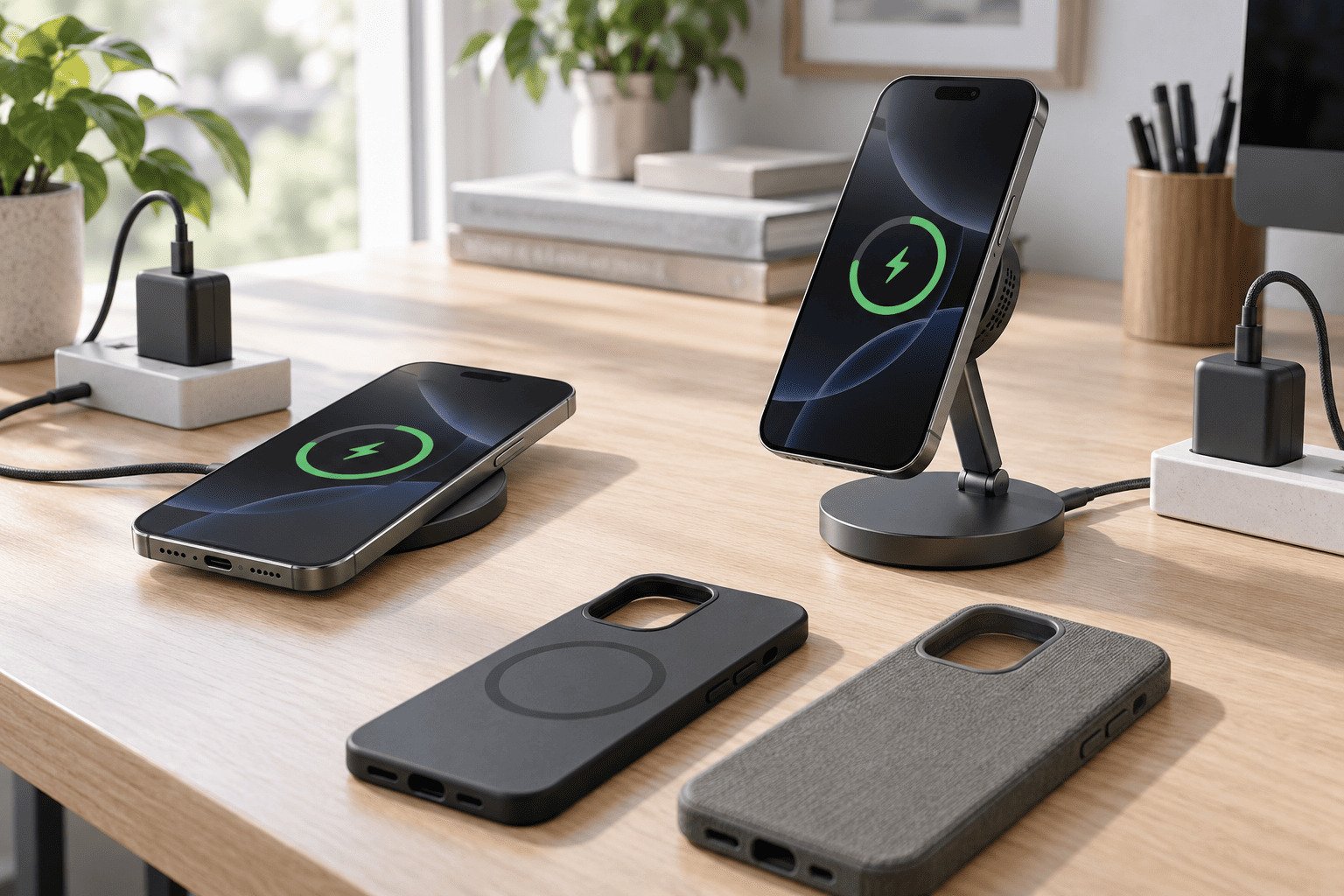
Before making a purchase, we should check Apple’s official spec page and its charging footnote. We should not treat “up to 25W” as guaranteed all-day charging speed, because wireless charging changes with heat, battery level1, adapter quality, and alignment.
Is Qi2 25W vs. Apple MagSafe Charger mainly about charging speed?
Speed matters, but it is not the whole decision. Many buyers see “25W” and assume the fastest charger always wins. That can lead to disappointment if the charger runs hot, uses a weak adapter, or loses magnetic alignment during daily use.
Qi2 25W and Apple MagSafe can both be good choices if the iPhone 18 Pro series officially supports the stated wattage. However, maximum wattage is a ceiling, not a promise. Real charging speed depends on the power adapter, cable, temperature, case thickness, battery level, and iOS charging management.2
What “25W support” really means
A wireless charger may advertise 25W, but the phone may not hold 25W from 0% to 100%. In real use, phones usually charge fastest at lower battery levels3. Then charging slows as the battery fills or the device warms up.
Key factors include:
- Adapter output: A weak USB-C adapter can limit charging.4
- Cable quality: Poor cables can reduce stable power delivery.5
- Heat control: Heat can force the phone to slow charging6
- Magnetic alignment: Even small misalignment can reduce efficiency.7
- Case design: Thick, metal, or non-magnetic cases may interfere.
- Software management: iOS may slow charging to protect battery health.8
| Factor | Why it matters | Buying tip |
|---|---|---|
| Certification | Reduces compatibility risk | Look for real Qi2/MagSafe-related documentation |
| Thermal design | Controls heat and speed drops | Avoid ultra-cheap unknown chargers |
| Magnet strength | Keeps coils aligned | Check reviews for grip and stability |
| Adapter match | Enables rated performance | Use a suitable USB-C PD adapter |
| Form factor | Affects daily convenience | Choose pad, stand, 3-in-1, car, or travel design |
We usually advise buyers to think in scenarios. A bedside charger does not need the same design as a car charger. A desk stand should hold the phone securely and allow StandBy-style viewing. A travel charger should fold flat and handle repeated cable movement.
When is Apple MagSafe Charger the better choice?
Apple MagSafe is the better choice when buyers want the simplest path. Some users do not want to compare certification documents, adapter requirements, magnet quality, and real-world reviews. They want an official accessory that fits neatly into Apple’s ecosystem.
Apple MagSafe is the safer default for users who value predictable compatibility, official support, and minimal setup risk. It is especially suitable for buyers who prefer Apple-branded accessories, dislike troubleshooting, or are purchasing for family members who just need a charger that works.
Why the official option reduces uncertainty
Apple’s charger has one major advantage: ecosystem clarity. Apple has listed charging standards and wattage on the iPhone 18 Pro / Pro Max spec page, users can compare that language directly with Apple’s own accessory claims.
However, we should still avoid overstating the benefit. Apple MagSafe does not mean zero heat. It also does not mean the phone will stay at peak wattage for the full session. Wireless charging always creates some heat because energy moves across an air gap.9
Apple MagSafe makes the most sense if you care about:
- Official accessory consistency
- Simple support path
- Low compatibility confusion
- Clean Apple ecosystem experience
- Less time comparing third-party listings
The trade-off is usually price and form factor. Apple’s own charger may not be the cheapest option. It may also not be the best shape for every use case. If you want a 3-in-1 station, foldable travel charger, car mount, or adjustable bedside stand, third-party Qi2 25W options may offer more flexibility.
When is a Qi2 25W charger the better buy?
A Qi2 25W charger can be the better buy when it combines real certification, good thermal control, strong magnets, and a practical design. The value is not only lower price. The value is getting the right charger for your actual routine.
A high-quality Qi2 25W charger is worth considering if you want more choices than Apple’s standard charger. It may fit better on a desk, in a car, beside a bed, or in a travel kit. The key is avoiding generic products that only advertise wattage without proof.
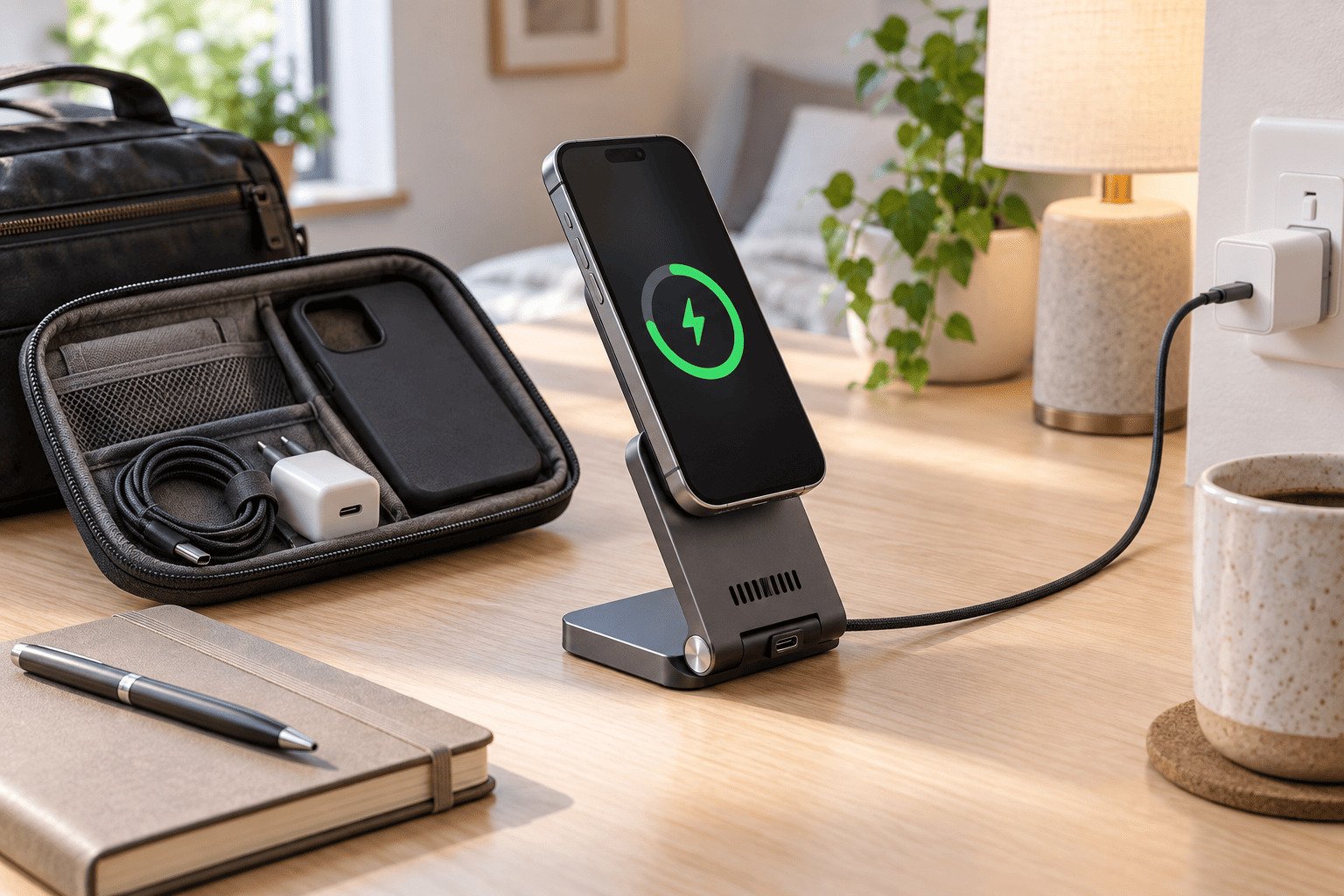
How to evaluate a Qi2 25W charger
We would not buy based on “25W” alone. We would check the full product story.
Look for:
- Qi2 certification or credible documentation10
- Clear iPhone 18 Pro / Pro Max compatibility statement
- Thermal protection and foreign object detection
- Strong magnetic hold
- Suitable USB-C PD adapter recommendation
- Return policy and warranty
For buyers choosing chargers in bulk, these checks become even more important. Product samples should be reviewed before large orders. Packaging claims, test reports, and certification documents should match the exact model being purchased, not just a similar product family.
The best Qi2 25W charger is not always the cheapest one. A higher-cost charger with better temperature control and stronger magnets may create far fewer complaints than a low-cost unit that drops speed or disconnects often.
Frequently Asked Questions
Does 25W mean my iPhone 18 Pro Max always charges at 25W?
No. “Up to 25W” means the phone may reach that level under suitable conditions. Actual speed depends on adapter power, cable quality, heat, battery level, case thickness, magnetic alignment, and iOS battery management.
Is Apple MagSafe safer than Qi2 25W?
Apple MagSafe is usually the safer default for simple compatibility and official ecosystem support. A certified, well-designed Qi2 25W charger can also be safe, but buyers should verify certification, thermal control, and real-world reviews.
Should I buy a stand, pad, or 3-in-1 charger?
Choose by location. A pad works well for simple charging. A stand is better for desks and bedside viewing. A 3-in-1 charger is useful if you also charge AirPods and Apple Watch.
Conclusion
Qi2 25W vs. Apple MagSafe Charger comes down to risk, not just wattage. Apple MagSafe is the easier default if you want official consistency and less comparison work. A strong Qi2 25W charger can be the better value if it is certified, thermally stable, magnetically secure, and suited to your daily setup. Before buying, verify Apple’s official iPhone 18 Pro / Pro Max charging wording and compare each charger’s documentation carefully.
"About iPhone charge speeds", https://support.apple.com/en-us/120619. Studies of inductive charging systems describe delivered power as dependent on thermal conditions, coupling efficiency, and battery-management controls, supporting the point that a stated wireless-charging wattage is a maximum operating condition rather than a sustained rate. Evidence role: mechanism; source type: paper. Supports: Wireless charging power and efficiency vary with thermal conditions and charging-control behavior, so a peak wattage rating does not imply sustained charging at that level.. Scope note: This would support the general mechanism of variable wireless charging power, not the specific behavior of an unreleased iPhone 18 Pro model. ↩
"How to use your MagSafe Charger with iPhone", https://support.apple.com/en-us/105047. Manufacturer support materials and battery-charging references indicate that wireless charging performance is conditioned by power-adapter capacity, thermal limits, device placement, and battery-management controls, supporting the article’s statement that real speed depends on multiple system variables. Evidence role: general_support; source type: institution. Supports: Wireless charging performance depends on power supply capability, thermal conditions, device placement, and device-side battery-management behavior.. Scope note: The source may describe MagSafe or lithium-ion charging generally rather than validating every listed factor for iPhone 18 Pro specifically. ↩
"Remaining capacity estimation of lithium-ion batteries based ...", https://pmc.ncbi.nlm.nih.gov/articles/PMC6034863/. Lithium-ion charging references describe a constant-current phase followed by a constant-voltage phase in which charge current tapers as the cell approaches full charge, supporting the claim that phones usually charge faster at lower battery levels than near full capacity. Evidence role: mechanism; source type: education. Supports: Lithium-ion batteries commonly use charging profiles in which current is higher earlier in the charge and tapers as voltage approaches the upper limit.. ↩
"Qi (standard)", https://en.wikipedia.org/wiki/Qi_(standard). Wireless-charger support documentation specifies minimum or recommended USB-C power-adapter ratings for higher charging output, supporting the statement that an underpowered adapter can limit wireless charging performance. Evidence role: mechanism; source type: institution. Supports: Wireless chargers require adequate input power from a compatible adapter to achieve their advertised charging output.. Scope note: This supports the electrical dependency between adapter capacity and charger output; it may not quantify the exact reduction for every charger model. ↩
"USB-C", https://en.wikipedia.org/wiki/USB-C. USB-IF materials describe USB-C cable current ratings and Power Delivery requirements, supporting the claim that unsuitable or low-quality cables can constrain stable power delivery to a wireless charger. Evidence role: mechanism; source type: institution. Supports: USB-C cables have defined current and power capabilities, and unsuitable cables can restrict or destabilize power delivery.. Scope note: This supports the cable-power mechanism generally rather than documenting failure rates for a specific charger. ↩
"About iPhone charge speeds", https://support.apple.com/en-us/120619. Apple support documentation notes that iPhone charging may be held or limited when the device becomes too warm, supporting the article’s statement that heat can force the phone to slow charging. Evidence role: mechanism; source type: institution. Supports: Phones may slow, pause, or manage charging when temperature rises outside preferred operating conditions.. ↩
"Qi (standard)", https://en.wikipedia.org/wiki/Qi_(standard). Wireless power-transfer studies report that lateral or angular coil misalignment reduces magnetic coupling and transfer efficiency, supporting the claim that even modest misalignment can impair wireless charging performance. Evidence role: mechanism; source type: paper. Supports: Coil misalignment in inductive wireless power transfer reduces coupling and can lower efficiency or delivered power.. Scope note: The source would establish the physical mechanism and may not measure the exact threshold for a particular iPhone or charger. ↩
"About Charge Limit and Optimized Battery Charging on ...", https://support.apple.com/en-us/108055. Apple documentation on Optimized Battery Charging explains that iOS can delay charging past certain levels to reduce battery aging, supporting the statement that iOS may slow charging to protect battery health. Evidence role: mechanism; source type: institution. Supports: iOS includes charging-management features that can delay or limit charging to reduce battery aging.. ↩
"Inductive charging", https://en.wikipedia.org/wiki/Inductive_charging. Research on inductive wireless power transfer describes efficiency losses caused by imperfect magnetic coupling, power conversion, and resistive effects, supporting the statement that wireless charging can generate heat as energy is transferred across an air gap. Evidence role: mechanism; source type: paper. Supports: Inductive wireless power transfer has conversion and coupling losses that appear partly as heat.. Scope note: The source would support the general physics of wireless charging losses, not the exact thermal profile of a specific MagSafe or Qi2 charger. ↩
"Qi (standard)", https://en.wikipedia.org/wiki/Qi_(standard). Wireless Power Consortium materials define Qi2 as a certified wireless-charging standard, including a magnetic alignment profile intended to improve interoperability between compatible devices and chargers, supporting the article’s emphasis on verifying Qi2 certification. Evidence role: definition; source type: institution. Supports: Qi2 is a Wireless Power Consortium standard with certification intended to support interoperability and standardized magnetic alignment for compatible devices and chargers.. Scope note: Certification supports standards compliance and interoperability claims; it does not by itself prove superior build quality, durability, or thermal performance for every certified product. ↩