
Wireless charger labels can look clear, but they often hide risk. I see buyers compare watts only, then face returns, heat issues, and wrong positioning.
In 2026, Qi2 is the open magnetic standard, Qi2.2 or Qi2 25W is the faster certified path, and MagSafe is the Apple-focused experience. The right choice depends on device support, certification, heat control, adapter power, and your target users.
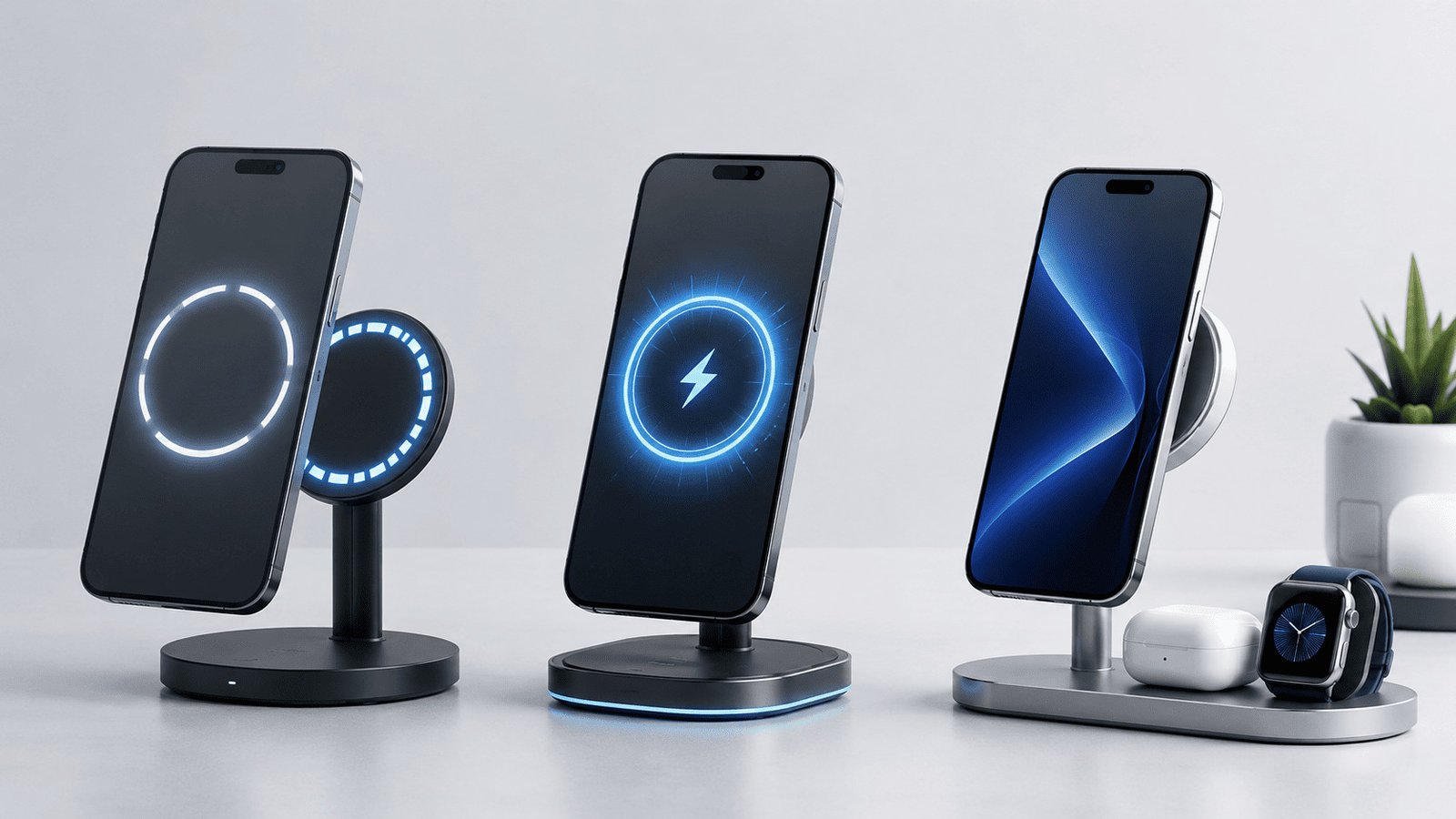
I do not see Qi2, Qi2.2, and MagSafe as three speed labels. I see them as three different product choices. One choice values open compatibility. One choice values certified higher performance. One choice values the Apple ecosystem. This difference matters more in 2026, because buyers need products that can sell for more than one season.
What do Qi2, Qi2.2, and MagSafe really mean in 2026?
Many product pages say magnetic, fast, and compatible. That sounds safe. I have seen those words create confusion when the charger does not match the phone, adapter, or market claim.
Qi2 means magnetic alignment under an open wireless charging standard. [Qi2.2, often discussed as Qi2 25W](https://en.wikipedia.org/wiki/Qi_(standard))1, moves that standard toward higher certified power. MagSafe is Apple’s mature magnetic charging and accessory system2 for iPhone users.
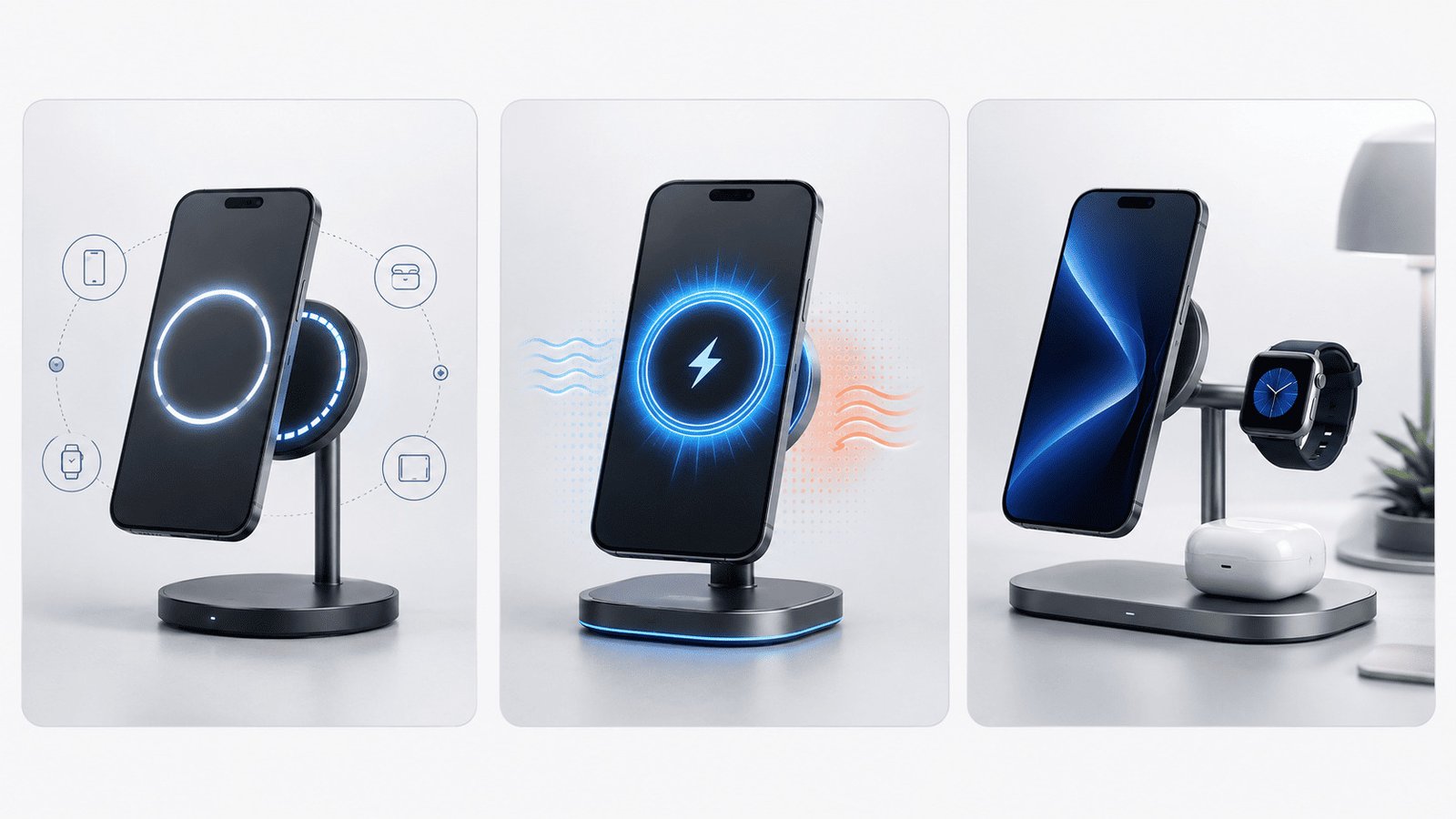
I usually explain this to buyers with one simple idea. Qi2 is not just “like MagSafe.” Qi2 takes the magnetic alignment idea and puts it into a wider standard3. This helps Android brands, iPhone users, accessory makers, and global distributors work from a clearer base.
Qi2.2, or Qi2 25W, adds a stronger performance story. But I never tell buyers to treat “25W” as a promised daily charging speed. Real charging depends on the phone4, charger certification, adapter output, coil design, [thermal control](https://www.osti.gov/servlets/purl/1871896)5, room temperature, phone case, and magnetic alignment.
MagSafe is different. It is still very strong for Apple-centered users. It has a mature accessory world. It also gives buyers a clear premium story for iPhone desks, bedrooms, cars, and travel setups.
| Choice | Main value | Best fit | Main risk |
|---|---|---|---|
| Basic Qi | Legacy support | Entry-level and older devices | No magnetic alignment |
| Qi2 | Open magnetic compatibility | Broad 2026 product lines | Some users may expect higher speed |
| Qi2.2 / Qi2 25W | Certified higher power direction | Future-ready fast wireless charging | “25W” needs full system support |
| MagSafe | Apple ecosystem experience | Premium iPhone users | Narrower ecosystem focus |
For B2B buyers, I think the safer question is not “Which one is fastest?” The better question is “Which value does my product need to sell?” A supermarket buyer may need reliable Qi2. A premium iPhone accessory brand may need MagSafe-style positioning. A 2026 catalog owner may need Qi2 25W models to stay current. Each choice can be correct when the product claim, certification, cost, and target user match.
Why is 25W not always the real charging speed?
A 25W claim can look powerful on a box. It can also cause complaints if the user expects 25W all the time and the real use condition cannot support it.
25W wireless charging needs support from the phone, certified charger design, proper adapter power, good heat control, close magnetic alignment, and a suitable environment. Without these, the charger may reduce power to protect the device6.
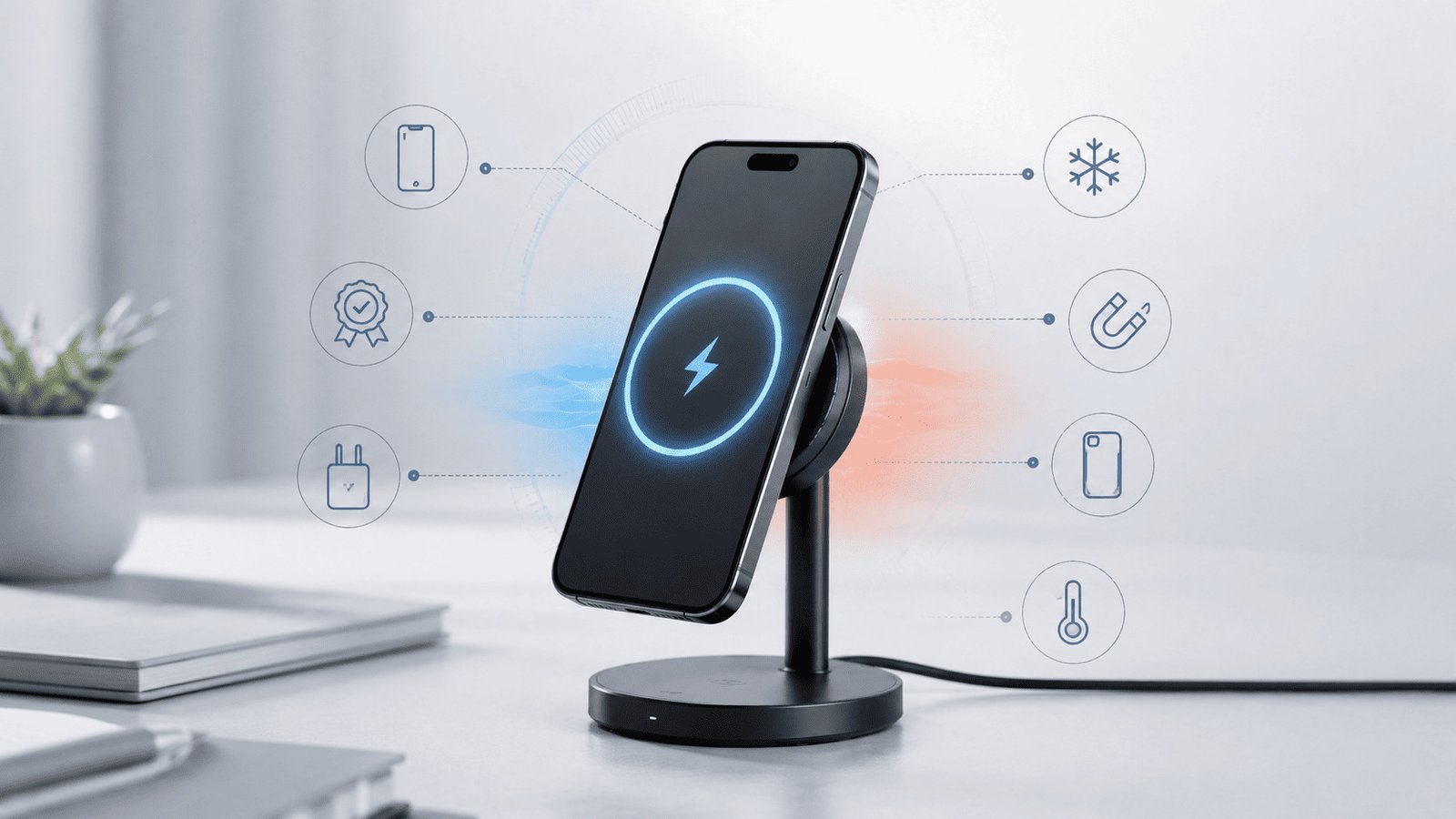
I have seen this issue many times in wireless charger development. A charger can be designed for a higher power class, but the final user may use a weak adapter. The user may also charge in a hot room. The phone may have a thick case. The phone may run video or navigation while charging. Each small detail changes the real charging curve.
Wireless charging is not like reading one number on a label. It is a controlled power process. The system checks heat, alignment, device demand, and safety.7 When heat rises, the charger or phone reduces power to protect the device, ensuring long-term battery health8. This is normal. It protects the battery and the product.
| Factor | What happens in real use | What buyers should check |
|---|---|---|
| Phone support | Unsupported phones cannot use full power | Target device list |
| Charger certification | Non-certified claims may not match tests | Qi2 or Qi2 25W certificate |
| Adapter power | Weak adapters limit output9 | Recommended PD adapter |
| Thermal design | Poor heat control lowers speed | Temperature test report |
| Magnetic alignment | Bad alignment wastes energy | Magnet strength and coil position |
| Use environment | Heat reduces charging power | Test at realistic temperatures |
This is why I tell procurement teams to avoid simple words like “fast wireless charging” without proof. I prefer clear claims. A product can say it supports Qi2. A product can say it supports Qi2 25W when certification and design allow it. A product can explain the needed adapter. This gives distributors fewer after-sales problems.
The same rule applies to “MagSafe compatible.” This phrase can mean many things in the market. It may mean the charger has magnets. It may mean it aligns with iPhone. It may not mean official Apple certification or full MagSafe performance.10 So I always advise buyers to ask for the exact standard, the test report, the device list, and the packaging claim before placing a bulk order.
How should I choose the right wireless charger for my market in 2026?
Choosing the wrong standard can hurt sales. A cheap model may miss premium users. A premium model may fail in a price-sensitive channel. A vague claim may create returns.
I choose by use case first. Basic Qi works for legacy or entry-level devices. Qi2 fits broad magnetic compatibility. Qi2 25W fits 2026-ready fast charging. MagSafe fits premium Apple-centered setups.
I would build a product line with clear layers. The first layer is basic Qi. This layer still matters for older phones, simple offices, and low-cost retail packs. It is not the future story, but it can still move volume in some channels.
The second layer is Qi2. This is the practical middle choice for many wholesalers and distributors. It brings magnetic alignment into a universal standard. It also gives buyers a cleaner story than old “magnetic compatible” wording.
The third layer is Qi2 25W. This layer is for buyers who want a future-facing catalog. It should be matched with stronger thermal design, better coil control, proper adapters, and clear certification. It should not be sold only with a big watt number.
The fourth layer is MagSafe-focused products. This layer works best when the target user is deep in the Apple ecosystem. It is useful for premium 3-in-1 stations, travel chargers, desk stands, and gift-ready products.
| Buyer type | Better choice | Reason |
|---|---|---|
| Entry-level wholesaler | Basic Qi or Qi2 | Lower price and wider device base |
| Mobile accessory distributor | Qi2 | Clear magnetic standard and broad appeal |
| 2026 catalog brand | Qi2 25W | Stronger future product story |
| Apple-focused brand | MagSafe-style setup | Better iPhone user experience |
| Corporate gift buyer | Qi2 or MagSafe | Easy use and higher perceived value |
For B2B buyers, I think the safer question is not “Which one is fastest?” The better question is “Which value does my product need to sell?” A supermarket buyer may need reliable Qi2. A premium iPhone accessory brand may need MagSafe-style positioning. A 2026 catalog owner may need Qi2 25W models to stay current. Each choice can be correct when the product claim, certification, cost, and target user match.
Conclusion
In 2026, I would choose wireless chargers by standard, certification, target user, and long-term compatibility, not by the biggest watt number on the box.
"Qi (standard) - Wikipedia", https://en.wikipedia.org/wiki/Qi_(standard). Wireless Power Consortium documentation on Qi2 25W identifies the updated Qi2 certification path as supporting higher certified wireless charging power than the earlier 15 W Qi2 profile. Evidence role: definition; source type: institution. Supports: WPC materials identify the Qi2 25W path or updated Qi2 specification as a higher-power certified wireless charging development.. Scope note: This supports the standards-level power class, not the charging speed achieved by every phone, adapter, or accessory in daily use. ↩
"MagSafe - Wikipedia", https://en.wikipedia.org/wiki/MagSafe. Apple support materials describe MagSafe for iPhone as a magnetic wireless charging and accessory system, supporting the article’s description of MagSafe as Apple-centered. Evidence role: definition; source type: institution. Supports: Apple documentation describes MagSafe for iPhone as a magnetic charging and accessory system.. ↩
"Qi (standard) - Wikipedia", https://en.wikipedia.org/wiki/Qi_(standard). WPC materials on the Qi2 Magnetic Power Profile state that the standard uses magnetic alignment to improve interoperability across compatible devices and chargers. Evidence role: historical_context; source type: institution. Supports: Qi2 incorporates magnetic alignment into a WPC standard intended for broad device and accessory interoperability.. Scope note: This establishes the standards context but does not prove that all Qi2-labeled products in the market are equally interoperable. ↩
"Qi (standard) - Wikipedia", https://en.wikipedia.org/wiki/Qi_(standard). Technical descriptions of Qi wireless charging explain that power delivery is controlled through communication between the transmitter and receiver, supporting the claim that the phone’s capabilities affect real charging power. Evidence role: mechanism; source type: research. Supports: Wireless charging systems regulate power through interaction between the transmitter and the receiving device, so device capability affects actual power.. ↩
"[PDF] Thermal Design and Optimization of High-Power Wireless Charging ...", https://www.osti.gov/servlets/purl/1871896. Studies of inductive wireless charging and lithium-ion battery thermal behavior report that temperature rise can require charging current or power reduction, supporting thermal control as a performance factor. Evidence role: mechanism; source type: paper. Supports: Research on wireless charging and lithium-ion battery charging shows that heat affects charging control and may require power limitation.. ↩
"Why iPhone Gets Hot on Wireless Charger and How to Prevent?", https://www.anker.com/blogs/wireless-chargers/iphone-gets-hot-on-wireless-charger. Battery charging and wireless power literature describes temperature-based protection mechanisms that reduce charging current or power when safety thresholds are approached. Evidence role: mechanism; source type: research. Supports: Charging systems commonly reduce power or current when thermal or safety limits are approached.. Scope note: The exact throttling thresholds vary by phone, charger firmware, battery chemistry, and certification profile. ↩
"[PDF] Wireless Charging Table with Automatic Alignment", https://courses.grainger.illinois.edu/ece445zjui/getfile.asp?id=19474. Wireless Power Consortium technical materials describe Qi charging as a controlled power-transfer process involving transmitter-receiver communication and safety functions, supporting the article’s account of active system checks. Evidence role: mechanism; source type: institution. Supports: Qi wireless charging systems use control and safety features related to power transfer, positioning, and protection.. Scope note: The source may describe the standard’s intended control features rather than the implementation quality of any individual charger. ↩
"Battery Lifespan | Transportation and Mobility Research | NLR", https://www.nlr.gov/transportation/battery-lifespan. Lithium-ion battery aging studies show that elevated operating and charging temperatures accelerate degradation, supporting the use of thermal power reduction as a battery-protection measure. Evidence role: mechanism; source type: paper. Supports: Elevated temperature accelerates lithium-ion battery degradation, so thermal management during charging is relevant to long-term battery health.. Scope note: This supports the general battery-aging mechanism, not a quantified health benefit for a specific wireless charger model. ↩
"Qi (standard) - Wikipedia", https://en.wikipedia.org/wiki/Qi_(standard). Manufacturer and standards documentation for wireless chargers commonly specifies minimum adapter input power, supporting the claim that an insufficient adapter can limit charging output. Evidence role: mechanism; source type: institution. Supports: Wireless chargers require sufficient input power from an adapter to deliver their rated wireless output.. Scope note: This is general support; exact adapter requirements depend on the charger design, conversion efficiency, and supported power profile. ↩
"MagSafe (wireless charger) - Wikipedia", https://en.wikipedia.org/wiki/MagSafe_(wireless_charger). Apple accessory documentation distinguishes official MagSafe or Made for MagSafe accessories from general compatible magnetic accessories, supporting the article’s caution that compatibility language does not necessarily imply certification or full MagSafe performance. Evidence role: definition; source type: institution. Supports: Apple distinguishes certified MagSafe accessories from general magnetic or compatible accessories, and certification affects official performance claims.. Scope note: The source clarifies Apple certification language but does not evaluate every third-party product using the phrase “MagSafe compatible.” ↩