
[A poor car charger looks fine online, then drops the phone, overheats, and charges slowly when navigation is running.
We choose the best car wireless charger for iPhone by checking the full driving system, not only wattage. We look at magnetic alignment, mount stability, heat control, USB-C PD input, case fit, viewing angle, and built-in safety protection.
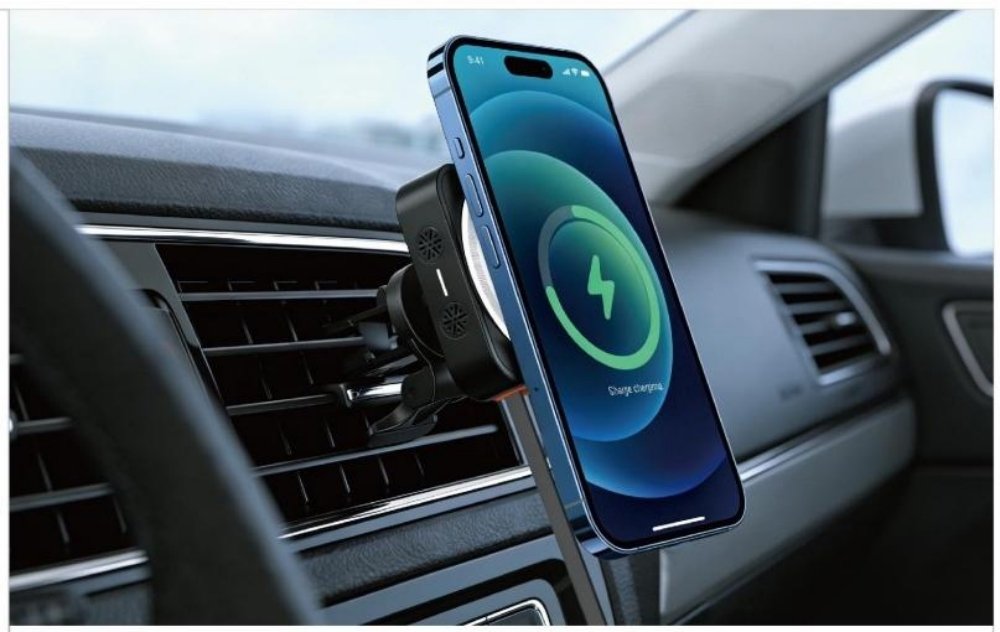
Many buyers ask for the “fastest” car wireless charger. We understand that request. Speed is easy to compare on a product page. Real driving is harder. The iPhone may run maps, music, Bluetooth, and CarPlay at the same time. The car may shake. The cabin may be hot. A case may change the magnetic pull. So we always look at the whole charging experience before we judge one model.
Why Should We Not Choose by Wattage Alone?
A wattage number can look strong, but it can mislead buyers when the charger cannot stay cool or hold the phone well.
We should not choose a car wireless charger only by 15W, 20W, or 25W claims. Real charging speed depends on iPhone limits, heat control, PD input power, alignment, and software behavior during driving.1
What the wattage claim really means
We often see product pages with large wattage labels. The label may be technically true under lab conditions. The problem is that a car is not a lab. The phone runs apps. The sun heats the dashboard. The mount may block airflow. Under extreme thermal conditions, the iPhone hardware will automatically reduce power to protect the battery, putting charging on hold or slowing it down significantly until the internal temperature drops.
| Check point | Why it matters in a car | What we prefer |
|---|---|---|
| Rated wireless output | It shows possible peak power | Clear and honest output data |
| USB-C PD input | It supports stable power supply | Proper PD car adapter match |
| Heat behavior | Heat slows wireless charging | Better coil design and heat path |
| iPhone charging rule | iPhone controls real speed | Compatibility with iPhone models |
| Long-use test | It shows real driving result | Stable output during navigation |
How we judge real speed
We judge speed by use cases. We test navigation, screen-on use, and music playback. We also check charging after 30 minutes and 60 minutes, not only the first 5 minutes. A charger that starts fast but becomes hot may charge slower later.2 A charger with modest peak power may feel better if it stays stable. For daily drivers, this steady performance matters more than a bold peak number. It ensures your phone actually gains battery life during a short commute and protects your device's battery health over time. We want the user to feel that the charger is reliable every day. That feeling is built by steady performance, not by one large wattage claim.
How Important Is Magnetic Alignment for iPhone Charging?
Weak alignment creates heat, slow charging, and poor user experience, especially when the road is rough or the phone is used with one hand.
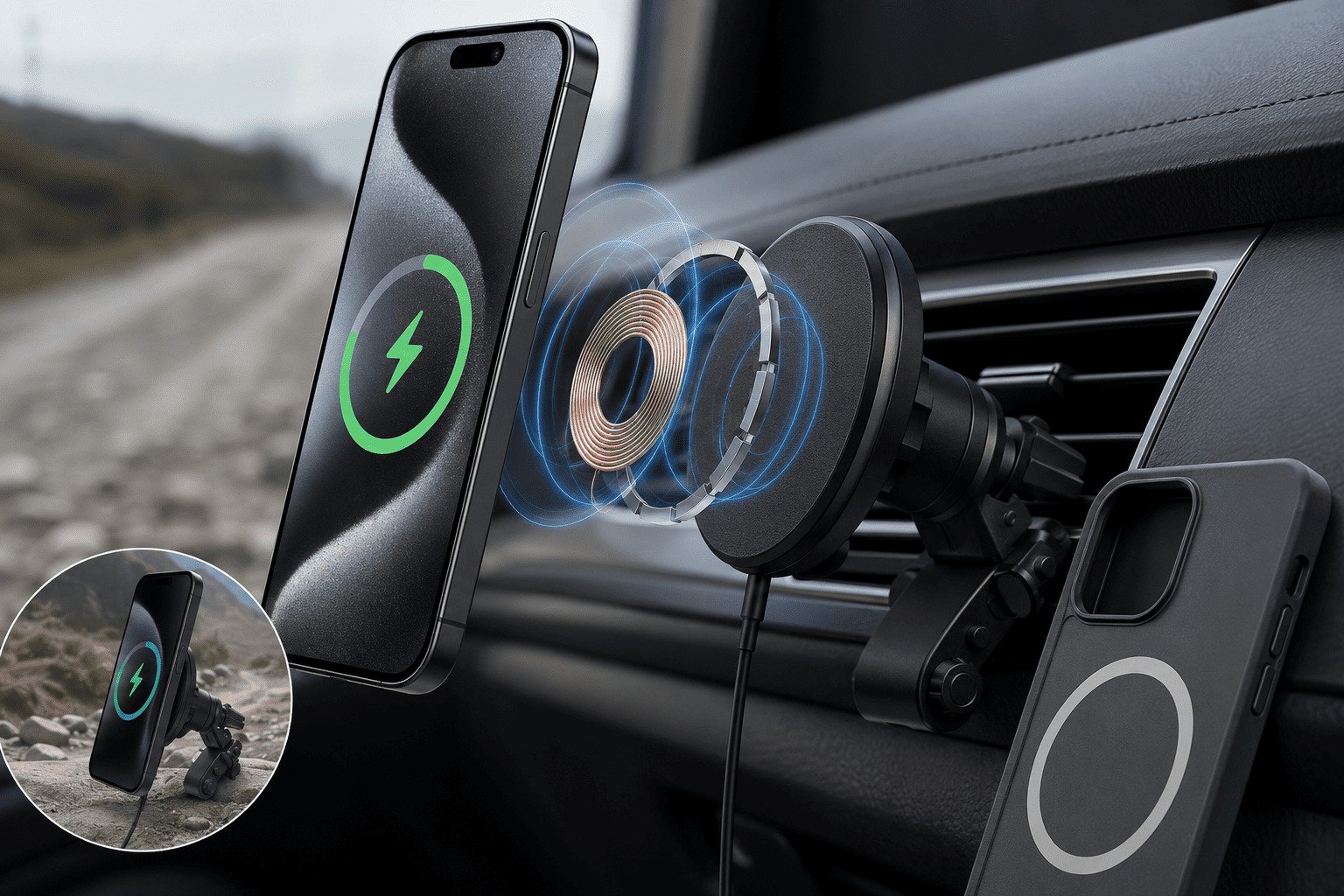
Magnetic alignment is critical for iPhone wireless charging because the charging coil must sit in the right place. A MagSafe-compatible structure helps the phone attach quickly, charge more efficiently, and stay secure during normal driving.
Why alignment affects both charging and safety
We see magnetic alignment as the first real test of a car wireless charger for iPhone. If the transmitter and receiver coils sit off-center, inductive coupling efficiency drops sharply3. In wireless power transfer systems, this [extra energy turns into heat](https://pmc.ncbi.nlm.nih.gov/articles/PMC12152173/)4 rather than electricity, causing a rapid temperature spike that forces the phone to throttle its charging speed.
| Alignment factor | Bad result | Better design choice |
|---|---|---|
| Weak magnet ring | Phone slides or drops | Strong and balanced magnetic array |
| Poor coil position | Slow charging and heat | Accurate coil-to-iPhone matching |
| Thick case gap | Lower magnetic force | MagSafe-compatible case support |
| One-hand placement | User needs adjustment | Auto-centering magnetic contact |
| Road vibration | Phone moves over bumps | Mount and magnet tested together |
What we test before we trust a model
We test phone attachment with different iPhone sizes. We also test with MagSafe-compatible cases because many users never remove the case in the car. We check bumpy-road movement, quick turns, and sudden stops. We do not only pull the phone straight away from the charger. We also check side force, because side movement often happens in real cars. A very strong magnet is not always enough. The mount must also be stable. If the magnet is strong but the vent clip is weak, the full system still fails. That is why we treat magnetic design and mounting design as one complete part. For us, secure holding means the phone stays visible, chargeable, and safe without constant hand adjustment.
What Mounting Design Works Best in Daily Driving?
A weak mount creates shaking, bad viewing angles, and phone drops, even when the charger itself has good magnetic strength.
The best mounting design depends on the car interior and user habits. We compare air vent mounts, dashboard mounts, and windshield mounts by stability, viewing angle, airflow, installation safety, and long-term durability.
How we compare mount types
We do not say one mount type is always best. We look at the car model, climate, and driver preference. Air vent mounts are common and easy to install. During hot summer days, active vehicle cabin airflow can drastically improve5 the thermal management of the electronic components by drawing heat away from the back of the charger. However, users should remain cautious in the winter, as turning on the car heater can blast hot air directly onto the mount and trigger immediate thermal protection on the iPhone6.
| Mount type | Main strength | Main risk | Our buying advice |
|---|---|---|---|
| Air vent mount | Easy use and better airflow | Weak vent blades in some cars | Check clip design and support foot |
| Dashboard mount | Stable if surface is good | Adhesive may fail in heat | Use quality adhesive and test aging |
| Windshield mount | Flexible viewing position | More sunlight and heat | Avoid blocking driver view |
| CD slot mount | Solid in some older cars | Not useful for newer cars | Use only for target markets |
| Multi-mount set | Fits more vehicles | Higher cost and packaging size | Flexible options for different cars |
Why viewing angle is also a safety feature
We treat viewing angle as part of safety. A driver should not look down for a long time. The phone should sit in a position that supports navigation, but it should not block the road view. The charger should allow angle adjustment without becoming loose. We also check whether the user can place and remove the phone with one hand. For daily users, this small detail makes the difference between a seamless drive and constant, annoying distractions. A good product feels easy from the first day. It also feels stable after weeks of heat, vibration, and repeated use. So we test the holder, hinge, ball joint, clip, and adhesive as one mechanical system.
Why Does Heat Control Matter During iPhone Wireless Charging?
Heat is one of the main reasons a car wireless charger feels slow, even when the advertised power looks high.
Heat control matters because iPhone charging speed can drop when the phone becomes warm. Navigation, sunlight, Bluetooth, CarPlay, and wireless charging all add heat7, so the charger needs good design to keep performance stable.
Where heat comes from in the car
We pay close attention to heat because cars create harsh conditions. In summer, the cabin can become very hot. The dashboard can be hotter than the air. If the phone runs maps and the screen stays bright, the phone already works hard. Wireless charging adds more heat. If the charger has poor coil alignment or poor materials, the temperature rises faster.
| Heat source | What happens | What we check |
|---|---|---|
| Direct sunlight | Phone temperature rises fast | Mount position and shade risk |
| Navigation app | Processor and screen work harder | Long-use charging performance |
| Wireless loss | Energy becomes heat | Coil design and alignment |
| Thick phone case | Heat escapes slowly | Case compatibility testing |
| Poor input adapter | Unstable power behavior | PD profile and cable quality |
How we reduce heat risk
We prefer a charger with efficient coil design, stable electronic control, and safe temperature protection. Some models use better heat paths in the back housing. Some use airflow from the air vent to reduce temperature. We also look at software protection. The charger should manage over-temperature, over-current, over-voltage, short circuit, and foreign object detection. In our work with wireless charging products, we see that heat control protects both user experience and product life. A cooler charger usually gives more stable charging, dramatically lowering the risk of battery degradation for your phone.
How Should We Check Case Compatibility and Power Input?
A charger may work well without a case, but many users charge with a case every single day.
We should check case compatibility with MagSafe-compatible cases, case thickness, camera bump clearance, and magnetic holding force. We should also match the charger with a proper USB-C PD car adapter and cable for stable input power.
Why the case changes the result
We often test chargers with bare phones first, but we never stop there. Most iPhone users keep a case on the phone. A normal thick case may weaken magnetic holding.8 A non-magnetic case may stop the phone from locking into the right charging position. A metal ring or metal plate may create safety issues. The camera bump can also touch the charger body and stop the phone from sitting flat.
| Item to check | Possible problem | Better requirement |
|---|---|---|
| MagSafe case | Good alignment if well made | Test with several case brands |
| Thick case | Weak magnetic contact | State supported thickness clearly |
| Metal plate | Heating or charging failure | Warn users not to use it |
| Camera bump | Phone may not sit flat | Leave enough clearance |
| Ring holder case | May block the coil | Check before buying |
Why USB-C PD input is not optional
Wireless charging depends heavily on input power. If the car adapter is weak, old, or unstable, the charger cannot perform well. We prefer USB-C PD input because it gives the charger enough power headroom and more stable control. Apple official documentation states that to hit peak wireless performance, the system requires a specific minimum required PD output profile—typically requiring at least a 20W (9V/2.22A) adapter for standard MagSafe systems to unlock full charging speeds safely without straining the battery. The cable also matters; a poor cable can cause voltage drop, heat, or random charging stops. Ensure the adapter and charger you buy carry reliable certifications such as CE, FCC, RoHS, or Qi-related compliance to avoid unexpected electrical issues in your vehicle.
What Safety and Quality Details Should Every iPhone User Look For?
A low-cost charger may pass a quick visual check, then fail or drop your phone over the first major pothole.
We should check for built-in safety protection, temperature regulations, robust joint materials, and real-world shock absorption to safeguard both our driving safety and our expensive mobile devices.
| Quality review item | Reason | What we prefer |
|---|---|---|
| Certifications | Ensures electrical safety | CE, FCC, RoHS, or Qi/Qi2 compliance |
| Drop-preventing mounts | Finds early physical failure | Secure locking mechanism over simple tension clips |
| Vibration dampening | Matches rough driving use | Soft silicone padding and firm ball-joints |
| Extreme temperature safety | Checks summer/winter risk | High-temperature circuit cut-off |
Why a reliable charger matters
When picking a car wireless charger for iPhone, you aren't just choosing a basic plastic cradle. A reliable charger must act as a seamless extension of your dashboard—protecting your phone from voltage spikes, absorbing intense road vibrations, and keeping your battery running cool. Investing in a highly rated, certified ecosystem ensures peace of mind across every commute.
Conclusion
We choose the best car wireless charger for iPhone by focusing on stable, safe, cool, and convenient charging in real driving conditions.]
"How to use your MagSafe Charger with iPhone - Apple Support", https://support.apple.com/en-us/105047. Research on inductive wireless power transfer and manufacturer documentation on MagSafe charging indicate that practical charging output depends on coil alignment, thermal limits, input power availability, and device charging controls, not only on a nominal wattage rating. Evidence role: general_support; source type: research. Supports: Wireless charging performance is influenced by alignment, thermal behavior, available input power, and device-side charging management.. Scope note: This would support the general mechanism rather than prove the performance of any specific car charger model. ↩
"About iPhone charge speeds - Apple Support", https://support.apple.com/en-us/120619. Apple’s temperature-management guidance states that iPhone charging may slow or stop when the device exceeds recommended operating temperatures, supporting the point that heat can reduce sustained charging speed. Evidence role: mechanism; source type: institution. Supports: Smartphones may slow or pause charging when operating temperature rises, which can make sustained charging slower than initial charging.. ↩
"[PDF] COIL MISALIGNMENT COMPENSATION TECHNIQUES ... - RUcore", https://rucore.libraries.rutgers.edu/rutgers-lib/48468/PDF/1/play/. Studies of inductive wireless power transfer report that lateral or angular misalignment between transmitter and receiver coils reduces magnetic coupling and lowers power-transfer efficiency. Evidence role: mechanism; source type: paper. Supports: Misalignment between transmitting and receiving coils reduces coupling and transfer efficiency in inductive wireless power systems.. ↩
"Maximizing wireless power transfer efficiency at exceptional points", https://pmc.ncbi.nlm.nih.gov/articles/PMC12152173/. Engineering literature on wireless power transfer explains that imperfect coupling and resistive losses reduce transfer efficiency, with the lost electrical energy primarily dissipated as heat. Evidence role: mechanism; source type: paper. Supports: Inefficiencies in wireless power transfer appear as power losses, commonly dissipated as heat in the charger, receiver, or nearby conductive materials.. ↩
"Thermal management (electronics) - Wikipedia", https://en.wikipedia.org/wiki/Thermal_management_(electronics). Heat-transfer references on electronics cooling show that forced airflow increases convective heat removal from electronic components, providing a technical basis for the claim that vent airflow can help cool a charger. Evidence role: mechanism; source type: education. Supports: Air movement over electronics can increase convective heat transfer and reduce component temperature compared with stagnant air.. Scope note: This supports the thermal principle; it does not quantify the cooling effect for a particular car vent, charger shape, or cabin condition. ↩
""Charging on hold due to iPhone temperatu… - Apple Community", https://discussions.apple.com/thread/256040409. Apple’s iPhone temperature guidance states that charging may slow or stop when the device becomes too warm, which supports the plausibility that direct hot airflow could activate thermal protection. Evidence role: mechanism; source type: institution. Supports: iPhones include temperature protection that can limit or stop charging when the device becomes too warm.. Scope note: Apple’s guidance supports the thermal-protection behavior, but it does not specifically test a heater vent aimed at a car charger. ↩
"[PDF] Smartphone Indoor Localization through Power Consumption", https://files.nyit.edu/files/engineering/SOECS_REU2015_PosterPresentation_NavadaKhullar.pdf. Research on smartphone energy consumption and wireless charging, together with device temperature guidance, supports that active navigation, display and radio use, environmental sunlight, and charging inefficiencies can add to a phone’s heat load. Evidence role: general_support; source type: research. Supports: Processor, display, radio activity, environmental heat, and charging losses can all contribute to a smartphone’s thermal load.. Scope note: The evidence would be cumulative and contextual; it may not isolate CarPlay or Bluetooth heat contribution in the exact driving scenario described. ↩
"Magnetic field - Wikipedia", https://en.wikipedia.org/wiki/Magnetic_field. Introductory electromagnetism references show that magnetic field strength and attraction decrease with increased separation, providing a physical basis for the claim that thicker cases can weaken magnetic holding. Evidence role: mechanism; source type: education. Supports: Increasing separation distance between magnets reduces magnetic attraction, which can weaken a magnetic mount when a thick case is used.. Scope note: This supports the general magnetic principle; actual holding force also depends on magnet geometry, case materials, and the presence of MagSafe-compatible magnets. ↩