
We hear this question often. Wireless charging feels easy, but many users worry that silent heat may slowly ruin their phone battery.
Wireless charging does not automatically damage a modern phone battery. We should care more about heat, charger quality, coil alignment, cases, charging habits, and long high battery levels. When we control these factors, wireless charging is safe for daily use.
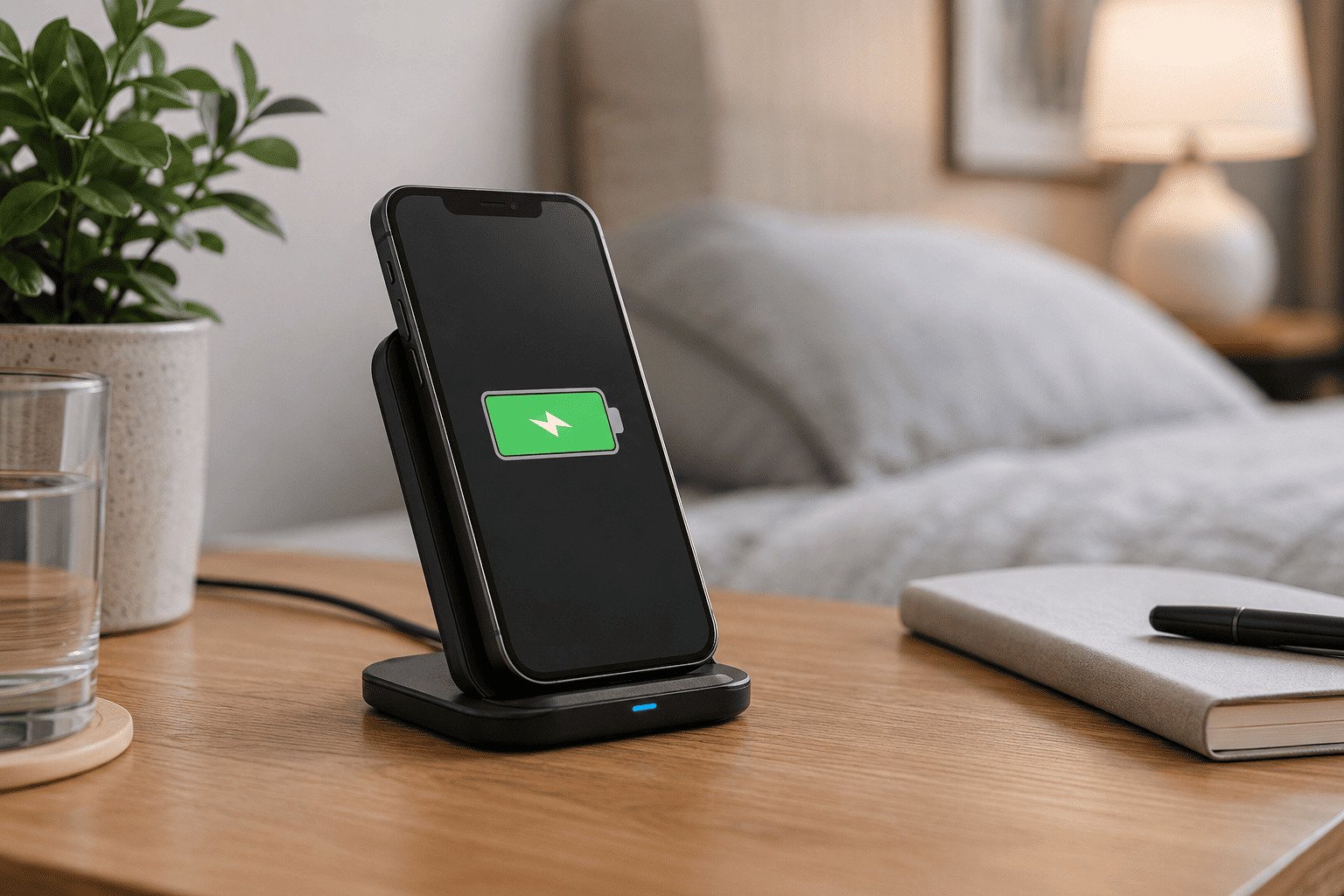
We should not treat wireless charging as a simple good or bad choice. We have seen many buyers, brand owners, and users ask the same question from different angles. Some people use a wireless charger every night. Some people use it in the car. Some people use it on the office desk for many short top-ups. The real question is not only “wireless or wired.” The real question is how the phone receives power, how much heat builds up, and how long the battery stays under stress. If we understand these points, we can use wireless charging with more confidence and less fear.
Why Is Wireless Charging Not the Real Enemy of Battery Health, but Uncontrolled Heat and Poor Charging Habits Are?
We may blame the wireless pad too fast. The phone battery usually ages because heat, high charge levels, and bad daily habits repeat for months.
Wireless charging is not the main enemy. We should focus on heat control, proper alignment, certified chargers, safe cases, clean charging surfaces, and smart charging settings. These points have a much bigger effect on battery life than the charging method alone.
What actually ages a phone battery?
We need to start with the battery itself. Most modern smartphones use lithium-ion batteries.1 We see the same core rule in many mobile devices. The battery ages slowly every time we charge and use it.2 This aging is normal. Wireless charging does not create this aging by itself. The battery chemistry does.
We usually see four main causes behind faster battery aging.
| Battery stress factor | What it means in daily use | Why it matters |
|---|---|---|
| Heat | The phone becomes warm or hot during charging | Heat speeds up battery chemical aging |
| Charging cycles | The battery goes through repeated charge and discharge use | More use means more natural wear |
| High battery level | The phone stays near 100% for many hours | High voltage can stress the battery |
| Bad environment | The phone charges in a hot car, under a pillow, or in direct sun | Poor cooling makes heat worse |
We should look at wireless charging through this table. Wireless charging can be safe, but it can also create more heat in some cases. That is why the answer must be balanced. The technology is not automatically harmful. Poor use is the real problem.
Why can wireless charging create more heat?
We should know how wireless charging works in simple terms. A wireless charger has a coil inside. The phone also has a coil. The charger sends energy through a magnetic field.3 The phone receives this energy and turns it into usable power for the battery.
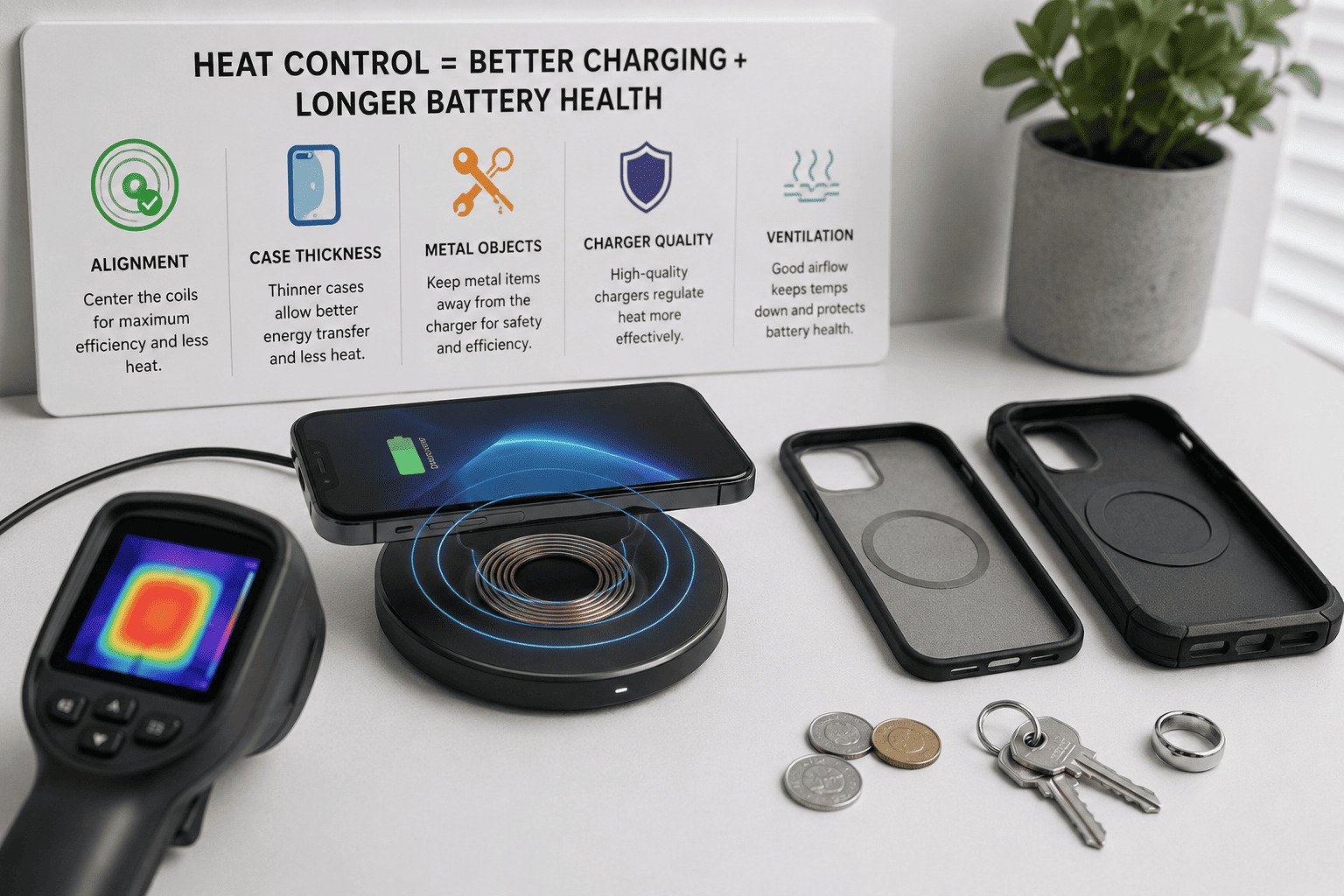
This process is convenient, but it is not as direct as a cable. Some energy is lost during transfer. This lost energy can become heat.4 If the phone and charger are aligned well, the loss is lower. When the transmitter and receiver coils are off-center, the magnetic coupling becomes inefficient.5 Industry data on wireless charging coil misalignment shows that a minor offset can cause efficiency to plummet, converting a larger percentage of drawn power into parasitic heat that warms up the phone.
We often see this in real use. A user places the phone on a pad quickly before sleep. The phone is not centered. The case is thick. A metal ring or card is inside the case. The room is warm. The phone also runs background apps. In this case, wireless charging may generate more heat than expected. The problem is not the idea of wireless charging. The problem is the full setup.
How should we compare wireless charging with wired charging?
We should compare them with real daily needs. Wired charging is highly efficient, with modern adapters reaching 90% to 95% power transfer.6 In contrast, standard Qi wireless inductive coupling typically achieves 70% to 80% efficiency, meaning 20% to 30% of the energy is naturally dissipated as heat. This explains why wireless systems inherently require better thermal management. It may be better for fast charging when a user needs power quickly. Wireless charging is usually better for convenience. It is useful on a desk, a bedside table, a shop counter, a meeting room, or a car mount.
We should not say wired charging is always safe and wireless charging is always risky. A poor cable charger can also overheat. A cheap adapter can also give unstable power. A phone can also get hot during wired fast charging. The charger type matters, but charger quality matters more.
| Use situation | Wireless charging fit | Battery health note |
|---|---|---|
| Desk top-ups | Good fit | We should use a stable stand or pad |
| Bedside charging | Good fit | We should enable optimized charging |
| Car charging | Useful, but heat risk is higher | We should avoid direct sun and hot cabins |
| Gaming while charging | Not ideal | We should avoid heavy use during charging |
| Emergency fast charge | Wired may be better | We should choose a safe certified adapter |
We have worked with many wireless charging products since 2017. We have seen that buyers do not only ask for power output. They also ask about temperature control, coil position, foreign object detection, compliance, and long-term reliability. These questions are correct. They are the questions that protect both users and brands.
Why do low-quality wireless chargers increase risk?
We should be careful with very cheap wireless chargers from unknown sources. A low-quality charger may use poor coils, weak circuit design, bad thermal control, and unstable output. It may also miss important protection features.
A reliable wireless charger must include key safety protocols. These functions include over-current protection, short-circuit protection, over-temperature protection, and Qi standard Foreign Object Detection (FOD), which cuts off power within milliseconds if conductive metals like coins or keys are detected on the pad. Qi or Qi2 compatibility also matters for many products.7 Certification is not only a logo. It shows that the product has passed a certain testing process.
As a manufacturer, we see this point from the production side. Stable wireless charging performance comes from design, material choice, testing, and process control. It is not only about making the charger look good. It is also about how the product behaves after many hours of use. A good charger should control heat in normal conditions. It should also stop or reduce output when something is wrong.
What role do cases and metal objects play?
We should pay close attention to the space between the phone and the charger. Wireless charging works best when the coils are close and aligned. A thick case increases the distance.8 A metal plate, coin, magnetic accessory, bank card, or key between the phone and charger can cause problems. Some metal objects may heat up. Some items may block power transfer. Some may trigger foreign object detection.
We should use a wireless-friendly case. We should also remove metal plates or cards before charging. If we use a magnetic wireless charger, we should make sure the phone and accessory are designed for that system. A good magnetic connection can help alignment, but a poor accessory can create new problems.
We can use this simple checklist before charging.
| Check point | What we should do |
|---|---|
| Phone position | We should place the phone in the center of the pad or use a stand with fixed alignment |
| Case thickness | We should use a thin case or a case made for wireless charging |
| Metal objects | We should remove coins, keys, rings, cards, and metal plates |
| Heat level | We should stop charging if the phone is already hot |
| Surface | We should charge on a hard, open, and ventilated surface |
What habits help protect the battery during wireless charging?
We should build habits that reduce heat and long stress. These habits are simple, but they work well.
First, we should avoid wireless charging in hot places. A car cabin in summer can become very hot.9 A charger on a dashboard can add more heat. If the phone is already hot from navigation, video, or sunlight, wireless charging may push it harder.
Second, we should avoid heavy phone use during charging. Gaming, video recording, hotspot use, and navigation all create heat. Charging also creates heat. When both happen together, the battery may stay hot for longer.
Third, modern operating systems use on-device machine learning to adapt to our habits. Features like Apple's official Optimized Battery Charging protocol and Android's Adaptive Charging intentionally delay power completion past 80% during long periods, drastically reducing the high-voltage stress that degrades lithium-ion chemistry. We should enable these features when we charge overnight.
Fourth, we should use good chargers and good power adapters. A wireless charger still needs input power from an adapter. A poor adapter can affect stability. We should choose a reliable adapter that matches the charger’s input requirement.
Fifth, we should keep the charging surface clear. While ordinary dust won't stop the magnetic flux, stray metal debris or magnetic particles can accidentally trigger safety warnings or trap heat beneath the phone.
Is overnight wireless charging bad?
We should not panic about overnight wireless charging. Modern phones and quality chargers manage charging better than older devices. The phone stops full-speed charging when the battery reaches full level. Many phones also manage temperature and battery protection.
Still, overnight charging can keep the battery at a high state of charge for a long time. This can add stress over months and years. We should use optimized charging or battery protection settings when available. Some phones offer an 80% limit. Some phones delay the last part of charging until morning. These features are useful.
We also should place the phone in an open area. We should not charge under a pillow, blanket, or stack of papers. We should not place the charger near a heater. Airflow matters. A charger that stays cool is usually better for long-term use.
What should buyers and brands look for in wireless chargers?
We should look beyond price and appearance. A charger may look simple, but the inside design decides safety and user experience. For wholesalers, importers, distributors, and brand owners, battery health concerns can become after-sales concerns. A product with poor heat control may create user complaints. A product with weak alignment may feel slow or unreliable. A product without proper compliance may create market risk.
We usually advise buyers to check these points.
| Buyer concern | What we should check |
|---|---|
| Safety | We should confirm protection design and temperature control |
| Compliance | We should ask for UL, CE, FCC, RoHS, PSE, KC, Qi, or other needed reports |
| Charging performance | We should test with real phone models and real cases |
| Heat behavior | We should run long-time charging tests |
| Production stability | We should check factory process control and capacity |
| Customization | We should confirm OEM and ODM support early |
| After-sales risk | We should ask how the supplier handles defects and spare parts |
We believe these checks matter because wireless charging is a daily-use product. Users touch it every day. They also leave phones on it for hours. A stable product protects the phone, the user, and the brand reputation.
What is the practical answer for everyday users?
We should use wireless charging as a convenient tool, not as a magic product and not as a danger. It is safe for daily use when the charger is reliable and the charging environment is controlled. It may create more heat than wired charging in some cases. That heat is the point we should manage.
We should place the phone correctly. We should avoid thick or metal cases. We should remove foreign objects. We should charge in a cool and open place. We should avoid charging when the phone is already hot. We should enable optimized charging. We should choose certified or reliable chargers from known suppliers.
If we follow these habits, wireless charging can support normal daily life very well. We can use it for small top-ups at work. We can use it beside the bed. We can use it in a car when the temperature is controlled. We should still use wired charging when we need faster power or when the phone is hot.
Conclusion
Wireless charging is safe when we control heat, alignment, charger quality, cases, and habits. We should manage the cause, not fear the method.
"Lithium-ion battery - Wikipedia", https://en.wikipedia.org/wiki/Lithium-ion_battery. Manufacturer and technical references describe contemporary smartphones as using rechargeable lithium-ion or lithium-ion polymer batteries, supporting the article's framing of phone battery ageing around lithium-ion chemistry. Evidence role: definition; source type: institution. Supports: The source should confirm that contemporary smartphones commonly use rechargeable lithium-ion or lithium-ion polymer batteries.. Scope note: This supports the general battery-chemistry context and may not identify the chemistry used in every individual phone model. ↩
"[PDF] Life Prediction Model for Grid-Connected Li-ion Battery Energy ...", https://docs.nlr.gov/docs/fy17osti/67102.pdf. Peer-reviewed lithium-ion battery ageing literature identifies both charge-discharge cycling and time-dependent calendar ageing as causes of gradual capacity loss, supporting the statement that normal charging and use contribute to battery ageing. Evidence role: mechanism; source type: paper. Supports: The source should explain that lithium-ion batteries lose capacity over time due to cycle ageing and calendar ageing.. Scope note: The cited ageing mechanisms are general to lithium-ion cells and may not quantify degradation for a specific smartphone design or charging pattern. ↩
"Qi (standard) - Wikipedia", https://en.wikipedia.org/wiki/Qi_(standard). Technical descriptions of inductive charging define the method as power transfer between transmitter and receiver coils through an alternating magnetic field, supporting the article's description of how wireless charging sends energy. Evidence role: definition; source type: encyclopedia. Supports: The source should define inductive wireless charging as energy transfer through a magnetic field between coils.. ↩
"Wireless power transfer - Wikipedia", https://en.wikipedia.org/wiki/Wireless_power_transfer. Engineering studies of inductive wireless power transfer describe efficiency losses from coil resistance, coupling conditions, and power electronics, with lost electrical energy dissipated partly as heat. Evidence role: mechanism; source type: paper. Supports: The source should explain that resistive and coupling losses in wireless power transfer reduce efficiency and dissipate energy as heat.. Scope note: The degree of heat generation depends on charger design, phone design, power level, and alignment. ↩
"Energy Efficiency Analysis through Misalignment on New Design of ...", https://www.academia.edu/92386713/Energy_Efficiency_Analysis_through_Misalignment_on_New_Design_of_Hexagonal_Coil_Array_in_Wireless_Power_Transfer. Studies of inductive wireless power transfer report that transmitter-receiver coil misalignment reduces magnetic coupling and transfer efficiency, supporting the article's explanation of off-center wireless charging. Evidence role: mechanism; source type: paper. Supports: The source should show that lateral or angular coil misalignment lowers coupling coefficient and wireless power transfer efficiency.. Scope note: The magnitude of the efficiency loss varies with coil geometry, control electronics, and operating frequency. ↩
"External Power Supplies - Department of Energy", https://www.energy.gov/cmei/buildings/external-power-supplies. Energy-efficiency standards and adapter test data for modern external power supplies show high active-mode conversion efficiencies, often near or above 90%, providing context for the article's comparison with wireless charging. Evidence role: statistic; source type: government. Supports: The source should provide measured or regulated efficiency values for modern external power supplies or USB power adapters.. Scope note: This supports adapter conversion efficiency and may not represent total end-to-end phone charging efficiency, which also depends on cable, phone electronics, and charging conditions. ↩
"Qi Certified Products | Wireless Power Consortium", https://www.wirelesspowerconsortium.com/knowledge-base/testing-and-certification/qi-certified-products/. The Wireless Power Consortium describes Qi and Qi2 certification as a compliance-testing process for wireless charging products, including interoperability and safety-related requirements, supporting the article's claim that compatibility matters beyond branding. Evidence role: expert_consensus; source type: institution. Supports: The source should explain that Qi or Qi2 certification involves testing for compliance, interoperability, and safety-related requirements.. Scope note: Certification indicates conformity to the standard but does not guarantee identical thermal performance in every real-world charging setup. ↩
"Wireless power transfer - Wikipedia", https://en.wikipedia.org/wiki/Wireless_power_transfer. Wireless power transfer research shows that increasing the air gap between transmitter and receiver coils can reduce coupling strength and transfer efficiency, supporting the article's caution about thick phone cases. Evidence role: mechanism; source type: paper. Supports: The source should support that increasing coil separation or air gap can reduce inductive power transfer efficiency.. Scope note: A case's actual effect depends on its thickness, materials, charger power control, and whether the case is designed for wireless charging. ↩
"As temperatures begin to rise, so do car interiors - MSU Extension", https://www.canr.msu.edu/news/as_temperatures_begin_to_rise_so_do_car_interiors. Public-safety agencies report that vehicle interiors can heat rapidly and reach high temperatures in warm weather, supporting the article's warning that car-based wireless charging can add thermal stress. Evidence role: statistic; source type: government. Supports: The source should provide evidence that parked or sun-exposed car interiors can become dangerously hot in warm weather.. Scope note: Vehicle temperature depends on weather, sunlight, ventilation, cabin materials, and whether the car is parked or actively cooled. ↩