
A Qi2 25W 3-in-1 Wireless Charger can solve a common daily problem: your iPhone, Apple Watch, and AirPods all need power, but cables, adapters, and charging spots quickly become messy. That mess creates missed charging, poor alignment, and speed confusion. A well-designed 3-in-1 charger gives users one predictable routine.
A Qi2 25W 3-in-1 wireless charger simplifies charging by creating one stable place for three Apple devices, improving magnetic alignment for the iPhone, reducing cable clutter, and making daily charging easier to remember. However, charging speed depends on device support, power distribution, protocol behavior, adapter choice, and real usage conditions.
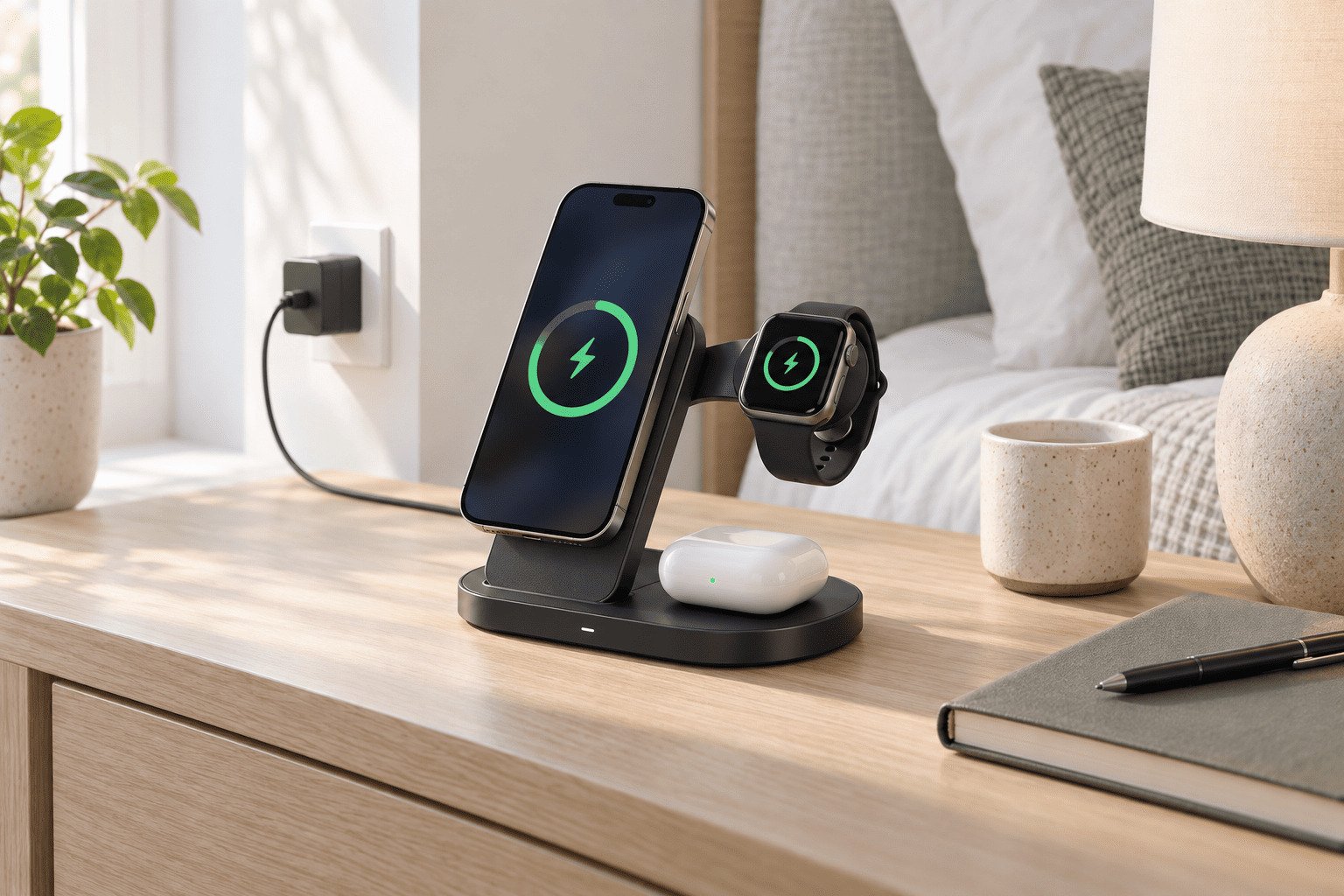
From our experience in wireless charger design, sampling, and mass production, users rarely ask only, “Does it look clean?” They ask more practical questions: Will my phone align correctly? Will my case work? Will my watch stay in place? Will all devices charge safely overnight?
How Does a Qi2 25W 3-in-1 Wireless Charger Reduce Daily Charging Hassle?
A Qi2 25W 3-in-1 Wireless Charger reduces hassle because it changes charging from three separate actions into one simple routine. Without that routine, users often forget their watch, leave AirPods in a bag, or plug the phone into the wrong cable.
The main benefit is workflow simplification. Users place the iPhone, Apple Watch, and AirPods in one dedicated area. This reduces repeated plugging, cable searching, and uncertainty. It also makes bedside and desk charging more predictable.
Why “3-in-1” Means More Than Three Charging Spots
A useful 3-in-1 charger is not only a stand with three coils or modules. It should support the way people actually charge devices:
- One location: The user knows where every device belongs.
- One habit: Charging becomes part of a nightstand or office routine.
- Fewer cables: One power input can replace several loose cables.
- Fewer forgotten devices: Watch and earbuds are more visible.
- Lower friction: The user does not need to plug and unplug every time.
In pre-sales feedback, many users tell us they already own several chargers, but still wake up with one device low on battery. The reason is not always charging speed. Often, the problem is scattered charging behavior.
A 3-in-1 charging station helps most when it is designed around placement clarity. The phone area should guide magnetic attachment. The watch module should hold the watch securely. The AirPods area should be easy to recognize and not blocked by the phone stand.
| User problem | 3-in-1 design response |
|---|---|
| Phone not charging overnight | Magnetic alignment and visible charging position |
| Watch forgotten on desk | Dedicated watch charging position |
| AirPods left in bag | Fixed earbuds charging area |
| Too many cables | One main power input |
| Messy bedside table | Vertical or compact layout |
This is why we see the best user experience when the product is treated as a charging workflow tool, not only as a desktop accessory.
Why Is Magnetic Alignment Important in a Qi2 25W 3-in-1 Wireless Charger?
Magnetic alignment is central because poor placement is one of the most common causes of wireless charging frustration. If the phone sits slightly off-center, charging may become unstable, slower, or fail to continue through the night.
Qi2 uses magnetic alignment under the Wireless Power Consortium standard. It is not the same as Apple’s official MagSafe brand1, but it is designed to improve positioning between compatible devices and chargers. Better alignment means less checking and fewer failed charging sessions.
What Users Should Check Before Buying
Magnetic alignment improves convenience, but it does not remove every variable. Users should still check:
- iPhone model compatibility
- Whether the phone supports the relevant Qi2 power profile
- Case thickness and magnet quality
- Charger certification status
- Adapter wattage and cable quality
We recommend that buyers verify Qi2 certification through official WPC information where possible. For a product described as Qi2 25W, users should also confirm that both the charger and the phone support the higher-power Qi2 profile. Support can vary by iPhone model, software version, and accessory design.2
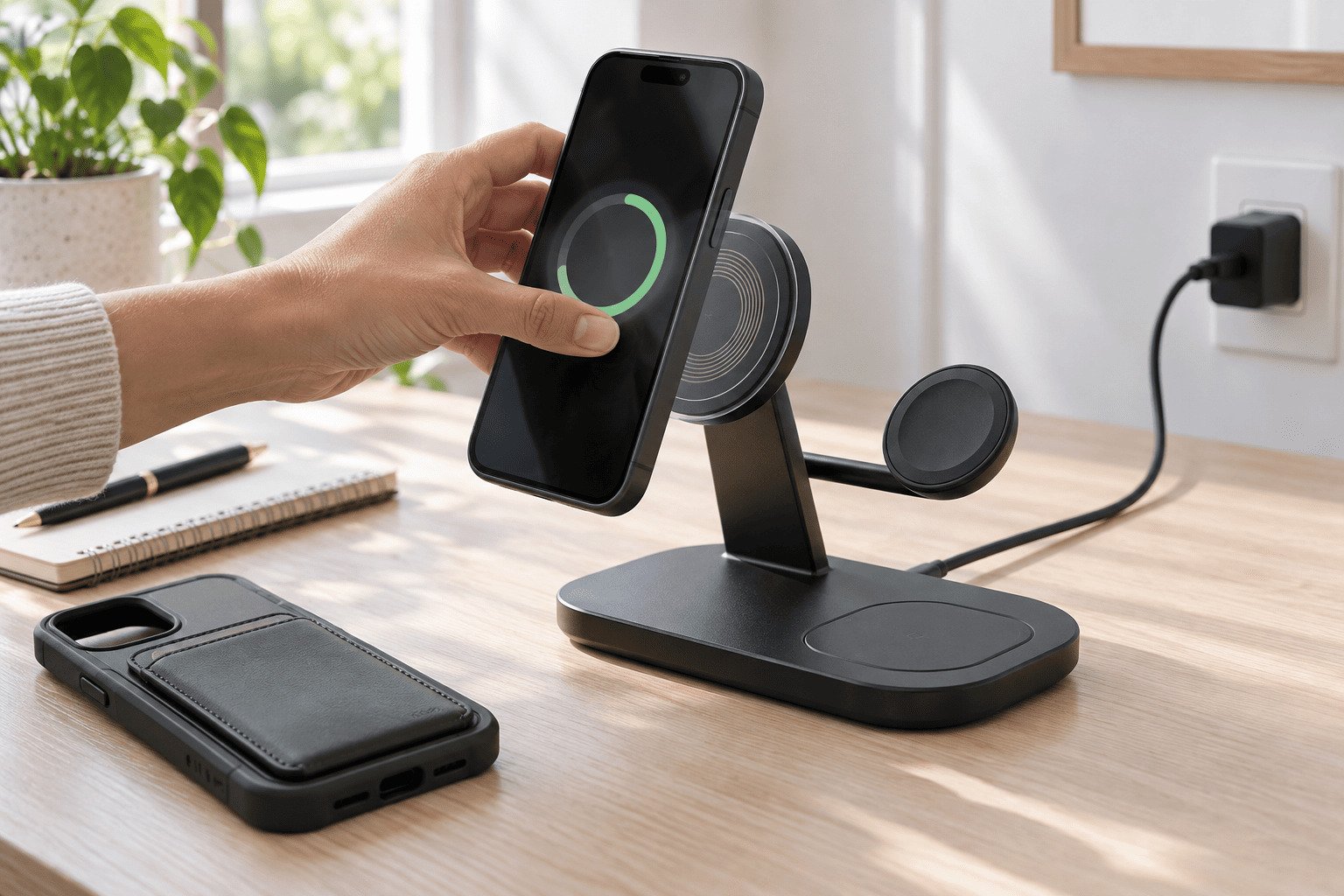
Why Alignment Changes the Real Experience
In product design, alignment affects more than speed. It affects trust. A user wants to place the phone down once and walk away. If they need to adjust the phone several times, the charger feels unreliable, even if the electronics are technically sound.
Good magnetic alignment helps with:
- Stable contact between phone and charging area
- Reduced placement guesswork
- Better bedside use in low light
- Less risk of waking up to an uncharged phone
- More confidence when using StandBy-style viewing positions
However, users should not assume every magnetic charger performs the same. Magnet strength, coil position, stand angle, heat management, and internal power control all affect the final experience. A heavier phone, a thick case, or a weak magnetic ring can reduce stability.
From customer questions, case compatibility is especially important. Some users use protective cases with card holders, metal plates, or thick back covers. These can interfere with wireless charging or magnetic attachment.3 A Qi2 charger may still work well, but the case must also be suitable for magnetic wireless charging.
Does “25W” Mean All Three Devices Charge at Maximum Speed?
No. “25W” should not be read as a promise that the iPhone, Apple Watch, and AirPods all charge at their maximum possible speed at the same time. Real charging depends on device support, charger design, adapter capacity, protocol negotiation, battery condition, and temperature control.
A Qi2 25W 3-in-1 Wireless Charger may support a higher wireless charging profile for compatible phones, but total experience still depends on power distribution. The watch and earbuds have their own charging limits and safety behavior.
How to Understand Power Claims
Charging power is often misunderstood. A simple way to read the specification is:
| Specification | What it may mean | What users should verify |
|---|---|---|
| Qi2 | WPC magnetic wireless charging standard | Certification and device support |
| 25W | Higher supported wireless output profile | Whether the phone supports it |
| 3-in-1 | Phone, watch, earbuds charging areas | Whether each device is compatible |
| Fast charging | Marketing description | Real protocol and adapter requirements |
Wireless charging is controlled by negotiation between the charger and device.4 The device may reduce power when the battery is nearly full, when temperature rises, or when software decides lower power is safer.5
This is why we avoid saying that all devices will always charge at their top rate together. A responsible product page should explain:
- What phone models are supported
- What adapter is recommended
- Whether the Apple Watch module supports the user’s watch model
- Whether the AirPods case supports wireless charging
- Whether certification documents are available for verification
For consumers, the practical question is not only “How many watts?” It is also “Will this charger give me a stable, repeatable routine every day?”
How Should Users Check Compatibility Before Buying?
Compatibility is part of convenience. A charger is not truly simple if the user must return it because their iPhone case is too thick, their AirPods case lacks wireless charging, or their Apple Watch position feels unstable.
Users should check the iPhone model, Apple Watch generation, AirPods case type, phone case design, adapter requirement, and certification information before buying. This prevents most common surprises and makes the charging setup easier from day one.
A Practical Pre-Purchase Checklist
Before choosing a Qi2 charging station, users can review this list:
- iPhone: Does the model support Qi2 or the advertised wireless power level?
- Apple Watch: Does the watch fit the charging position comfortably?
- AirPods: Does the case support wireless charging?
- Phone case: Is it magnetic wireless charging compatible?
- Adapter: Does the charger require a specific USB-C PD adapter?
- Desk or bedside use: Is the angle stable and easy to see?
- Travel use: Is the design foldable or compact if needed?
- Certifications: Are WPC/Qi2 and safety compliance documents available?
For retail buyers and distributors, we suggest going one step further. Sample the product with common device combinations before bulk purchase. We often see that small details affect satisfaction: LED brightness at night, watch holder angle, anti-slip base material, and cable exit direction.
A good charger should feel boring in the best way. The user places devices down, sees clear positioning, and stops thinking about charging.
Frequently Asked Questions
Is Qi2 the same as Apple MagSafe?
No. Qi2 is a wireless charging standard from the Wireless Power Consortium. MagSafe is Apple’s own magnetic charging brand and ecosystem. They are related in user experience because both involve magnetic alignment, but buyers should not treat the names as identical.
Can a Qi2 25W 3-in-1 Wireless Charger charge through a phone case?
It can work with many compatible magnetic wireless charging cases. However, thick cases, metal plates, card holders, and weak magnetic cases may reduce alignment or stop charging. Users should check case compatibility before purchase.
Do AirPods need a special case for wireless charging?
Yes, the AirPods case must support wireless charging6. Some AirPods charging cases support wireless charging, while others may require wired charging. Users should confirm their exact AirPods case model.
Is a 3-in-1 charger safe for overnight charging?
A properly designed charger should include safety controls such as over-current, over-voltage, foreign object detection, and temperature-related protection7. Users should still use a qualified adapter and verify product certifications before relying on overnight charging.
Conclusion
A Qi2 25W 3-in-1 Wireless Charger simplifies charging when it improves the whole routine: one place, better alignment, clearer compatibility, stable placement, and fewer daily charging decisions. Users should look beyond the watt number and check device support, case fit, adapter requirements, and certification information. If you are evaluating 3-in-1 wireless charging products for retail, distribution, or brand projects, we recommend requesting samples, compatibility details, and compliance documents before placing a bulk order.
"Wireless Power Consortium: Home", https://www.wirelesspowerconsortium.com/. Wireless Power Consortium and Apple documentation distinguish Qi2 as an industry wireless-charging standard from MagSafe as Apple’s branded magnetic charging and accessory ecosystem. Evidence role: definition; source type: institution. Supports: Qi2 is administered by the Wireless Power Consortium, while MagSafe is Apple’s branded magnetic charging and accessory system.. Scope note: Contextual support: a single source may define only one side of the distinction, so paired WPC and Apple sources may be needed. ↩
"Qi-certified wireless chargers for iPhone", https://support.apple.com/guide/iphone/qi-certified-wireless-chargers-iph91de3977e/ios. Apple support materials and WPC certification listings indicate that wireless charging capabilities are specified by device model and certified accessory implementation, supporting the need to verify compatibility rather than assuming uniform Qi2 performance. Evidence role: general_support; source type: institution. Supports: Apple and WPC compatibility materials show that wireless charging features are model- and accessory-dependent.. Scope note: Contextual support: software-version effects may require Apple release notes or support pages in addition to certification listings. ↩
"How to use your MagSafe Charger with iPhone", https://support.apple.com/en-us/105047. Apple support guidance states that objects or unsuitable cases placed between an iPhone and a wireless charger can interfere with charging, supporting the caution about thick cases, metal plates, and card holders. Evidence role: mechanism; source type: institution. Supports: Apple warns that cases, magnetic objects, metal objects, or items between the phone and charger can affect wireless charging.. ↩
"Qi (standard)", https://en.wikipedia.org/wiki/Qi_(standard). Wireless Power Consortium technical descriptions of Qi charging explain that the power transmitter and receiver communicate to identify the device and regulate power transfer, supporting the article’s statement that charging is controlled through protocol negotiation. Evidence role: mechanism; source type: institution. Supports: Qi wireless charging includes transmitter–receiver communication and power-control behavior rather than fixed uncontrolled output.. ↩
"About iPhone charge speeds", https://support.apple.com/en-us/120619. Apple support documentation notes that iPhone charging may be limited when temperature rises and that software battery-management features can alter charging behavior, supporting the statement that charging power is not constant throughout a session. Evidence role: mechanism; source type: institution. Supports: Apple documentation states that charging may be limited by temperature and software battery-management features, and lithium-ion charging generally tapers near full charge.. Scope note: Contextual support: Apple documentation may not describe every charger’s exact power curve, so it supports the general mechanism rather than a precise wattage outcome. ↩
"Charge AirPods, AirPods Pro, or AirPods Max", https://support.apple.com/guide/airpods/charge-airpods-devde25a4bbe/web. Apple product and support documentation distinguishes AirPods charging cases that support wireless charging from cases that require wired charging, supporting the need to verify the exact case model. Evidence role: definition; source type: institution. Supports: Apple identifies AirPods cases by model and specifies whether they support wireless charging.. ↩
"History of the Qi Specifications", https://www.wirelesspowerconsortium.com/knowledge-base/qi-specification/history-of-the-qi-specifications/. Wireless Power Consortium certification materials describe safety-related requirements for Qi chargers, including foreign-object detection and controlled power transfer, providing standards-based support for the inclusion of electrical and thermal protection features. Evidence role: expert_consensus; source type: institution. Supports: Qi-related standards and certification materials address safety mechanisms such as foreign object detection, power control, and thermal protection in wireless chargers.. Scope note: Contextual support: over-current and over-voltage protection may also need an electrical safety standard or compliance document if the WPC source does not list those terms explicitly. ↩