
A 3 in 1 25W foldable wireless charger solves a common charging problem: too many devices, too many cables, and too little space. When a phone, smartwatch, and earbuds all need power at once, separate chargers quickly create clutter. A well-designed foldable charger turns that mess into one clean, portable charging system.
A 3 in 1 25W foldable wireless charger can charge a phone, smartwatch, and earbuds in one compact unit while reducing cable clutter, saving desk space, and improving travel convenience. Its real value depends on charging protocol support, adapter power, magnetic alignment, heat control, hinge stability, and real compatibility across devices.
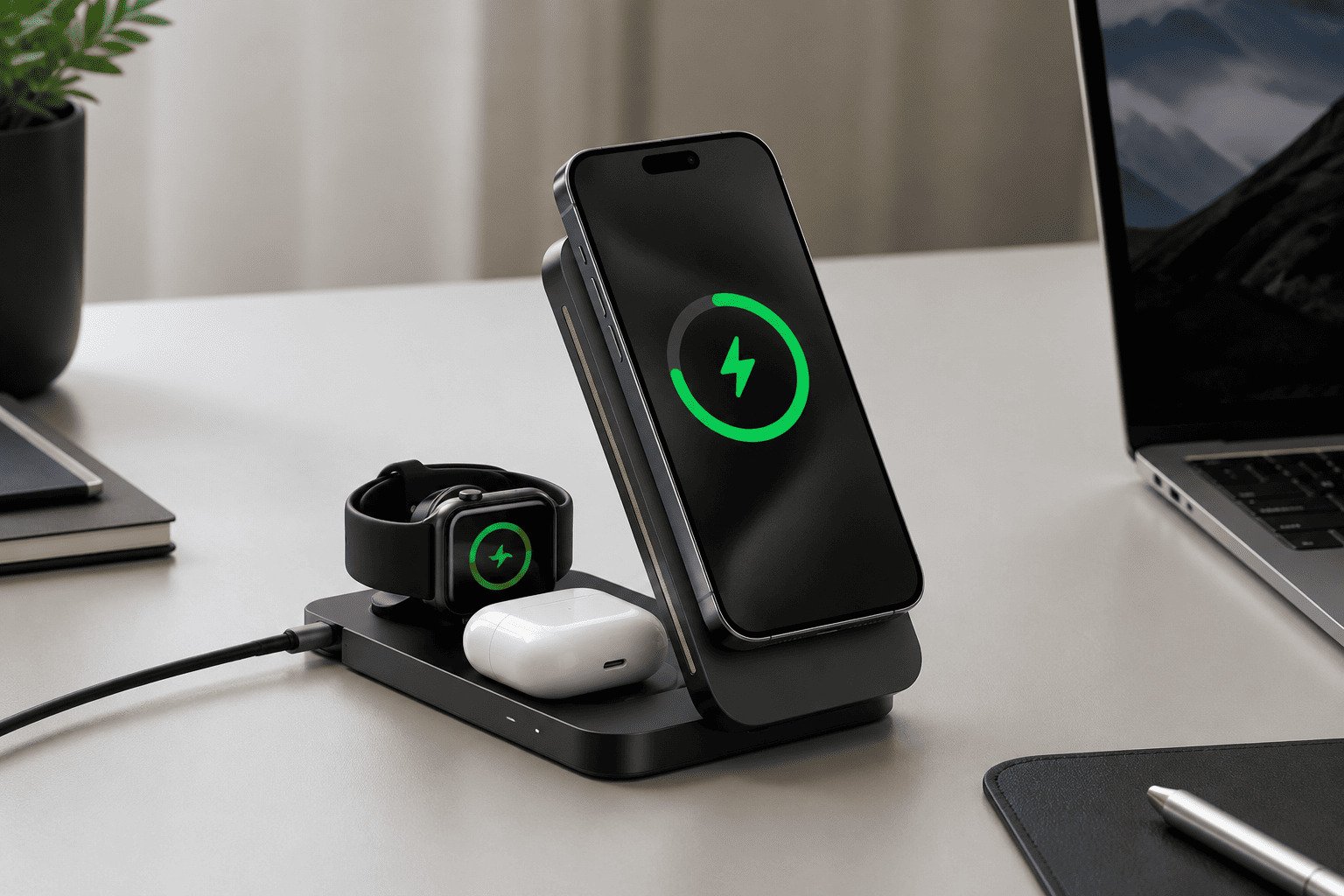
The “25W” label is important, but it is not the whole story. We need to look at how power is distributed1, how devices align, and how the charger performs when all three charging areas work together.
Why Is a 3 in 1 25W Foldable Wireless Charger Better Than Separate Chargers?
Separate chargers look simple at first, but they create hidden problems. They need more sockets, more cables, and more space. For buyers, distributors, and brands, they also create more SKUs, more packaging, and more after-sales variables.
A 3 in 1 25W foldable wireless charger is better because it integrates phone, watch, and earbuds charging into one device. It reduces cable management problems, supports multi-device use, folds for storage, and provides a cleaner charging experience at home, in the office, or during travel.
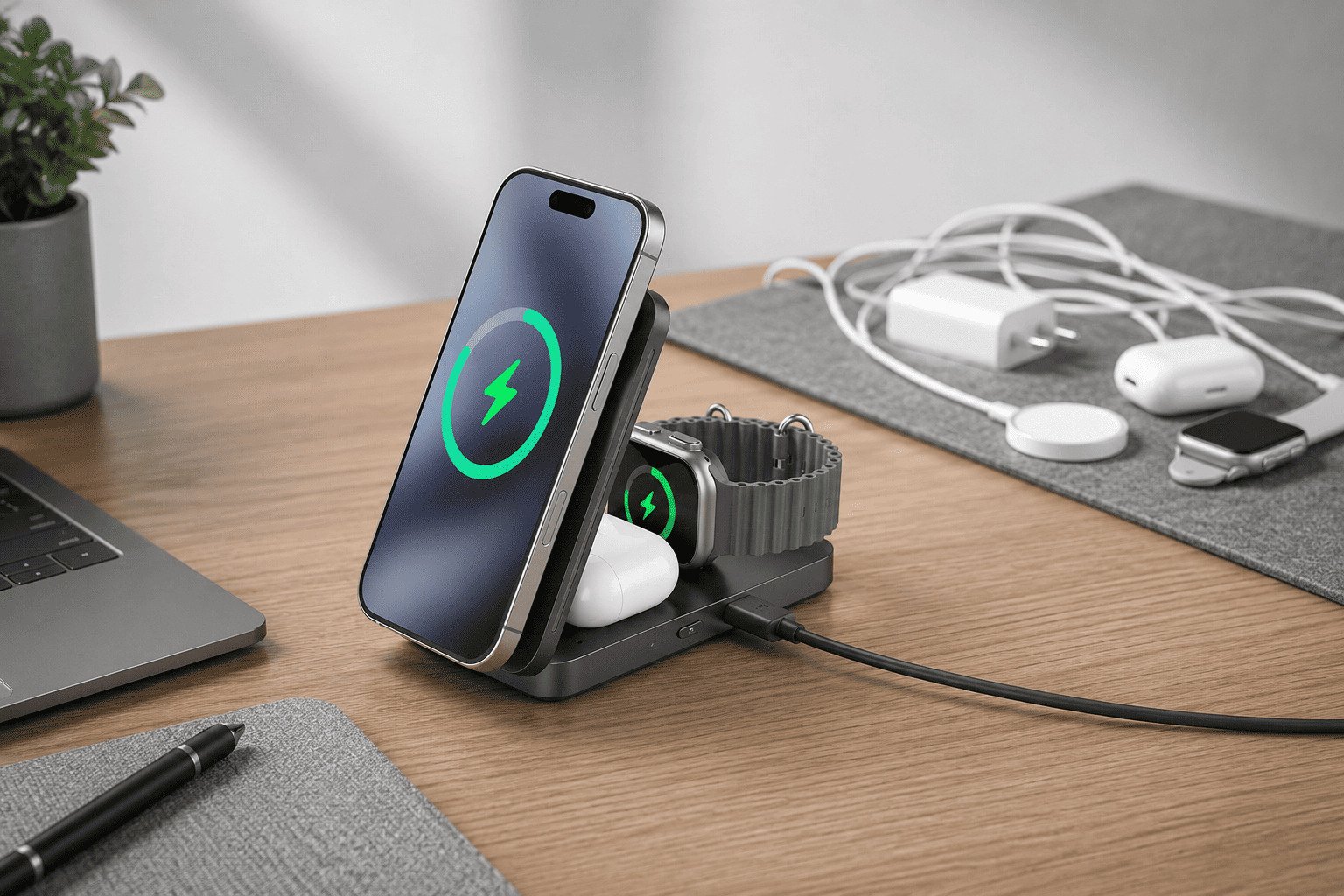
The main advantage is not only “charging three devices.” Many products can do that. The real advantage is system integration.
A strong foldable wireless charging station combines:
- Phone wireless charging area
- Smartwatch charging module
- Earbuds charging pad
- USB-C input
- Magnetic alignment
- Foldable hinge structure
- Thermal protection system
- Compact travel form factor
This matters because daily charging is not a lab test. Users place devices quickly. They use phone cases. They charge overnight. They fold and unfold the product many times. They also expect the phone to stay stable when used as a bedside clock or video stand.
For procurement teams, this creates a different evaluation standard. The best model is not always the one with the highest advertised wattage. The best model is the one that performs consistently with real devices.
| Feature | Separate Chargers | 3 in 1 Foldable Charger |
|---|---|---|
| Cable quantity | 3 or more | Usually 1 |
| Desk space | High | Low |
| Travel convenience | Poor | Strong |
| Device alignment | Mixed | Better with magnets |
| Product experience | Fragmented | Integrated |
| Retail appeal | Average | Higher |
We often see buyers focus only on output numbers. That is understandable, but it can be risky. A charger marked “25W” may mean 25W phone output, or it may mean 25W total system output2(https://www.wirelesspowerconsortium.com/) shared across all charging areas. These are very different.
For example:
- A phone may receive up to 15W or 25W only under supported protocols.
- A watch module may need a specific design for Apple Watch or Samsung Watch.
- Earbuds usually require lower power, often around 3W to 5W3.
- Simultaneous charging may reduce phone charging speed4.
- A weak adapter or poor cable can limit total performance.
So, the advantage comes from balanced engineering, not just a bold number on the box.
What Should Buyers Check Before Choosing a 3 in 1 25W Foldable Wireless Charger?
A product can look premium in photos but fail in real use. The phone may slide. The watch may not charge. The hinge may loosen. The charger may overheat when all zones are active. These issues create returns and damage brand trust.
Buyers should check whether the 3 in 1 25W foldable wireless charger supports the right protocols, adapters, cables, magnetic alignment, case thickness, watch modules, and heat control. They should also test simultaneous charging, aging performance, hinge stability, and compatibility with target-market devices.
A reliable product should pass more than a basic power-on test. We recommend checking the charger as a complete charging system.
1. Confirm What “25W” Really Means
The first question is simple: Does 25W refer to the phone area or total output?
Some chargers advertise total power. Others advertise maximum phone-side wireless output. Buyers should ask for a clear power distribution table.
Example:
| Charging Scenario | Expected Behavior |
|---|---|
| Phone only | Highest supported phone output |
| Phone + watch | Shared system power |
| Phone + earbuds | Shared system power |
| Phone + watch + earbuds | Stable lower distributed output |
This table helps prevent misunderstanding between suppliers, brands, and end users.
2. Test Device Compatibility
Compatibility is one of the biggest real-world factors. Wireless charging depends on coil position, protocol, and device design.
We suggest testing:
- iPhone models with MagSafe-style alignment
- Android phones with Qi wireless charging
- Samsung Galaxy devices
- Apple Watch or Samsung Watch versions
- AirPods and other wireless charging earbuds
- Magnetic cases and standard protective cases
- Thick cases above common safe thickness ranges
- USB-C PD and QC adapters
- Different cable lengths and cable qualities
A thick case, metal ring, pop socket, or non-magnetic case can reduce charging performance5. Some phones may not reach 25W because they do not support the required wireless charging protocol.
3. Check Magnetic Holding and Coil Alignment
Magnetic alignment is not only about convenience. It also affects efficiency and heat. Poor alignment can reduce charging speed and increase temperature6.
A good charger should hold the phone securely in both vertical and horizontal positions. The phone should not slide when the desk moves slightly. The charging area should remain stable when users tap the screen.
4. Evaluate Heat Control
Wireless charging always creates some heat7. The question is whether the product controls that heat safely.
Important tests include:
- Full-load simultaneous charging test
- Temperature rise test over several hours
- Overnight charging simulation
- Foreign object detection test
- Adapter and cable heat check
- Charging recovery after thermal protection
Safe heat control protects batteries and reduces after-sales complaints.
5. Inspect Foldable Structure
The foldable design is a major advantage only when the hinge is stable. A weak hinge can make the product feel cheap and unreliable.
We recommend checking:
- Folding life-cycle test
- Hinge resistance after repeated use
- Angle stability
- Phone weight support
- Surface material durability
- Travel bag pressure resistance
For wholesale and brand projects, these physical details matter as much as electrical performance.
Frequently Asked Questions
Can every phone charge at 25W on a 3 in 1 25W foldable wireless charger?
No. The phone must support the required wireless charging protocol, and the charger must receive enough input power from a compatible adapter and cable. Some phones will charge at 5W, 7.5W, 10W, 15W, or lower depending on device limits.
Does simultaneous charging reduce speed?
Yes, it can. When a phone, watch, and earbuds charge at the same time, the charger may distribute power across all zones. This can reduce the phone’s charging speed compared with phone-only charging.
Are all smartwatches compatible?
No. Watches often need specific charging modules. Apple Watch, Samsung Watch, and other smartwatch models may require different coil structures or authentication solutions. Buyers should confirm compatibility before bulk orders.
Will a thick phone case affect wireless charging?
Yes. Thick, metal, or non-magnetic cases can weaken alignment and reduce charging efficiency. For best results, users should use a compatible magnetic case or a thin wireless-charging-friendly case.
Conclusion
A 3 in 1 25W foldable wireless charger offers real value when it combines multi-device charging, compact storage, magnetic alignment, reliable heat control, and stable foldable construction. Buyers should look beyond the wattage label and verify protocols, adapter requirements, compatibility, power distribution, and aging performance. At Fabucharger, we support OEM and ODM projects with certified production, strong R&D, and bulk supply capability. Contact us to develop a reliable foldable wireless charging solution for your market.
"Qi (standard) - Wikipedia", https://en.wikipedia.org/wiki/Qi_(standard). The Wireless Power Consortium's Qi documentation describes wireless charging as a negotiated power-transfer system with defined power profiles, supporting the need to distinguish advertised system wattage from actual power delivered to a device. Evidence role: mechanism; source type: institution. Supports: Wireless charging systems operate through defined power profiles and negotiated power transfer rather than a single universal output value.. Scope note: The documentation explains the mechanism generally and would not verify the rating of any particular charger. ↩
"Power supply - Wikipedia", https://en.wikipedia.org/wiki/Power_supply. Educational materials on multi-output power supplies explain that a device's total rated output may be distributed across connected loads, supporting the distinction between total system wattage and per-device charging wattage. Evidence role: mechanism; source type: education. Supports: In multi-output charging systems, the total rated output can be shared across multiple charging loads rather than being available to each load simultaneously.. Scope note: This would explain the electrical principle but would not document the labeling practice of every commercial wireless charger. ↩
"Qi (standard) - Wikipedia", https://en.wikipedia.org/wiki/Qi_(standard). Technical specifications for wireless earbud charging cases commonly list low input-power requirements, supporting the statement that earbuds generally require less wireless charging power than smartphones. Evidence role: statistic; source type: institution. Supports: Earbud charging cases commonly use lower wireless charging power levels than phones, often within a low-watt range such as 5 W.. Scope note: The exact wattage varies by earbud model and charging case design. ↩
"Charging Stations for Multiple Devices - Anker US", https://www.anker.com/collections/charging-station-for-multiple-devices. Technical literature on multi-load power delivery explains that simultaneous loads share the available input power budget, supporting the claim that phone charging speed can decrease when additional charging zones are active. Evidence role: mechanism; source type: research. Supports: When multiple devices draw from a shared input power budget, the available power for an individual device can decrease.. Scope note: The degree of speed reduction depends on the charger's design, adapter capacity, and connected devices. ↩
"What kind of cases interfere with wireless-charging & S pen? - Reddit", https://www.reddit.com/r/S25Ultra/comments/1oia6d1/what_kind_of_cases_interfere_with/. Device-support guidance and Qi-related technical materials state that metal objects, incompatible accessories, and increased separation between transmitter and receiver can interfere with wireless charging. Evidence role: mechanism; source type: institution. Supports: Objects that increase distance, disrupt alignment, or introduce metal between the charger and device can impair wireless charging.. Scope note: The impact varies by phone, case material, coil design, and charger power-management behavior. ↩
"Design and implementation of a high misalignment-tolerance ... - PMC", https://pmc.ncbi.nlm.nih.gov/articles/PMC11161604/. Experimental and modeling studies of inductive wireless power transfer report that transmitter-receiver coil misalignment reduces coupling efficiency and can increase thermal losses, supporting the link between alignment, speed, and heat. Evidence role: mechanism; source type: paper. Supports: Misalignment in inductive charging lowers coupling efficiency, which can reduce delivered power and contribute to heat generation.. Scope note: Temperature rise in a finished product also depends on enclosure design, control firmware, and ambient conditions. ↩
"Inductive charging - Wikipedia", https://en.wikipedia.org/wiki/Inductive_charging. Research on inductive wireless power transfer identifies resistive, magnetic, and conversion losses that manifest as heat, supporting the statement that wireless charging produces some thermal rise during operation. Evidence role: mechanism; source type: paper. Supports: Inductive wireless charging involves energy losses that can appear as heat in the charger and receiving device.. Scope note: The amount of heat depends on alignment, charging power, materials, thermal design, and environmental conditions. ↩