
PSE and KC on wireless chargers can look simple on a product label, but they often create serious procurement risk when buyers treat them as logo requirements only. A missing test scope, wrong adapter, or inconsistent model number can delay customs clearance, sales launch, and after-sales support. The solution is to manage compliance from product design to mass production.
PSE and KC on wireless chargers refer to Japan and South Korea compliance requirements, but they are not the same as Qi or Qi2 certification. Their application depends on the charger’s power supply method, adapter, battery, Bluetooth or radio function, labeling, importer responsibility, and final sales market. OEM buyers should verify tested models, reports, labels, BOM, packaging, and production consistency before shipment.
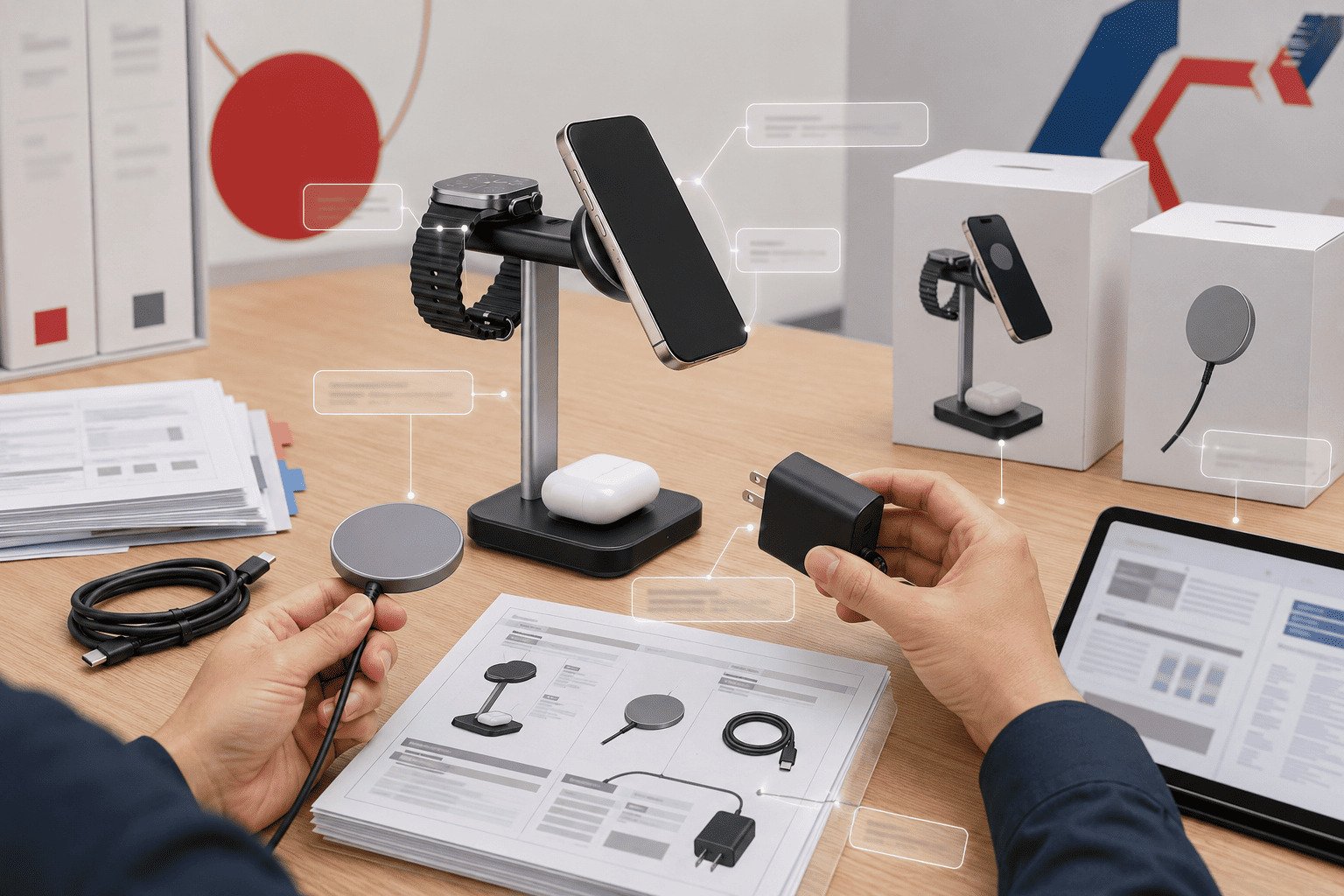
Many procurement problems happen because the compliance discussion starts too late. We have seen projects where the charger was ready, the package was printed, and only then the buyer asked, “Can we add PSE or KC?” That is the wrong order. Below, we explain how OEM buyers should think about classification, testing, documentation, and production control.
What Do PSE and KC on Wireless Chargers Actually Cover?
PSE and KC on wireless chargers are easy to misunderstand because both marks are connected with safety and market access. The problem is that buyers may assume one certificate covers the whole product family. That assumption can become expensive when the charger, adapter, battery, or wireless module is outside the approved scope.
PSE is mainly connected with Japan’s electrical appliance safety requirements.1 KC is South Korea’s certification system covering electrical safety, EMC, and radio requirements depending on the product2. For wireless charger OEM projects, coverage depends on the complete product configuration, not only the charging pad or stand itself.
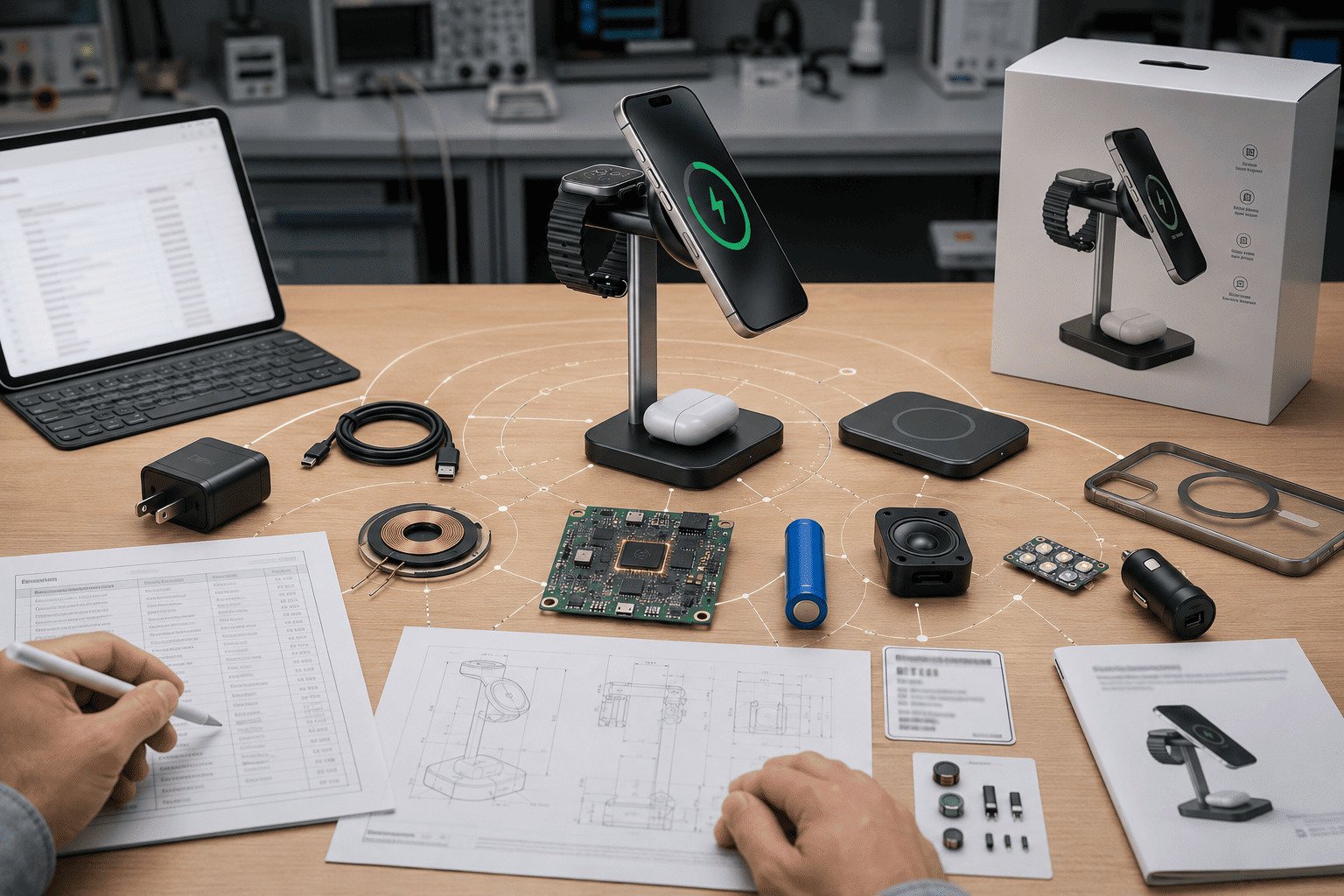
PSE, KC, and Qi are different systems
A key point is simple: Qi or Qi2 certification does not replace PSE or KC compliance3. Qi and Qi2 focus on wireless charging interoperability, communication, alignment, power transfer, and performance4 under the Wireless Power Consortium ecosystem. They help prove that a charger works properly with compatible devices.
However, national compliance asks different questions:
| Requirement | Main Focus | Typical Relevance |
|---|---|---|
| Qi / Qi2 | Wireless charging performance and interoperability | Charging function, WPC ecosystem |
| PSE | Japan electrical appliance safety | AC adapters, electrical products sold in Japan |
| KC Safety | South Korea electrical safety | Products or adapters subject to safety rules |
| KC EMC | Electromagnetic compatibility | Electronic devices sold in Korea |
| KC Radio | Wireless communication compliance | Bluetooth, Wi-Fi, radio modules5 |
Product configuration decides the scope
A wireless charger can be simple or complex. The compliance path changes when the product includes:
- An AC power adapter
- A built-in rechargeable battery6
- Bluetooth speaker function
- LED lamp function
- Magnetic charging module
- Qi2 magnetic power profile
- USB-C input only
- Multiple output modules
- Car charger input
- Different housing, coil, PCB, or power IC versions
For example, a 3-in-1 wireless charging station with a supplied AC adapter, Apple Watch charging module, Bluetooth speaker, and LED light is not the same compliance case as a simple USB-powered wireless charging pad. Even if both are called “wireless chargers,” their risk profile is different.
We usually advise buyers to define the compliance boundary before tooling. The question is not only “Do you have PSE and KC?” The better questions are:
- Which exact model was tested?
- Which adapter was included in the test scope?
- Does the certificate cover this rating and input method?
- Does the report match the BOM and PCB version?
- Are Bluetooth or radio functions included?
- Are the label, manual, and packaging consistent?
- Who is the importer or local responsible party?7
This approach reduces the risk of a painful discovery after mass production.
Why Should Wireless Charger OEM Buyers Define PSE and KC Scope Before Tooling?
PSE and KC on wireless chargers should be discussed before mold opening, PCB finalization, packaging design, and adapter selection. If the compliance scope is unclear, the buyer may approve a sample that cannot legally match the final shipment. Then the project faces retesting, relabeling, repacking, or shipment delay.
OEM buyers should define compliance scope early because certification is based on specific product information8. The tested sample, model number, rating label, critical components, adapter, battery, wireless module, manual, and packaging must align with the final mass-produced product.
The real risk is mismatch, not only missing documents
In OEM procurement, the biggest compliance issue is often not a completely absent certificate. It is a document mismatch.
Common examples include:
- The certificate shows model “WC-101,” but the package shows “WC-101 Pro.”
- The tested sample used adapter A, but mass production ships with adapter B.
- The report covers a 15W charger, but the buyer sells a 25W product.
- The label uses different input ratings from the test report.
- The BOM changes the power IC or coil after approval.
- The product adds Bluetooth speaker function after the original test.
- The factory uses a different battery cell due to supply shortage.
- The manual claims functions not included in the approved sample.
These gaps can create problems during customs inspection, marketplace review, distributor audit, or retailer compliance checks9.
What buyers should confirm before tooling
Before production, we recommend a simple compliance checklist:
| Item | Why It Matters |
|---|---|
| Product type | Defines applicable safety, EMC, and radio requirements |
| Power input | USB-only, adapter-included, car input, or built-in battery |
| Output power | Affects thermal, safety, and performance testing |
| Adapter model | Must match approved scope if supplied |
| Battery cell | May trigger additional safety and transport requirements |
| Bluetooth/radio module | May require radio compliance |
| Model number system | Must match certificate, label, packaging, and invoice |
| Critical components | Changes may require reassessment |
| Target country | Japan and Korea have different rules |
| Importer role | Local responsibility must be clear |
This is why a credible manufacturer should not simply say, “Yes, we can print the logo.” A responsible OEM partner should help define what is actually covered.
At Fabucharger, we treat compliance as part of product engineering. We check power architecture, adapter options, charging module design, label space, and document consistency before pilot production. This helps wholesalers, importers, and brand owners control risk before money is spent on inventory.
How Can We Control PSE and KC on Wireless Chargers During Mass Production?
PSE and KC on wireless chargers do not end after a test report is issued. A buyer can still face risk if the factory changes the PCB, adapter, battery, cable, coil, firmware, or label during production. The challenge is to keep the approved product and the shipped product consistent.
The best way to control PSE and KC compliance is to build a documented process. OEM buyers should manage product classification, test evidence, model coverage, label approval, BOM control, supplier change control, production inspection, and shipment document review before every order.
Compliance control should follow the product lifecycle
A practical process has five stages:
-
Classification
- Define whether the product is a pad, stand, power bank, car charger, lamp charger, speaker charger, or 3-in-1 station.
- Confirm power input, adapter, battery, and wireless functions.
-
Testing and evidence
- Work with qualified laboratories.
- Confirm whether reports and certificates cover the exact model.
- Check related safety, EMC, radio, and performance requirements.
-
Labeling and documentation
- Align model numbers, electrical ratings, warnings, importer information, and instruction manuals.
- Avoid printing marks before approval is confirmed.
-
Mass production control
- Lock the BOM.
- Control critical components.
- Use approved adapter and battery suppliers.
- Keep production samples for traceability.
-
Change management
- Reassess compliance when components, firmware, output power, supplier, or structure changes.10
- Do not assume a small change is always acceptable.
What a strong China wireless charger manufacturer should provide
For OEM buyers, the China wireless charger supplier’s role is important. A capable manufacturer should support more than assembly. The manufacturer should help buyers reduce procurement risk through engineering and documentation control.
A strong China wireless charger supplier should provide:
- Clear model list and version control
- BOM and critical component records
- Test report and certificate coordination
- Rating label artwork review
- Packaging and manual consistency check
- Adapter and cable matching confirmation
- Pre-production sample approval
- Incoming material inspection
- Production line quality control
- Final inspection and shipment document support
This matters because wireless chargers often have many variants. One product family may include 10W, 15W, Qi2, magnetic, stand, folding, lamp, or speaker versions. These variants may look similar, but compliance coverage may differ.
At Fabucharger, our production background helps here. We operate wireless charger manufacturing with ISO 9001 and BSCI systems, WPC membership, OEM/ODM experience, and product certifications such as UL, CE, RoHS, FCC, PSE, KC, Qi, and others depending on the model and market. We also support buyers with China and Vietnam production options, customization, and bulk supply planning.
The key message is practical: PSE and KC compliance is not a one-time logo-checking exercise. It is a process of classification, testing, evidence verification, labeling, responsibility allocation, and ongoing consistency.
Frequently Asked Questions
Does Qi2 certification replace PSE or KC for wireless chargers?
No. Qi2 certification verifies wireless charging interoperability and performance under WPC standards. It does not replace Japan PSE or South Korea KC requirements. Electrical safety, EMC, radio, labeling, and importer obligations may still apply depending on the product configuration.11
Can one PSE or KC certificate cover all wireless charger models?
Not always. Coverage depends on model numbers, ratings, power input, adapter, battery, wireless modules, PCB design, and critical components. Similar-looking wireless chargers may require separate review if their technical structure or sales configuration is different.
What is the biggest compliance mistake in wireless charger OEM projects?
The biggest mistake is document mismatch. The tested sample, certificate, report, rating label, BOM, adapter, packaging, and mass-produced product must match. If they do not, buyers may face customs delays, retailer rejection, or extra retesting costs.
Should the AC adapter be included in the compliance review?
Yes, if the adapter is supplied with the product or sold as part of the retail package. The adapter can affect electrical safety scope12, labeling, documentation, and importer responsibility. Buyers should confirm whether the approved documents cover the exact adapter model.
When should OEM buyers discuss PSE and KC compliance?
Buyers should discuss PSE and KC compliance before tooling, packaging design, and mass production. Early review helps define the correct product scope, avoid incorrect labels, select suitable components, and reduce launch delays in Japan or South Korea.
Conclusion
PSE and KC on wireless chargers are important market-access requirements, but they are not simple quality logos. OEM buyers need to check product configuration, adapter coverage, battery use, radio functions, model numbers, labels, reports, and production consistency. Qi or Qi2 certification is valuable, but it does not replace national safety, EMC, or radio compliance. If you need a wireless charger OEM partner with engineering, certification, customization, and mass production support, contact Fabucharger to review your project before production starts.
"Act on Product Safety of Electrical Appliances and Materials", https://en.wikipedia.org/wiki/Act_on_Product_Safety_of_Electrical_Appliances_and_Materials. Japan's Ministry of Economy, Trade and Industry describes the PSE framework under the Electrical Appliance and Material Safety Act as a safety compliance system for regulated electrical appliances and materials. Evidence role: definition; source type: government. Supports: The source should explain that Japan's PSE mark is part of the Electrical Appliance and Material Safety Act framework for regulated electrical products.. ↩
"KC Certification for South Korea", https://www.korea-certification.com/en/kc/what-is-kc-certification/. Korean government conformity-assessment materials distinguish product safety certification from EMC and radio equipment conformity requirements, supporting the point that KC-related obligations vary by product function. Evidence role: definition; source type: government. Supports: The source should show that Korean conformity requirements include product safety and, where applicable, EMC or radio equipment conformity assessment.. Scope note: The source may document the regulatory categories separately rather than proving their application to every wireless charger configuration. ↩
"Qi (standard) - Wikipedia", https://en.wikipedia.org/wiki/Qi_(standard). Wireless Power Consortium materials describe Qi and Qi2 certification as conformance to wireless-power interoperability standards; this contextual support does not itself determine whether a given product is subject to PSE or KC regulation. Evidence role: general_support; source type: institution. Supports: The source should support that Qi/Qi2 certification concerns conformance to Wireless Power Consortium wireless charging standards, not national legal approvals.. Scope note: The support is contextual because it establishes the scope of Qi/Qi2 certification rather than directly comparing it with every national compliance system. ↩
"Qi (standard) - Wikipedia", https://en.wikipedia.org/wiki/Qi_(standard). Wireless Power Consortium descriptions of Qi and Qi2 identify the standards as wireless-power specifications intended to ensure interoperable charging behavior, including communication and power-transfer requirements. Evidence role: definition; source type: institution. Supports: The source should describe the technical aims of Qi/Qi2 certification, including interoperability and wireless power-transfer behavior.. ↩
"Designation Requirements for the Republic of Korea | NIST", https://www.nist.gov/standardsgov/designation-requirements-republic-korea. Korea's radio-equipment conformity-assessment rules apply to devices using radio functions, which supports reviewing Bluetooth or Wi-Fi functions separately from the charging function. Evidence role: general_support; source type: government. Supports: The source should support that equipment with radio transmitting functions, such as Bluetooth or Wi-Fi, is subject to radio-equipment conformity assessment in South Korea.. Scope note: The source would establish the regulatory principle; classification of a specific bundled charger would still depend on its exact radio module and sales configuration. ↩
"[PDF] Lithium Battery Guide for Shippers", https://www.phmsa.dot.gov/sites/phmsa.dot.gov/files/2024-11/Lithium-Battery-Guide-2024.pdf. International lithium-battery transport and safety guidance treats rechargeable lithium cells and batteries as regulated components requiring specified tests or handling conditions, supporting the need to reassess products with built-in batteries. Evidence role: general_support; source type: institution. Supports: The source should support that lithium rechargeable batteries are subject to specific safety or transport testing and documentation requirements.. Scope note: This supports the general battery-related compliance issue and does not determine the complete PSE or KC classification of a particular wireless charger. ↩
"Act on Product Safety of Electrical Appliances and Materials", https://en.wikipedia.org/wiki/Act_on_Product_Safety_of_Electrical_Appliances_and_Materials. METI materials on Japan's Electrical Appliance and Material Safety Act describe obligations for manufacturers and importers of regulated electrical products, supporting the need to identify the responsible party before sale. Evidence role: general_support; source type: government. Supports: The source should support that importers or local responsible parties have legal obligations under national electrical product safety regimes.. Scope note: This directly supports importer responsibility in the Japanese PSE context; Korean responsible-party obligations should be checked under the applicable Korean product category. ↩
"ISO/IEC 17065:2012(en), Conformity assessment — Requirements ...", https://www.iso.org/obp/ui/#iso:std:iso-iec:17065:ed-1:v1:en. International product-certification frameworks such as ISO/IEC 17065 and IECEE scheme documentation base certification decisions on defined product specifications and assessment scope, supporting the need to match certificates to the exact tested configuration. Evidence role: general_support; source type: institution. Supports: The source should support that product certification is tied to defined product specifications, models, ratings, components, or assessment scope.. Scope note: This is general conformity-assessment support and does not by itself state the detailed PSE or KC documentation rules for wireless chargers. ↩
"EU - Labeling/Marking Requirements", https://www.trade.gov/country-commercial-guides/eu-labelingmarking-requirements. Government market-access and product-safety guidance commonly requires regulated electrical products to carry appropriate markings and conformity documentation, supporting the risk that mismatched labels or certificates may be challenged during import or market review. Evidence role: general_support; source type: government. Supports: The source should support that authorities or market-surveillance systems can review product markings, documentation, and conformity evidence during import or sale.. Scope note: This supports the general enforcement risk rather than proving a specific customs delay for wireless chargers. ↩
"OSHA's Nationally Recognized Testing Laboratory (NRTL) Program", http://www.osha.gov/nationally-recognized-testing-laboratory-program/frequently-asked-questions. Product-certification guidance commonly requires review of significant changes to certified designs or critical components, supporting reassessment when power architecture, firmware, suppliers, or structure change. Evidence role: mechanism; source type: institution. Supports: The source should explain that changes to certified products or critical components can affect certification validity and may require further evaluation.. Scope note: The cited source would support the general certification mechanism; the threshold for reassessment depends on the specific PSE, KC, or laboratory scheme. ↩
"PSE Mark (Mandatory Safety & EMC Approval) - JQA", https://www.jqa.jp/english/safety/service/mandatory/pse/. National product-safety and radio-regulatory guidance treats safety certification, EMC or radio conformity, labeling, and importer obligations as legal compliance matters distinct from private interoperability certification. Evidence role: general_support; source type: government. Supports: The source should support that national product compliance can include safety, EMC, radio, labeling, and importer duties depending on product features.. Scope note: The support is contextual because no single source may cover every listed obligation for every wireless charger configuration in both Japan and South Korea. ↩
"Act on Product Safety of Electrical Appliances and Materials", https://en.wikipedia.org/wiki/Act_on_Product_Safety_of_Electrical_Appliances_and_Materials. METI guidance on Japan's Electrical Appliance and Material Safety Act identifies AC adapters and similar power-supply products within regulated electrical-appliance categories, supporting the need to include supplied adapters in compliance review. Evidence role: general_support; source type: government. Supports: The source should support that AC adapters are within the scope of Japan's electrical appliance safety regulation when sold or supplied for use.. Scope note: The source supports the adapter-scope issue for Japan; Korean classification would require a separate Korean regulatory source. ↩