
Many buyers choose a charger supplier too fast. They see low prices first. Later, they face heat, returns, delays, and certification problems.
A leading OEM and ODM wireless charger manufacturer in China helps buyers turn product ideas into safe, compliant, stable, and mass-producible products. The value is not only factory size or price. The value is risk control across design, engineering, testing, certification, production, and delivery.
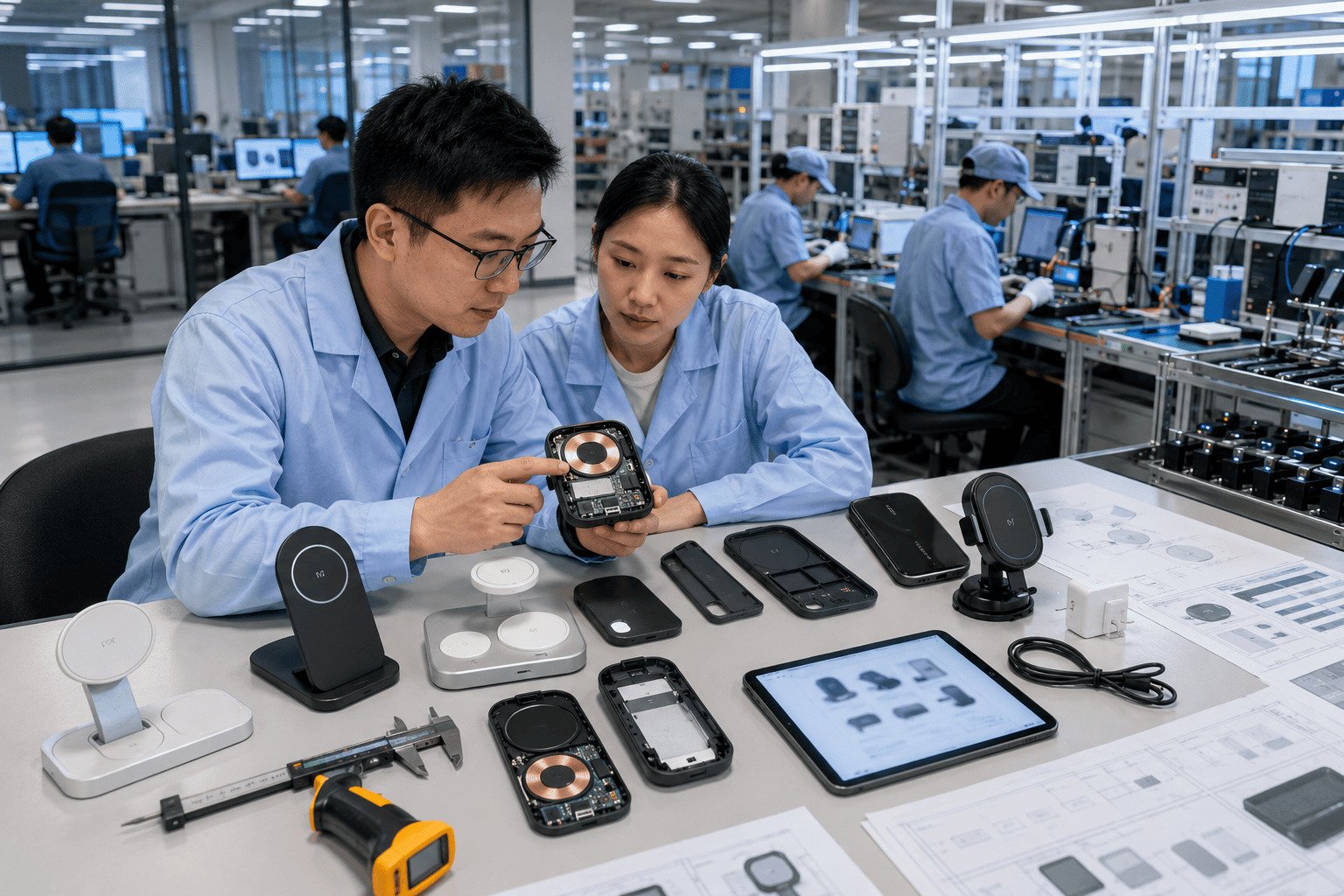
We have seen many wireless charger projects look simple at the first meeting. A buyer may only ask for 15W charging, a logo, and a good package. The real work starts after that. We need to check the phone model, coil position, magnetic structure, adapter, cable, case thickness, heat rise, firmware, protocol, and test standard. If one part is weak, the whole product may fail in the market. This is why we believe a good manufacturer must reduce project risk before mass production starts.
Why Is Factory Size Not Enough to Define a Leading Wireless Charger Manufacturer?
Many buyers feel safe when they see a large factory. This feeling is understandable. Large capacity matters. Yet size alone cannot solve poor design, weak testing, or unstable parts.
A leading wireless charger manufacturer is defined by the ability to deliver stable products at scale. The factory must prove engineering skill, process control, compliance support, and repeatable production results, not only show production lines and catalogs.
We have worked with buyers who first asked only about price and daily output. We answered these questions, but we also asked about target market, sales channel, certification need, phone models, retail price range, and after-sales rules. These questions may look slow at the start. They save time later.
A wireless charger is not only a plastic shell with a coil. It is a power product. It has a PCBA, coil, magnet, heat path, firmware, protocol, and housing.1 Each part must match the others. If the supplier only copies a common design, the product may pass a quick demo but fail under long use.
| What buyers often check | What buyers should also check | Why it matters |
|---|---|---|
| Factory area | Engineering review process | It reduces design mistakes |
| Unit price | BOM stability | It controls long-term quality |
| Catalog size | Real project cases | It proves problem-solving ability |
| Daily capacity | Production traceability | It helps find root causes |
| Sample speed | Pilot production data | It shows mass-production risk |
We think capacity is still important. Our China factory has 8 production lines, more than 300 employees, and a daily production capacity of 30,000 units. These figures matter only when they are supported by incoming inspection, process inspection, aging tests, function tests, and clear records. A buyer should ask for both capacity data and quality evidence.
What Is the Difference Between Basic OEM and True ODM Capability?
Many suppliers say they provide OEM and ODM services. The words are common. The actual work behind the words can be very different.
Basic OEM usually covers logo, color, package, manual, and small appearance changes. True ODM covers product definition, ID design, structure, electronics, PCBA choice, prototype, testing, certification, tooling, pilot run, and mass-production validation.2
We often explain this difference before a project starts. If a buyer already has a mature design, OEM may be enough. We can adjust logo, color, packaging, cable, adapter set, or sales kit. This is useful for distributors and wholesalers who need fast launch.
ODM is different. ODM starts from a market idea. A buyer may say, “We need a 3-in-1 wireless charging station for North America with a foldable structure and better travel use.” This request needs product planning. We need to define the charging areas, output power, magnetic layout, hinge life, heat path, adapter requirement, material, finish, packaging size, and certification plan.
| Project step | Basic OEM | True ODM |
|---|---|---|
| Logo and color | Yes | Yes |
| Packaging design | Yes | Yes |
| Product definition | Limited | Yes |
| ID design | Usually no | Yes |
| Structural design | Limited | Yes |
| PCBA and coil matching | Usually fixed | Yes |
| Prototype testing | Basic | Full project stage |
| Tooling | Rare | Yes |
| Pilot production | Sometimes | Required |
| Certification support | Based on existing model | Planned from the start |
A strong ODM supplier should show real files and records when suitable. These may include design drawings, prototype reports, thermal test data, compatibility lists, tooling records, pilot run reports, and change control documents. We do not think ODM should be only a sales word. ODM should be a managed process with clear decisions, clear tests, and clear risk control.
Why Does Wireless Charging Performance Depend on the Whole System?
Many buyers compare wireless chargers by advertised wattage. This is simple, but it can be misleading. A 15W mark does not always mean the phone receives stable 15W.3
Wireless charging performance depends on the phone, charger, coil alignment, magnetic structure, adapter, cable, phone case, temperature, firmware, and charging protocol.4 The charger is only one part of the system.
We have tested products where the same charger performed differently with different phones. We have also seen a strong charger perform poorly when paired with a weak adapter or a low-grade cable. This is why we do not judge a design only by peak power in a short test.
The coil position is a key point. If the coil is not aligned with the phone receiver, power transfer drops and heat rises. Magnetic alignment helps, but magnet strength and magnet layout must be controlled. A magnet that is too weak gives poor alignment. A magnet that is not designed well may affect structure, cost, or compatibility.
Thermal management is another key point. Wireless charging creates heat. The heat comes from power loss in the coil, PCBA, phone, and surrounding structure.5 The product may charge well in a cool lab but slow down in a hot room, inside a thick phone case, or near a lamp module.6
| Factor | What we test | Common risk |
|---|---|---|
| Coil alignment | Charging position and offset | Slow charging and heat |
| USB-C PD or PPS adapter | Input voltage and current | Unstable output |
| Cable | Voltage drop | Power loss |
| Phone case | Thickness and material | Poor transfer |
| Firmware | Protocol matching | Stop-and-start charging |
| Temperature | Heat rise over time | Power throttling |
| Magnetic structure | Holding force and position | Misalignment |
We believe a responsible manufacturer should tell buyers the limits. A charger cannot force every phone to charge at the same speed. Phone brands control charging behavior through software and protocols. The right approach is to test target devices and define real performance under clear conditions.
How Should Quality Control and Certification Support Reduce Procurement Risk?
A product can look good in a sample room and still fail in mass production. This is one of the biggest risks for importers, distributors, and brand owners.
Quality control reduces procurement risk when the supplier controls materials, process, testing, records, and corrective actions. Certification support reduces market risk when the product is designed and tested for the target country from the start.
We work under certified systems, and we also know that certificates alone are not enough. A buyer should check how the system works inside the factory. ISO 9001 and BSCI show basic management and social compliance.7 WPC membership is important for wireless charging work.8 Product certifications such as UL, CE, RoHS, FCC, PSE, KC, and Qi help prove that products can meet market rules when the correct model and test report are provided.
The process is practical. First, incoming materials must be checked. PCBA, coil, magnet, housing, cable, adapter, and packaging materials should match approved standards. Next, production must follow work instructions. Key steps should have inspection points. Final products should pass function tests, aging tests when required, appearance checks, packing checks, and sampling inspection.
| Control point | Evidence buyers can request | Risk reduced |
|---|---|---|
| Incoming inspection | IQC records | Bad materials |
| PCBA process | Test data and repair records | Hidden electronic faults |
| Assembly process | Work instructions | Operator variation |
| Function test | Output and protocol test records | Charging failure |
| Thermal test | Temperature rise report | Overheating complaints |
| Aging test | Aging records | Early failure |
| Traceability | Lot number and production date | Slow root-cause analysis |
| Certification | Test reports and certificates | Customs and sales risk |
We also suggest checking how the supplier handles changes. A small change in coil, IC, cable, or magnet can affect performance. A strong factory should have an engineering change process. The buyer should be informed when the change affects function, certification, appearance, or delivery. This discipline protects both sides.
What Practical Evidence Should Buyers Ask for Before Choosing a Supplier?
Many supplier claims sound similar. Buyers need a simple way to separate real capability from sales language.
Buyers should ask for evidence that proves engineering, compliance, mass-production control, and after-sales support. Useful proof includes project records, test reports, certifications, inspection files, equipment lists, pilot run data, and traceability samples.
We recommend that overseas buyers use a checklist before placing bulk orders. The checklist should not only focus on price. It should cover the full life of the project. A low price can become expensive when returns, delays, rework, and certification issues appear.
| Area to check | Questions buyers can ask | Good sign |
|---|---|---|
| Engineering | Who reviews coil, PCBA, heat, and structure? | Engineers join early meetings |
| ODM process | Can you show a past development flow? | Clear stages and records |
| Compatibility | Which phones and adapters were tested? | Test list with conditions |
| Certification | Which reports match this exact model? | Model number is clear |
| Production | What is daily capacity and line setup? | Stable output data |
| Quality | What tests are done before shipment? | Written test standards |
| Traceability | Can you trace a batch after shipment? | Lot records exist |
| After-sales | How are defects handled? | Root-cause and corrective action process |
| Supply chain | Are key parts fixed and approved? | Approved vendor list |
| IP and patents | Are there design or technology patents? | Documents are available |
We also suggest asking for a pilot order before large-scale launch. A pilot order can show real yield, assembly issues, packing strength, carton labels, and logistics details. It can also reveal whether the sample standard can be repeated in production.
We have learned that trust grows through verified details. A buyer may visit the factory, review video audits, check certificates, compare samples from different batches, and ask for third-party inspection. These steps are normal. A capable manufacturer should welcome them.
A long-term partner should protect the buyer’s market position. This means the supplier should not only ship products. The supplier should help the buyer select the right product level, control compliance risk, support packaging and documentation, keep delivery stable, and solve problems when the market gives feedback.
Conclusion
The best manufacturer is not only large or cheap. We believe the best partner reduces risk, protects quality, and helps buyers launch reliable products.
"Wireless Power Transfer: Systems, Circuits, Standards, and Use ...", https://pmc.ncbi.nlm.nih.gov/articles/PMC9371050/. A technical review of inductive wireless power transfer describes charger systems as integrated electromagnetic, power-electronic, control, and thermal designs rather than simple coil assemblies; the source supports the general system description, although it does not evaluate this manufacturer's designs. Evidence role: definition; source type: paper. Supports: A source should describe the main functional elements of inductive wireless charging systems, including coils, power electronics, control/communication, and thermal considerations.. Scope note: Contextual support only; it explains wireless charger architecture generally, not the specific products discussed in the article. ↩
"Original design manufacturer - Wikipedia", https://en.wikipedia.org/wiki/Original_design_manufacturer. An academic or industry-management source defining OEM and ODM can substantiate the distinction that OEM arrangements emphasize manufacturing to a buyer's specification, whereas ODM arrangements include supplier-led product design and development; the support is definitional and may vary by contract. Evidence role: definition; source type: education. Supports: A source should define OEM and ODM and distinguish manufacturing/customization from original design and development responsibility.. Scope note: The exact scope of OEM or ODM services can differ by supplier agreement and industry practice. ↩
"Investigating human exposure to a practical wireless power transfer ...", https://pmc.ncbi.nlm.nih.gov/articles/PMC7428189/. Research on inductive wireless charging reports that transferred and received power vary with coupling efficiency, alignment, load conditions, and control behavior, supporting the point that a nominal 15 W rating does not guarantee stable 15 W at the handset; the evidence is general rather than model-specific. Evidence role: mechanism; source type: paper. Supports: A source should show that received power in inductive charging depends on efficiency, coupling, temperature, and device control rather than only the charger's nominal rating.. Scope note: The source would support the mechanism across wireless charging systems, not prove the performance of any particular 15 W charger. ↩
"Wireless Power Transfer Efficiency Optimization Tracking Method ...", https://pmc.ncbi.nlm.nih.gov/articles/PMC11086091/. Technical literature on inductive wireless power transfer identifies alignment, separation distance, coupling, power electronics, load control, and thermal conditions as important determinants of charging performance; this supports the article's system-level claim, though it may not address every listed accessory such as a specific cable or case. Evidence role: general_support; source type: research. Supports: A source should discuss multiple variables affecting wireless charging performance, especially alignment, distance, temperature, power electronics, and receiver behavior.. Scope note: The support is broad; individual factors such as cable quality or firmware may require additional device-specific evidence. ↩
"[PDF] Thermal Design and Optimization of High-Power Wireless Charging ...", https://www.osti.gov/servlets/purl/1871896. Thermal analyses of wireless power transfer systems attribute heating to resistive coil losses, switching and conduction losses in power electronics, and losses in receiver-side components and nearby materials; this supports the described heat sources, while the exact distribution of heat is design-specific. Evidence role: mechanism; source type: paper. Supports: A source should explain that electrical and magnetic losses in coils, power electronics, and device structures generate heat during wireless charging.. Scope note: The source would explain common heat-generation mechanisms but not measure the article's specific charger models. ↩
"Do phone cases contribute to premature thermal throttling? - Reddit", https://www.reddit.com/r/GooglePixel/comments/1mguocl/do_phone_cases_contribute_to_premature_thermal/. Research and technical guidance on wireless charging indicate that increased separation, intervening materials, and elevated temperature can reduce efficiency or trigger charging-rate limits; this supports the article's real-world performance caution, although it may not specifically test lamp-integrated chargers. Evidence role: mechanism; source type: research. Supports: A source should document that temperature, spacing, intervening materials, or thermal management can affect wireless charging rate or efficiency.. Scope note: The claim about a lamp module is contextual unless the source directly tests chargers integrated with lamps. ↩
"ISO 9001:2015 - Quality management systems — Requirements", https://www.iso.org/standard/62085.html. Official materials identify ISO 9001 as a quality-management-system standard and amfori BSCI as a framework for social-compliance monitoring in supply chains, supporting the article's categorization; neither framework alone proves product safety or performance. Evidence role: definition; source type: institution. Supports: A source should define ISO 9001 as a quality-management standard and BSCI as a social-compliance or responsible-sourcing framework.. Scope note: The frameworks indicate management or social-compliance systems, not direct evidence that a specific wireless charger model meets technical requirements. ↩
"Qi (standard) - Wikipedia", https://en.wikipedia.org/wiki/Qi_(standard). The Wireless Power Consortium is the organization that maintains the Qi wireless charging standard and associated certification program, which explains why WPC participation can be relevant to wireless charging projects; membership itself does not prove that any individual product is Qi-certified. Evidence role: historical_context; source type: institution. Supports: A source should establish that the Wireless Power Consortium is the standards organization behind Qi wireless charging and related certification processes.. Scope note: WPC membership is contextual evidence of standards engagement, not direct evidence of product compliance. ↩