
Tired of customer complaints about inconsistent wireless charging? The frustration with slow speeds and overheating is real. Qi2 is here to solve some of the most common user-experience problems in wireless charging.
Qi2 is the future because it introduces the Magnetic Power Profile (MPP), which uses magnetic attachment to help align the phone and charger more accurately. This helps address a key weakness of older Qi charging: inconsistent placement. With better alignment, Qi2 can support more efficient charging, reduce energy loss1, and create a more reliable wireless charging experience for both users and sellers.

We've been in this industry since 2015, manufacturing wireless chargers for partners worldwide. We've seen the good, the bad, and the ugly of the original Qi standard. While it was a great first step, its flaws created major headaches for everyone, from the end-user to the wholesaler. Now, with Qi2, we're at a turning point. It's not just a minor update; it's a major step toward a more standardized and reliable wireless charging experience. Let's break down exactly why this matters so much for your business.
What Problems with Traditional Qi Does Qi2 Actually Solve?
Do you worry about product returns due to poor charging performance? Misalignment and overheating can hurt your brand's reputation. Qi2's design directly addresses these long-standing issues.
Qi2 helps solve some of the biggest problems of traditional Qi: poor alignment, inconsistent charging speeds, and unnecessary heat caused by inefficient energy transfer.2 By using magnetic attachment for more accurate placement, Qi2 helps improve power transfer efficiency and provides a more user-friendly experience than many older wireless charging products.
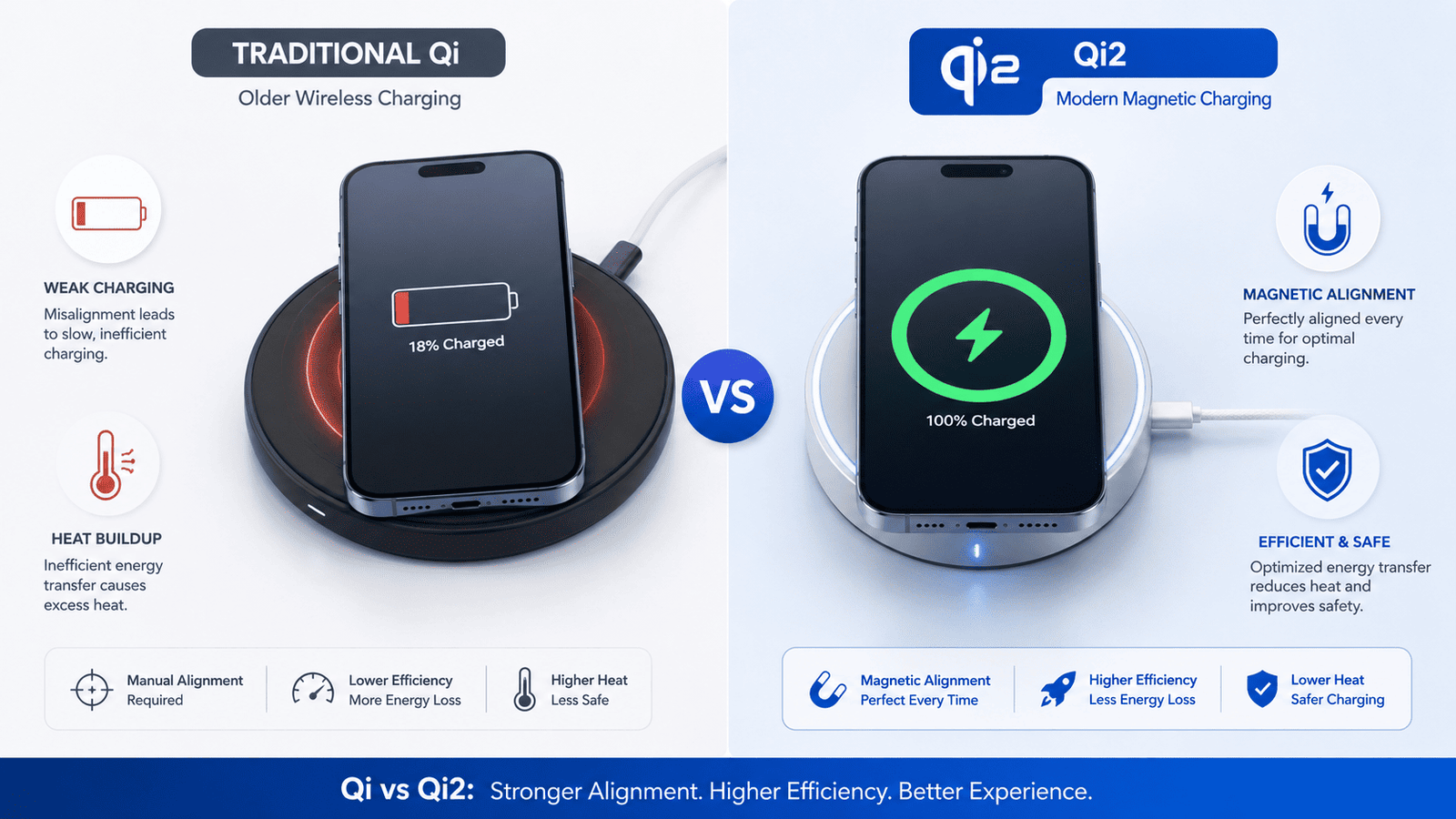
For years, as a manufacturer, we've had to engineer around the inherent flaws of first-generation Qi products. The biggest headache has always been the "sweet spot." Customers would place their phone on a charger, only to wake up to a low battery because it was slightly misaligned. This wasn't just an annoyance; for our wholesale and brand partners, it translated directly into customer complaints, negative reviews, and costly product returns.
Overheating was another major concern. In wireless power transfer systems, coil misalignment can reduce coupling efficiency and affect power transfer, which may increase energy loss and heat generation. Qi2, with its Magnetic Power Profile, tackles this issue at the user-experience level by making correct alignment easier and more consistent. It's not just "Qi with magnets"; it's a re-engineered standard built around reliability.3
Key Problems Solved by Qi2
| Problem with Traditional Qi | How Qi2 Helps Solve It | Benefit for Your Business |
|---|---|---|
| Coil Misalignment | Magnetic attachment helps users place the phone more accurately. | Fewer alignment-related complaints and a smoother user experience. |
| Slow & Inefficient Charging | Better alignment helps improve power transfer efficiency. | More stable charging performance and stronger product appeal. |
| Overheating | More efficient alignment can reduce unnecessary energy loss. | Better thermal performance and improved product trust. |
| Compatibility Uncertainty | Qi2 certification helps verify safety and interoperability.4 | Broader market appeal and simplified product positioning. |
How Does Qi2's Magnetic Power Profile (MPP) Create More Value for Buyers?
Are you looking for products with a clear competitive edge? Generic chargers offer low margins and little differentiation. Qi2's MPP technology provides a tangible feature customers can understand immediately.
Qi2's Magnetic Power Profile adds value by creating a more standardized, high-performance charging experience. For buyers, this means you can source products built around a recognized wireless charging standard, support stronger product claims, and move away from the low-margin commodity market.
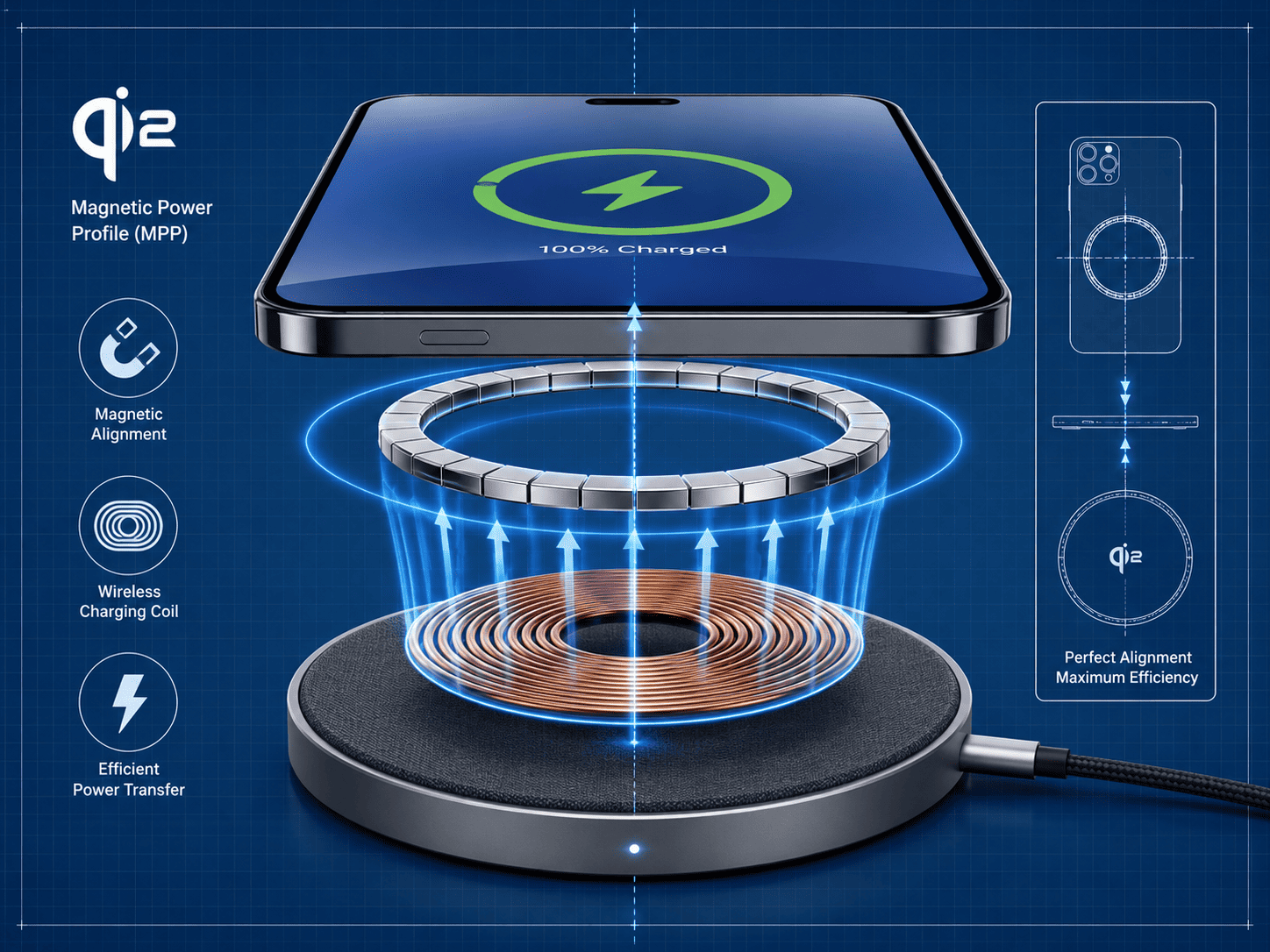
The Magnetic Power Profile is the core technology behind Qi2, and it is closely related to the magnetic charging experience made popular by Apple’s MagSafe ecosystem.5 Apple's own technical specifications show that modern iPhones can support Qi2 wireless charging up to 15W, while traditional Qi charging is typically listed at a lower wireless charging level on the same devices.
As an ODM/OEM manufacturer, we see this as a game-changer. It's not just about adding magnets; it's about creating a universal, certified standard that more device and accessory makers can adopt. Before, magnetic wireless charging was strongly associated with a proprietary experience. Now, Qi2 makes magnetic alignment part of a broader wireless charging standard.
This standardization is where the real value lies for importers and distributors. It means you are no longer selling just a "wireless charger." You are selling a product that fits into a growing, recognized charging ecosystem.6 This elevates the product from a simple accessory to a more reliable solution. This perceived value allows you to move upmarket, away from the race-to-the-bottom pricing of generic Qi pads. Customers are often willing to pay more for the certainty that their charger is designed to be efficient, safe, and compatible.
MPP: From Feature to Ecosystem
- Standardization: Qi2 creates a standardized magnetic charging profile that can be adopted across compatible devices and accessories. This simplifies your product sourcing and broadens your target market.
- Performance: Qi2 supports faster 15W wireless charging for certified mobile devices under compatible conditions. This gives you a stronger and more credible performance claim.
- Future-Proofing: As more device makers and accessory brands adopt Qi2, certified products become easier to position as future-ready charging solutions. You're investing in the direction of the industry, not just a temporary product trend.
Why is Qi2 Certification a Bigger Deal Than Just a Logo?
Concerned about sourcing low-quality, non-compliant products? The risk of unsafe or poorly tested chargers is a major liability. Official Qi2 certification helps protect your business and your customers.7
Qi2 certification is crucial because it verifies that a product has met Wireless Power Consortium requirements for safety and interoperability. For a wholesaler or brand, this logo helps reduce compliance risk, supports product quality claims, and gives customers more confidence in the product.
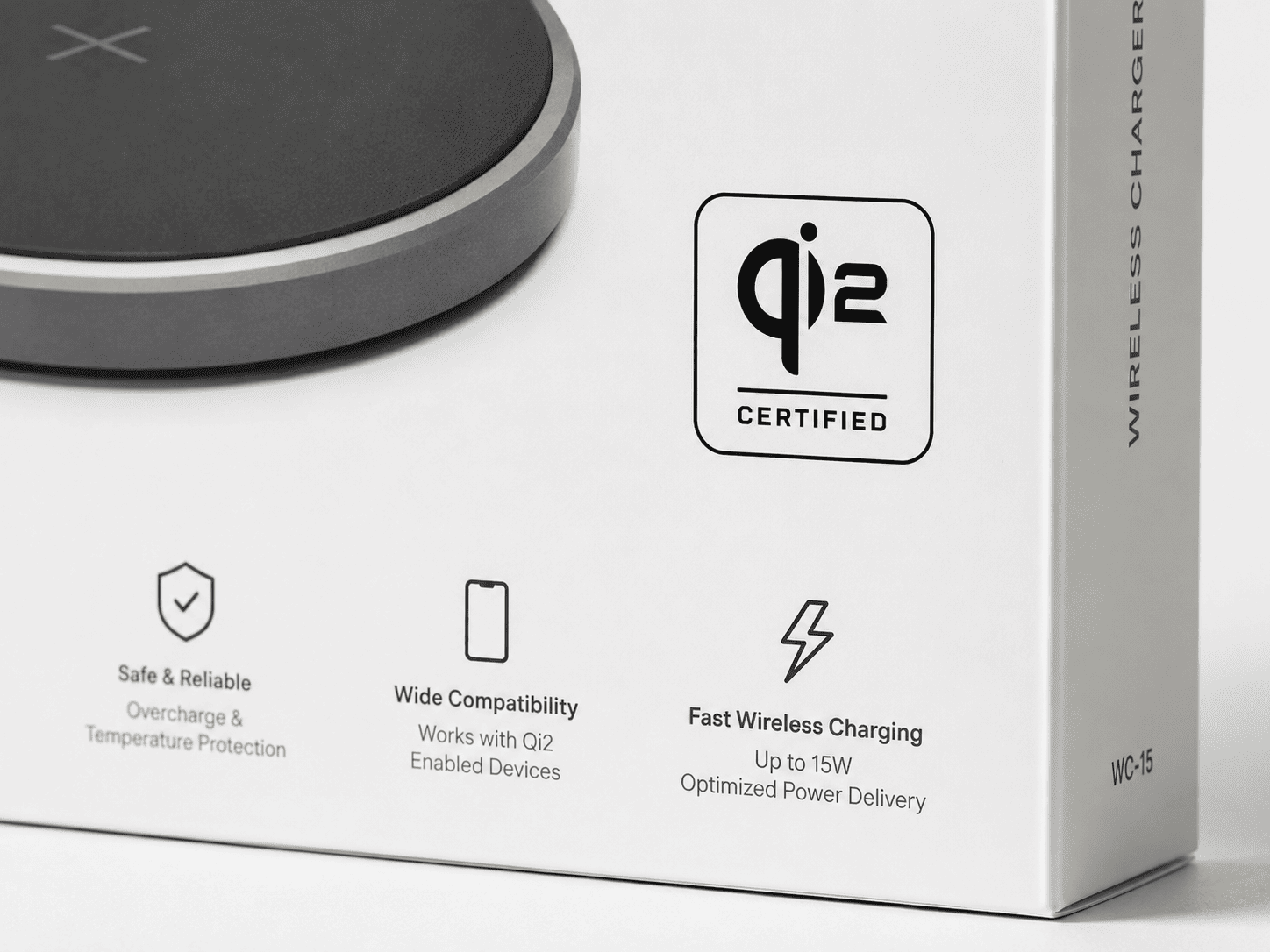
In our years of exporting chargers globally, We've seen firsthand the problems that come from uncertified products. They may fail more easily, create inconsistent user experiences, and damage a brand's reputation. The Qi2 certification process is managed by the Wireless Power Consortium, the standards body behind the Qi wireless charging standard.
For our clients—importers, distributors, and brand owners—certification is a practical business tool. WPC states that certified products receive a certified ID number and are included in its Qi Certified Product Database. This helps buyers verify whether a product is actually certified instead of simply relying on a logo printed on the packaging.
This is a powerful selling point. You can confidently tell your customers that the product has been tested against relevant requirements for safety and interoperability. This builds trust and helps distinguish certified products from uncertified look-alike accessories flooding the market.
The Value of the Qi2 Logo
| Aspect | Why It Matters for Your Business |
|---|---|
| Safety Verification | Helps reduce risks associated with unsafe electronics and potential product recalls. |
| Guaranteed Interoperability | Helps ensure your products work within the growing ecosystem of Qi2-compatible devices. |
| Performance Validation | Supports credible claims such as up to 15W Qi2 wireless charging under compatible conditions. |
| Market Differentiation | The logo is a recognizable quality signal that helps separate certified products from uncertified alternatives. |
How Can Partnering with an Experienced Manufacturer Maximize Your Qi2 Opportunity?
Ready to enter the Qi2 market but unsure where to start? Partnering with the wrong supplier can lead to delays, compliance problems, and quality issues. An experienced manufacturer is your key to success.
An experienced manufacturer like us helps buyers navigate the complexities of Qi2 R&D, production, and international compliance. We offer OEM/ODM services, quality control support, and certification guidance, helping buyers bring compliant wireless charging products to market more efficiently.
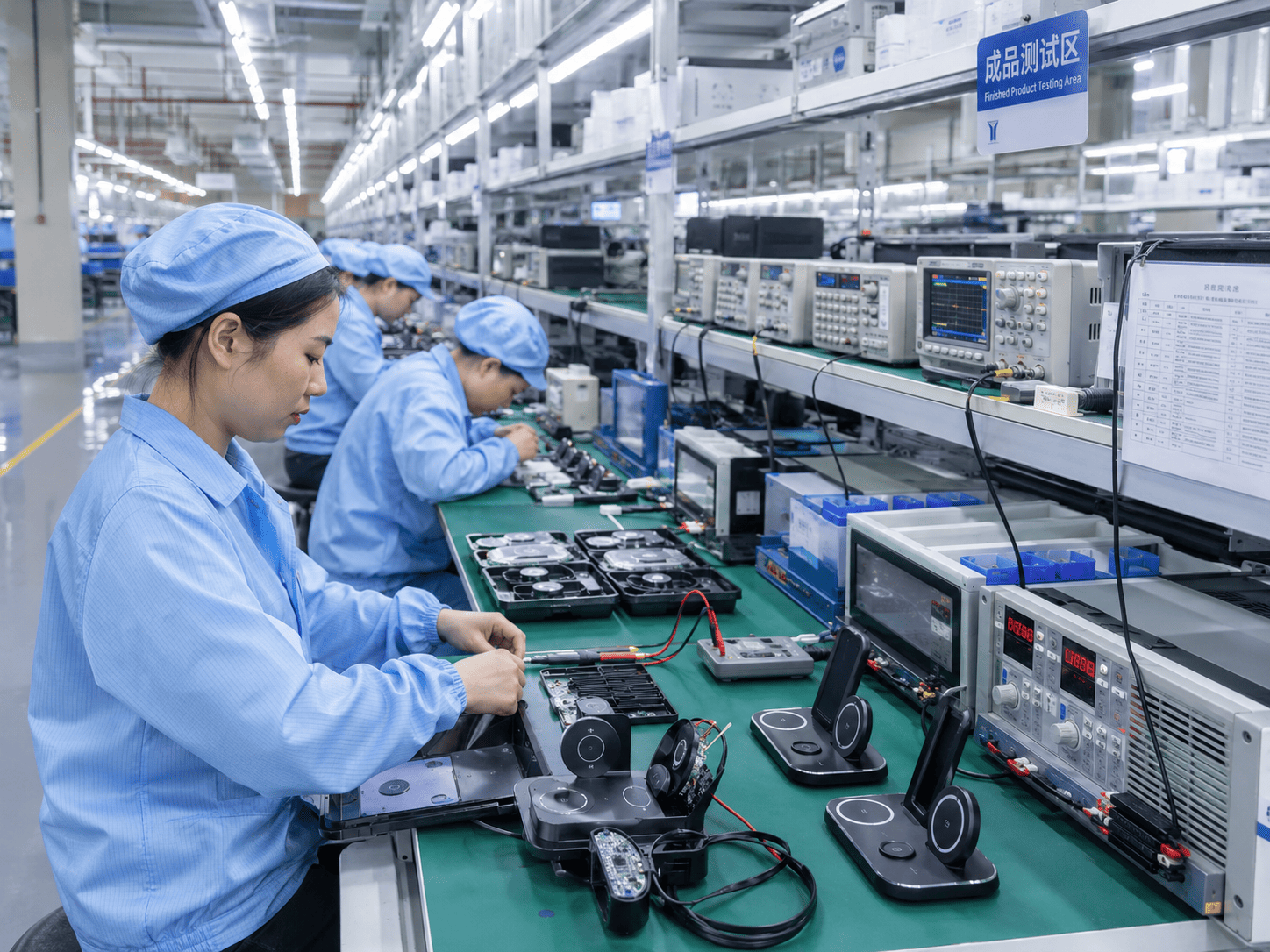
The shift to Qi2 is a huge opportunity, but it also presents new manufacturing challenges. It requires precise engineering, new testing protocols, and a strong understanding of certification and compliance requirements. For example, electronic products entering the U.S. market may need to comply with FCC equipment authorization requirements, while products sold in the European Economic Area may need to meet CE marking requirements and RoHS restrictions on hazardous substances.
Since 2015, we've built our expertise in wireless charging technology. We have over 200 patents and a dedicated R&D capability for wireless charging products. When you partner with us for your OEM or ODM project, you're not just buying a product; you're leveraging our manufacturing experience.
We manage the entire process, from initial design and component sourcing to mass production and international compliance support. We understand the pain points of bulk procurement because we work with distributors and brand owners every day. Our 10,000 sqm factory and annual production capacity of over 5 million units ensure we can scale with your business.
Our Partnership Advantage
- R&D Expertise: We can help you design custom Qi2 products or modify our existing molds to fit your brand identity.
- Compliance Navigation: We help ensure products meet the required standards for your target market, including common requirements such as CE, FCC, RoHS, UL, PSE, KC, and Qi certification.
- Quality Control: Our testing process helps improve charging stability, reduce quality risks, and protect your brand reputation.
- Scalable Production: Whether you need a small initial order or a large-scale rollout, our production lines are ready to deliver.
Conclusion
In short, Qi2 is the future because it delivers the reliability that wireless charging always promised. It uses magnetic alignment to make wireless charging easier, more consistent, and more efficient. For wholesalers, importers, distributors, and brand owners, Qi2 is more than a technical upgrade. It is a business opportunity to move from generic wireless chargers to certified, high-quality, future-ready charging solutions.
"[2312.12565] Precise Coil Alignment for Dynamic Wireless Charging ...", https://arxiv.org/abs/2312.12565. Peer‑reviewed studies of inductive wireless power transfer report that coil misalignment lowers coupling efficiency, increasing losses and heat generation, implying that improved alignment raises transfer efficiency; these results establish the mechanism but are demonstrated under laboratory conditions that may not cover every consumer device geometry. Evidence role: mechanism; source type: paper. Supports: That coil misalignment reduces coupling efficiency and increases losses/heat, implying accurate alignment improves efficiency.. ↩
"Design and implementation of a high misalignment-tolerance ... - PMC", https://pmc.ncbi.nlm.nih.gov/articles/PMC11161604/. According to the Wireless Power Consortium, Qi2’s magnet‑assisted alignment seeks to improve charging efficiency and consistency, and research on inductive systems shows that misalignment contributes to heat and performance variability; taken together, these sources support the claim that Qi2 targets these problems, though they do not constitute field measurements of every commercial charger. Evidence role: general_support; source type: institution. Supports: That Qi2 targets alignment/efficiency improvements and that misalignment can cause heat and performance variability.. ↩
"Wireless Power Consortium approves release of the QI2 Standard", https://www.wirelesspowerconsortium.com/blog-pages/unplugged-revolution-the-media-frenzy-over-the-new-qi-v20-wireless-charging-standard/. The Wireless Power Consortium characterizes Qi2 (Qi v2.0) as a significant update that adds the Magnetic Power Profile and updates certification to improve efficiency and interoperability, framing it as more than a cosmetic change; this describes the standard’s scope but does not itself quantify reliability outcomes in the field. Evidence role: historical_context; source type: institution. Supports: That Qi v2.0 adds new profiles and certification updates intended to improve efficiency, interoperability, and reliability.. ↩
"Testing and Certification | Wireless Power Consortium", https://www.wirelesspowerconsortium.com/knowledge-base/testing-and-certification/. The Wireless Power Consortium’s certification program describes testing against safety requirements (such as temperature limits and foreign object detection) and interoperability across certified products, indicating that certification verifies these aspects; this defines scope rather than guaranteeing performance in every usage scenario. Evidence role: definition; source type: institution. Supports: That Qi certification includes safety-related requirements and interoperability testing.. ↩
"Wireless Power Consortium approves release of the QI2 Standard", https://www.wirelesspowerconsortium.com/blog-pages/unplugged-revolution-the-media-frenzy-over-the-new-qi-v20-wireless-charging-standard/. The Wireless Power Consortium’s announcement states that Qi2 is built on a Magnetic Power Profile contributed by Apple, aligning the standard with the magnet‑assisted approach popularized by MagSafe; this establishes provenance but does not imply full feature equivalence between Qi2 and MagSafe. Evidence role: historical_context; source type: institution. Supports: That Apple contributed a magnetic alignment profile to WPC that forms the basis of Qi2’s Magnetic Power Profile.. ↩
"Qi (standard) - Wikipedia", https://en.wikipedia.org/wiki/Qi_(standard). The Wireless Power Consortium reports that hundreds of millions to billions of Qi‑compatible devices and transmitters have shipped worldwide, indicating a large and growing ecosystem; these are industry‑reported aggregates and may not capture uncertified or unreported devices. Evidence role: historical_context; source type: institution. Supports: That the number of Qi-compatible devices and transmitters shipped globally is large and has grown over time.. ↩
"Foreign Object Detection in the Qi standard - Wireless Power Wiki", https://wirelesspowerwiki.com/doku.php?id=foreign_object_detection_in_the_qi_standard. Because the Wireless Power Consortium’s certification regime includes safety‑related tests (e.g., foreign‑object detection and temperature controls), certified products have been evaluated against defined safety criteria, which can reduce certain risks to users and brands; this is a general risk‑reduction rationale rather than proof that certification prevents all incidents. Evidence role: general_support; source type: institution. Supports: That Qi certification includes safety-focused tests which can reduce some product risks.. ↩