
A charger for iPhone 18 Pro may not need to be new just because the phone is new. The problem is that “compatible” can mean basic charging, not the fastest or most stable charging.1 If buyers check connector type, charging standard, cable quality, certification, and heat control, they can avoid wasting money.
Most users do not automatically need a new charger for iPhone 18 Pro.2 An existing charger may still work if it supports the correct wired or wireless charging method, uses a suitable cable, carries trusted safety certification, and does not overheat. Final iPhone 18 Pro charging specifications should be verified against Apple’s official release.
We work with wireless charging products every day, so we usually separate the question into three real use cases: wired USB-C charging, standard Qi wireless charging, and magnetic wireless charging. These charging methods follow different rules, and mixing them often leads to the wrong purchase.
Do You Need a New Charger for iPhone 18 Pro for Wired USB-C Charging?
Many users worry that a new iPhone means a new wall adapter. That worry is understandable because charging ports, cables, and power ratings have changed across phone generations. However, the adapter is only one part of the charging chain.3
A wired charger for iPhone 18 Pro is likely enough if it uses the correct USB-C connection, supports a suitable USB power output, works with a quality USB-C cable, and has reliable safety certification. Users should upgrade only when the current adapter is too weak, unstable, damaged, uncertified, or incompatible.
What matters more than the watt number?
Maximum wattage alone can mislead buyers.4 A charger marked with a high output does not guarantee that the phone will take that full power. The final speed depends on several factors:
- The phone’s charging limit, which should be checked on Apple’s official iPhone 18 Pro specifications page.
- The adapter’s output profile, not only the largest printed wattage.5
- The USB-C cable quality, especially if the cable is old, thin, damaged, or uncertified.6
- Protocol support, such as standard USB power negotiation.
- Heat control, because phones may slow charging when temperature rises.
In procurement work, we often see buyers compare only “20W vs 30W vs 65W.” That is too simple. A well-made moderate-power charger can provide a better real-world experience than a poorly built high-wattage charger. Stability, temperature, and certification matter.
| Current wired setup | Likely result | Upgrade needed? |
|---|---|---|
| Certified USB-C adapter + good USB-C cable | Basic charging likely | Not automatically |
| Old low-power adapter | Slow charging likely | Maybe |
| Damaged cable or loose connector | Unstable charging | Yes |
| Unknown, uncertified adapter | Safety concern | Strongly consider |
| High-watt laptop charger | May charge, but not necessarily faster | Not for wattage alone |
We recommend that users avoid buying a new adapter only because the package says “fast.” Instead, buyers should ask: Does this charger match the iPhone charging method, does it negotiate power correctly, and does it stay cool under normal use?
For B2B buyers, the same logic applies at scale. A distributor should request documentation such as CE, FCC, UL, RoHS, or other market-specific reports where relevant. [These documents should be verified, not assumed.]7 For any application-specific decision, especially bundled kits or branded accessories, qualified compliance review is a safer path.
Do You Need a New Charger for iPhone 18 Pro for Wireless or Magnetic Charging?
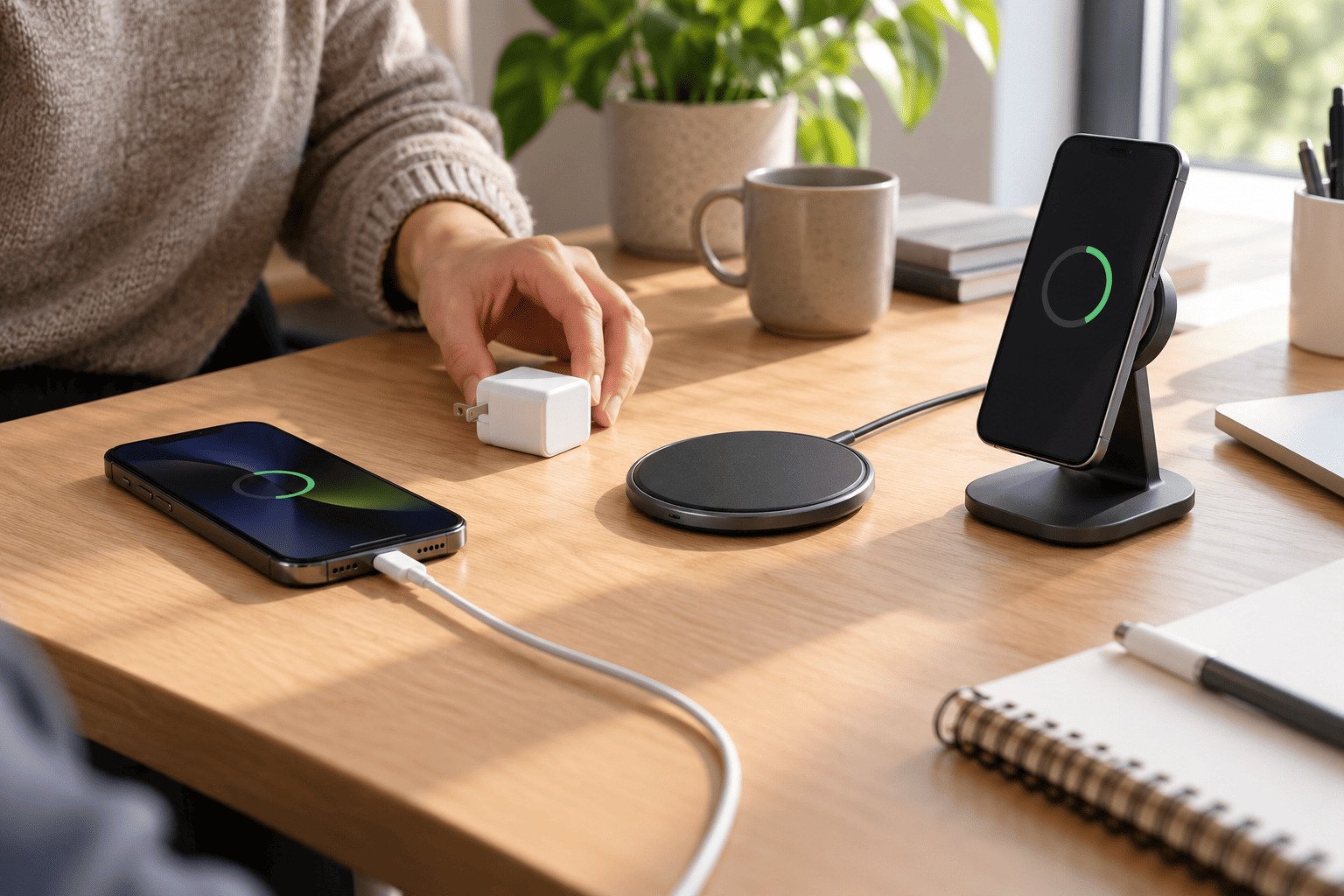
Wireless charging creates more confusion than wired charging because several products look similar. A flat Qi pad, a magnetic charger, and a MagSafe-style stand may all charge phones, but they do not always deliver the same alignment, speed, heat control, or user experience.
A wireless charger for iPhone 18 Pro may be suitable if it supports the correct wireless charging standard, aligns properly with the phone, manages heat well, and has trusted certification. Users should not assume every magnetic-looking charger provides the same performance as an officially supported magnetic charging system.8
Why alignment and heat matter
Wireless charging is more sensitive than wired charging. Small design details can change the result:
- Coil alignment affects energy transfer.
- Magnet strength and placement affect how consistently the phone sits on the charger.
- Thermal design affects whether the phone slows charging.
- [Case thickness can reduce efficiency or weaken magnetic hold.]9
- Foreign object detection helps reduce safety risks when metal objects are nearby.
A charger can be “compatible” and still feel disappointing. For example, a basic Qi pad may charge the phone overnight, but it may not be ideal for a desk where users pick up the phone often. A magnetic stand may feel better because alignment is easier, but only if the magnets, coil position, and thermal structure are well designed.
| Wireless option | Best use case | Main risk |
|---|---|---|
| Standard Qi pad | Overnight charging | Misalignment |
| Qi stand | Desk or bedside viewing | Heat if poorly designed |
| Magnetic wireless charger | Better placement consistency | Not all magnets mean full support |
| 3-in-1 station | Phone, watch, earbuds area | Certification and heat design matter |
Users should consider a new wireless charger only when the current one:
- Charges inconsistently.
- Gets unusually hot.
- Requires careful manual placement every time.
- Does not support the desired magnetic function.
- Lacks trusted certification or test documentation.
- Cannot work well with the user’s protective case.
From a manufacturing viewpoint, wireless charger quality is not only about output power. It is also about coil structure, PCB design, thermal materials, housing design, magnetic positioning, and safety testing. For importers and brand owners, sample testing should include charging stability, surface temperature, case compatibility, packaging claims, and regional compliance documents.
Frequently Asked Questions
Can we use an old iPhone charger with iPhone 18 Pro?
An old charger may work if it has the right connection, enough output, a suitable cable, and proper safety certification. However, basic charging does not always mean optimized charging. Users should confirm final iPhone 18 Pro requirements on Apple’s official specifications page.
Is a higher-watt charger always better for iPhone 18 Pro?
No. A higher-watt charger is not always better. The phone controls how much power it accepts. Cable quality, protocol support, temperature, and certification also affect the real charging experience. Buying only by wattage can lead to poor value.
Will any wireless charger work with iPhone 18 Pro?
Not necessarily. Some standard Qi chargers may provide basic wireless charging, but magnetic alignment, charging speed, heat control, and case compatibility can vary. Users should check the supported wireless standard and verify product certification before buying.
When should we buy a new charger for iPhone 18 Pro?
Users should consider a new charger if the current one is too slow, uses the wrong cable, overheats, disconnects often, lacks trusted certification, or does not support the preferred wireless or magnetic charging method.
Conclusion
A charger for iPhone 18 Pro does not need to be replaced automatically. The better question is whether the current wired, wireless, or magnetic setup meets the right interface, standard, cable, certification, and heat-control conditions. Since final iPhone 18 Pro specifications should be verified through Apple’s official page, buyers should avoid fear-based upgrades. If you source chargers in bulk, request samples, compliance documents, and real-world charging evaluations before placing orders.
"Qi (standard)", https://en.wikipedia.org/wiki/Qi_(standard). USB-IF and Wireless Power Consortium materials distinguish interoperability from negotiated or certified power levels, supporting the point that a device may be compatible for charging without necessarily delivering the fastest or most stable charging mode. Evidence role: definition; source type: institution. Supports: A standards source should support that charging systems define interoperability and negotiated power separately from advertised maximum charging performance.. Scope note: This would provide standards context rather than direct evidence about unreleased iPhone 18 Pro behavior. ↩
"USB-C to USB Adapter", https://www.apple.com/shop/product/mw5l3am/a/usb-c-to-usb-adapter. Apple support guidance and USB-IF materials describe USB-C charging as interoperable when a compatible adapter, cable, and device negotiate power properly, supporting the general claim that a new handset does not automatically require a new charger. Evidence role: general_support; source type: institution. Supports: A source should support that compliant USB-C chargers and cables can generally charge compatible USB-C devices through negotiated power delivery.. Scope note: This is contextual support only because official iPhone 18 Pro charging specifications would still be required for model-specific confirmation. ↩
"USB-C", https://en.wikipedia.org/wiki/USB-C. USB Power Delivery documentation describes charging as a negotiated interaction among the power source, the cable, and the sink device, supporting the claim that the adapter is only one part of the charging chain. Evidence role: mechanism; source type: institution. Supports: A USB standards source should show that wired USB-C charging involves the power source, cable, and sink device negotiating allowable power.. ↩
"USB Charger (USB Power Delivery)", https://www.usb.org/usb-charger-pd. USB Power Delivery materials explain that the sink device requests allowable voltage and current from the source, supporting the claim that a charger’s maximum wattage rating alone does not determine phone charging speed. Evidence role: mechanism; source type: institution. Supports: A source should support that USB-C charging power is negotiated and constrained by the receiving device, not simply by the charger's maximum rating.. ↩
"USB hardware", https://en.wikipedia.org/wiki/USB_hardware. USB Power Delivery specifications describe chargers as advertising defined voltage-current capabilities, supporting the claim that output profiles, not only the largest printed wattage, affect charging compatibility and performance. Evidence role: mechanism; source type: institution. Supports: A technical source should support that USB PD chargers advertise specific power profiles rather than only a single maximum wattage.. ↩
"Do USB-C to USB-C cables need an emarker chip ...", https://www.reddit.com/r/UsbCHardware/comments/13j0gev/do_usbc_to_usbc_cables_need_an_emarker_chip_to/. USB-IF guidance on certified USB Type-C cables and current ratings supports the claim that cable quality, condition, and certification can influence charging reliability and safe power delivery. Evidence role: mechanism; source type: institution. Supports: A USB standards source should support that USB-C cable construction, current rating, and certification affect charging performance and safety.. ↩
"CE marking", https://en.wikipedia.org/wiki/CE_marking. FCC Equipment Authorization records and recognized certification databases provide mechanisms for checking product authorization or certification claims, supporting the article’s statement that compliance documents should be verified rather than assumed. Evidence role: general_support; source type: government. Supports: A government or certification database source should support that product authorization and certification claims can be verified through official records.. Scope note: This supports the verification principle broadly; specific products may require review across multiple regional schemes. ↩
"Magnetism", https://en.wikipedia.org/wiki/Magnetism. Wireless Power Consortium materials on Qi2 describe a Magnetic Power Profile intended to standardize alignment and charging behavior, supporting the claim that a magnetic-looking charger is not necessarily equivalent to a certified magnetic charging system. Evidence role: definition; source type: institution. Supports: A standards or official support source should support that certified magnetic wireless charging systems define alignment and charging requirements beyond the mere presence of magnets.. Scope note: This provides standards context and does not prove the performance of any individual charger. ↩
"Inductive charging", https://en.wikipedia.org/wiki/Inductive_charging. Wireless power transfer research shows that increased coil separation reduces coupling and transfer efficiency, providing technical support for the claim that thicker cases can impair wireless charging performance; magnetic-hold effects require separate evidence on magnet spacing and materials. Evidence role: mechanism; source type: paper. Supports: A technical paper should support that increasing separation distance between coils can reduce wireless power transfer efficiency, and that distance affects magnetic coupling or holding force.. Scope note: The charging-efficiency portion can be supported directly, while the magnetic-hold portion may require additional physics or product-standard evidence. ↩