
“MagSafe Compatible” can look simple on a product page, but it often creates procurement risk. Buyers may assume it means Apple certification, Qi2 approval, or stable 15W charging. That assumption can lead to wrong packaging claims, customer complaints, or customs and marketplace issues. We need to separate magnetic fit, charging speed, and certification clearly.
“MagSafe Compatible” usually means a wireless charger can magnetically align with MagSafe-style iPhones or magnetic cases. It does not automatically mean Apple official MagSafe certification, MFi authorization, Qi2 certification, or guaranteed 15W wireless charging.1 Buyers should verify documents, test reports, charging performance, adapter requirements, and approved marketing wording before bulk purchase.
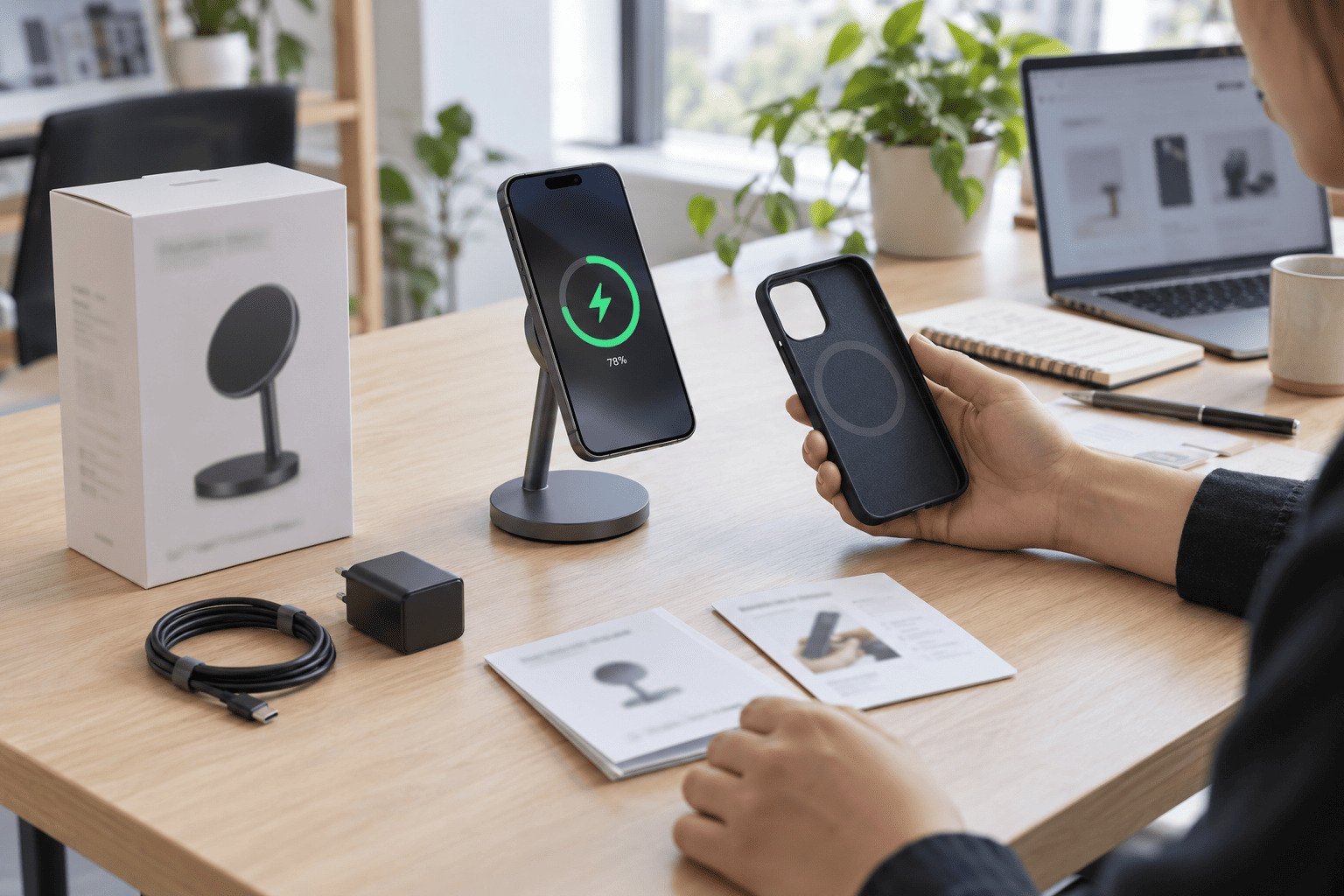
In our daily communication with importers, wholesalers, and brand buyers, this question appears often during product selection and packaging review. The safest approach is not to ask only, “Is it MagSafe Compatible?” A better question is: What can we legally claim, what speed can users expect, and what proof can the supplier provide?
Does “MagSafe Compatible” Mean Apple Official Certification?
Many buyers see “MagSafe Compatible” and worry about wording. That concern is reasonable. If the phrase is used carelessly, it may suggest a stronger approval than the product actually has. This can affect listings, retail packaging, and after-sales expectations.
“MagSafe Compatible” should usually be understood as a magnetic-fit compatibility claim, not as proof of Apple official MagSafe certification or MFi authorization. Buyers should only use official certification wording when the supplier provides valid documents that can be checked against Apple or authorized program requirements.
Why the wording matters for buyers
In practical procurement, the problem is not only technical. It is also commercial and legal. A charger may work well with a magnetic iPhone, but the packaging may still create risk if it says or implies “official MagSafe” without verified authorization.
We usually suggest buyers divide claims into three levels:
| Claim type | What it usually means | What buyers should verify |
|---|---|---|
| MagSafe Compatible | Magnetic alignment with MagSafe-style iPhones or cases | Magnet strength, fit, case compatibility, charging behavior |
| Made for MagSafe / official wording | Possible Apple-related authorization | Valid Apple documentation, approved wording |
| Qi2 Certified | Certified under WPC Qi2 standard | WPC listing, certificate, model match |
| MFi authorized factory/product | Apple MFi program relationship or product authorization | Scope, validity, product category, official records |
Common procurement mistake
A common mistake is treating “compatible” as the same as “certified.” These are not the same. Compatibility describes function. Certification describes verified compliance under a defined program.2
Before confirming packaging or marketplace content, buyers should ask suppliers for:
- Exact model number matching the quotation and sample
- Qi or Qi2 certificate, if claimed
- Test reports for CE, FCC, RoHS, UL, PSE, KC, or other target-market requirements
- Charging test data with specific phone models
- Recommended input adapter specification, such as 9V/2A or USB-C PD
- Approved product description wording for retail and online channels to avoid trademark issues under nominative fair use principles
Our view is simple: “MagSafe Compatible” can be useful wording, but it should stay within its true meaning unless certification documents support a stronger claim.
Can a MagSafe Compatible Wireless Charger Deliver 15W Charging?
Speed is where many misunderstandings happen. A buyer may hold a sample, feel strong magnetic alignment, and assume the charger will deliver fast wireless charging. However, alignment is only one part of the charging system.
A MagSafe Compatible charger can attach correctly but still charge below 15W. Actual output depends on the phone model, wireless charging protocol, transmitter design, input adapter, coil alignment, thermal control, firmware, and verified certification status. Buyers should test real devices instead of relying only on headline wattage.
Why magnetic fit is not the same as power output
Magnetic alignment helps the phone sit in the correct position. That can improve charging stability compared with loose placement. But magnets do not decide the whole charging speed.
Wireless charging speed depends on several connected factors:
-
Phone acceptance limit
Different iPhone models and software versions may accept different wireless power levels (non-Qi2 chargers are generally capped at 7.5W3). Buyers should verify current Apple documentation for model-specific behavior. -
Charging standard and protocol
Qi, Qi2, and Apple-related charging modes are not interchangeable labels. Qi2 with Magnetic Power Profile is designed to support magnetic alignment and higher standardized performance4, but buyers should confirm details through official WPC sources. -
Adapter input power
A charger advertised as 15W may not reach expected performance with a weak 5V/1A adapter. Procurement teams should define the required adapter in the user manual and product listing. -
Thermal management
Wireless charging creates heat. If the phone or charger becomes too warm, software power throttling reduces speed automatically to preserve battery longevity5. -
Case thickness and magnet quality
Thick, metal, or non-magnetic cases can reduce alignment and charging efficiency.6
What buyers should request during sample evaluation
For bulk purchasing, we recommend a simple test matrix:
| Test item | Why it matters |
|---|---|
| iPhone model testing | Confirms real compatibility across target users |
| 30-minute and 60-minute charging data | Shows practical charging trend, not only peak wattage |
| Surface temperature record | Helps evaluate thermal control against safety standards like IEC 62368-1 |
| Adapter requirement test | Prevents complaints caused by wrong power input |
| Case compatibility check | Matches real consumer usage |
| Standby and foreign object behavior | Supports safety and quality review |
A product page may say “15W,” but procurement teams should ask: 15W for which device, under which protocol, with which adapter, and supported by what document?
How Are Qi, Qi2, MagSafe, and MFi Different?
The terms often appear together, so buyers may treat them as one system. That creates confusion during supplier comparison. In fact, each term belongs to a different concept: charging standard, magnetic alignment, Apple ecosystem wording, or authorization program.
Qi and Qi2 are wireless charging standards managed by the Wireless Power Consortium7 MagSafe is Apple’s magnetic charging ecosystem wording. MFi is Apple’s licensing program for certain accessories.8 A MagSafe Compatible claim does not replace Qi2 certification, and Qi2 certification does not automatically mean every Apple marketing claim is allowed.9
Simple buyer-friendly comparison
| Term | Main meaning | Buyer action |
|---|---|---|
| Qi | Established wireless charging standard | Check WPC certificate if claimed |
| Qi2 | Newer standard including Magnetic Power Profile | Verify WPC listing and model number |
| MagSafe Compatible | Works with MagSafe-style magnetic alignment | Test fit, magnet strength, and charging |
| Official MagSafe wording | Apple-related claim | Require valid Apple documentation |
| MFi | Apple licensing program | Confirm scope and authorization |
How to control risk before placing an order
Buyers should build a verification checklist before approving mass production. This is especially important for importers, distributors, and e-commerce sellers who must defend their product claims in front of marketplaces, retailers, and end users.
A practical checklist includes:
- Product claim review: Confirm whether the listing says “MagSafe Compatible,” “Qi2 Certified,” or something stronger.
- Document matching: Make sure certificates match the exact model, not only the supplier name.
- Packaging review: Avoid wording that implies Apple official approval unless verified.
- Sample testing: Test with multiple iPhone models and cases used in the target market.
- Manual accuracy: State adapter requirements and realistic charging notes clearly.
- Batch consistency: Confirm magnet, coil, PCBA, and firmware consistency before shipment.
For application-specific decisions, buyers should involve qualified compliance consultants, certification bodies, or testing labs. A manufacturer can provide samples, documents, and production information, but official certification status should be verified through the relevant authority.
Frequently Asked Questions
Is “MagSafe Compatible” the same as Qi2 Certified?
No. “MagSafe Compatible” usually refers to magnetic alignment with MagSafe-style iPhones or cases. Qi2 Certified means the product has passed certification under WPC Qi2 requirements. Buyers should request the Qi2 certificate and verify the exact model listing.
Does MagSafe Compatible mean 15W charging?
No. A MagSafe Compatible charger may charge at different speeds depending on the device, protocol, adapter, heat control, and certification status. Buyers should test real charging data instead of relying only on advertised wattage.
Can suppliers print “Made for MagSafe” on packaging?
Buyers should not print official-sounding Apple claims unless valid authorization documents support that wording. Packaging claims should be reviewed carefully because misleading wording can create marketplace, retail, or legal risk.
What documents should buyers ask for?
Buyers should ask for Qi or Qi2 certificates if claimed, CE/FCC/RoHS/UL/PSE/KC reports where relevant, charging test data, product specifications, user manuals, and confirmation that all documents match the exact model number.
Conclusion
“MagSafe Compatible” is a useful term, but buyers should treat it as a starting point, not final proof. It mainly describes magnetic fit, not Apple official certification, MFi status, Qi2 approval, or guaranteed 15W charging. The best procurement approach is to verify documents, test real devices, review packaging claims, and define realistic speed expectations. If you are sourcing wireless chargers for bulk orders, request samples, certification files, and model-specific test data before confirming production.
"Accessory Search - MFi Licensee App", https://mfi.apple.com/account/accessory-search. Apple and Wireless Power Consortium documentation describe MagSafe/MFi authorization and Qi2 certification as distinct program-based statuses, supporting the distinction between informal compatibility wording and formal certification; the source would not verify any individual supplier's product claim. Evidence role: definition; source type: institution. Supports: Apple-related authorization, MFi licensing, and WPC Qi2 certification are separate program statuses and should not be inferred from informal compatibility wording.. Scope note: Contextual support; it establishes category distinctions rather than testing a specific charger. ↩
"International Accreditation Forum", https://en.wikipedia.org/wiki/International_Accreditation_Forum. ISO/IEC conformity-assessment terminology defines certification as attestation of conformity to specified requirements, supporting the article's distinction between functional compatibility and program-based certification. Evidence role: definition; source type: institution. Supports: Certification is a conformity-assessment activity in which compliance with specified requirements is attested by a body or program.. ↩
"How to use your MagSafe Charger with iPhone - Apple Support", https://support.apple.com/en-us/105047. Apple support materials state that iPhone charging wattage depends on the charger type and identify higher-power charging for MagSafe or Qi2 accessories compared with standard Qi wireless charging; model and software differences limit the generality of the 7.5W statement. Evidence role: statistic; source type: institution. Supports: Apple documentation distinguishes 15W MagSafe or Qi2 charging from lower-power Qi wireless charging, commonly 7.5W for compatible iPhone models.. Scope note: The exact limit may depend on iPhone model, iOS version, region, adapter, and accessory certification. ↩
"Qi (standard)", https://en.wikipedia.org/wiki/Qi_(standard). Wireless Power Consortium materials describe Qi2 as incorporating a Magnetic Power Profile for aligned wireless charging and standardized power delivery; public summaries may not provide the full technical specification details available to WPC members. Evidence role: mechanism; source type: institution. Supports: The Qi2 standard includes a Magnetic Power Profile intended to improve alignment and standardize higher wireless-charging performance.. Scope note: Public WPC descriptions may summarize rather than reproduce the complete standard. ↩
"About iPhone charge speeds", https://support.apple.com/en-us/120619. Apple support documentation explains that iPhone may slow or stop charging when the device becomes too warm, supporting the article's statement that thermal conditions can reduce charging speed to protect battery operation. Evidence role: mechanism; source type: institution. Supports: iPhone software may limit or pause charging when device temperature exceeds recommended conditions in order to protect the device and battery.. Scope note: The source supports Apple device behavior specifically and may not generalize to all phones. ↩
"Inductive charging", https://en.wikipedia.org/wiki/Inductive_charging. Technical studies of inductive wireless charging show that coil separation, misalignment, and intervening conductive materials can reduce power-transfer efficiency, supporting the concern that certain phone cases may impair charging performance. Evidence role: mechanism; source type: research. Supports: Increased coil distance, misalignment, and conductive or magnetic interference can reduce inductive charging efficiency or disrupt charging.. Scope note: The magnitude of the effect depends on case design, charger geometry, and device-specific control algorithms. ↩
"Qi (standard) - Wikipedia", https://en.wikipedia.org/wiki/Qi_(standard). Wireless Power Consortium materials identify Qi and Qi2 as WPC wireless-charging standards, supporting the article's attribution of those standards to WPC. Evidence role: definition; source type: institution. Supports: The Wireless Power Consortium develops and administers the Qi and Qi2 wireless-charging standards and certification ecosystem.. ↩
"MFi Program", https://en.wikipedia.org/wiki/MFi_Program. Apple's MFi Program materials describe MFi as a licensing framework for certain accessories made to work with Apple products and technologies, supporting the article's definition of MFi. Evidence role: definition; source type: institution. Supports: Apple operates the MFi Program as a licensing program for eligible accessories that interact with Apple devices or technologies.. Scope note: The precise accessory categories and technical requirements may change over time. ↩
"Products", https://www.wirelesspowerconsortium.com/products/. WPC certification materials and Apple trademark guidance support treating Qi2 certification and Apple-related marketing authorization as separate compliance questions; neither source alone resolves whether a particular advertisement is permissible. Evidence role: general_support; source type: institution. Supports: WPC Qi2 certification concerns compliance with the Qi2 standard, while Apple trademark and program rules separately govern Apple-related marketing wording.. Scope note: Contextual support; final marketing approval depends on the exact claim, authorization status, and applicable law. ↩