
Wireless car chargers reduce summer overheating risk, but they cannot remove every heat source around a phone. A hot cabin, direct sunlight, GPS navigation, 5G, high screen brightness, and the battery itself all add thermal stress. The real solution is not just “more watts.” It is better thermal design, smarter control, and realistic testing.
Wireless car chargers prevent phones from overheating in summer by reducing the extra heat created during charging. Good designs use accurate coil alignment, efficient power conversion, heat-dissipation materials, airflow paths, temperature sensors, and charging-control algorithms. However, the phone may still overheat if sunlight, cabin temperature, app workload, or poor installation conditions are too severe.
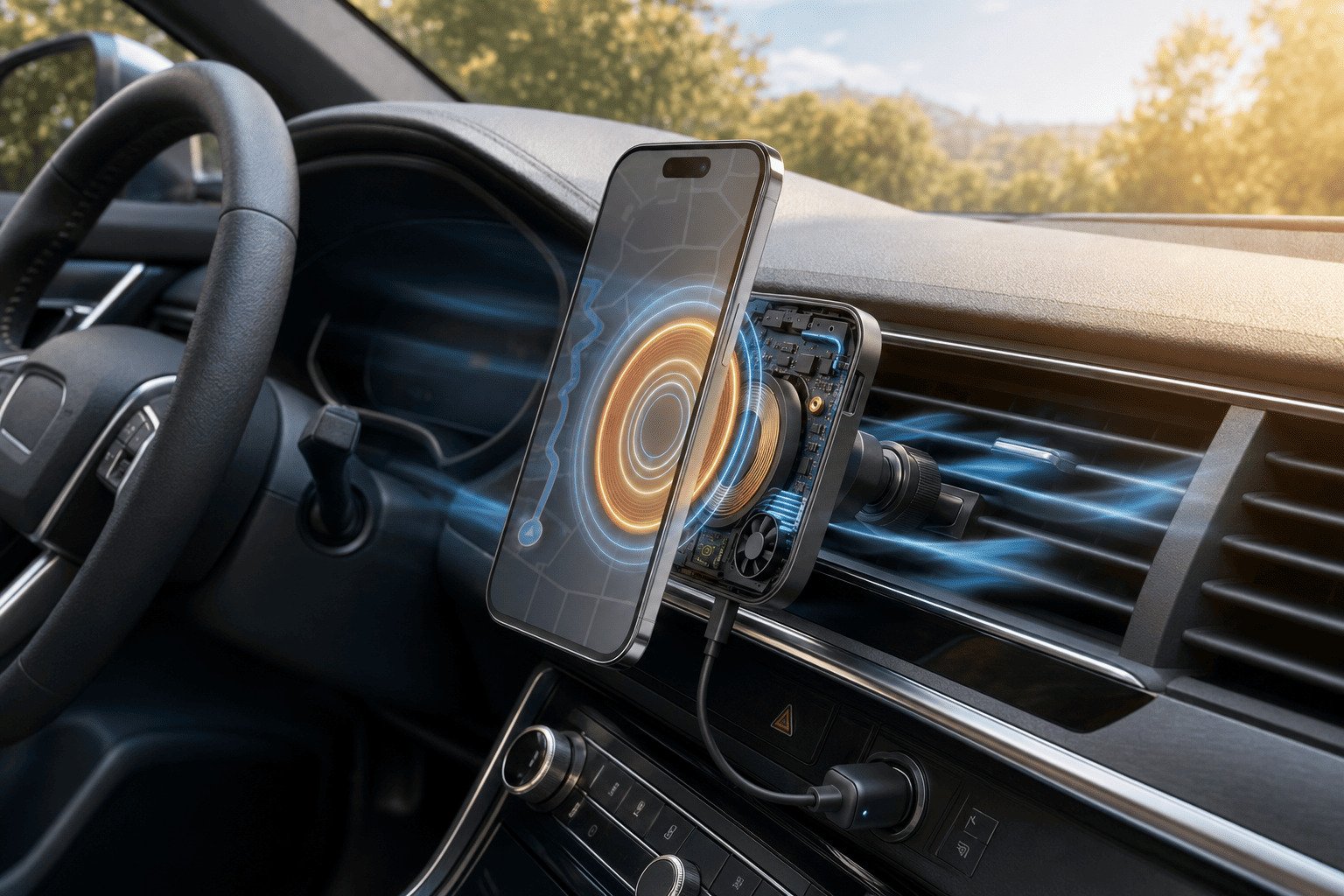
For buyers, this topic needs careful judgment. A “15W” or “25W” label does not prove stable summer charging.1 We prefer to look at temperature over time, sustained charging power, and real battery gain under realistic driving conditions.
Can Wireless Car Chargers Completely Prevent Overheating in Summer?
Wireless car chargers cannot completely prevent overheating because the charger is only one part of the thermal environment. The phone may already be hot before charging begins. Summer driving often combines sunlight, navigation, mobile data, and a closed cabin, which can push the phone close to its thermal limit.2
The practical answer is simple: a well-designed charger can lower the additional heat it creates, but it cannot overcome extreme external heat indefinitely. The phone’s own thermal-management system may reduce charging speed or stop charging when internal temperatures rise too high.
What Usually Makes the Phone Hot?
Several heat sources can work together:
- Direct sunlight on the screen or back cover
- High cabin temperature, especially after parking
- GPS navigation and maps rendering
- 5G or weak-signal communication
- High screen brightness
- Battery charging heat
- Wireless power-conversion losses
- Phone case insulation or metal parts
This is why we do not treat overheating as a charger-only problem. A charger with poor efficiency can make the situation worse, but even a good charger has limits. If a phone sits near a windshield in direct sun, the surface temperature can rise quickly. In that case, charging control may reduce power, but the phone can still display a temperature warning.
For B2B buyers, this distinction matters. If customers complain that charging slows down in summer, the reason may not be a failed charger. It may be the phone protecting itself. A reliable supplier should explain these limits clearly and provide test data instead of only promoting peak output.
How Do Wireless Car Chargers Reduce the Heat They Add?
Wireless car chargers reduce heat mainly by improving energy transfer and controlling temperature rise. The better the coil alignment and power-conversion efficiency, the less waste heat appears inside the charger and phone.3 The charger should also detect abnormal temperature and reduce or pause power when needed.4
In practical terms, good wireless car chargers rely on coil accuracy, efficient circuits, thermal materials, airflow design, and firmware protection. Active cooling can help in some models, but it must be tested for fan noise, lifetime, dust exposure, and long-term reliability.
Key Thermal Design Factors
| Design factor | Why it matters in summer |
|---|---|
| Coil alignment | Poor alignment creates more loss and heat |
| Magnetic positioning | Helps keep the phone centered during driving |
| Power efficiency | Less wasted power means less heat |
| Heat-dissipation materials | Spreads heat away from hot spots |
| Airflow channels | Helps natural or fan-assisted cooling |
| Temperature sensors | Allows real-time thermal protection |
| Firmware control | Reduces or stops charging at defined limits |
Accurate alignment is especially important. If the transmitting coil and receiving coil are offset, the charger may work harder to deliver power. That can increase heat while producing less actual battery gain. Magnetic wireless car chargers can improve repeatability, but case thickness, magnet layout, and phone model compatibility still matter.5
Thermal protection should also be predictable. A charger should not wait until the housing becomes uncomfortable to touch. It should monitor temperature and adjust output based on defined thresholds. The phone may also reduce charging independently, so both systems can affect the final charging curve.
For product development, we look beyond the shell temperature. We care about the hot spot near the coil, the PCB temperature, the phone back temperature, and the battery gain after a fixed test period.
Are Vent-Mounted Wireless Car Chargers Cooler Than Dashboard or Windshield Models?
Vent-mounted wireless car chargers can perform better when the air conditioner sends cool air through the vent and the phone is shaded.6 However, they are not always safer. If the vent blows hot air, if the mount blocks airflow, or if the phone is poorly positioned, a vent mount may perform worse than expected.
The correct answer is: installation position affects thermal performance, but no position is always best. Buyers should compare vent, dashboard, and windshield mounting under the same cabin temperature, sunlight, phone model, case, workload, and test duration.7
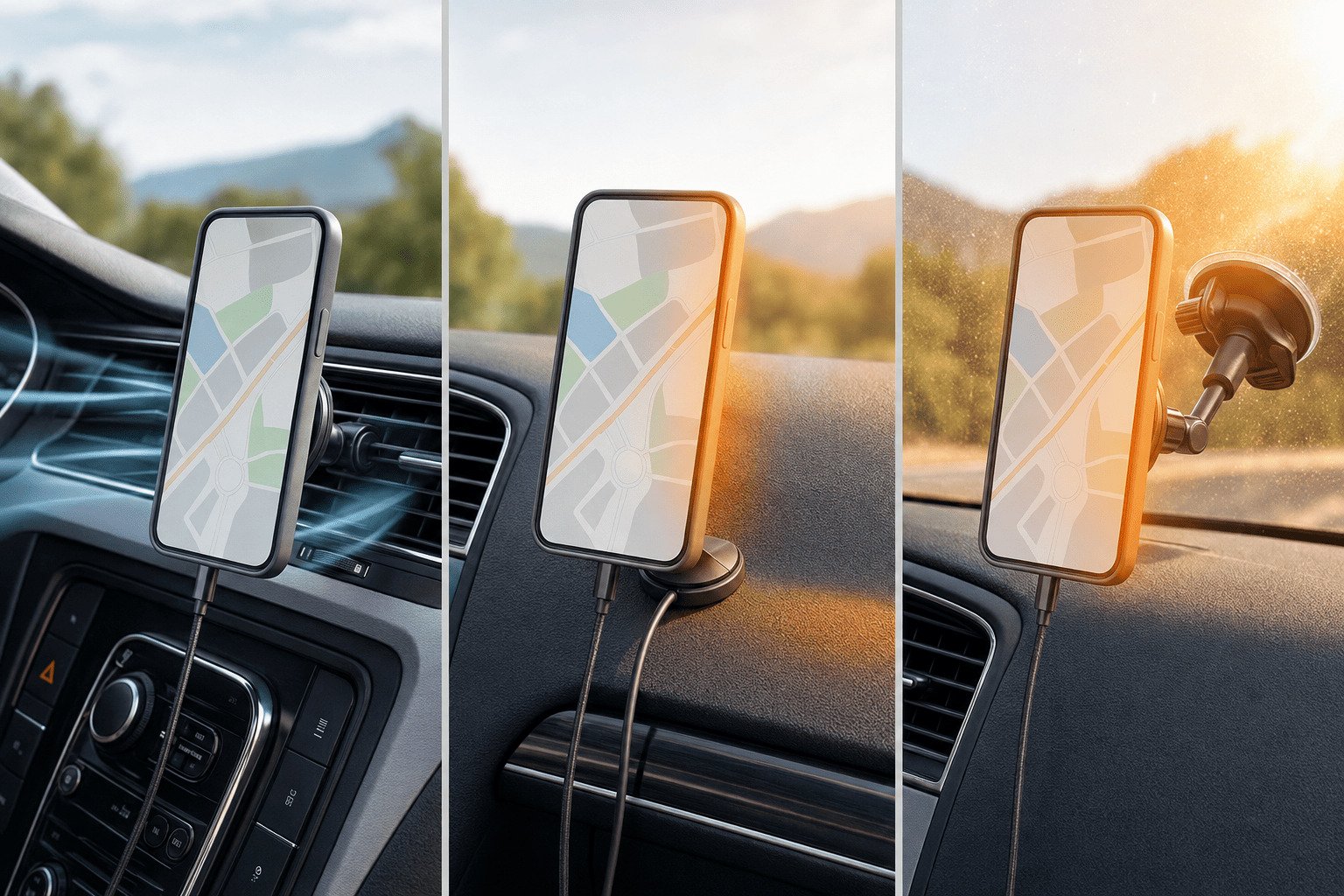
Position Comparison
| Mounting position | Possible advantage | Possible risk |
|---|---|---|
| Air vent | AC airflow may cool phone and charger | Hot air or blocked vent may increase heat |
| Dashboard | Stable position and easier cable routing | Sun exposure can be strong |
| Windshield | Good visibility for navigation | Often exposed to direct sunlight |
| Console area | Usually more shaded | May be less convenient for viewing |
We avoid saying “vent mount is always cooler” because real cars differ. Some vents are small. Some point away from the phone. Some drivers use heating in the morning and cooling later. In certain regions, the dashboard surface can become very hot before the AC stabilizes the cabin.
A fair comparison should record the installation position and airflow condition. For example, a vent-mounted charger tested with AC at full cooling cannot be directly compared with a windshield charger exposed to sunlight. That would not be a meaningful test.
For distributors and brand owners, installation guidance should be included in the user manual. Clear instructions reduce after-sales issues. A good manual should warn users not to leave the phone on the charger in a parked, sun-heated vehicle.
Why Is Sustained Charging Power More Important Than Peak Wattage?
Peak wattage looks attractive in marketing, but it does not show summer performance. A charger may briefly reach 15W or 25W, then reduce power because of heat. The user may see slower battery gain even though the product label looks strong.
The better metric is sustained charging power over time, combined with phone temperature, charger temperature, and actual battery percentage increase. A stable 10W under hot conditions may be more useful than a short 15W peak that quickly throttles.
What We Prefer to Measure
A useful summer test should include:
- Ambient temperature
- Cabin temperature
- Phone back temperature
- Charger surface and internal temperature if available
- Input voltage and current
- Estimated or measured charging power
- Battery percentage gain
- Phone model and software version
- Phone case thickness and material
- Navigation, screen brightness, 5G, and Bluetooth status
- Mounting position
- Test duration
A single “maximum wattage” number does not answer the real question. We need curves: temperature–time and power–time. These curves show whether the charger stays stable or quickly drops output.8
For active-cooled models, the test should compare the same phone, same case, same mount position, same adapter, and same cable against a passive-cooled model. Fan noise and fan lifetime also matter. A fan that cools well but becomes noisy or unreliable may create another after-sales problem.
What Should B2B Buyers Ask Suppliers Before Ordering?
B2B buyers should not rely only on product photos, wattage labels, or short demo videos. Summer charging performance depends on engineering details and validation. A professional supplier should provide test evidence, compliance documents, and compatibility results.
Before placing bulk orders, buyers should request high-temperature charging data, thermal-protection logic, compatibility reports, aging tests, fan reliability data if applicable, and compliance documentation such as CE, FCC, RoHS, UL-related reports, Qi information, PSE, KC, or other market-specific requirements.
Practical Supplier Checklist
Ask for:
- High-temperature test reports under defined ambient conditions
- Power-time and temperature-time curves
- Phone compatibility list
- Case compatibility guidance
- Adapter and cable requirements
- Thermal shutdown or power-reduction thresholds
- Active fan noise data, if the model has a fan
- Fan lifetime or dust-resistance test information
- Aging and continuous-operation test results
- Certification and regulatory documents for target markets
This is especially important for importers, wholesalers, and brand owners. A product that works well in a showroom may not perform the same in Arizona, Dubai, Spain, Brazil, or Southeast Asia during hot weather. Stable performance reduces returns, protects brand reputation, and lowers after-sales cost.
Frequently Asked Questions
Do phone cases make wireless car chargers hotter?
Yes, some cases can increase heat. Thick cases, metal plates, magnetic rings with poor placement, or insulating materials can reduce charging efficiency. Lower efficiency means more wasted energy and more heat. Buyers should test popular case types before mass purchasing.
Is active cooling always better for wireless car chargers?
No. Active cooling can reduce temperature, but it adds fan noise, moving parts, dust risk, and lifetime questions. It should be tested under the same conditions as passive cooling. The best choice depends on product positioning, target market, and reliability requirements.
Why does my phone stop charging even when the charger still works?
The phone may stop charging because its internal thermal-management system has reached a protection limit. This can happen even if the charger is functioning normally. Sunlight, navigation, 5G, and high screen brightness can all raise phone temperature.
What adapter should be used with wireless car chargers?
Use an adapter that matches the charger specification and supports the required fast-charging protocol. A poor adapter or low-quality cable can cause unstable input, extra heat, or reduced output. For bulk products, adapter and cable combinations should be tested together.
Conclusion
Wireless car chargers can reduce overheating risk by improving alignment, efficiency, heat dissipation, airflow, and thermal-control logic. However, they cannot fully protect a phone left in extreme sunlight or a sun-heated vehicle. For summer performance, we should judge sustained charging power, temperature curves, and real battery gain instead of only peak wattage. If you are sourcing wireless car chargers for your brand or distribution channel, contact Fabucharger to discuss OEM/ODM design, compliance needs, and high-temperature test requirements.
"Wireless Power Transfer: Systems, Circuits, Standards, and ...", https://pmc.ncbi.nlm.nih.gov/articles/PMC9371050/. Research on wireless power transfer and charging thermal control shows that delivered power may be reduced under elevated temperature to protect the device, indicating that a nominal peak wattage rating is not equivalent to sustained charging performance. Evidence role: general_support; source type: paper. Supports: The source should show that wireless charging power can be reduced as temperature rises and that peak power ratings do not necessarily represent sustained charging output.. Scope note: General support; the cited study may not test the same 15 W or 25 W consumer models discussed by the article. ↩
"Any way to keep my phone from overheating when leaving ...", https://www.reddit.com/r/lifehacks/comments/1deynbp/any_way_to_keep_my_phone_from_overheating_when/. Government vehicle-heat guidance documents that enclosed cars can reach hazardous temperatures rapidly in sunlight, providing environmental context for smartphone overheating risk; it does not by itself measure phone temperature during navigation or mobile-data use. Evidence role: general_support; source type: government. Supports: The source should document rapid vehicle cabin heating in sunlight, ideally supplemented by smartphone thermal-management evidence for navigation and radio workload.. Scope note: Contextual support; a second technical source may be needed for the phone workload component. ↩
"Design and implementation of a high misalignment-tolerance ...", https://pmc.ncbi.nlm.nih.gov/articles/PMC11161604/. Studies of inductive wireless power transfer report that coil misalignment reduces coupling efficiency and increases electrical losses, supporting the claim that better alignment and conversion efficiency reduce waste heat in the charging link. Evidence role: mechanism; source type: paper. Supports: The source should show that coil misalignment lowers coupling or efficiency and increases losses that appear as heat.. Scope note: Direct for the wireless power-transfer mechanism, but not a complete measurement of total heat inside every phone-and-charger combination. ↩
"Qi (standard)", https://en.wikipedia.org/wiki/Qi_(standard). Wireless charging specifications and safety guidance commonly require or describe thermal protection mechanisms, including temperature monitoring and power limitation or interruption when defined thresholds are exceeded. Evidence role: expert_consensus; source type: institution. Supports: The source should describe temperature monitoring, over-temperature protection, or power control as part of wireless charger safety or interoperability requirements.. Scope note: Standards support the design principle, but exact thresholds and control behavior vary by implementation and certification scheme. ↩
"Is MagSafe the Same as Qi2 Wireless Charging?", https://www.belkin.com/company/blog/is-magsafe-same-as-qi2/. Institutional documentation on magnetic wireless charging describes magnets as an alignment aid and notes that compatible cases and device geometry affect charging performance, supporting the article’s compatibility caveat. Evidence role: general_support; source type: institution. Supports: The source should explain that magnetic alignment helps position devices for wireless charging and that cases or device-specific layouts can affect compatibility.. Scope note: Contextual support; documentation for one ecosystem, such as Qi2 or MagSafe, may not cover all magnetic car chargers. ↩
"Impact of solar radiation on human comfort in a vehicle cabin", https://ui.adsabs.harvard.edu/abs/2023BuEnv.24510849S/abstract. Heat-transfer research shows that increased airflow can raise convective heat removal and that solar radiation increases surface heat load, supporting the expectation that shaded devices exposed to cool vent air may run cooler. Evidence role: mechanism; source type: paper. Supports: The source should support that forced or increased airflow and reduced solar loading lower electronic-device surface temperature or heat accumulation.. Scope note: Mechanistic support; it does not prove that every vent-mounted charger will outperform other mounting positions in real vehicles. ↩
"Vehicle Thermal Management | Transportation and Mobility ...", https://www.nlr.gov/transportation/vtm. Thermal-test methodology guidance for electronics emphasizes controlling ambient temperature, operating workload, device configuration, and test duration when comparing heat performance, supporting the article’s call for like-for-like mount testing. Evidence role: expert_consensus; source type: research. Supports: The source should support that valid thermal comparisons require controlled ambient conditions, workload, sample configuration, and measurement duration.. Scope note: General testing-method support; it may not specify wireless car chargers as the exact test article. ↩
"Research on fast-charging battery thermal management ...", https://pmc.ncbi.nlm.nih.gov/articles/PMC10359346/. Electronics thermal-performance testing commonly relies on time-resolved temperature and power measurements to identify steady-state behavior and throttling, supporting the use of power-time and temperature-time curves. Evidence role: expert_consensus; source type: research. Supports: The source should support using time-resolved temperature and power measurements to evaluate thermal stability and throttling.. Scope note: Methodological support; it does not establish any particular charger’s stability without actual test data. ↩