
A Qi2 25W Magnetic Power Bank sounds like a simple upgrade, but buyers can easily overestimate what “25W” means. Faster charging is attractive, yet heat, compatibility, certification, and usable capacity all matter. We see Qi2 25W as an important step forward, but not a reason to replace every good 15W model.
A Qi2 25W Magnetic Power Bank is worth it if your phone and power bank both support Qi2 25W, and you value faster mobile top-ups. It is not always better for every user. A certified 15W Qi2 or MagSafe-compatible power bank can still be the better choice for lower cost, lighter weight, cooler operation, or overnight charging.
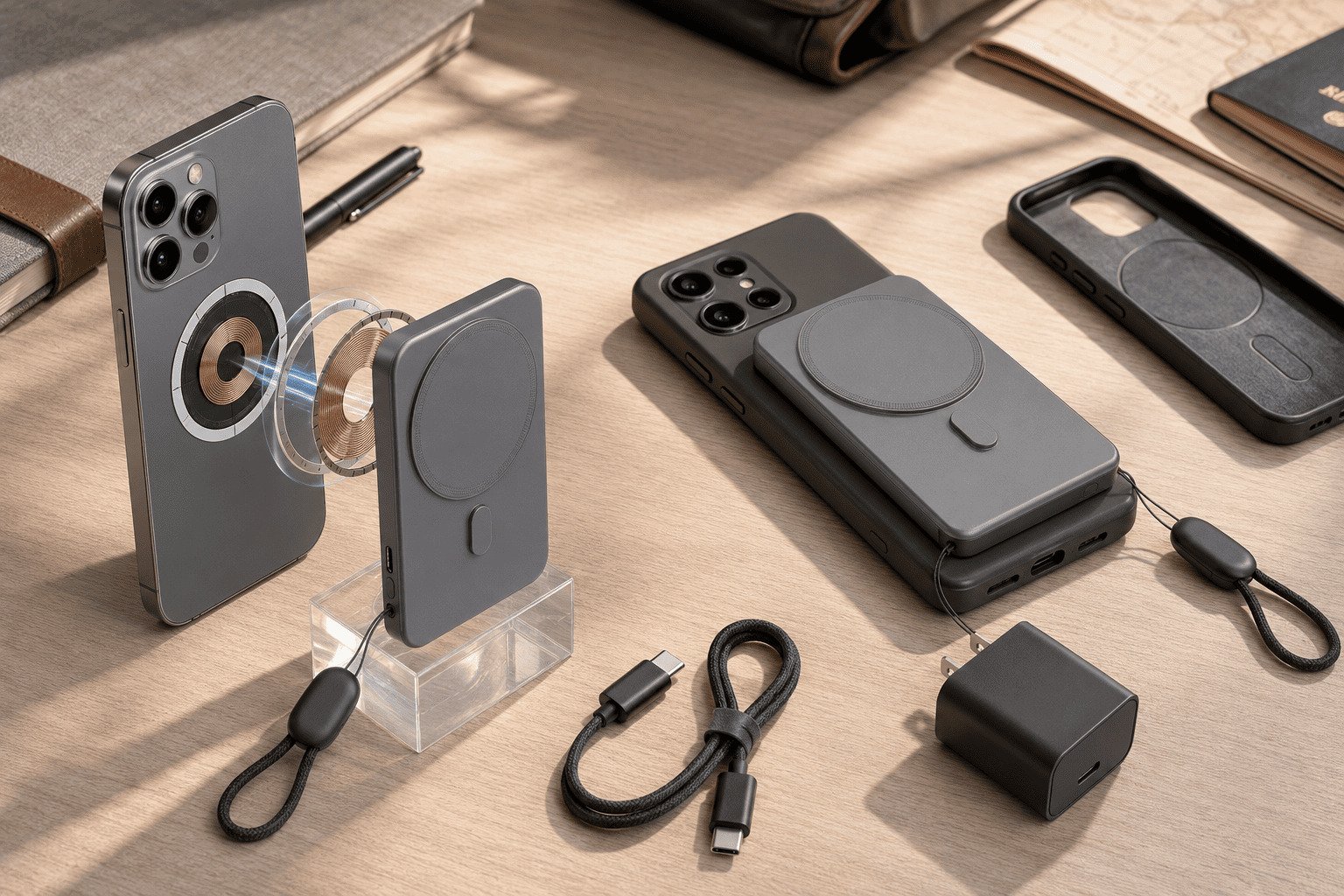
Qi2 25W is the WPC branding for the newer Qi v2.2.1 standard.1 It raises maximum wireless power from 15W to 25W while keeping magnetic alignment, interoperability testing, thermal monitoring, intelligent power management, and foreign-object detection.2 However, real-world performance depends on more than the logo.
What makes a Qi2 25W Magnetic Power Bank different?
A Qi2 25W Magnetic Power Bank is different because it combines magnetic alignment with a higher certified wireless power ceiling. The upgrade is not only about speed. It also requires better control of power delivery, coil alignment, heat, and safety.
The short answer is simple: Qi2 25W increases the maximum wireless charging output from 15W to 25W under the Qi v2.2.1 framework, but only compatible phones and certified power banks can use that higher level.
Why 25W is harder in a power bank
A wall charger can draw stable power from an outlet. A power bank must convert stored battery energy into wireless output while managing heat inside a small enclosure.3 That makes 25W wireless charging much more demanding.
A good Qi2 25W design needs:
- High-quality battery cells with stable discharge performance
- Efficient power conversion to reduce energy loss
- Accurate magnetic coil alignment to avoid wasted power
- Thermal monitoring to prevent overheating
- Smart firmware to adjust output based on phone status
- Proper casing design for heat dissipation and magnetic strength
“Up to 25W” does not mean continuous 25W charging.4 The phone may reduce power when the battery reaches a higher state of charge, when the device becomes warm, when apps are running, or when the case blocks heat transfer.
| Factor | Effect on real charging |
|---|---|
| Phone support | Both phone and bank must support Qi2 25W |
| Battery level | Charging usually slows as battery percentage rises |
| Temperature | Heat can trigger power reduction |
| Case design | Thick or non-magnetic cases reduce alignment and efficiency |
| Firmware | Charging curves depend on device control strategy |
| Internal battery size | Higher output consumes power-bank capacity faster |
For users, this means Qi2 25W is best for short, fast top-ups, such as charging from 20% to 50% while commuting. It may be less important for overnight charging, where 15W is already enough.
Is a Qi2 25W Magnetic Power Bank faster in real use?
A Qi2 25W Magnetic Power Bank can be faster in real use, but the speed gain depends on the full charging system. The phone, power bank, case, ambient temperature, and firmware all influence the charging curve.
The practical answer is: Qi2 25W should charge compatible devices faster than 15W in ideal conditions, especially at lower battery levels, but it may not sustain 25W throughout the full session. Thermal limits often matter more than the peak rating.
What a trustworthy test should include
We should be careful with performance claims. A meaningful test should not only say “charged fast.” It should document the exact conditions.
A proper test report should list:
- Phone model
- Power bank model and firmware version
- Initial phone battery level, such as 10%, 20%, or 50%
- Ambient temperature, for example 23°C or 30°C
- Case type, including magnetic case thickness
- Charging curve, not just one final number
- Surface temperature data on phone and power bank
- Usable capacity, not only nominal mAh
- USB-C input and output performance
- Pass-through charging behavior, if supported
For example, a 10,000mAh power bank does not deliver 10,000mAh into a phone. Wireless conversion loss, voltage conversion, heat, and battery protection reduce usable capacity.5 This is why procurement teams should compare measured Wh output and real charging sessions instead of relying only on nominal mAh.
What buyers should expect
Qi2 25W can bring visible benefits when:
- The phone supports Qi2 25W
- The power bank is fully certified
- The case supports magnetic alignment
- The device is not already hot
- The user wants quick charging during travel
But 15W may still be enough when:
- The user charges overnight
- Cost is a priority
- The product must be slim and light
- Cooler operation is more important than speed
- The target phone base does not yet support Qi2 25W
This is why we do not treat 25W as an automatic replacement for every 15W product.
How should we compare MagSafe and Qi2?
MagSafe and Qi2 should not be treated as direct opposites.MagSafe is Apple’s magnetic charging and accessory ecosystem.6 Qi2 is a WPC-certified, multi-brand wireless charging standard developed with magnetic technology contributed by Apple.7
The concise comparison is: MagSafe is Apple-centered, while Qi2 is a broader certification standard for multiple brands. Their user experience overlaps, but certification systems, device coverage, accessory rules, and market positioning are different.
MagSafe vs. Qi2 in practical terms
| Topic | MagSafe | Qi2 |
|---|---|---|
| Ecosystem | Apple magnetic accessory system | WPC multi-brand standard |
| Certification | Apple-controlled programs | WPC certification and Qi ID |
| Device coverage | Mainly iPhone ecosystem | iPhone and supported Android devices |
| Magnetic alignment | Yes | Yes, through Magnetic Power Profile |
| Power level | Depends on product and device | Qi2 15W or Qi2 25W depending on standard version |
| Buyer concern | Apple compatibility and accessory fit | WPC certification and cross-brand support |
For consumers, the experience may look similar: the power bank snaps onto the back of the phone. For buyers, the difference is important. A product can be “MagSafe-compatible” without being Apple MagSafe certified.8 A Qi2 product should have WPC certification for the finished product, not only a certified component.
We recommend comparing products by actual use cases:
- iPhone users: Check whether the iPhone model supports the claimed wireless speed.
- Android users: Android users: Check whether the phone supports Qi2 or Qi2 25W.
- Travel users: Check weight, thickness, and airline battery labeling.
- Retail buyers: Check packaging claims, certification documents, and after-sales risk.
- Brand owners: Check whether the supplier can customize ID design without affecting thermal performance.
What should B2B buyers verify before bulk orders?
B2B buyers should verify finished-product certification, not only chipset claims. A certified module does not automatically make the complete power bank Qi2 certified.9
The direct answer is: Before bulk orders, buyers should verify the product’s Qi ID in the WPC database and review battery, transport, wireless, EMC, safety, and target-market compliance documents.
Key documents to request
Procurement teams should ask suppliers for:
- WPC Qi certification and Qi ID
- UN38.3 transport test report10
- MSDS / SDS for battery shipping
- IEC/UL battery safety documents where applicable
- FCC, CE, RoHS, UKCA, PSE, KC, or other market certifications
- Charging performance report with thermal data
- Aging test and reliability test summaries
- Production QC flow and inspection standards
For a 25W magnetic power bank, factory capability also matters. The supplier should control coil placement, magnet strength, battery consistency, firmware tuning, and heat dissipation. Small assembly errors can reduce efficiency or increase temperature.
At Fabucharger, we focus on OEM and ODM wireless charging products for global buyers. For Qi2 25W projects, we believe buyers should review not only appearance and price, but also certification path, power architecture, production stability, and market compliance.
Frequently Asked Questions
Does Qi2 25W work with every iPhone?
No. The phone must support the required Qi2 25W charging profile. Older iPhone models may charge at lower wireless power levels even if the power bank supports 25W.
Is Qi2 25W safer than ordinary magnetic charging?
Qi2 certification includes requirements such as magnetic alignment, interoperability testing, thermal monitoring, intelligent power management, and foreign-object detection. However, safety still depends on the finished product design, battery quality, and certification status.
Does a 10,000mAh Qi2 power bank fully charge a phone twice?
Not always. Nominal mAh is measured at cell voltage, while phone charging involves conversion loss and wireless loss. Buyers should check usable output capacity and real charging data.
Is wired USB-C still useful on a Qi2 25W power bank?
Yes. USB-C wired output is useful when users need higher efficiency, cooler charging, or compatibility with devices that do not support Qi2 magnetic wireless charging.
Conclusion
A Qi2 25W Magnetic Power Bank is a future-ready choice for users with compatible phones who want faster wireless top-ups on the go. Still, it is not automatically better for every market or user. A well-designed certified 15W power bank may be cheaper, lighter, cooler, and better for overnight use. For wholesale, ODM, or brand projects, we recommend comparing certification, thermal performance, usable capacity, and compliance documents before placing orders. Contact Fabucharger if you need OEM or ODM support for certified wireless charging power banks.
"Qi (standard) - Wikipedia", https://en.wikipedia.org/wiki/Qi_(standard). The Wireless Power Consortium identifies Qi v2.2.1 as the specification associated with Qi2 25 W wireless charging, supporting the terminology used here. Evidence role: definition; source type: institution. Supports: The source should identify Qi2 25W as part of, or associated with, the Qi v2.2.1 wireless charging specification.. ↩
"Qi (standard) - Wikipedia", https://en.wikipedia.org/wiki/Qi_(standard). WPC documentation describes Qi2 certification as combining a higher 25 W power profile with alignment, interoperability, thermal management, and foreign-object detection requirements; this supports the standards-level claim but not the behavior of every certified product. Evidence role: general_support; source type: institution. Supports: The source should support that the newer Qi2 framework increases maximum wireless charging power to 25 W and includes requirements for alignment, interoperability, thermal control, power management, and foreign-object detection.. Scope note: Standards documentation describes certification requirements and maximum rated capability, not measured performance for a specific power bank. ↩
"Inductive charging - Wikipedia", https://en.wikipedia.org/wiki/Inductive_charging. Studies of inductive wireless power transfer report that conversion inefficiencies generate heat and require thermal management, providing the engineering basis for the added constraints in compact battery-powered chargers. Evidence role: mechanism; source type: paper. Supports: The source should explain that wireless charging involves conversion losses that appear as heat and that compact battery-powered systems must manage those losses.. Scope note: Such studies usually describe the general mechanism and may not test Qi2 25 W power banks specifically. ↩
"Why are rechargeable batteries charged CC/CV? - Reddit", https://www.reddit.com/r/AskElectronics/comments/3ygdmz/why_are_rechargeable_batteries_charged_cccv/. Educational battery-engineering references describe lithium-ion charging as a controlled process in which current and power are reduced as voltage, state of charge, or temperature limits are approached, supporting the distinction between peak and sustained charging power. Evidence role: mechanism; source type: education. Supports: The source should explain that charging power is managed dynamically and commonly decreases because of battery state-of-charge and temperature limits.. Scope note: The source supports the charging-control mechanism generally rather than documenting a particular Qi2 25 W product curve. ↩
"Why is the Rated Capacity of Power Banks Lower Than Expected?", https://service.anker.com/au/article-description/Why-is-the-Rated-Capacity-of-Power-Banks-Lower-Than-Expected. Technical discussions of portable battery packs and wireless power transfer show that delivered energy is lower than nominal cell capacity because of DC conversion, wireless-transfer inefficiency, thermal loss, and battery-management limits. Evidence role: mechanism; source type: research. Supports: The source should support that stored battery energy is reduced by voltage conversion, wireless transfer inefficiency, thermal losses, and protection circuitry before reaching the receiving device.. Scope note: The evidence supports the general energy-loss pathway; the exact usable capacity depends on the tested power bank, receiver, cable or wireless mode, and temperature. ↩
"MagSafe (wireless charger) - Wikipedia", https://en.wikipedia.org/wiki/MagSafe_(wireless_charger). Apple describes MagSafe for iPhone as a magnetic charging and accessory system, supporting the article's definition of MagSafe as Apple-centered. Evidence role: definition; source type: institution. Supports: The source should define MagSafe as Apple's magnetic charging and accessory system for compatible devices.. ↩
"Qi (standard) - Wikipedia", https://en.wikipedia.org/wiki/Qi_(standard). WPC materials state that Qi2 is a consortium standard and that its Magnetic Power Profile was developed using technology contributed by Apple, supporting the historical context for the MagSafe-Qi2 comparison. Evidence role: historical_context; source type: institution. Supports: The source should state that Qi2 is a WPC standard and that its Magnetic Power Profile was developed with technology contributed by Apple.. ↩
"MFi Program - Wikipedia", https://en.wikipedia.org/wiki/MFi_Program. Apple accessory-program materials distinguish certified MagSafe accessories from products that merely claim compatibility, supporting the need to treat “MagSafe-compatible” as different from Apple certification. Evidence role: definition; source type: institution. Supports: The source should distinguish general compatibility claims from formal Apple certification or Made for MagSafe authorization.. Scope note: Apple documentation may define certification categories without surveying how all third-party sellers use compatibility language. ↩
"Qi Certified Products | Wireless Power Consortium", https://www.wirelesspowerconsortium.com/knowledge-base/testing-and-certification/qi-certified-products/. WPC certification materials describe Qi certification and Qi ID listing at the product level, supporting the statement that a certified module alone does not establish certification for a complete power bank. Evidence role: general_support; source type: institution. Supports: The source should support that Qi certification is granted to listed products with Qi IDs and that component certification does not automatically extend to the finished device.. Scope note: The exact treatment of modules, reference designs, and finished products depends on the current WPC certification program rules. ↩
"Lithium Battery Test Summaries (TS) | PHMSA", https://www.phmsa.dot.gov/training/hazmat/new-un-requirement-test-summaries. Transport-regulation guidance for lithium batteries refers to UN Manual of Tests and Criteria subsection 38.3 testing and test-summary documentation, supporting the inclusion of UN38.3 reports in procurement checks for power banks. Evidence role: general_support; source type: government. Supports: The source should establish that lithium cells and batteries are subject to UN 38.3 transport testing requirements and related test-summary documentation.. Scope note: Specific documentation duties can vary by jurisdiction, shipping mode, battery configuration, and consignee requirements. ↩