
Qi2 25W wireless charging1 can work through a thick phone case, but the result is not always fast, stable, or efficient. Many users see charging start and assume everything is fine. However, distance, heat, magnets, metal parts, and alignment can quietly reduce power. The better answer is to test the full charging path.
A thick phone case does not automatically block Qi2 25W wireless charging.2 A well-designed magnetic case may still charge reliably, while a thin but poorly aligned or metal-containing case may perform worse. Case thickness matters, but coil distance, magnetic-ring position, material, heat buildup, charger design, adapter output, and phone thermal control matter more.3
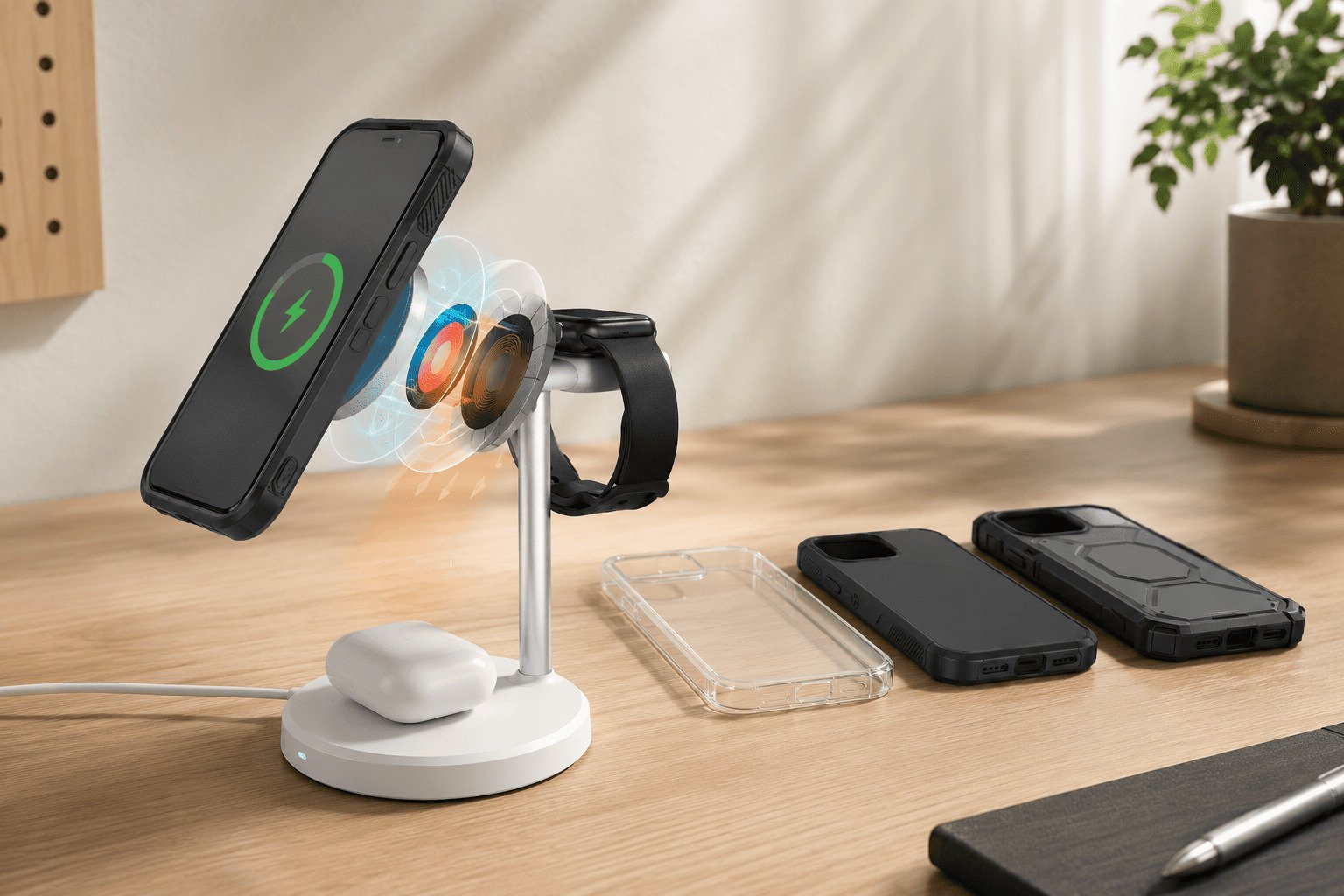
Charging success is only the first checkpoint. A phone may detect the charger and begin charging, yet fail to sustain higher power after several minutes. For real evaluation, we need to compare charging behavior over time, not just check whether the charging icon appears.
Does Case Thickness Alone Decide Qi2 25W Wireless Charging Performance?
Case thickness affects Qi2 25W wireless charging, but it is not the only factor. A thick protective case can increase transmission distance and trap heat. Still, a case with correct magnetic alignment and low-loss materials may outperform a thinner case with metal inserts or poor coil positioning.
The key point is simple: case thickness is one variable in a complete power-transfer system. Qi2 depends on magnetic alignment, receiver-coil distance, clean contact geometry, stable input power, and temperature control. If one part of that system is weak, charging speed may drop even when the case looks acceptable.
What Actually Changes When a Case Gets Thicker?
A thicker case usually creates three practical problems:
- Longer coil-to-coil distance4, which can reduce efficiency.
- Weaker magnetic coupling5, especially if the ring is misplaced.
- Higher heat retention6, which may trigger power reduction.
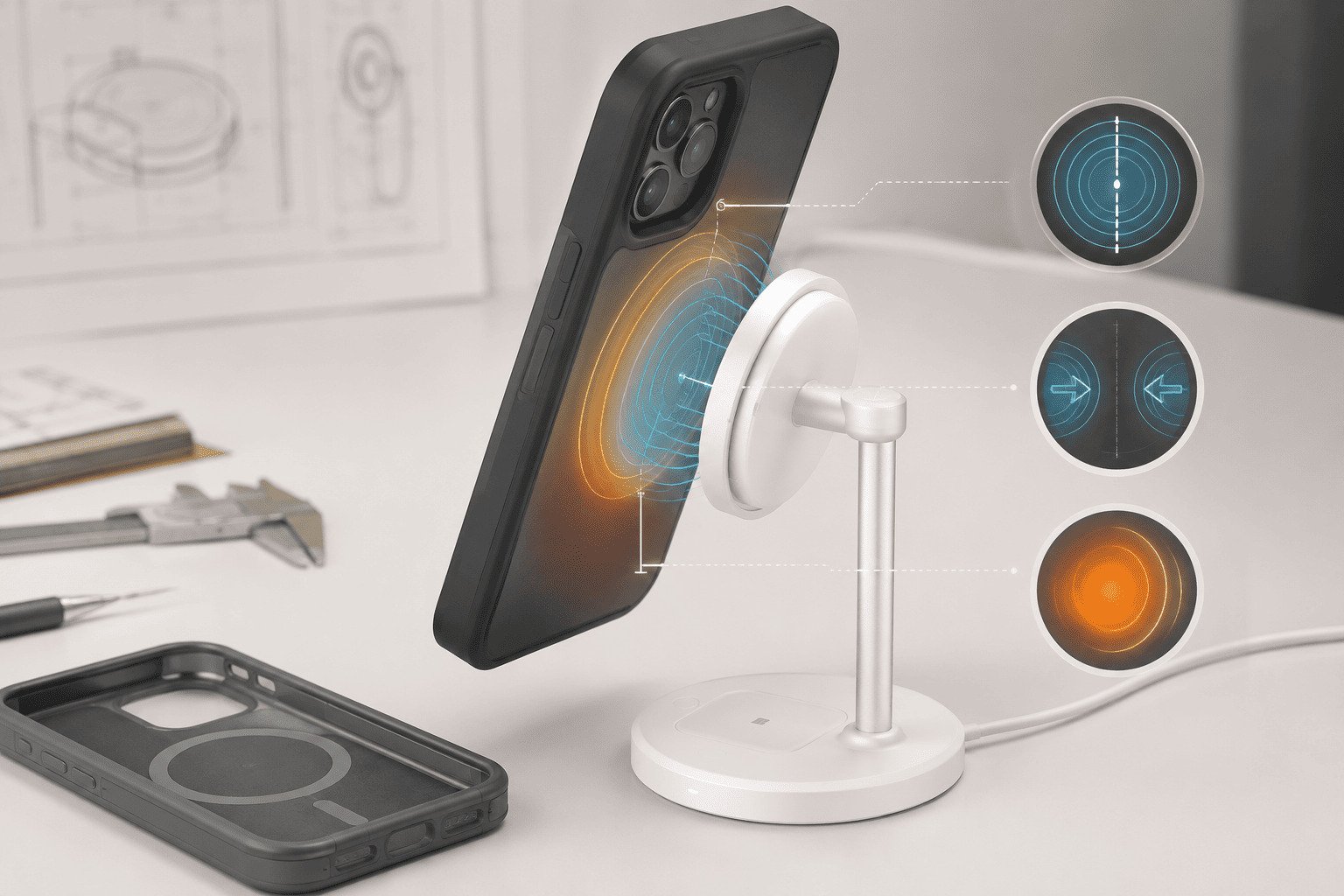
However, we should avoid saying that every case above a certain millimeter limit will fail. Real performance depends on the case structure. For example, a uniformly thick TPU protective case may work better than a slim case with a metal kickstand near the charging coil7.
| Case Feature | Possible Effect on Charging |
|---|---|
| Uniform plastic or TPU thickness | May reduce efficiency slightly |
| Misaligned magnetic ring | May cause unstable attachment and lower power |
| Metal plate or wallet layer | May block or interrupt charging |
| Raised camera-bump design | May create air gaps on flat chargers |
| Heat-trapping rugged shell | May cause power throttling after minutes |
We have seen in product evaluation that “charging starts” does not prove “charging stays at high power.” A phone can peak briefly, heat up, and then reduce input power. This matters more for Qi2 25W wireless charging because higher power creates more thermal pressure than slower wireless charging.
How Should We Test Thick Cases for Qi2 25W Wireless Charging?
We should test Qi2 25W wireless charging with a controlled comparison: bare phone, thin case, medium case, and thick case. Each test should use the same phone, same charger, same USB-C adapter, same cable, same battery starting level, and same room temperature.
A useful test records more than pass or fail. We should measure charging detection, peak input power, sustained power, temperature rise, battery gain, interruptions, and alignment stability. This gives buyers a real view of charging quality instead of a simple marketing claim.
A Practical Test Plan
For consumer brands, distributors, and importers, we recommend a repeatable test like this:
- Use one phone model and one Qi2 charger.
- Start each test at the same battery level, such as 20% or 30%.8
- Keep room temperature stable, such as 23–25°C.
- Use the same certified USB-C power adapter and cable.
- Test for a fixed time, such as 30 minutes.
- Record surface temperature every 5 or 10 minutes.
- Note any charging pause, restart, vibration movement, or misalignment.
The most useful data is not only peak wattage. Peak power may last for a short time. Sustained power is more important because users care about real battery percentage gained. A case that allows a 25W peak for one minute but drops quickly due to heat may not deliver a good user experience.
For B2B buyers, this is especially important. A charger validated only with a bare phone may look strong in a lab but fail in the market when users add rugged cases, wallet cases, magnetic cases, or decorative covers. We believe procurement teams should require testing across representative case materials, phone sizes, ambient temperatures, and charging durations.
Which Case Designs Cause the Most Problems?
The most risky cases are not always the thickest ones. Cases with metal plates, wallet layers, decorative inserts, poor magnetic-ring placement, uneven backs, or large camera-bump interference can reduce Qi2 25W wireless charging performance even when they appear slim.
A good case should keep the charging area clean, flat, and aligned. It should also avoid trapping too much heat between the phone and charger. When a phone becomes unusually hot, charges slowly, disconnects repeatedly, or needs careful repositioning, users should remove the case and test again.
Uniform Thickness vs. Local Obstacles
We should separate two case types:
- Uniform protective cases: These are thick across the back but may still work if the magnetic ring and material are correct.
- Localized obstacle cases: These include wallets, metal stands, grip accessories, magnetic plates, or raised design elements near the coil.
Localized obstacles are often more damaging than general thickness. A small metal part near the receiver coil can disturb charging more than a few extra millimeters of plastic. Air gaps also matter. If a raised camera area prevents the phone from sitting flat on a pad-style charger, the coil distance may increase unevenly.
For product teams, this means compatibility should be designed into both the charger and the case ecosystem. Charger coil structure, magnet strength, heat dissipation, firmware control, and input-power design all affect the final experience.
Frequently Asked Questions
Can a thick case still support Qi2 25W wireless charging?
Yes. A thick case can support Qi2 25W wireless charging if it uses suitable materials, has a correctly positioned magnetic ring, avoids metal near the coil, and controls heat well. Actual sustained charging speed still needs testing.
Does charging start mean the phone is receiving 25W?
No. Charging detection only means the phone and charger connected successfully. The phone may receive lower power, reduce power after heating, or interrupt charging later. Sustained power and battery gain are better indicators.
Should users remove the case when wireless charging is slow?
Yes. Users should remove the case if charging is unusually slow, hot, unstable, or repeatedly interrupted. This quick check helps identify whether the case is adding distance, blocking alignment, or trapping heat.
What should B2B buyers request from suppliers?
B2B buyers should request Qi2 compatibility testing with bare phones and representative cases. Test reports should include temperature, sustained power, charging time, interruptions, adapter specification, cable specification, and environmental conditions.
Conclusion
A thick phone case does not automatically block Qi2 25W wireless charging, but it can reduce efficiency, stability, and sustained speed. The full charging path matters: case material, thickness over the coil, magnetic alignment, metal parts, air gaps, charger structure, adapter power, cable quality, and temperature behavior. For brands, importers, and distributors, Fabucharger can support OEM/ODM wireless charger development with practical compatibility testing for real market use. Contact us to discuss your Qi2 charging product requirements.
"Qi (standard) - Wikipedia", https://en.wikipedia.org/wiki/Qi_(standard). The Wireless Power Consortium identifies Qi2 and its later specification updates as standards for magnetically aligned wireless power transfer, including higher-power profiles up to 25 W. Evidence role: definition; source type: institution. Supports: An authoritative standards source should confirm the existence of a Qi2-related 25 W wireless charging specification or profile.. Scope note: The source establishes the standard and rated profile, but it does not prove that every product labeled Qi2 25W will deliver 25 W in all real-use conditions. ↩
"Wireless Power Transfer: Systems, Circuits, Standards, and Use ...", https://pmc.ncbi.nlm.nih.gov/articles/PMC9371050/. Research on inductive wireless power transfer shows that increasing transmitter-receiver separation generally reduces coupling efficiency, although power transfer can continue when alignment and system design remain within operating limits. Evidence role: mechanism; source type: paper. Supports: A technical source should show that coil separation affects coupling and efficiency but does not inherently stop inductive power transfer.. Scope note: The evidence supports the physical mechanism generally and may not test every Qi2 25W phone-case combination directly. ↩
"Inductive charging - Wikipedia", https://en.wikipedia.org/wiki/Inductive_charging. Reviews of inductive wireless power transfer describe charging efficiency as a system-level outcome influenced by coil alignment, separation distance, intervening materials, power electronics, and thermal constraints. Evidence role: general_support; source type: research. Supports: A review or standards-oriented source should support that alignment, distance, materials, input power, and temperature control all affect wireless charging performance.. Scope note: The source would provide contextual support for the factors, not rank them exactly as the article does. ↩
"Wireless power transfer - Wikipedia", https://en.wikipedia.org/wiki/Wireless_power_transfer. Inductive power-transfer literature shows that increasing the distance between transmitter and receiver coils reduces magnetic coupling, which commonly lowers transfer efficiency and available delivered power. Evidence role: mechanism; source type: paper. Supports: A source should show that greater spacing between inductive charging coils reduces magnetic coupling and often lowers efficiency.. Scope note: The source supports the physics of coil separation but may not specify a universal phone-case thickness threshold. ↩
"Qi (standard) - Wikipedia", https://en.wikipedia.org/wiki/Qi_(standard). The Qi2 Magnetic Power Profile is designed to improve transmitter-receiver alignment, and wireless power-transfer research shows that misalignment between coils can reduce coupling and charging efficiency. Evidence role: mechanism; source type: institution. Supports: An authoritative source should explain that Qi2 uses magnetic alignment and that coil misalignment can impair wireless power transfer.. Scope note: This supports the role of alignment generally; it does not quantify the effect of every third-party case ring placement. ↩
"[PDF] Challenges and Innovations of Lithium-Ion Battery Thermal ... - ECEC", https://ecec.me.psu.edu/Pubs/2023_Liu_JHMT.pdf. Thermal-management studies of mobile electronics and lithium-ion charging indicate that restricted heat dissipation can increase device temperature, prompting control systems to limit charging power for safety and reliability. Evidence role: mechanism; source type: paper. Supports: A source should support that heat dissipation conditions affect device temperature and that charging systems may reduce power to manage temperature.. Scope note: The source may discuss thermal control broadly rather than testing the exact case designs described in the article. ↩
"Wireless Power Transfer: Systems, Circuits, Standards, and Use ...", https://pmc.ncbi.nlm.nih.gov/articles/PMC9371050/. Wireless power-transfer research describes conductive foreign objects near the magnetic field as sources of eddy-current loss and heating, which can reduce efficiency or cause protective interruption. Evidence role: mechanism; source type: research. Supports: A source should explain that nearby conductive metal can induce eddy-current losses, heating, or charging interruption in inductive wireless charging.. Scope note: The evidence supports the mechanism for metal objects generally, not the performance of a particular metal kickstand design. ↩
"State of charge - Wikipedia", https://en.wikipedia.org/wiki/State_of_charge. Lithium-ion batteries are typically charged using current- and voltage-limited stages, so charging current and power vary with state of charge; controlling initial battery level improves comparability between charging tests. Evidence role: mechanism; source type: education. Supports: A battery-technology source should explain that lithium-ion charging power and current depend on state of charge, so comparisons should control starting battery level.. Scope note: The source supports the need to control state of charge generally, not the specific choice of 20% or 30%. ↩