
A small coin under a phone can become a heat source. If buyers ignore FOD, a safe-looking charger can become a real risk.
Foreign Object Detection, or FOD, is a safety function in wireless charging.1 It helps detect metal objects in the charging area and can stop output, reduce power, or warn users to lower abnormal heating risk.2
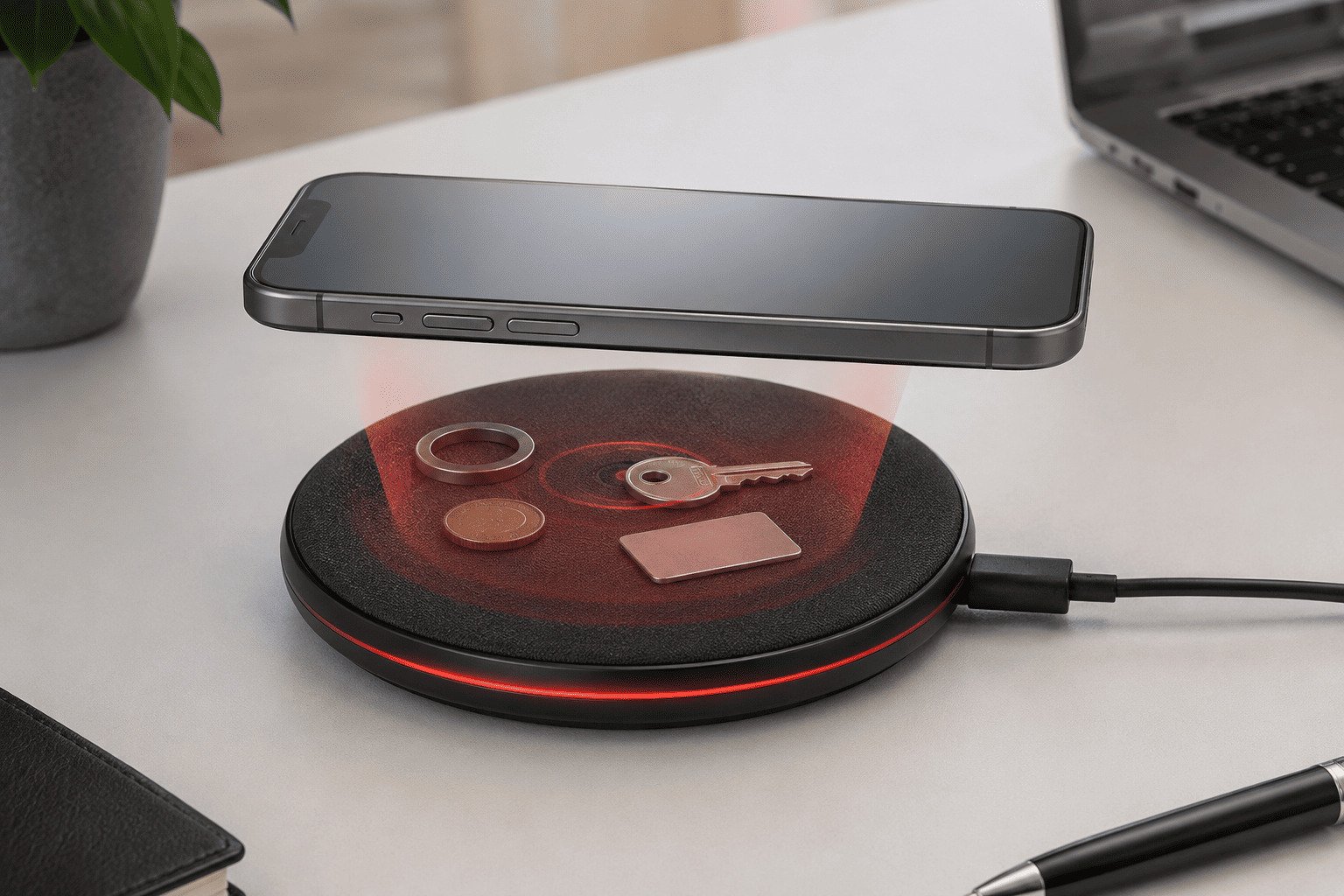
We do not see FOD as a simple selling point on a product page. We see it as part of the charger’s safety design. When we develop wireless chargers for mobile devices, we must think about coins, keys, metal phone-case parts, magnetic rings, and many small objects that users may place near the coil by mistake. A charger works in real life, not in a clean lab only. That is why FOD matters to buyers, brands, and distributors.
How does FOD reduce abnormal heating in real charging use?
A metal object near the charging coil can heat up fast due to eddy current effects and parasitic energy losses. If the charger keeps working, the user may face a severe burn risk, thermal deformation, or product damage.
Foreign Object Detection reduces this risk by checking whether abnormal energy loss may be caused by a metal object. When the charger finds a possible issue, it may stop charging, lower output power, or show an indicator warning.
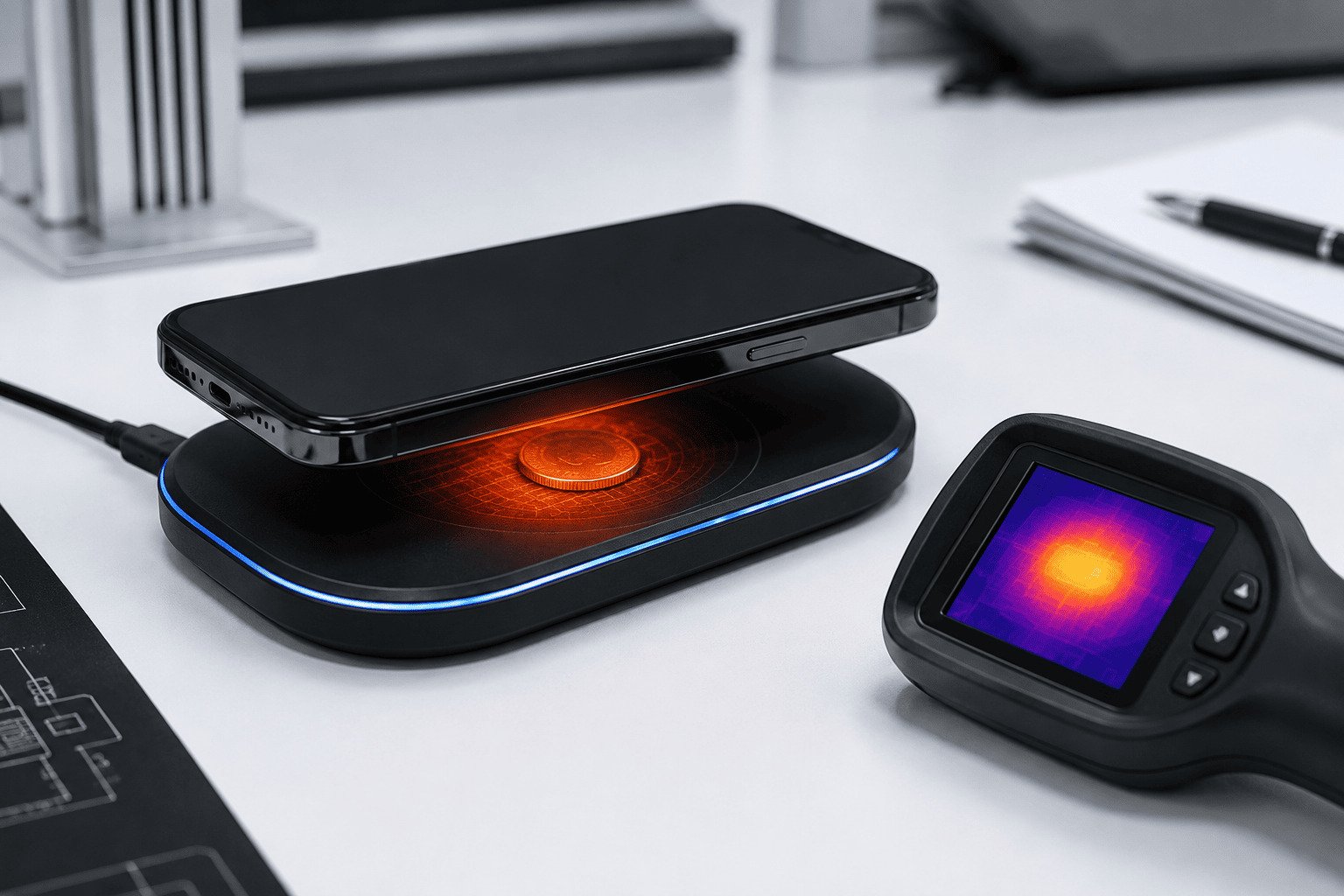
A wireless charger sends power through an electromagnetic field.3 The receiver coil inside the phone receives that power. A metal object can also react to this field. It does not work like a correct receiver coil. It may turn part of the field energy into heat.4 This heating can happen on a coin, key, jewelry, metal plate, magnetic ring, or metal part inside a phone case.
We often explain FOD to buyers with a simple idea. The charger should know the difference between useful power and suspicious power loss. If too much energy seems to disappear in the wrong place, the charger should react. This reaction is not just for comfort. It is for safety and product reliability.
Common metal objects and typical risks
| Object type | Common real-life situation | Main risk | Expected charger response |
|---|---|---|---|
| Coin | User places a coin on the charging pad | Fast surface heating | Stop output or refuse charging |
| Key | Key stays near the phone on a desk | Local hot spot | Stop output or warning light |
| Metal phone-case plate | User uses a magnetic car mount plate | Heating behind phone | Power limit or charging failure |
| Magnetic ring | User adds ring accessory to case | Coil area interference | Stop charging or unstable charging alert |
| Jewelry | Ring or chain touches pad area | Small but hot contact point | Stop output or indicator warning |
FOD is not only about one test object. A charger must face many object sizes, shapes, and positions. A very small metal object may heat in a different way from a large metal plate.5 A thin metal part inside a case may also be hard to detect. This is why we do not treat one pass result as enough proof.
Why the charger may stop, reduce, or warn
| Charger action | What it means | When it may happen |
|---|---|---|
| Stop output | The charger cuts power | The risk looks clear or charging is unsafe |
| Reduce power | The charger lowers power level | The system sees abnormal loss but not full failure |
| Indicator warning | LED or display shows an error | The charger needs the user to remove the object |
| Refuse charging | The charger does not start | The object is detected before stable charging begins |
In our product work, we prefer clear and stable behavior. A charger should not keep switching on and off in a confusing way. It should also not continue full power when a foreign object creates heat. This balance depends on hardware, firmware, coil design, and testing which prevents dangerous temperature shifts during long operations. FOD is one part of a full safety system, not a magic function.
Why must FOD work with the full charger design?
Some suppliers write “FOD supported” on the specification sheet. That phrase alone does not tell us whether the charger is safe in daily use.
Reliable FOD must work with temperature control, power management, coil design, firmware tuning, and Qi or Qi2 certification.6 If one part is weak, the total safety result may still be weak.
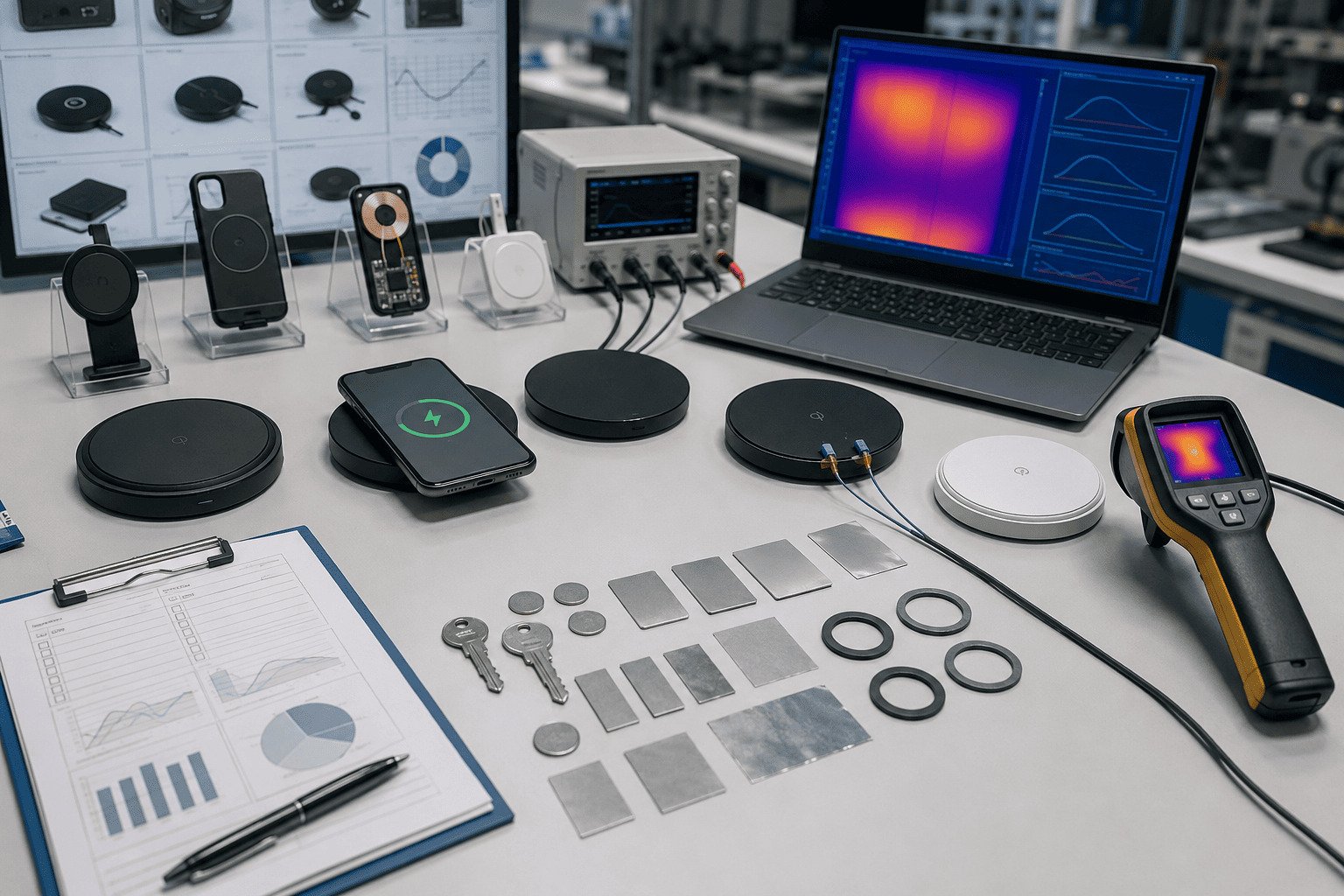
We see many buyers focus on output power first. They ask for 15W, 20W, or higher power. This is normal. The market wants fast charging. But higher power also means the safety design must be stronger as implementing technologies like MPP Power Loss Accounting (MPLA) becomes mandatory to prevent rapid heat generation under 15W thresholds. A charger with poor FOD tuning may look fine during short testing.7 It may fail during long charging, high room temperature, thick phone case use, or poor phone alignment.
FOD depends on how the whole charging system reads power. The transmitter measures input and output behavior. The receiver inside the phone also affects the result. The coil size, coil position, shielding material, PCB layout, and firmware limits all change the final response.8 A good design should reduce false alarms and also reduce missed risks.
FOD is only one layer of protection
| Safety layer | Role in wireless charging | Why it matters |
|---|---|---|
| FOD | Finds possible metal objects and abnormal loss | Reduces heating risk from foreign objects |
| Temperature control | Monitors heat on key parts | Stops long-term overheating |
| Power management | Controls voltage, current, and output level | Keeps charging stable and safer |
| Coil design | Shapes the charging field | Reduces wasted energy and hot spots |
| Firmware tuning | Decides response rules | Makes protection actions stable |
| Certification testing | Checks compliance with standards | Gives buyers basic third-party confidence |
Qi and Qi2 certification also matter.9 They do not replace internal quality work, but they provide a common base. A product that follows WPC rules has a clearer technical path to ensure uniform safety, protocol compliance, and precise object evaluation. For buyers, certification helps reduce risk in market access and product safety claims. But buyers should still check test details, because certification is not the same as perfect behavior in every case.
FOD also has limits
We should be honest about FOD limits. FOD reduces risk. It does not guarantee that every unsafe object or every bad usage case will be detected perfectly.10 A metal object may be too small. It may sit at the edge of the coil. It may be hidden inside a phone case. The phone may be misaligned. The room may be hot. The user may charge for many hours.
This is why we do not like to say “FOD makes charging completely safe.” A more correct statement is this: FOD is a key safety and quality-control function that helps reduce abnormal heating risk when it is well designed, well tested, and stable in mass production.
In our own factory review process, we usually look at FOD together with thermal rise, charging stability, phone compatibility, and long-duration performance. We do this because one single feature cannot carry the full safety responsibility. A good charger is a system. The system must work under normal use, wrong use, and repeated use.
What should B2B buyers check before trusting an FOD claim?
A low-cost charger can list the same FOD wording as a better charger. If buyers only read the sheet, they may miss the real risk.
B2B buyers should ask for FOD test records, object samples, thermal data, case-compatibility results, long-duration charging validation, and mass-production consistency checks before they approve a supplier.
For wholesalers, importers, distributors, and brand owners, FOD is not only a technical detail. It is a procurement risk point. If a product creates heating complaints in the market, the buyer faces returns, channel pressure, brand damage, and after-sales cost. A good FOD design can reduce these problems. A weak FOD design can hide until shipment volume grows.
We suggest buyers ask direct questions. The supplier should answer with records, not only words. A serious manufacturer should know what objects were tested, where they were placed, what temperature was recorded, how long the test lasted, and how the charger responded. The supplier should also know whether the same result is stable in mass production.
Practical FOD questions for supplier audit
| Buyer question | Good answer should include | Risk if answer is weak |
|---|---|---|
| What objects were used for FOD testing? | Coins, keys, metal plates, rings, metal case parts | Test scope may be too narrow |
| Where were the objects placed? | Center, edge, between phone and pad, near coil area | Real use may not match lab test |
| What was the maximum temperature? | Thermal data with time and room temperature | Heating risk is not clear |
| How did the charger respond? | Stop, reduce power, warning indicator, or no start | Protection behavior may be unstable |
| Was phone-case compatibility tested? | Thick cases, magnetic cases, metal plates | Market complaints may increase |
| Was long-duration charging tested? | Several hours under normal and warm conditions | Short tests may hide heat problems |
| Was mass production checked? | Sampling plan and production test records | Pilot sample may not represent bulk goods |
Buyers should also check the supplier’s quality system. ISO 9001, BSCI, WPC membership, and product certifications such as UL, CE, FCC, RoHS, PSE, KC, Qi, or Qi2 can support trust.11 But the buyer should still ask for the real product test report. A certificate shows one part of compliance. A full engineering file shows how the product was controlled.
Why production consistency matters
A sample can pass FOD testing. Bulk production can still fail if key parts change.12 The coil supplier may change. The shielding material may change. The firmware version may change. The PCB layout may receive a small update. The case material may change thickness. Each change can affect FOD behavior.
This is why mass-production consistency is important. We believe the buyer should ask how the factory controls approved parts, firmware versions, production testing, and incoming material checks where component tolerances and shielding alignment directly alter the final FOD calibration thresholds. If the product comes from a factory with stable R&D, production, and quality control, the FOD result is more likely to remain stable.
In our manufacturing work, we see FOD as proof of engineering discipline. A disciplined factory does not only chase output power and appearance. It checks heat, loss, safety response, certification, and user behavior. It also keeps records. Those records help buyers make a safer decision before placing bulk orders.
A simple buyer checklist
| Check item | Why it matters |
|---|---|
| FOD test record | Shows actual detection performance |
| Metal object sample list | Shows whether the test covered real objects |
| Thermal image or temperature log | Shows heat rise and risk level |
| Firmware version control | Prevents hidden changes after approval |
| Case-compatibility test | Reduces complaints from phone-case users |
| Qi or Qi2 report | Confirms standard-based design direction |
| Long-duration validation | Finds problems that short tests miss |
| Production sampling plan | Helps keep bulk order quality stable |
A buyer does not need to become an engineer to ask these questions. The buyer only needs to ask for proof. If a supplier can give clear records and explain the test logic in simple words, that is a good sign. If a supplier only repeats “we support FOD” without data, the buyer should slow down.
Conclusion
FOD is a safety and quality-control system. We should judge it by real tests, stable design, and mass-production proof, not by one checkbox.
"Wireless Power Consortium: Home", https://www.wirelesspowerconsortium.com/. A Wireless Power Consortium or comparable standards source describes foreign object detection as a safety-related function in wireless power transfer that identifies non-receiver objects in the charging field to reduce unsafe power loss and heating. Evidence role: definition; source type: institution. Supports: Foreign object detection is part of wireless power charging safety and is used to identify objects that may cause unsafe energy loss or heating.. ↩
"[PDF] A review of foreign object detection (FOD) for inductive power ...", https://chrismi.sdsu.edu/publications/170.pdf. Technical literature on wireless power transfer describes FOD as a protection mechanism in which a transmitter evaluates abnormal power loss or object presence and may inhibit, reduce, or fault power transfer when a foreign object is suspected. Evidence role: mechanism; source type: research. Supports: Wireless charging FOD systems can respond to suspected foreign objects by interrupting or limiting power transfer and by reporting a fault condition.. Scope note: The source may describe typical control actions rather than proving that every commercial charger implements all listed responses. ↩
"Wireless power transfer - Wikipedia", https://en.wikipedia.org/wiki/Wireless_power_transfer. General references on wireless power transfer explain that inductive charging transfers energy through electromagnetic fields between coupled transmitter and receiver coils rather than through wired electrical contact. Evidence role: definition; source type: encyclopedia. Supports: Wireless power transfer and inductive charging use electromagnetic fields to transfer energy between a transmitter and receiver.. ↩
"Eddy current - Wikipedia", https://en.wikipedia.org/wiki/Eddy_current. Educational and engineering sources on electromagnetic induction explain that time-varying magnetic fields can induce eddy currents in conductive objects, and resistive losses from those currents convert part of the field energy into heat. Evidence role: mechanism; source type: education. Supports: Conductive metal objects exposed to changing electromagnetic fields can experience induced currents that dissipate energy as heat.. ↩
"Eddy current - Wikipedia", https://en.wikipedia.org/wiki/Eddy_current. Experimental and modeling studies of foreign objects in wireless power transfer systems report that induced heating depends on object geometry, material properties, and position relative to the transmitter coil. Evidence role: mechanism; source type: paper. Supports: The heating of foreign metal objects in wireless power fields varies with object size, shape, material, and placement.. ↩
"[PDF] Foreign Object Detection in Wireless Power Transfer Systems", https://chrismi.sdsu.edu/publications/194.pdf. Engineering literature on wireless power systems treats foreign-object detection as one element of an integrated safety architecture that also includes coil design, power regulation, thermal monitoring, and protocol-level controls. Evidence role: expert_consensus; source type: research. Supports: Wireless charging safety depends on multiple interacting design elements, including detection algorithms, coil design, thermal monitoring, and power-control behavior.. Scope note: The source may support the systems-level relationship generally rather than naming every component in the article’s list. ↩
"[PDF] A review of foreign object detection (FOD) for inductive ... - Chris Mi", https://chrismi.sdsu.edu/publications/170.pdf. Studies of wireless charging thermal behavior show that temperature rise and control stability can depend on charging duration, alignment, load, and ambient conditions, indicating that short functional checks may not capture all thermal risks. Evidence role: general_support; source type: paper. Supports: Thermal and safety behavior in wireless charging can vary over time and under operating conditions, so short tests may not fully characterize risk.. Scope note: The source would provide contextual support for the testing concern rather than direct evidence about a specific charger model. ↩
"Receiver–Coil Location Detection in a Dynamic Wireless Power ...", https://pmc.ncbi.nlm.nih.gov/articles/PMC8949139/. Research on inductive wireless power transfer shows that coupling, losses, and detection thresholds are sensitive to coil geometry, alignment, shielding materials, and control settings, which can affect the transmitter’s interpretation of abnormal power loss. Evidence role: mechanism; source type: paper. Supports: Wireless power transfer behavior and foreign-object detection thresholds can be influenced by coil geometry, alignment, shielding, electronics layout, and control parameters.. Scope note: The source may not address PCB layout and firmware in the same study, so it should be used as contextual support for the broader design-dependence claim. ↩
"Qi (standard) - Wikipedia", https://en.wikipedia.org/wiki/Qi_(standard). The Wireless Power Consortium describes Qi and Qi2 as standards and certification programs intended to verify compliance and interoperability for wireless charging products. Evidence role: historical_context; source type: institution. Supports: Qi and Qi2 are certification programs associated with Wireless Power Consortium standards for wireless charging interoperability and compliance.. Scope note: Certification supports standards compliance but does not independently prove flawless behavior under every user condition. ↩
"Foreign Object Detection for Wireless Power Transfer", https://available-inventions.umich.edu/product/foreign-object-detection-for-wireless-power-transfer. Wireless power transfer studies note that FOD performance is limited by object material, geometry, placement, and measurement thresholds, so detection reduces foreign-object heating risk but cannot be treated as a guarantee against every unsafe condition. Evidence role: expert_consensus; source type: paper. Supports: Foreign-object detection systems have practical limits because detectability depends on object size, position, material, coupling conditions, and algorithm thresholds.. ↩
"ISO 9001:2015 - Quality management systems — Requirements", https://www.iso.org/standard/62085.html. ISO and international conformity-assessment guidance state that management-system certification and product conformity assessment are mechanisms for providing confidence that organizations or products meet defined requirements. Evidence role: general_support; source type: institution. Supports: Formal quality-management and conformity-assessment frameworks are used to provide confidence that products, processes, or organizations meet specified requirements.. Scope note: This supports the general role of certification in buyer confidence, not the effectiveness of every credential listed or the safety of any specific charger. ↩
"ISO 9001: 2015 & QMS Change Management for Life Sciences", https://www.mastercontrol.com/gxp-lifeline/iso-9001-2015-qms-change-management-best-practices/. Quality-management standards such as ISO 9001 require organizations to control planned changes and review their consequences because changes in production inputs or processes can affect product conformity. Evidence role: expert_consensus; source type: institution. Supports: Quality-management standards require control of production and design changes because changes can affect product conformity and performance.. ↩