
A phone that charges well on a desk can fail in a car.1 I see this problem when bumps, heat, and weak power meet.
Stable MagSafe-style charging in a car needs four things working together2: magnetic alignment, mount stability, USB-C PD input power, and heat control. “MagSafe compatible” alone does not promise stable charging3 during navigation, braking, turning, or summer driving.
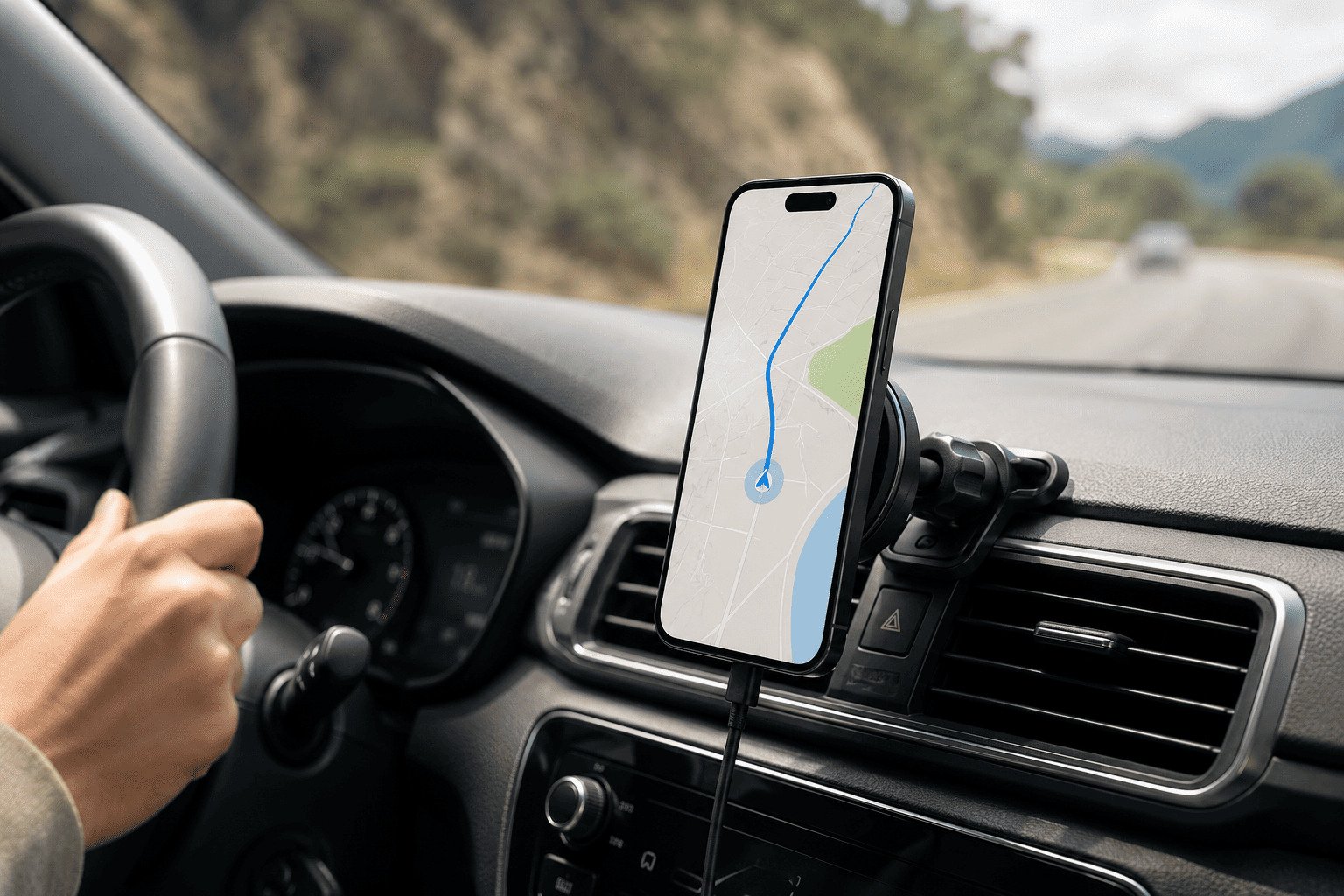
I do not judge an in-car wireless charger only by its watt number. I judge it by what happens on the road. The phone must stay aligned. The mount must not droop. The power input must stay steady. The phone must not get too hot. If one part fails, the driver sees charging icons flashing, slow battery gain, or a phone slipping after a bump4. This is why I treat car MagSafe integration as a system, not as a simple convenience feature.
Why does “MagSafe compatible” not guarantee stable charging in a car?
Many drivers buy a MagSafe-compatible charger and expect a perfect result. I have seen the same setup work on a desk but fail on rough roads.
A MagSafe-compatible car charger can still perform poorly if the magnet is weak, the mount shakes, the case blocks alignment, the USB-C PD adapter is underpowered, or heat forces the phone to reduce charging speed.
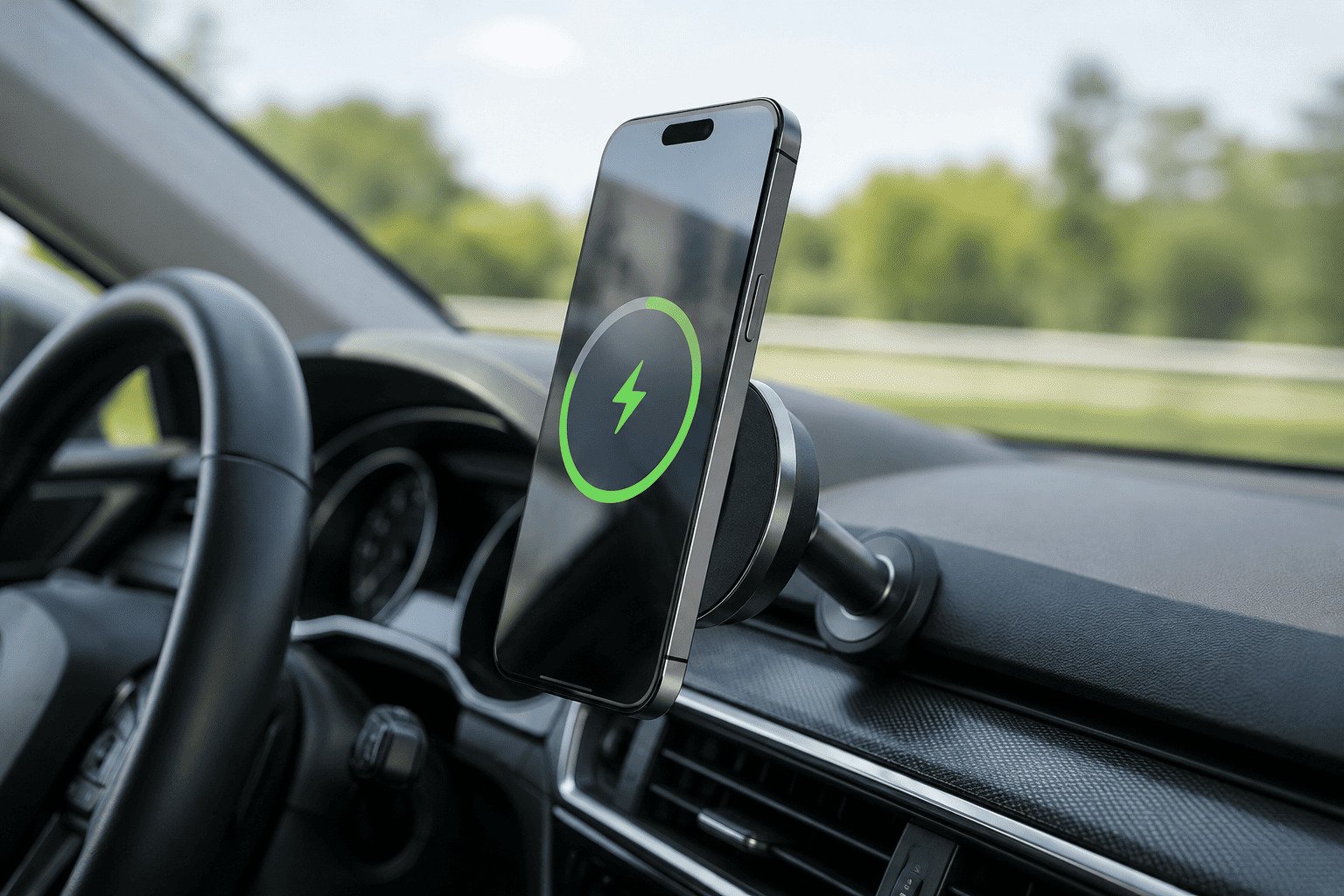
A desktop wireless charger has an easy job. The phone sits still. A car charger has a harder job.5 It must hold the phone during vibration, sharp turns, braking, and speed bumps. It must also charge while the screen is on for GPS. I often see four weak points during real road use.
First, magnetic alignment must be strong enough to keep the coil centered and resist road gravitational acceleration6. If the phone slowly rotates, charging can become unstable. Second, the mount must be short and rigid to handle physical displacement. Based on basic mechanical laws, a long arm can shake and magnify road movement like a lever, loosening the magnetic hold. Third, the power source must provide reliable USB-C PD input. A weak car adapter can make charging start and stop constantly due to insufficient input voltage. Fourth, heat must be controlled. In summer, navigation plus sunlight can raise phone temperature and reduce charging speed, as wireless charging inherently creates some heat because [energy moves through coils](https://en.wikipedia.org/wiki/Inductive_charging)7 via electromagnetic induction, converting a small percentage of energy into thermal loss.
| Factor I check | Road problem it prevents | Practical sign |
|---|---|---|
| Magnetic alignment | Phone rotation and coil misalignment | Phone stays centered after bumps |
| Mount stability | Drooping and shaking | Screen angle stays fixed |
| USB-C PD input | Charging on and off | Charging icon stays steady |
| Heat control | Slow charging in summer | Phone stays reasonably warm, not hot |
How can I judge whether a car MagSafe setup will keep power steady?
I do not judge only by product photos. I test the charger like a driver, with navigation on, screen bright, and the car moving.
A useful car MagSafe setup should keep the phone aligned on bumpy roads, continue charging during GPS use, hold heavier phones without drooping, and manage heat during long drives.
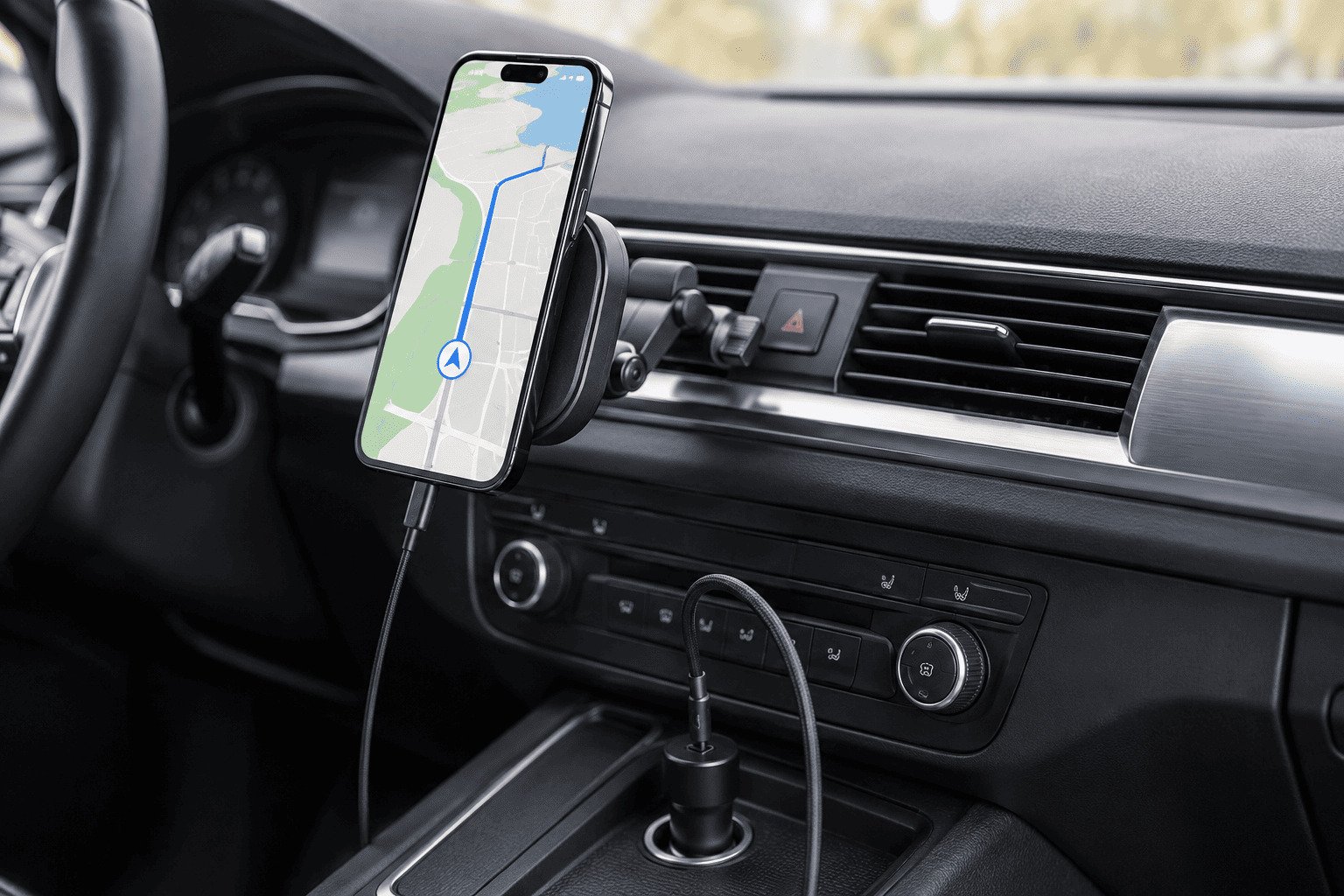
I start with the phone case. A MagSafe-friendly case is important because a thick or non-magnetic case can weaken the hold8. I then look at the mount position. A vent mount can be stable if the vent clip locks firmly. A dashboard or windshield mount can work well if the base has strong adhesion and the arm is not too long.
I also check the car power adapter. I prefer a proper USB-C PD car adapter, not an old USB-A port with a cheap cable. The charger needs stable input before it can deliver stable wireless output. I also watch heat. If the phone becomes hot during one hour of navigation, charging speed can drop. This does not always mean the charger is broken. It can mean the phone is protecting the battery through its built-in hardware thermal management. A good setup reduces this risk with better airflow, better position, and controlled power design.
| Test I use | Good result | Warning sign |
|---|---|---|
| Speed bump test | Phone stays locked and aligned | Phone slips or rotates |
| Navigation test | Battery rises or stays stable | Battery drops while “charging” |
| Heavy phone test | Mount angle stays firm | Mount slowly droops |
| Summer drive test | Phone stays reasonably cool | Charging slows after heat builds |
What should buyers and brands look for before choosing a car MagSafe charger?
I tell buyers to look beyond the word “compatible.” That word is only the start. Real performance depends on the full charging system.
A strong car MagSafe product should combine usable magnetic force, a rigid structure, secure vehicle attachment, reliable USB-C PD input, case compatibility, and heat-aware charging behavior.
For drivers, the best question is simple: does the phone stay charging when life is not perfect? Roads are not smooth. Cars shake. Drivers brake. Phones get heavier with cases. Navigation creates heat9. A car charger must handle all of this at the same time.
For wholesalers, distributors, and brand buyers, I would also check consistency across batches. One sample may feel strong, but bulk products must keep the same magnetic hold, same mount strength, and same power behavior. I also ask for compliance documents and test reports because in-car products face heat, vibration, and long use10. At Fabucharger, I see this as part of product design, not only accessory design. A charger that works well in a parked car is not enough. It must work when the driver is moving, turning, and using GPS for a long trip.
Conclusion
I see stable in-car MagSafe charging as a full system. The best setup balances alignment, mounting, PD power, and heat control.
"Environmental and Accelerated Reliability Testing for Automotive ...", https://espec.com/na/chamber_faq/answer/automotive. Sources such as automotive electronics standards describe the harsh operating environment inside a vehicle, which includes significant vibration, mechanical shock from road conditions, and a wider range of operating temperatures, all of which can affect the performance and reliability of consumer electronic devices. Evidence role: general_support; source type: institution. Supports: The source should describe the environmental stressors for electronics in automobiles, including vibration, shock, and temperature extremes, which are not present in a typical home or office setting.. ↩
"[PDF] wireless electric - vehicle charging - SANDAG", https://www.sandag.org/-/media/SANDAG/Documents/PDF/projects-and-programs/innovative-mobility/clean-transportation/wireless-electric-vehicle-charging/wireless-electric-vehicle-charging-white-paper-2022-08-01.pdf. Technical analyses of in-vehicle wireless charging systems confirm that performance and reliability are dependent on a combination of factors, including maintaining precise coil alignment despite vibration, securing the device mechanically, ensuring a stable power supply, and managing thermal load. Evidence role: general_support; source type: paper. Supports: The source should discuss the engineering challenges of implementing wireless charging in an automotive environment, ideally touching on issues of alignment, vibration, power stability, and thermal management.. Scope note: The source may discuss general Qi charging rather than Apple's MagSafe standard specifically, but the underlying physical principles are the same. ↩
"What Does MagSafe Compatible Mean? | Beginner's Guide - MOFT", https://www.moft.us/blogs/news/what-does-magsafe-compatible-mean?srsltid=AfmBOorHGOexeJuQXT6AEj71cFwZ0EQEel8dbMFnxkgj4mV8KiClsFhU. Accessory industry reporting clarifies that 'MagSafe compatible' typically indicates the presence of magnets for alignment with a MagSafe device, but unlike Apple's official 'Made for MagSafe' certification, it does not guarantee a specific magnetic force, charging rate, or performance level. Evidence role: definition; source type: other. Supports: The source should explain that 'MagSafe compatible' often refers only to the inclusion of a magnetic ring for alignment, and does not necessarily certify a specific level of magnetic holding force or charging efficiency.. ↩
"Issues with wireless charging | Samsung LEVANT", https://www.samsung.com/levant/support/mobile-devices/issues-with-wireless-charging/. Technical explanations of wireless charging show that interruptions caused by coil misalignment or an inadequate power supply can force a device's power management system to repeatedly initiate and terminate the charging cycle, resulting in symptoms like a flashing charging icon and slow or no net battery gain. Evidence role: mechanism; source type: education. Supports: The source should explain that intermittent connections, whether from physical movement causing coil misalignment or from an unstable power source, can cause a device's charging circuit to repeatedly start and stop.. ↩
"Automotive Standards for Electronic Components | Altium 365", https://resources.altium.com/p/automotive-standards-electronic-components. Automotive industry standards, such as those from the Automotive Electronics Council (AEC), mandate that electronic components for vehicles must withstand extreme temperature fluctuations, constant vibration, and mechanical shock, conditions not encountered in a stable desktop environment. Evidence role: general_support; source type: institution. Supports: The source should outline the rigorous testing standards for automotive-grade electronics, covering wide temperature ranges, resistance to vibration, and electrical transients.. ↩
"G-force - Wikipedia", https://en.wikipedia.org/wiki/G-force. Studies on vehicle dynamics show that passenger cars can experience vertical accelerations exceeding 1.5 g when hitting bumps or potholes and lateral accelerations approaching 1 g during aggressive cornering, forces which a magnetic mount must be able to withstand to hold a device securely. Evidence role: statistic; source type: paper. Supports: The source should provide data on the typical accelerations (g-forces) experienced inside a passenger vehicle during events like hitting a pothole, hard braking, or sharp turns.. Scope note: The exact g-forces can vary significantly based on the vehicle's suspension, speed, and the severity of the road imperfection or maneuver. ↩
"Inductive charging - Wikipedia", https://en.wikipedia.org/wiki/Inductive_charging. Research on inductive power transfer shows that current consumer wireless charging systems typically operate at 70-80% efficiency, with the remaining 20-30% of energy being lost, primarily as heat generated in the coils and associated electronics of both the charger and the device. Evidence role: statistic; source type: paper. Supports: The source should explain that inductive power transfer is not perfectly efficient and provide typical efficiency ranges, noting that the lost energy is primarily dissipated as heat.. ↩
"Magnetic Interference on Cardiac Implantable Electronic Devices ...", https://pubmed.ncbi.nlm.nih.gov/34074132/. The principles of magnetism dictate that the force exerted by a permanent magnet decreases rapidly with distance. A thick phone case increases the separation between the charger's magnets and the phone's internal magnets, thereby reducing the holding force. Evidence role: mechanism; source type: education. Supports: The source should explain that the strength of a magnetic field decreases with distance and can be affected by the material it passes through.. ↩
"3 W's of smartphone power consumption - WCSNG @ UC San Diego", https://wcsng.ucsd.edu/ue-power/. Studies on smartphone power consumption demonstrate that navigation applications are among the most power-intensive, as they require continuous operation of the GPS receiver, heavy CPU and GPU processing for map rendering and routing, and a constantly illuminated display, leading to substantial heat generation. Evidence role: mechanism; source type: paper. Supports: The source should show that navigation applications place a sustained, high load on multiple phone components simultaneously, leading to significant power draw and heat generation.. ↩
"[PDF] Guide to Using Automotive-Grade EEEE Parts in Space Applications", https://nepp.nasa.gov/docs/etw/2018/20JUNE18/1345%20-%20Sung%20Hong%20-%20AEC%20vs%20MIL%20PRF%20NEPP%20Talk%202018.pdf. The Automotive Electronics Council's AEC-Q family of standards (e.g., AEC-Q100 for integrated circuits) defines rigorous stress tests, including thermal cycling over wide temperature ranges and extensive vibration and shock testing, to ensure components are reliable for the demanding in-vehicle environment. Evidence role: case_reference; source type: institution. Supports: The source should be an official standard or a summary of one (like AEC-Q100/AEC-Q200) that defines the stress tests for electronic components used in automotive applications.. Scope note: These standards apply to electronic components within the car's systems, but they serve as a benchmark for the environmental stresses that any device, including a third-party accessory, will face inside a vehicle. ↩