
Your phone dying on a remote trail is a modern nightmare. A standard power bank can feel clumsy when you need to manage cables, devices, and outdoor gear at the same time, while a high-efficiency Qi2.2 magnetic power bank offers a more practical charging solution for modern travel.
Yes, a high-efficiency Qi2.2 power bank can be a practical option for outdoor adventures. Its magnetic alignment helps keep the phone and charger properly positioned, supporting more efficient wireless charging, easier usability, and better charging stability on the go. This gives travelers a more convenient way to power phones, wearables, and other small devices without relying only on tangled cables.
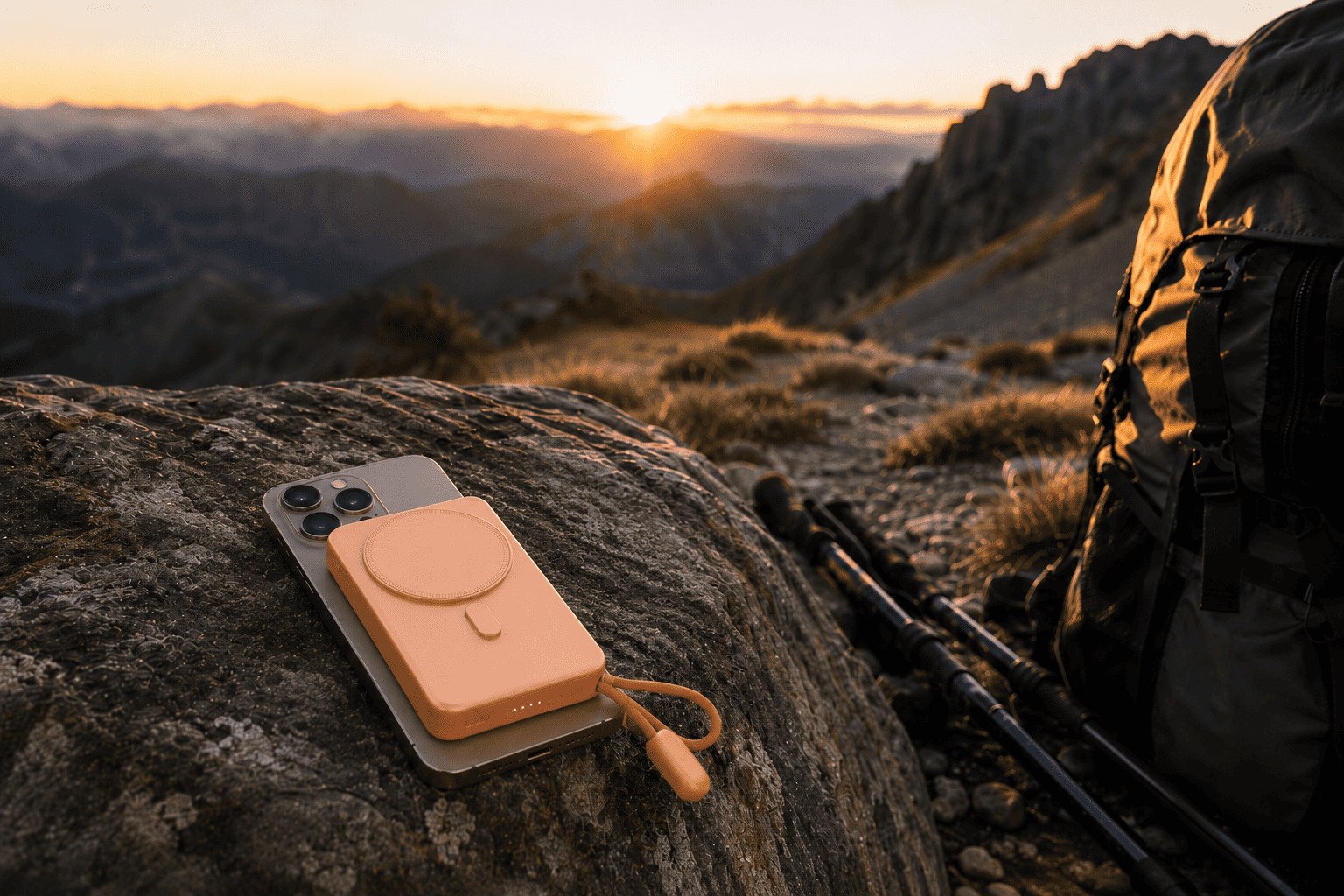
When I pack for a trip, every item is scrutinized. Does it solve a problem? Is it reliable? For years, many travelers have treated capacity as the only factor that matters in a power bank1. But in real outdoor use, the number printed on the box is not the whole story. What matters is how much energy can actually be delivered to your device, how stable the charging process is, and whether the product is safe and convenient enough for travel. This is why usable energy, charging efficiency, and battery safety matter so much for outdoor travelers.
How Does Magnetic Alignment Make Qi2.2 More Efficient for Hiking?
Your phone can shift out of position on a traditional wireless charger, especially when your gear is moving inside a backpack. That misalignment may reduce charging performance and create unnecessary heat2.
Qi2 technology uses magnetic attachment technology to align mobile devices and chargers more accurately. According to the Wireless Power Consortium’s Qi wireless charging standard, Qi2 supports faster 15W charging for certified mobile devices and uses magnetic attachment technology to improve energy efficiency, charging speed, and ease of use.
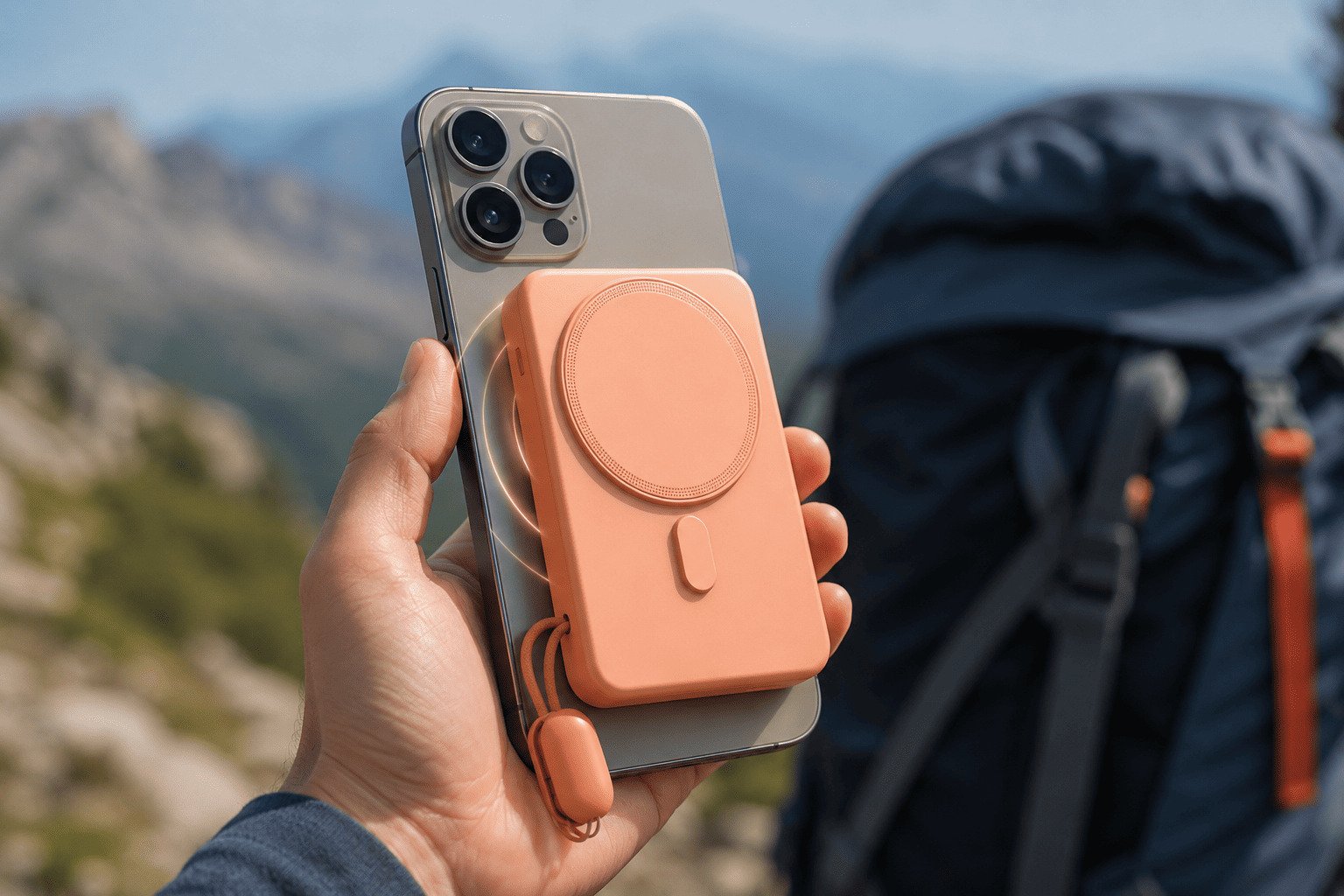
The real advantage of Qi2.2 for outdoor use is its magnetic alignment. Earlier wireless charging experiences often required users to find the correct charging position manually. If the phone and charger were not aligned well, energy transfer could become less efficient, and charging might slow down or become unstable. Research on wireless power transfer also shows that the alignment of transmitting and receiving coils affects transmission efficiency, which explains why better positioning matters in real charging scenarios.
For hiking, camping, and road trips, this matters because your gear is often moving. A magnetic power bank can stay attached more securely to a compatible phone, reducing charging interruptions when the device is placed in a bag, pocket, or on a camping table. It is not that magnetic alignment eliminates all energy loss, but it helps reduce the common losses caused by poor placement.
Here is a simple breakdown:
| Feature | Standard Wireless Charging | Qi2.2 Magnetic Power Bank | Outdoor Advantage |
|---|---|---|---|
| Alignment | Manual placement, easier to misalign | Magnetic alignment | Fewer charging interruptions during travel |
| Efficiency | More sensitive to placement | More consistent positioning | More stable power delivery |
| Heat | Misalignment may increase energy loss | Better alignment may help reduce unnecessary loss | Safer and more comfortable for packed gear |
| Speed | Depends on charger and device | Qi2 supports faster 15W charging for certified devices | Faster top-ups when compatible |
This makes magnetic wireless charging more practical for active travel, especially when convenience, compactness, and charging stability matter.
Are Qi2.2 Power Banks Truly Safe for Extreme Travel Conditions?
You worry about your power bank overheating or failing you in a remote location. In the outdoors, an unreliable charger is not just an inconvenience; it can become a real travel risk3.
Yes, but only when the product is properly designed, tested, and certified. Qi2.2 technology alone does not guarantee safety. A reliable travel power bank also depends on quality battery cells, thermal design, protection circuits, and compliance with relevant safety and market requirements. Buyers should look for certification documents and test reports, not just marketing claims.
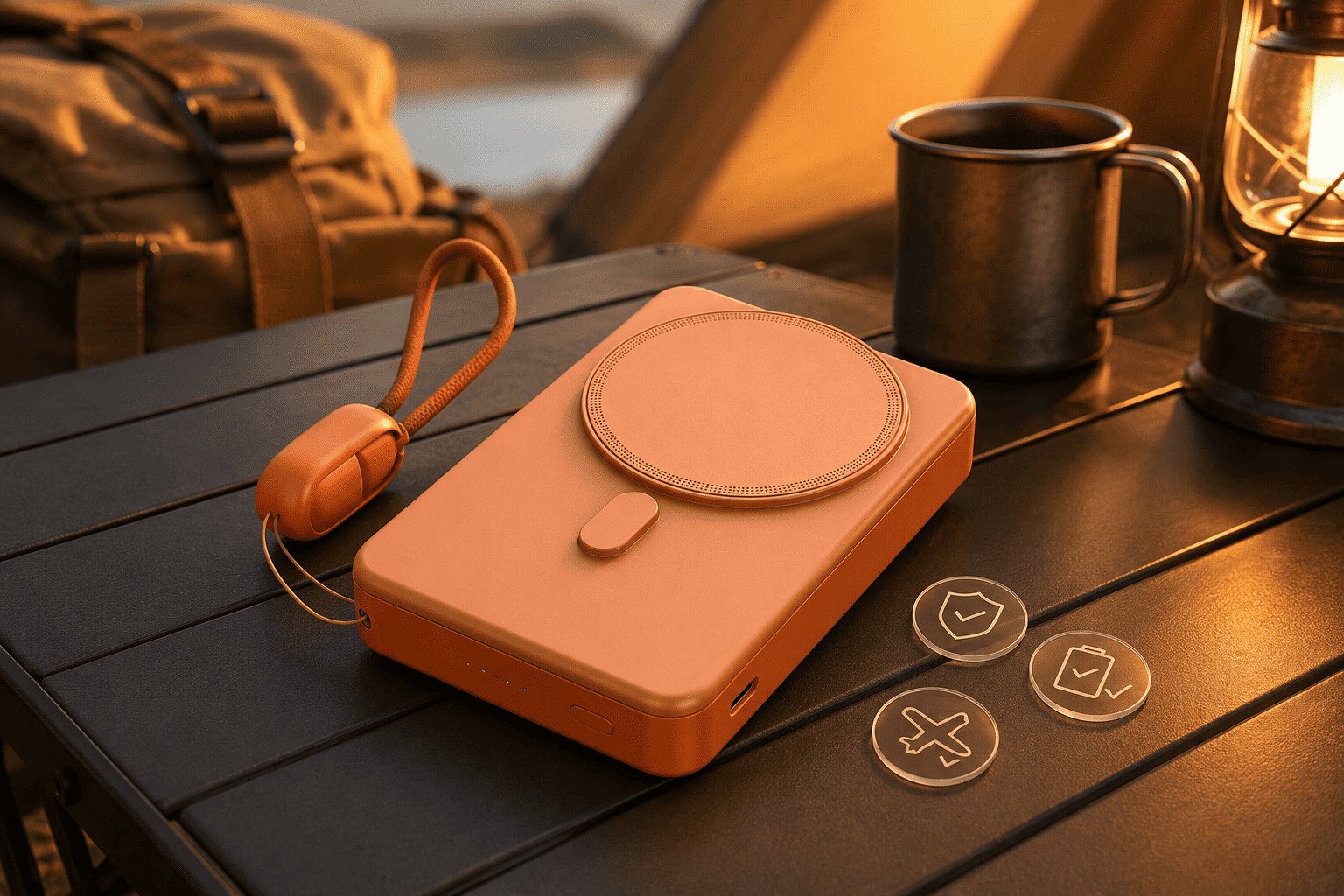
When you are miles from the nearest power outlet, you have to trust your gear completely. A power bank is no exception. Its safety depends on more than the charging standard; it depends on the quality of its construction, battery system, circuit protection, and manufacturing control.
High-Quality Battery Cells
The heart of any power bank is its battery. For travel products, buyers should evaluate battery cell quality, capacity accuracy, thermal performance, cycle life, and supplier consistency. Instead of focusing only on whether a product uses lithium-polymer or cylindrical lithium-ion cells4, B2B buyers should ask for product specifications, test reports, and quality control records.
Built-in Safety Protections
A smart power bank should be designed to protect both itself and the connected device. Important safety features include overcharge protection, over-discharge protection, overcurrent protection, short-circuit protection, foreign object detection, and temperature control. For power banks sold into demanding markets, safety testing is especially important. For example, UL 2056 for power banks addresses safety risks related to portable power banks and helps manufacturers demonstrate product safety.
The Importance of Certification
Certifications do not mean a product is risk-free, but they indicate that the product has been assessed or tested against relevant market requirements. For international buyers, this is essential for reducing procurement risk.
Look for these marks and documents:
- CE: The European Commission explains CE marking as an indication that products sold in the European Economic Area have been assessed to meet relevant safety, health, and environmental protection requirements.
- FCC: The FCC equipment authorization process applies to radio frequency devices before they can be marketed, imported, or used in the United States.
- RoHS: The European Commission’s RoHS Directive restricts hazardous substances in electrical and electronic equipment to protect public health and the environment.
- UL/ETL: Third-party safety testing can help buyers verify that a power bank has been evaluated for electrical and battery-related risks.
- Qi Certification: The WPC Qi Certified Product Database is the best place to verify whether a wireless charging product has been certified for Qi safety and interoperability.
Finally, travel buyers should also consider airline compliance. The FAA PackSafe guidance on lithium batteries states that lithium ion rechargeable batteries are limited to 100 watt-hours per battery for common passenger use, and the TSA guidance on lithium batteries notes that spare lithium-ion batteries, including power banks, must be carried in carry-on baggage. The IATA lithium battery travel guidance also highlights the importance of safe handling and packing of lithium battery-powered devices.
To estimate watt-hours, use this formula:
Wh = mAh × V / 1000
For example, a 20,000mAh battery rated at 3.7V is about 74Wh, which is generally below the 100Wh threshold. A 26,800mAh battery rated at 3.7V is about 99.16Wh, which is close to the limit. Travelers should always check the specific airline rules before flying.
Isn't Relying Only on Wireless Charging Risky Outdoors?
You enjoy the convenience of wireless charging, but what if you need to charge a non-wireless device? Carrying too many chargers and cables can feel inefficient, but relying on only one charging method is not ideal either.
That is a valid concern. That is why many well-designed outdoor power banks are not just wireless. A practical Qi2.2 magnetic power bank should also include a USB-C port, giving users the flexibility to charge phones, headlamps, cameras, GPS devices, and other small electronics with or without a cable.
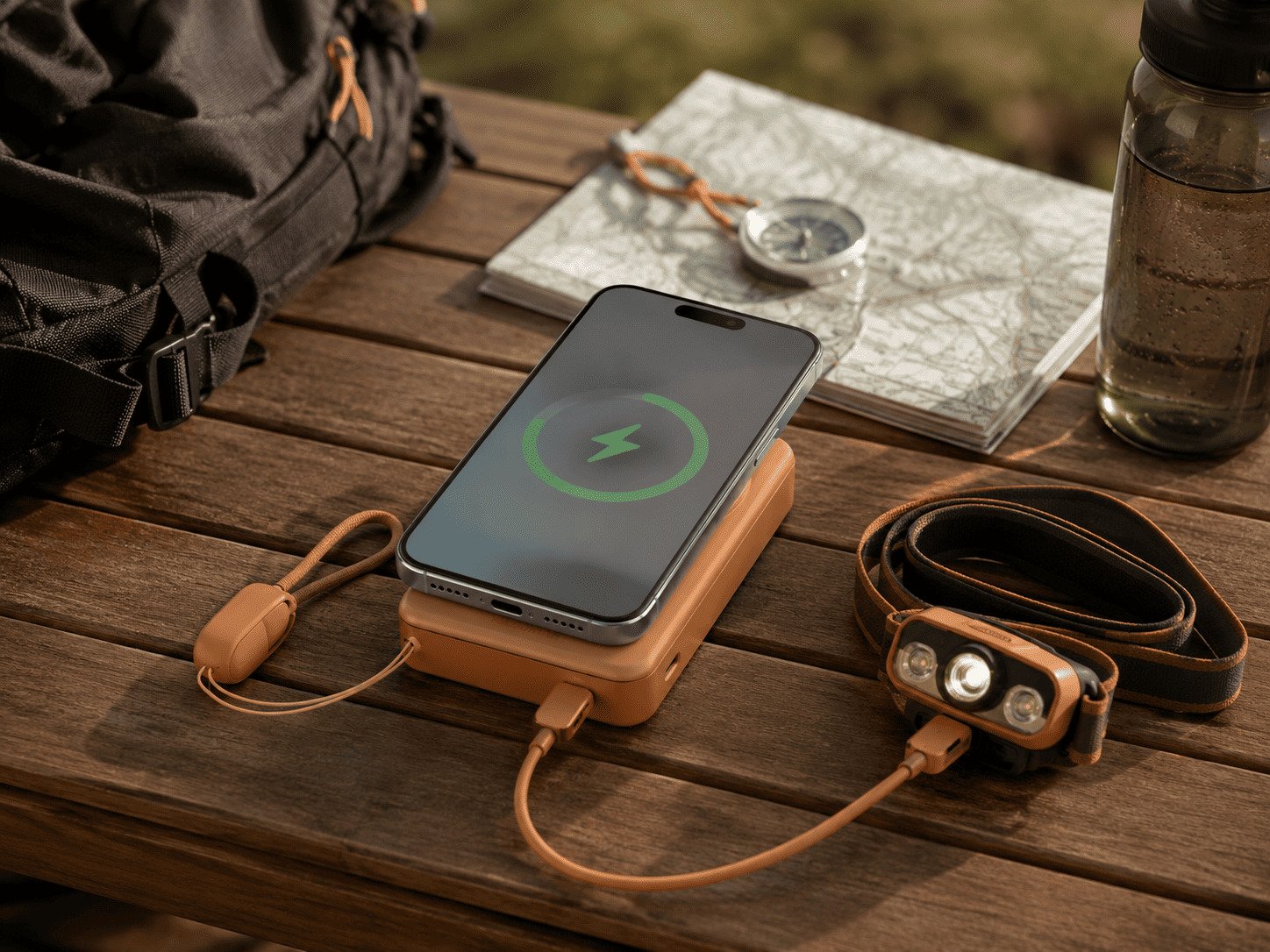
While the magnetic wireless feature is the star of the product, a smart traveler always needs a backup plan. Relying on a single charging method is not practical when outdoor gear can include phones, earbuds, smartwatches, headlamps, cameras, GPS devices, and emergency tools5.
The Power of the USB-C Port
A USB-C Power Delivery port can turn a wireless power bank into a more flexible travel power hub. The USB-IF USB Power Delivery specification defines USB Power Delivery as a charging technology for USB devices, and the USB-IF overview of USB PD charging explains that USB PD has expanded the power range available through USB Type-C charging.
A USB-C PD port allows you to:
- Fast charge your phone: When you have only a few minutes at a cafe, campsite, or airport, wired USB-C PD can often deliver faster charging than wireless charging, depending on the power bank and phone.
- Charge other outdoor gear: Your headlamp, camera, GPS device, or friend's phone may not support wireless charging. USB-C gives you broader compatibility.
- Recharge the power bank faster: A USB-C input with PD support can help refill the power bank more quickly than low-power input options, depending on battery capacity and input wattage.
| Scenario | Best Charging Method | Why? |
|---|---|---|
| Phone in backpack while hiking | Qi2.2 wireless | Secure magnetic alignment and fewer cable snags |
| Quick charge at a rest stop | USB-C PD wired | Usually better for faster top-ups |
| Charging phone and headlamp at camp | Wireless + USB-C | Supports multiple device types |
| Emergency backup charging | USB-C wired | Useful when wireless compatibility is limited |
This dual-capability design does not mean you can always leave every charger at home. However, it can reduce the number of cables and adapters needed for short trips, making outdoor charging simpler and more organized.
How Can I Source Reliable Qi2.2 Power Banks for My Brand?
You want to add Qi2.2 power banks to your product line, but you are worried about quality control. Choosing the wrong supplier can increase return risks, compliance problems, and after-sales pressure.
You should partner with an experienced manufacturer with proven R&D, production capacity, quality systems, and compliance support. For Qi2.2 power banks, ask for relevant certification documents, test reports, product specifications, quality control processes, and OEM/ODM customization capabilities.
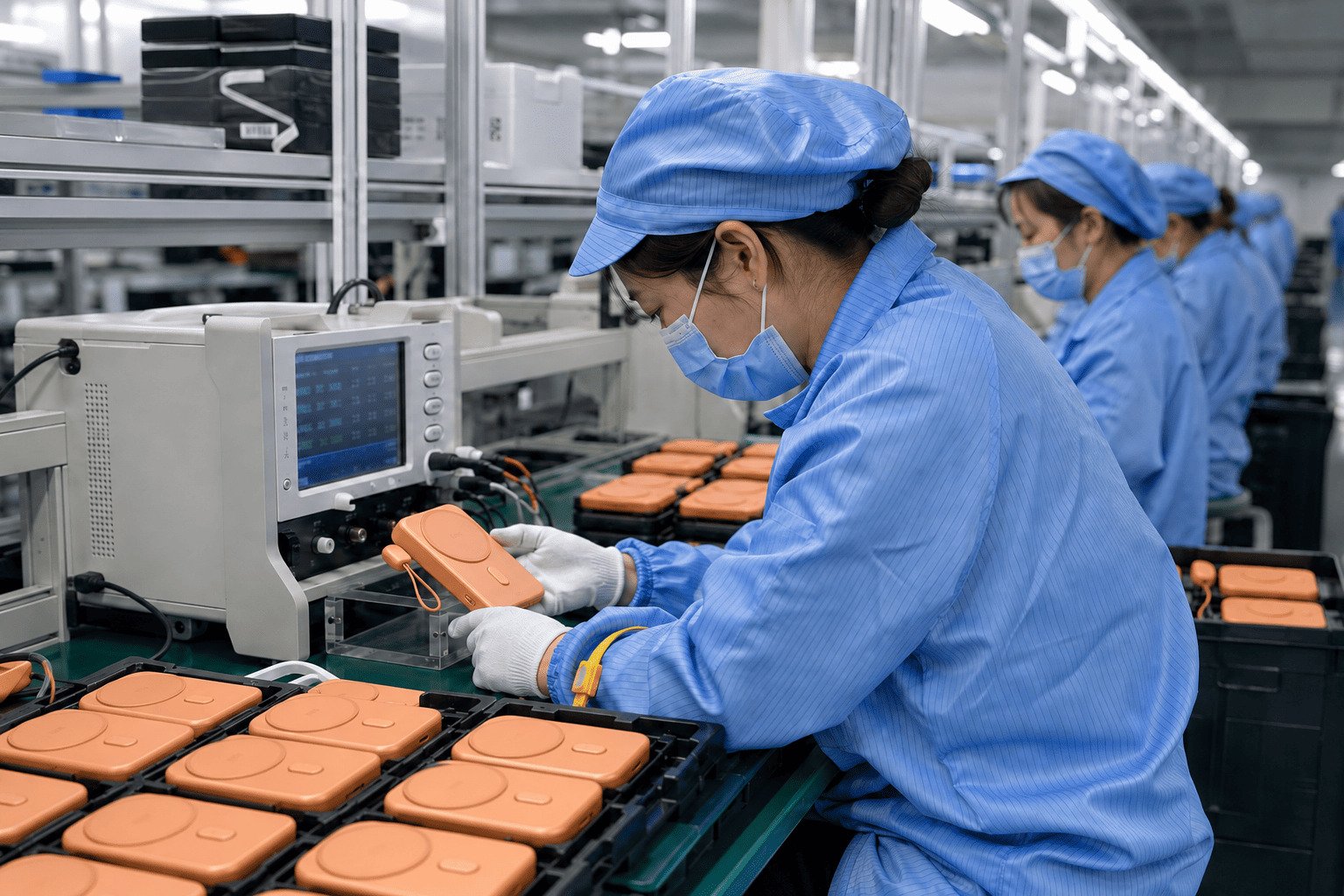
As a B2B buyer, your primary concern is sourcing a product that is not only attractive to the market, but also reliable, compliant, and scalable. The market for mobile charging accessories is competitive, and a low-quality power bank can damage your brand through returns, customer complaints, safety concerns, and delayed shipments.
We're a China manufacturer of desktop wireless chargers, car wireless chargers, wireless charging power banks, 3-in-1 wireless charging stations, wireless charging stands, and other mobile device wireless charging products, with manufacturing history dating back to 2017. We supplies products to markets including North America, Europe, South Korea, Japan, South America, Southeast Asia, and other regions.
For B2B procurement teams, the supplier’s manufacturing capability is just as important as the product concept.
Key Supplier Vetting Criteria
- Certification Portfolio: Do not accept a simple “yes” when asking about certifications. Request actual test reports for QI, CE, FCC, RoHS, UL, PSE, KC, and other relevant regional standards. For Qi products, buyers can verify certified models through the WPC Qi Certified Product Database.
- Quality Management System: An ISO 9001 quality management system helps organizations improve performance, meet customer expectations, and demonstrate commitment to quality.
- Social Compliance: amfori BSCI helps companies identify, assess, verify, and mitigate social risks across their supply chains.
- R&D and Patents: Buyers should evaluate whether the supplier has in-house R&D, testing, and engineering support, not only assembly capacity. We own hundreds of technology and design patents related to wireless charging products.
- Production Transparency: We have 8 production lines in our China factory, a daily production capacity of 30,000 units, more than 8,000 sqm of factory area in China, and more than 300 employees. These details are useful for buyers who need stable supply and scalable production.
- OEM & ODM Flexibility: OEM is suitable when buyers want to apply their own brand to an existing proven model. ODM is suitable when buyers want a more customized product developed around their design, market, or channel needs. We provide both OEM and ODM services.
- Global Supply Support: Production bases in China and Vietnam can help support international buyers with supply flexibility, regional market planning, and bulk order management.
For wholesalers, importers, distributors, and mobile accessory brands, sourcing a Qi2.2 magnetic power bank is not just about finding a product with a good appearance. It is about controlling procurement risk, ensuring stable product performance, reducing after-sales costs, and building a scalable product line for outdoor travel and mobile charging markets.
Conclusion
For outdoor travel, a certified and well-designed Qi2.2 magnetic power bank can be more than a convenient accessory. It can provide stable wireless charging, USB-C backup charging, safer battery protection, and practical usability for travelers who rely on their devices for navigation, photography, communication, and emergency backup.
For B2B buyers, the real value comes from pairing this product opportunity with a qualified manufacturer. By evaluating Qi certification, safety compliance, battery protection, production capacity, quality systems, and OEM/ODM support, buyers can source Qi2.2 power banks with greater confidence and lower procurement risk.
"Power Bank Buying Guide - YouTube",
. A source from a market research firm or tech publication could support this by showing that high milliamp-hour (mAh) ratings have historically been a dominant feature in power bank marketing and a key factor in consumer purchasing decisions. Evidence role: general_support; source type: research. Supports: The source should provide data or analysis showing that battery capacity (mAh) has been a primary marketing point and consumer consideration for power banks.. Scope note: The source would likely show a trend or common behavior, not that all travelers considered only capacity. ↩"Wireless Power Transfer Efficiency Optimization Tracking Method ...", https://pmc.ncbi.nlm.nih.gov/articles/PMC11086091/. A technical paper or study on inductive power transfer could explain that energy not successfully transferred to the receiving coil due to misalignment is often dissipated as heat in the charger's transmitter coil and surrounding components. Evidence role: mechanism; source type: paper. Supports: The source should explain the physical mechanism by which poor coil alignment in an inductive charging system leads to lower efficiency and increased heat generation.. ↩
"Keeping Mobile Devices Charged - Department of Energy", https://www.energy.gov/ceser/keeping-mobile-devices-charged. A report or safety guide from a search and rescue organization or national park service could support this by highlighting cases where a lack of a functional communication or navigation device, such as a phone, contributed to a dangerous situation for hikers or travelers. Evidence role: case_reference; source type: institution. Supports: The source should provide examples or official advice linking a reliable power source for communication or navigation devices to outdoor safety.. Scope note: The source would likely not mention power banks specifically but would support the underlying premise that losing power to essential devices is a significant risk. ↩
"Lithium polymer battery - Wikipedia", https://en.wikipedia.org/wiki/Lithium_polymer_battery. A technical overview could explain that while lithium-polymer (Li-Po) cells offer more flexible form factors and cylindrical lithium-ion cells are often more standardized, the overall safety and performance of a power bank depend more on the quality of the cell's manufacturing and the battery management circuitry than on the cell type alone. Evidence role: general_support; source type: encyclopedia. Supports: The source should compare and contrast lithium-polymer and cylindrical lithium-ion cells, noting that overall product safety and performance depend more on the quality of the specific cell and its management system.. ↩
"Best Hiking Gear 2026: Trail Tested - Hiking Guy", https://hikingguy.com/best-hiking-gear/. A gear guide from a major outdoor retailer or publication could corroborate this by listing common electronic items recommended for backpacking or camping, such as GPS units, satellite messengers, headlamps, cameras, and smartphones. Evidence role: case_reference; source type: other. Supports: The source should be a gear checklist or guide from a reputable outdoor organization or retailer that lists the various electronic devices commonly carried by hikers, campers, or backpackers.. Scope note: The exact list of devices will vary depending on the activity and the specific guide. ↩