
Wireless charging with a phone case can be convenient, but it can also become confusing when charging slows down, stops, or makes the phone warm. The problem is not always the charger or the phone. Often, the case thickness, material, accessories, and phone position decide whether case-on charging works well.1
Yes, you can usually use wireless charging with a phone case if the case is thin, non-metallic2, and does not block coil alignment. Plastic, silicone, and TPU cases often work.3 However, metal plates, wallet cases, thick rugged cases, pop grips, and incompatible magnetic accessories may cause slow charging, heat, or charging failure.
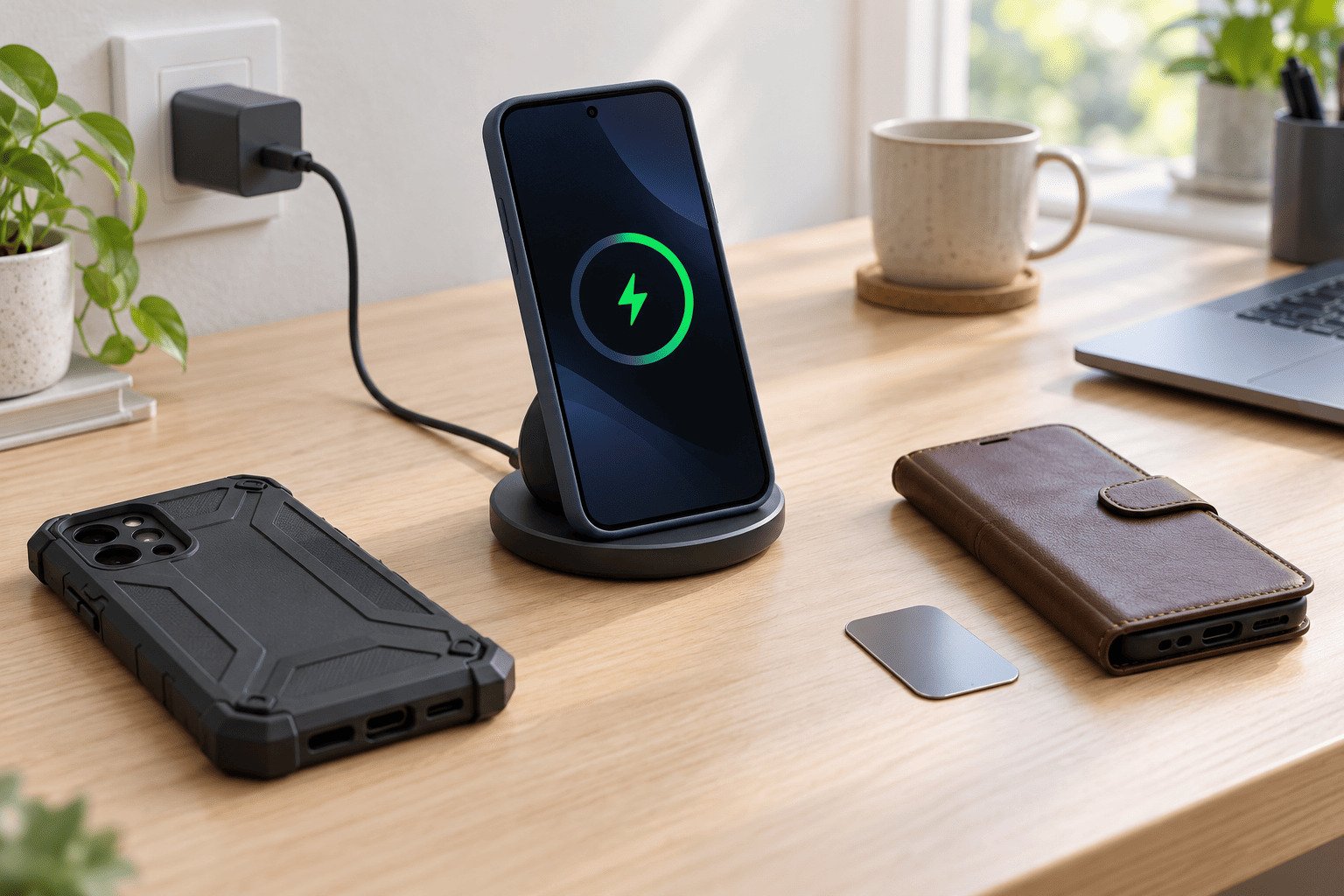
From our product validation experience, case-on charging is best judged by practical symptoms: detection, charging speed, temperature, and stability. A case that works on one charger may not work equally well on a stand, car mount, or multi-device charging station.4
Does Wireless Charging with a Phone Case Usually Work?
Case-on charging usually works, but it is not guaranteed. Many users expect a simple yes or no answer. The real issue is whether the charger can transfer power through the case without interference, distance problems, or poor alignment.
Wireless charging with a phone case usually works when the case is thin, flat, and non-metallic. Common silicone, TPU, and plastic cases are often compatible. Problems become more likely when the case adds too much distance, contains metal, or makes the phone sit unevenly on the charger.5
What usually works?
In most everyday situations, these cases have a good chance of working:
- Thin silicone cases
- Clear TPU cases
- Slim plastic cases
- Official magnetic-compatible cases designed for wireless charging
- Flat protective cases without metal parts
However, “thin” is not the only factor. We have seen customer-reported issues where a relatively slim case failed because it had a hidden metal ring, card pocket, magnetic patch, or uneven raised design.
What may cause problems?
| Case or accessory type | Possible issue |
|---|---|
| Metal plate | May block charging or [trigger foreign object detection6] |
| Wallet case with cards | Can increase distance and create safety concerns7 |
| Pop grip or ring holder | May prevent proper contact and alignment |
| Thick rugged case | May reduce charging efficiency |
| Magnetic ring not designed for the phone | May cause misalignment or unstable charging |
If the phone starts and stops charging repeatedly, the case may be creating distance or alignment instability. If the phone becomes unusually hot, users should stop charging and test without the case.
How Thick Can a Phone Case Be for Wireless Charging?
Thickness matters because wireless charging relies on close distance between the charger coil and the phone’s receiving coil. When the gap becomes too large, charging may slow, become unstable, or fail completely.
Many wireless chargers are designed to work through ordinary slim cases, often around a few millimeters thick. But there is no universal thickness rule8. Case material, accessories, surface shape, and charger design can matter as much as the measured thickness.
Why thickness is only part of the answer
A 3 mm silicone case may work better than a 2 mm case with a metal kickstand. A flat case may charge better than a case with a raised camera ring that prevents the phone from sitting level. This is why we recommend testing by behavior, not by thickness alone.
Use this simple check:
- Charge the phone without the case.
- Charge the phone with the case.
- Compare charging detection time.
- Check whether charging stops and restarts.
- Feel whether the phone becomes unusually warm.
- Remove accessories and test again.
If charging improves without the case, the case or attached accessory is likely affecting performance. If both tests perform poorly, the charger position, cable, adapter, or phone settings may also need review.
What Case Features Interfere with Wireless Charging?
Users often blame thickness first, but accessories are often the bigger issue. A case can look normal and still interfere with case-on wireless charging.
The most common problem features are metal plates, card slots, magnets, kickstands, rings, and pop grips. These parts may block the charging field, increase distance, trap heat, or stop the phone from aligning correctly with the charger coil.
Features to check before charging
Look for these details:
- Metal plates used for car magnetic mounts
- Credit cards or transit cards inside wallet cases
- Magnetic rings not certified or designed for your phone
- Pop grips that create an air gap
- Thick decorations on the back of the case
- Uneven back surfaces that make the phone tilt
A case that charges on a flat pad may still perform poorly on a vertical stand if the raised design shifts the phone away from the sweet spot.
Heat is another signal. Some warmth is normal during wireless charging9, but strong heat, repeated charging interruptions, or slow progress can suggest poor efficiency. In that case, remove the case and accessories before continuing.
How Can You Improve Wireless Charging with a Phone Case?
Small adjustments often solve case-on charging problems. Users do not always need a new phone or charger. They usually need to isolate the cause and improve alignment.
To improve wireless charging with a phone case, remove metal accessories, center the phone carefully, use a suitable power adapter, test without the case, and avoid thick or uneven case designs. If problems continue, choose a charger with better alignment support for your phone size.
Practical charging tips
Try these steps in order:
- Center the phone on the charging pad or stand.
- Remove cards, metal plates, and grips from the case.
- Use the recommended power adapter for the charger.
- Avoid charging under pillows or in hot areas.
- Test a slimmer case if charging is slow or unstable.
- Check the charger type: stands, pads, car chargers, and multi-device chargers align differently.
For stands and car wireless chargers, alignment is especially important.10 A larger phone or thick case may sit slightly higher or lower than expected. This can reduce efficiency even when charging technically starts.
Frequently Asked Questions
Can a thick case still work with wireless charging?
Yes, a thick case can sometimes work if it is non-metallic, flat, and within the charger’s effective distance. However, thick rugged cases increase the risk of slow charging, unstable charging, or excess heat.
Should I remove my phone case for wireless charging?
You do not need to remove the case if charging is stable, normal in speed, and not unusually hot. Remove it if charging fails, stops repeatedly, or becomes much slower than expected.
Do magnetic cases affect wireless charging?
Some magnetic cases are designed for wireless charging and work well. Others may cause misalignment or interference, especially if the magnetic ring or metal part is not designed for that phone and charger combination.
Is heat normal during wireless charging?
Mild warmth is common. Strong heat is not something to ignore. If the phone or case becomes very warm, stop charging, remove the case, check for metal accessories, and test again.
Conclusion
Wireless charging with a phone case is possible in many everyday setups, but compatibility depends on more than thickness. Case material, metal parts, magnetic accessories, coil alignment, and heat behavior all matter. We recommend testing step by step: charge without the case, charge with it, remove accessories, and compare stability. If you source wireless charging products in bulk, ask suppliers for case-on compatibility checks, certification documents, and clear usage guidance.
"Qi (standard)", https://en.wikipedia.org/wiki/Qi_(standard). Research on inductive wireless power transfer shows that coil separation, lateral misalignment, and intervening materials affect coupling efficiency, supporting the claim that case thickness, material, accessories, and phone position can determine case-on charging performance. Evidence role: mechanism; source type: paper. Supports: A source should explain that inductive wireless charging efficiency depends on coupling between transmitter and receiver coils, which is affected by separation distance, lateral alignment, and intervening materials.. Scope note: The evidence would support the physical mechanism rather than test every commercial phone case. ↩
"Qi (standard)", https://en.wikipedia.org/wiki/Qi_(standard). Wireless Power Consortium materials on Qi charging describe inductive charging over a short distance and include safeguards for metallic foreign objects, supporting the practical guidance that cases should be thin and non-metallic. Evidence role: general_support; source type: institution. Supports: A source should support that Qi wireless charging is intended to work through limited non-metallic separation and that metallic objects can interfere with charging or safety detection.. Scope note: The source may describe the standard generally rather than certify a specific phone case. ↩
"Inductive charging", https://en.wikipedia.org/wiki/Inductive_charging. Educational materials on electromagnetic induction and material properties identify common polymers as electrically insulating, which contextually supports the statement that plastic, silicone, and TPU cases often permit wireless charging. Evidence role: mechanism; source type: education. Supports: A source should explain that common polymer materials such as plastic, silicone, and TPU are generally non-metallic and electrically insulating, making them less likely than metal to interfere with inductive charging.. Scope note: Material properties alone do not prove compatibility for a specific case thickness, geometry, or accessory configuration. ↩
"Wireless Power Transfer Efficiency Analysis under Various ...", https://www.academia.edu/176560256/Wireless_Power_Transfer_Efficiency_Analysis_under_Various_Misalignment_Conditions_in_Drone_Charging. Studies of inductive wireless power transfer report that efficiency varies with transmitter-receiver coil alignment and separation, providing contextual support for the claim that a case may work on one charger form factor but not another. Evidence role: mechanism; source type: paper. Supports: A source should show that wireless charging performance varies with transmitter-receiver coil alignment and distance, which can differ by charger form factor.. Scope note: The evidence would not directly compare every stand, car mount, or multi-device charger model. ↩
"Wireless power transfer", https://en.wikipedia.org/wiki/Wireless_power_transfer. Peer-reviewed studies on inductive wireless charging show that increased coil separation and misalignment reduce coupling efficiency, while conductive foreign objects can disturb the field, supporting the claim that distance, metal, and uneven seating increase charging problems. Evidence role: mechanism; source type: paper. Supports: A source should support that inductive charging is sensitive to separation distance, coil misalignment, and conductive or metallic objects near the charging field.. Scope note: The source would establish the engineering mechanism rather than provide consumer failure rates. ↩
"History of the Qi Specifications", https://www.wirelesspowerconsortium.com/knowledge-base/qi-specification/history-of-the-qi-specifications/. Wireless Power Consortium documentation describes foreign object detection as a Qi safety function for detecting metallic objects in the charging field, directly supporting the statement that metal plates may trigger this protection. Evidence role: definition; source type: institution. Supports: A source should define foreign object detection in Qi charging and explain that it is intended to detect metallic objects that may heat or interfere during power transfer.. ↩
"Does QI charging work with Wallet Cases? : r/applehelp", https://www.reddit.com/r/applehelp/comments/74fokv/does_qi_charging_work_with_wallet_cases/. Institutional guidance on Qi wireless charging warns against placing foreign objects between the device and charger and emphasizes close coupling, supporting the statement that wallet-case contents can add separation and raise safety concerns. Evidence role: general_support; source type: institution. Supports: A source should support that extra layers increase separation and that objects such as cards or metallic items should not be placed between the phone and charger because of possible heating, interference, or damage.. Scope note: The source may address foreign objects and cards generally rather than every wallet-case construction. ↩
"Inductive charging", https://en.wikipedia.org/wiki/Inductive_charging. Engineering literature on inductive wireless power transfer identifies multiple determinants of performance, including separation, alignment, coil geometry, materials, and control circuitry, supporting the statement that no universal case-thickness rule guarantees compatibility. Evidence role: expert_consensus; source type: paper. Supports: A source should show that wireless charging performance depends on several interacting parameters, including distance, alignment, material properties, coil geometry, and power-control design.. Scope note: The source would justify the principle but may not discuss consumer phone cases specifically. ↩
"Wireless power transfer", https://en.wikipedia.org/wiki/Wireless_power_transfer. Studies of inductive wireless power transfer describe resistive and conversion losses that generate heat during charging, supporting the statement that mild warmth can occur during normal wireless charging. Evidence role: mechanism; source type: paper. Supports: A source should explain that wireless charging is not perfectly efficient and that power losses in coils, electronics, and batteries can appear as heat.. Scope note: The source would not define a precise safe temperature for every phone model. ↩
"Inductive charging", https://en.wikipedia.org/wiki/Inductive_charging. Research on inductive charging demonstrates that lateral coil misalignment reduces power-transfer efficiency, providing contextual support for the claim that alignment is especially important in stands and car mounts where the phone position is constrained. Evidence role: mechanism; source type: paper. Supports: A source should support that lateral misalignment between transmitting and receiving coils reduces wireless power transfer efficiency, making physical positioning important in fixed stands and mounts.. Scope note: The evidence supports the alignment mechanism rather than ranking all charger form factors by risk. ↩