
Fast charging often creates confusion because buyers may focus on the charger wattage or the USB-C connector alone. That can lead to mismatched cables, slower charging, unclear claims, and channel complaints. We find it more useful to treat fast charging as a compatibility decision across the phone, charger, cable, and protocol.
Fast charging works when the phone, charger, cable, and charging protocol agree on a safe power level. The phone sets the charging limit1, the charger offers available output, and the cable must support the required current and power. A higher-watt charger or USB-C cable alone does not guarantee faster charging.
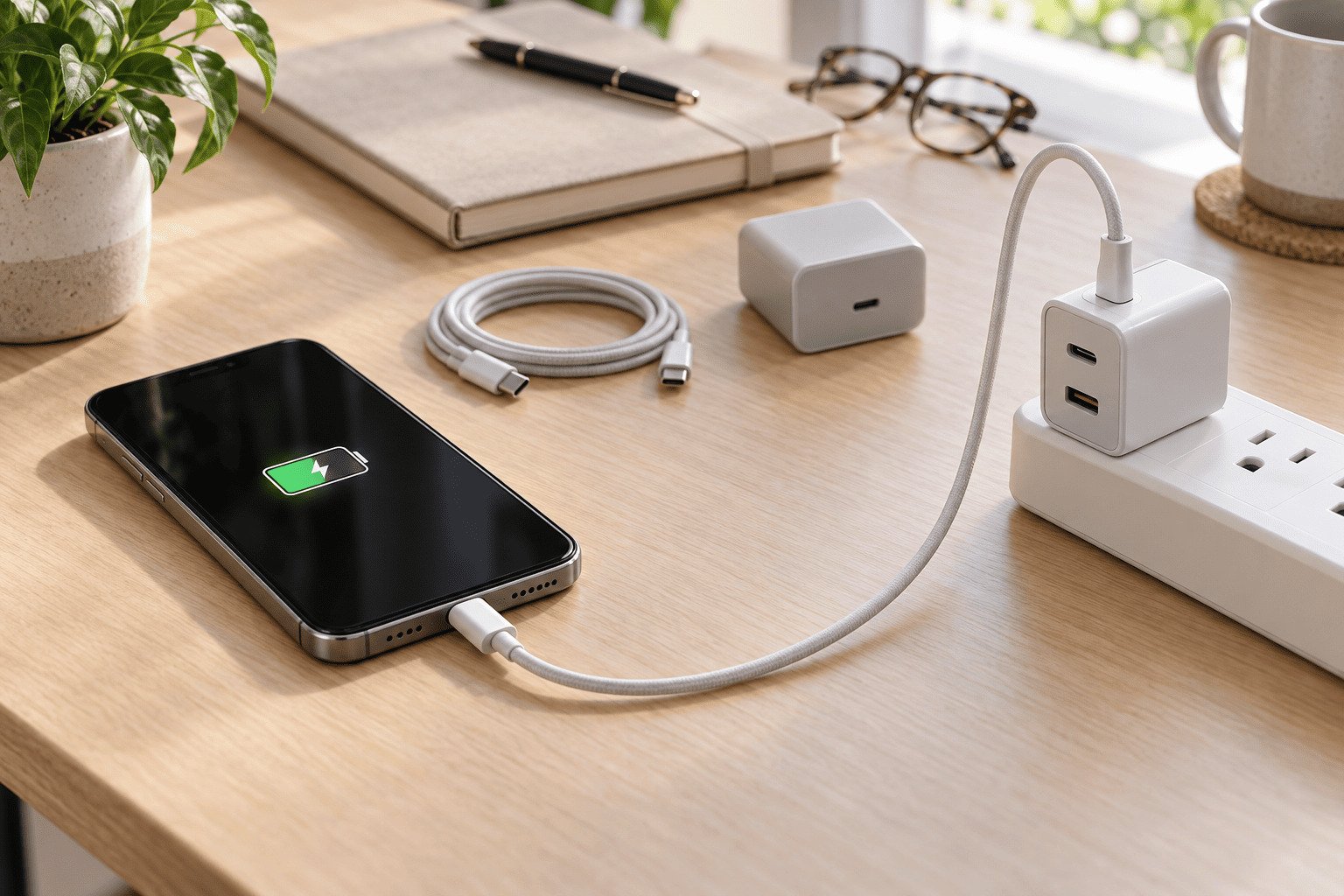
In procurement conversations, we often see one simple question: “Which cable should we buy?” A better question is: “Will this cable match our target phones, charger output, charging protocol, and promised user experience?” That shift helps reduce returns, disputes, and unclear product positioning.
How Does Fast Charging Actually Work?
Fast charging becomes difficult when one part of the system is overestimated. A buyer may choose a 65W charger and expect every phone to charge at 65W. In reality, the phone may accept much less, and the cable may also limit the result.
Fast charging is best understood as a three-part negotiation. The phone decides the maximum it can accept, the charger provides supported power levels, and the cable must safely carry the required current. The protocol allows these parts to communicate and select a suitable charging mode.
The three parts of the charging system
| Part | What It Does | Buyer Risk If Misunderstood |
|---|---|---|
| Phone | Sets charging limit | Users expect speeds the phone cannot support |
| Charger | Offers power output | High wattage may not match phone protocol |
| Cable | Carries current and power | Wrong rating may reduce speed or cause complaints |
| Protocol | Manages communication | Incompatible protocol may fall back to slower charging |
For example, a phone that supports up to 25W charging will not become a 65W charging device just because it uses a 65W adapter2. The phone’s battery management system controls charging behavior to protect the device.3 So, the practical charging speed depends on what the phone allows.
The charger also matters. A charger may support USB Power Delivery, PPS, QC, or other protocols. If the phone and charger do not share the right mode, charging may still work, but it may not reach the advertised fast-charging level.
The cable is the third condition. Not all USB-C cables are equal. Some cables are suitable for lower current. Some support 3A. Some support 5A and need proper electronic marking for higher-power USB-C applications.4 For B2B buyers, the concern is not only technical performance. It is also whether the cable specification is clear enough for packaging, reseller communication, and after-sales handling.
We should not ask only, “What is the highest wattage?” We should ask, “What power level can this complete charging set reliably support for the intended phone models?”
Why Are Not All USB-C Fast Charging Cables the Same?
USB-C connectors look similar, so it is easy to assume that all USB-C cables perform the same. This assumption creates procurement risk. Two cables may look nearly identical but differ in current rating, construction, marking clarity, and suitability for bundled or resale use.
A USB-C fast charging cable should be selected by its rated current, power capacity, protocol suitability, connector quality, and documentation. Buyers should verify whether the cable supports the intended charger output and target phone models instead of relying only on appearance or connector type.
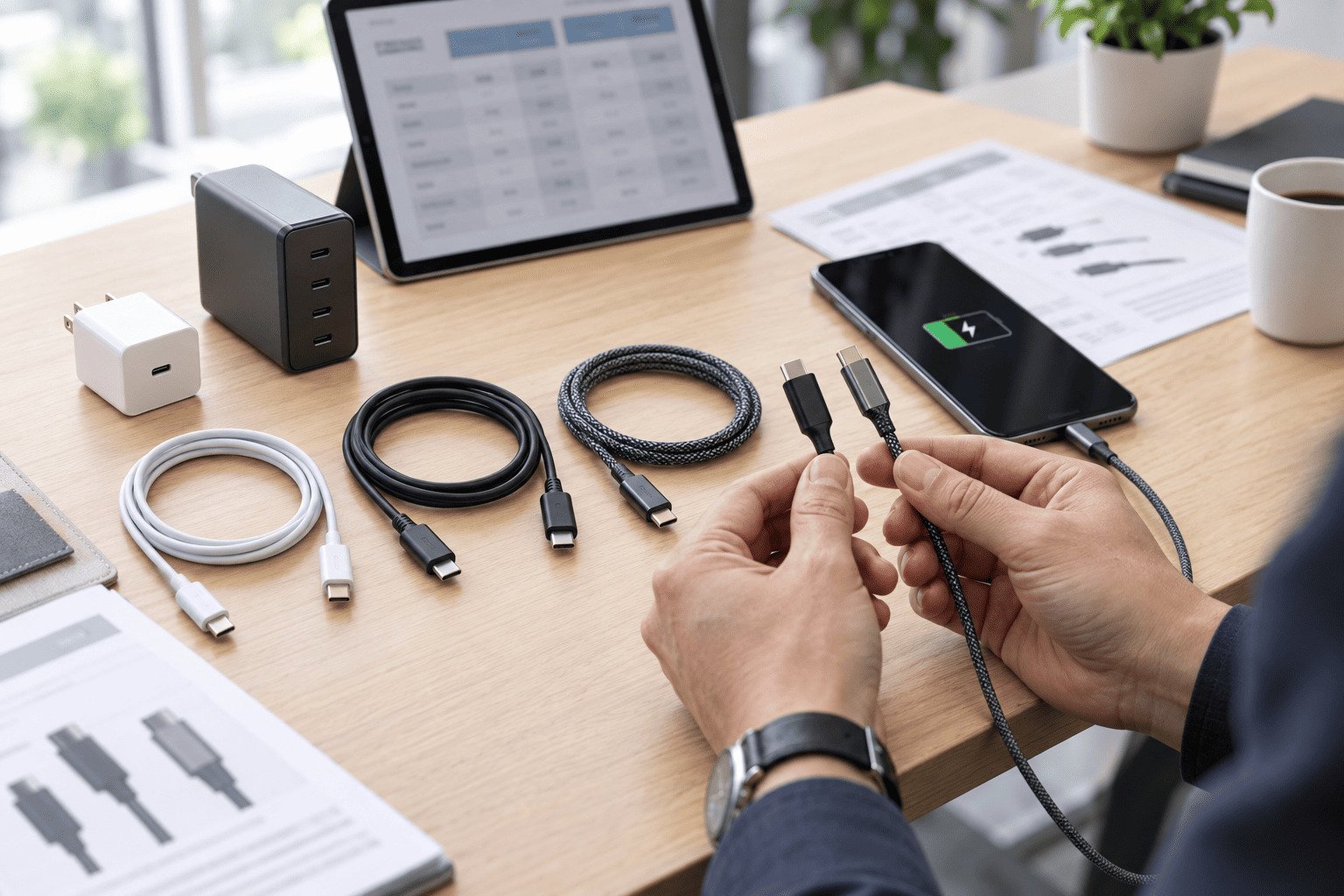
Key cable specifications to check
When we review cable options for mobile accessory programs, we usually focus on these points:
- Current rating: Common examples include 3A and 5A.
- Power capacity: A cable may be promoted for 60W, 100W, or higher depending on design and applicable standards.5
- Connector type: USB-C to USB-C, USB-A to USB-C, Lightning, or mixed connector formats all affect compatibility.
- Protocol suitability: The cable should match the charger and device use case.
- Marking and labeling: Clear ratings reduce channel confusion.
- Material and durability: Jacket, strain relief, connector fit, and bend resistance affect user satisfaction.
- Test documents: Buyers should request relevant reports or supplier verification documents when needed.
Why cable clarity matters in wholesale channels
For retail or distribution, unclear specifications can create problems after the sale. A customer may buy a “fast charging cable” and expect maximum speed on every phone. If the result is slower, the user may blame the brand, distributor, or store.
This is why buyers should define the cable around the target application:
| Use Case | Practical Cable Focus |
|---|---|
| Bundled with wireless charger | Match input power requirement and packaging claim |
| Sold as phone accessory | State compatible power range clearly |
| Used with high-watt USB-C charger | Verify cable current and power rating |
| Multi-market distribution | Check labeling, compliance, and documentation needs |
Low-cost cables are not automatically unsuitable. The issue is whether the cable is specified honestly and matched correctly to the product promise. A basic cable may be fine for standard charging. It becomes risky when it is marketed as high-power fast charging without clear support.
For brand owners and importers, a vague cable claim can become a business problem. It can lead to return disputes, negative reviews, and reduced trust from dealers. Clear specifications protect both the buyer and the end user.
How Should Buyers Choose a Fast Charging Cable for Bulk Procurement?
Procurement teams often want one simple cable that works for every market, phone, and charger. That is understandable, but it is not always realistic. A better approach is to define the expected charging experience first, then choose the cable specification around that promise.
Buyers should choose a fast charging cable by matching four items: target phone models, charger output, charging protocol, and cable rating. They should also confirm labeling, test documents, packaging claims, and supplier quality controls before placing bulk orders.
A practical selection checklist
We recommend using a short checklist before confirming a bulk cable order:
-
Define the target devices.
List the main phone brands and models your customers use. -
Confirm charger output.
Check whether the charger is 20W, 30W, 45W, 65W, or another level. -
Check protocol expectations.
Confirm whether the product claim involves USB PD, PPS, QC, or brand-specific charging behavior. -
Match the cable rating.
Choose a cable rated for the required current and power level. -
Review packaging language.
Avoid claims that suggest every phone will reach maximum speed. -
Request documentation.
Ask for relevant test reports, compliance documents, or specification sheets. Buyers should verify certification claims as part of their own approval process. -
Evaluate supplier consistency.
A cable sample is useful, but stable bulk production is more important.
Better product claims reduce after-sales risk
For channel buyers, wording matters. A claim such as “supports up to 60W charging with compatible devices and chargers” is more accurate than “charges all phones at 60W.”6 The first statement explains conditions. The second creates unrealistic expectations.
This is especially important when cables are bundled with wireless chargers, charging stations, power banks, or desktop charging products. If the cable is part of the user experience, then its specification should support the complete product promise.
In our buyer discussions, the most successful procurement teams usually do not chase the highest number first. They define the user scenario, then choose a cable that supports it with clear documentation and stable supply.
Frequently Asked Questions
Does a higher-watt charger always mean faster charging?
No. The phone controls how much power it accepts. A higher-watt charger may provide more available power, but the phone, cable, and protocol must support the same charging mode before faster charging can happen.
Can any USB-C cable support fast charging?
No. USB-C describes the connector, not the full cable capability.7 Cable current rating, power capacity, construction, and protocol suitability can differ.8 Buyers should check specifications instead of judging by connector appearance.
Is a 100W cable always better than a 60W cable?
Not always. A 100W cable may be useful for higher-power applications, but it may be unnecessary for lower-power phone charging. Buyers should match the cable to the charger, phone models, product claim, and target price point.
What causes customer complaints about fast charging cables?
Common causes include unclear packaging claims, mismatched charger and phone protocols, low cable rating, or unrealistic expectations. The cable may still charge the phone, but not at the speed the customer expected.
Conclusion
Fast charging is not decided by one impressive wattage number or by the USB-C connector alone. It depends on the phone, charger, cable rating, and charging protocol working together. For wholesale buyers, importers, and brand teams, the right decision reduces slower-than-expected charging, return disputes, and channel confusion. Before selecting a cable, we recommend confirming target devices, charger output, protocol needs, cable specifications, and supplier documentation. For bulk programs, ask your supplier for clear specifications and application-based cable recommendations before final approval.
"USB Charger (USB Power Delivery)", https://www.usb.org/usb-charger-pd. USB Power Delivery documentation identifies the sink device as the party that requests an operating power contract from the source within the device’s supported limits. Evidence role: mechanism; source type: institution. Supports: The source should support that the sink device requests or accepts power according to its own capabilities and limits.. ↩
"USB Charger (USB Power Delivery)", https://www.usb.org/usb-charger-pd. Research on lithium-ion battery charging and battery-management systems shows that portable devices regulate charging current and voltage to remain within device and battery limits, so an adapter with a higher rating does not by itself determine charging power. Evidence role: mechanism; source type: research. Supports: The source should support that battery-powered devices regulate charging current and voltage according to device and battery limits.. Scope note: The source would support the engineering principle, not the specific 25 W and 65 W numerical example unless those figures are documented separately. ↩
"(PDF) VCT Protection IC for Li-Ion Battery", https://www.academia.edu/15158220/VCT_Protection_IC_for_Li_Ion_Battery. Peer-reviewed literature on lithium-ion battery-management systems describes charging control, monitoring, and protection functions that regulate current, voltage, and temperature during charging. Evidence role: mechanism; source type: paper. Supports: The source should explain that battery-management systems monitor and regulate charging parameters to protect lithium-ion batteries.. ↩
"Identifying USB-C E-Mark Cables", https://satechi.com/blogs/news/identifying-usb-c-e-mark-cables?srsltid=AfmBOorJSdks-eqGaZQjoBYKDSLleMwDaLXHE-Y8_Ti_9-O9COA3ypEn. USB-IF USB Type-C documentation distinguishes standard-current and 5 A cable capabilities and specifies electronically marked cable identification for higher-current USB-C cable assemblies. Evidence role: definition; source type: institution. Supports: The source should support the distinction between 3 A and 5 A USB-C cable current ratings and the role of electronically marked cables.. ↩
"USB Charger (USB Power Delivery)", https://www.usb.org/usb-charger-pd. USB-IF materials on USB Power Delivery define power levels associated with USB-C cable assemblies, including standard power operation and higher-power categories introduced under later USB PD specifications. Evidence role: definition; source type: institution. Supports: The source should support common USB-C cable power categories and their relationship to USB Power Delivery standards.. Scope note: The source supports the standards context; individual product labels still require verification against the specific cable’s certification or test data. ↩
"FTC Policy Statement Regarding Advertising Substantiation", https://www.ftc.gov/legal-library/browse/ftc-policy-statement-regarding-advertising-substantiation. FTC advertising guidance states that product-performance claims should be truthful, substantiated, and qualified where necessary to prevent consumers from being misled about the conditions under which the claim applies. Evidence role: expert_consensus; source type: government. Supports: The source should support that advertising claims should be truthful, substantiated, and properly qualified to avoid misleading consumers.. Scope note: This supports the advertising-law rationale for qualified wording, not a technical measurement of 60 W charging performance. ↩
"USB-C", https://en.wikipedia.org/wiki/USB-C. USB-IF documentation treats USB Type-C as a connector and cable specification, while separate cable markings and specifications identify supported current, data, and power-delivery capabilities. Evidence role: definition; source type: institution. Supports: The source should clarify that USB Type-C defines a connector and cable system while individual cable assemblies vary in supported current, data rates, and features.. ↩
"USB-C", https://en.wikipedia.org/wiki/USB-C. USB Type-C specifications classify cable assemblies by electrical and identification characteristics, supporting the statement that visually similar USB-C cables may differ in current rating, power capacity, and supported functions. Evidence role: general_support; source type: institution. Supports: The source should support that USB-C cable assemblies are specified by current, power, data, and identification features rather than connector shape alone.. ↩