
Wireless power bank vs. regular power bank is not a simple “newer is better” decision. Many buyers see wireless charging as cleaner and more convenient, but the wrong choice can mean slower charging, more heat, less usable capacity, or poor phone-case compatibility. The better solution is to match the power bank to real charging behavior.
A wireless power bank is best for cable-free, frequent phone top-ups, especially with magnetic attachment. A regular USB-C PD power bank is usually better for faster charging, longer trips, laptops, and higher energy utilization. A hybrid wired-and-wireless model works best when users want both convenience and flexibility.
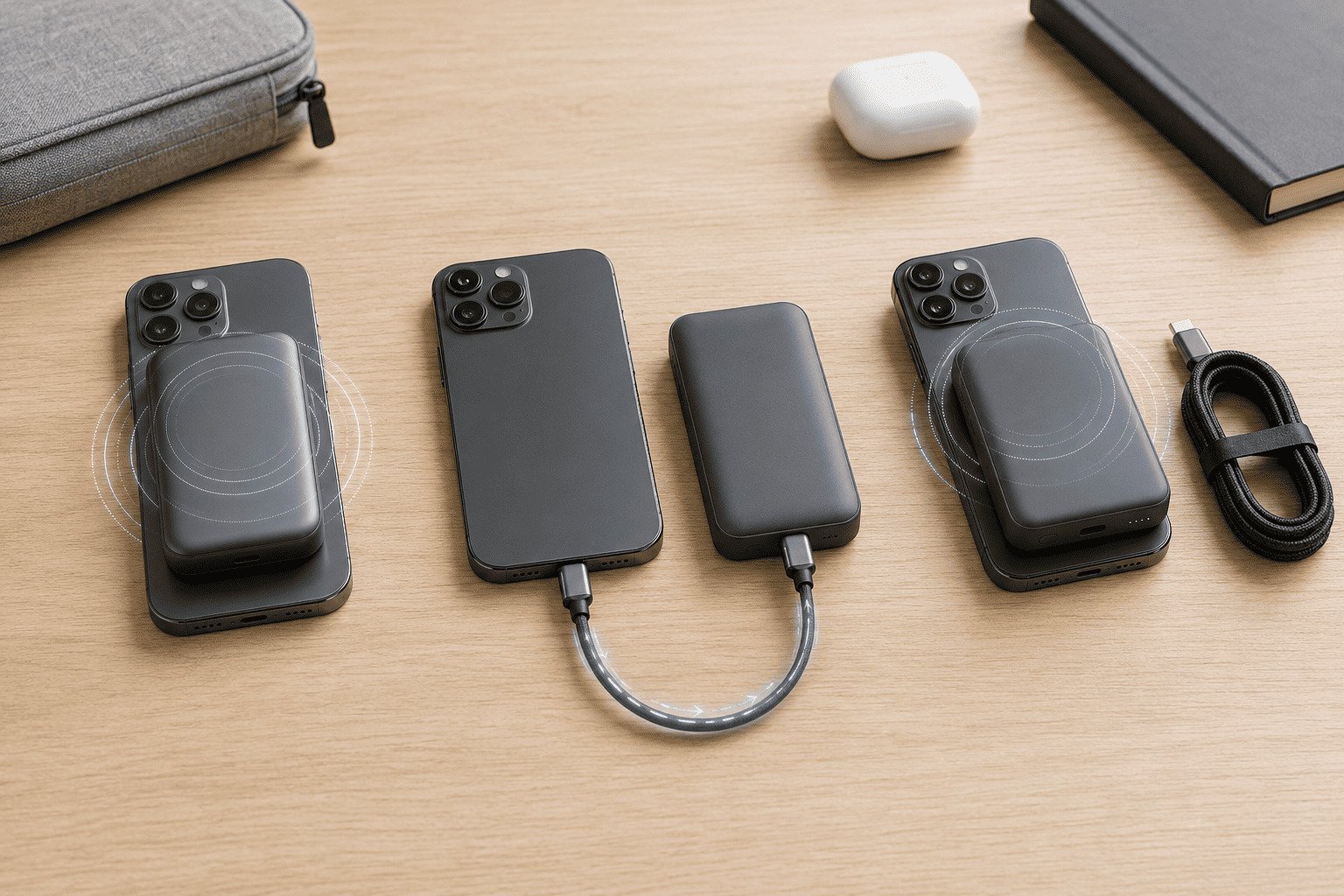
The important point is that marketing numbers do not tell the full story. The same mAh rating does not always deliver the same number of phone recharges. Peak wattage also does not always mean sustained charging power. We need to look at efficiency, heat, protocols, safety, and actual use cases.
Wireless Power Bank vs. Regular Power Bank: What Is the Real Difference?
Choosing between these two products can feel confusing because both may show similar capacity, similar output labels, and similar product photos. The problem is that they deliver power in different ways. If buyers ignore that difference, they may overestimate charging speed, usable capacity, or device compatibility.
A wireless power bank transfers energy through a charging coil1, often with magnetic alignment for supported phones. A regular power bank transfers energy through a cable, usually USB-A or USB-C. Wireless models prioritize convenience. Wired models usually provide better efficiency, stronger compatibility, and more predictable sustained power.2
Dive deeper
The main difference is how energy moves from the power bank to the phone. A regular power bank uses a physical cable, so the electrical path is direct. A wireless power bank uses inductive charging, which requires coil alignment between the power bank and the phone.
That difference affects several buying factors:
| Factor | Wireless power bank | Regular power bank |
|---|---|---|
| Main benefit | Cable-free top-ups | Faster and more efficient charging |
| Typical user | Commuter, office user, light traveler | Heavy phone user, traveler, laptop user |
| Energy loss | Higher due to wireless transfer and heat | Lower due to direct wired output |
| Case sensitivity | Higher | Lower |
| Compatibility | Depends on Qi/Qi2, magnets, phone design | Depends on cable and protocol |
| Best use | Frequent small recharges | Longer sessions and higher output |
Magnetic attachment is useful because it improves alignment and makes charging easier while walking, commuting, or working at a desk. However, magnets do not remove all limitations. A thick case, metal plate, ring holder, or misaligned coil can reduce charging performance or stop wireless charging completely.3
A regular wired power bank depends on cables, but that dependence is also its strength. A good USB-C PD power bank can charge phones, tablets, earbuds, cameras, and sometimes laptops. For procurement teams, this broader compatibility often reduces after-sales questions.
We often see buyers focus on mAh first. That is understandable, but rated capacity is not the same as usable capacity4. A 10,000mAh power bank is usually rated at the internal battery cell voltage, commonly around 3.7V5. The output must be converted to 5V, 9V, or higher. While high-quality wired USB-C PD power banks generally achieve 80% to 90% efficiency6, wireless charging adds an extra inductive step and thermal loss, causing overall efficiency to drop to roughly 65% to 75%7 due to conversion stage, plus thermal loss.
So, two power banks with the same mAh rating may not recharge the same phone the same number of times. The wireless model may deliver fewer complete recharges because more energy is lost during transfer. This does not mean wireless is bad. It means buyers should choose it for the correct reason: convenience, not maximum energy utilization.
Wireless Power Bank vs. Regular Power Bank: Which Charges Faster and More Efficiently?
Many product pages highlight peak wattage, but peak output can be misleading. A power bank may briefly reach a high number and then reduce output because of heat, coil misalignment, battery protection, or phone thermal control. This creates disappointment when real charging time is slower than expected.
A regular USB-C PD power bank usually charges faster and uses energy more efficiently than a wireless power bank.8 For instance, a 20W USB-C wired connection can charge a standard flagship smartphone from 0% to 50% in roughly 30 minutes9, whereas a 15W wireless power bank typically takes 50 to 60 minutes for the same charge.
Dive deeper
Charging speed should be judged by sustained power, not only advertised peak wattage. This matters for both retail buyers and B2B procurement teams.
For example, a wireless power bank may advertise 15W wireless charging. In real use, thermal benchmarks show that 15W output often throttles down to 7.5W or 5W after 10–15 minutes as device temperature rises10. Several conditions can reduce actual output:
- Coil misalignment between the phone and charging pad
- Thick phone cases (especially cases exceeding 3mm or containing metal plates/ring holders)
- High ambient temperature, such as inside a car or near a window
- Phone thermal protection, which lowers charging input when the device gets warm
- Low power bank battery level, depending on the design
- Protocol mismatch, such as non-certified wireless charging behavior
A regular USB-C PD power bank is also affected by heat and device limits, but the wired path is more stable. It usually delivers better performance when users need fast charging before a flight, during a business trip, or while running multiple devices.
For better evaluation, we recommend documented charging tests instead of general claims. A useful test report should record:
- Phone model
- Initial phone battery level, such as 10% or 20%
- Phone case type, including thickness and material
- Ambient temperature, for example 25°C
- Measurement method, such as USB power meter or controlled lab equipment
- Charging duration, such as 30 minutes, 60 minutes, and full-session data
- Temperature readings on the phone and power bank surface
- Final battery percentage and remaining power bank capacity
This test structure helps avoid vague claims like “fast charging” or “high efficiency.” It also helps buyers compare approved samples with later mass-production units.
For consumer choice, the decision is simple:
- Choose a magnetic wireless power bank if users mainly need cable-free top-ups during the day.
- Choose a regular USB-C PD power bank if users need faster charging, longer trips, or laptop support.
- Choose a hybrid wired-and-wireless power bank if users want one product for both convenience and emergency speed.
For B2B buyers, speed is only one part of the evaluation. Consistency matters more. A product that performs well in one sample but changes during mass production creates warranty pressure. Procurement teams should review BOM control, cell quality, thermal design, aging tests, and final inspection standards.
How Should B2B Buyers Evaluate Wireless Power Bank vs. Regular Power Bank?
Procurement risk increases when buyers evaluate only appearance, capacity, and price. A low-cost power bank may look acceptable at first, but weak cells, unstable output, poor thermal control, or incomplete compliance documents can create return costs and channel complaints later.
B2B buyers should evaluate wireless and regular power banks through certification, sustained-power testing, cell quality, safety protection, transport compliance, compatibility, and production consistency. Samples should be tested under documented conditions, and current certificates or test reports should be verified before bulk orders.
Dive deeper
For distributors, importers, wholesalers, and brand owners, the best product is not always the model with the highest printed wattage. The best product is the one that matches the channel, local regulations, target device list, and expected after-sales level.
At Fabucharger, we manufacture wireless charging products for mobile devices, including wireless charging pads, 3-in-1 charging stations, wireless charging stands, wireless charger power banks, and related OEM/ODM products. Based on our business context, we see that buyers usually care about three things: stable quality, compliant supply, and predictable delivery.
For wireless models, buyers should pay special attention to:
- Qi or Qi2 certification status, when applicable
- Magnetic alignment strength and stability
- Charging performance with common phone cases
- Surface temperature during long charging sessions
- Foreign object detection and protection logic
- Consistency between approved samples and mass production
For regular wired models, buyers should review:
- USB-C PD protocol support
- PPS support, if targeting newer phones that benefit from it
- Cable quality, if cables are included
- Multi-port output behavior when several devices charge together
- Actual usable capacity under 5V, 9V, or higher-voltage output
- Laptop compatibility, if the product claims notebook charging
Safety protection should never be treated as a marketing line. A qualified power bank should include protections such as over-current, over-voltage, over-temperature, short-circuit, over-charge, and over-discharge protection. Buyers should also check transport requirements for lithium battery products, including relevant UN38.3 documentation and shipping rules.
Certifications should be handled carefully. Product pages may list UL, CE, RoHS, FCC, PSE, KC, Qi, or other compliance marks, but buyers should verify the actual certificate, test report, model number, issuing body, and validity. Application-specific decisions should be reviewed by qualified compliance or engineering professionals, especially for regulated markets.
Price also needs context. Wireless power banks often cost more because they include coils, alignment parts, thermal design, and wireless control circuits, which typically raise BOM costs by 20% to 35%. A regular power bank may offer better watt-per-dollar value. A hybrid model may cost more, but it can reduce SKU complexity because it serves more user scenarios.
Frequently Asked Questions
Is a wireless power bank better than a regular power bank?
A wireless power bank is better for cable-free convenience, not for maximum speed or efficiency. A regular power bank is usually better for faster charging, longer battery use, laptop charging, and broader compatibility. The better choice depends on daily charging habits.
Why does the same mAh rating give different charging results?
The same mAh rating does not guarantee the same usable energy. Power conversion, output voltage, cable loss, wireless transfer loss, and heat all affect real performance. Wireless charging usually loses more energy than wired charging, so it may deliver fewer full phone recharges.
Does 15W wireless charging always mean 15W charging speed?
No. Advertised peak wattage does not always represent sustained power. Coil alignment, phone case thickness, ambient temperature, power bank temperature, and phone thermal controls can reduce wireless charging output during real use.
What should importers check before buying power banks in bulk?
Importers should check certification documents, cell quality, rated-capacity testing, sustained output, temperature rise, safety protections, transport compliance, packaging requirements, and consistency between approved samples and mass production. They should also test with the target phone models in their market.
Conclusion
Wireless power bank vs. regular power bank should be decided by use case, not by marketing claims. Wireless models suit users who want magnetic, cable-free, frequent top-ups. Regular USB-C PD models suit users who need faster charging, better efficiency, longer trips, or laptop support. Hybrid models balance both needs. For bulk sourcing, we recommend verified test reports, confirmed compliance documents, and sample-to-mass-production quality control. Contact Fabucharger to discuss OEM/ODM wireless power bank options for your target market.
"Inductive charging", https://en.wikipedia.org/wiki/Inductive_charging. A neutral technical reference on inductive charging supports that wireless chargers transfer energy through electromagnetic coupling between coils rather than through a conductive cable. Evidence role: definition; source type: encyclopedia. Supports: Wireless charging commonly uses inductive coupling between coils to transfer electrical energy without a physical connector.. ↩
"Inductive charging", https://en.wikipedia.org/wiki/Inductive_charging. Comparative studies of wired and inductive charging support the general conclusion that wireless charging introduces additional transfer losses and greater sensitivity to operating conditions than direct wired charging. Evidence role: general_support; source type: paper. Supports: Research comparing wired and inductive charging should show that wireless transfer introduces additional conversion and alignment losses relative to direct wired charging.. Scope note: The source may support the efficiency and variability comparison generally, but it may not test every commercial power bank design or phone model. ↩
"Qi (standard)", https://en.wikipedia.org/wiki/Qi_(standard). Technical material on Qi inductive charging supports that coupling efficiency depends on coil alignment and separation, and that intervening metallic objects or incompatible accessories can impair or interrupt charging. Evidence role: mechanism; source type: institution. Supports: Wireless charging depends on coil alignment and can be disrupted by distance, metallic objects, or accessories between the charger and receiver.. ↩
"Why is the Rated Capacity of Power Banks Lower Than ...", https://service.anker.com/au/article-description/Why-is-the-Rated-Capacity-of-Power-Banks-Lower-Than-Expected. Educational battery references support that ampere-hour ratings must be interpreted with voltage and conversion efficiency, so the usable output capacity of a power bank can be lower than its nominal cell rating. Evidence role: mechanism; source type: education. Supports: Battery capacity ratings depend on cell voltage and delivered usable energy is reduced by voltage conversion and efficiency losses.. ↩
"Lithium-ion battery", https://en.wikipedia.org/wiki/Lithium-ion_battery. Battery engineering references identify many lithium-ion cells used in portable electronics as having a nominal voltage of approximately 3.6 to 3.7 volts. Evidence role: definition; source type: education. Supports: Lithium-ion cells used in portable electronics commonly have a nominal voltage near 3.6V to 3.7V.. Scope note: The source supports the common cell-voltage range, but specific power banks may use different cell chemistries or pack configurations. ↩
"Powerbank to phone overall efficiency when using PD/PPS?", https://www.reddit.com/r/UsbCHardware/comments/1jm4gr8/powerbank_to_phone_overall_efficiency_when_using/. Published measurements of portable battery packs and DC-DC conversion stages support that wired-output efficiency can fall near the 80% to 90% range under controlled operating conditions. Evidence role: statistic; source type: paper. Supports: Measured or modeled portable battery pack conversion efficiency commonly falls in the 80% to 90% range under favorable wired-output conditions.. Scope note: The range is condition-dependent and varies with load current, output voltage, converter design, temperature, and battery state of charge. ↩
"Inductive charging", https://en.wikipedia.org/wiki/Inductive_charging. Experimental studies of inductive smartphone charging support that wireless systems can exhibit lower end-to-end efficiency than wired charging because of coupling losses, alignment sensitivity, and heat generation. Evidence role: statistic; source type: paper. Supports: Wireless smartphone charging can have lower end-to-end efficiency than wired charging because of inductive coupling, alignment, and heat losses.. Scope note: The exact 65% to 75% range depends on charger design, receiver design, alignment, operating power, ambient temperature, and measurement method. ↩
"MagSafe wireless charging or USB-C fast charging?", https://www.reddit.com/r/iphone/comments/rldec7/which_is_healthier_for_the_battery_magsafe/. Technical and experimental literature on USB Power Delivery and inductive charging supports the general finding that wired USB-C PD charging can deliver higher effective power and efficiency than wireless charging in comparable smartphone use. Evidence role: general_support; source type: research. Supports: USB Power Delivery supports negotiated higher wired power levels, while wireless charging often has lower effective power because of transfer and heat losses.. Scope note: The comparison is general; actual speed depends on the phone, cable, charger protocol, battery temperature, and manufacturer charging limits. ↩
"Fast charge your iPhone", https://support.apple.com/en-us/102574. Manufacturer specifications or controlled device tests support that certain flagship smartphones can reach approximately 50% battery charge in about 30 minutes when using a compatible 20W wired USB-C charger. Evidence role: case_reference; source type: institution. Supports: Some flagship smartphones using approximately 20W USB-C wired fast charging can reach about 50% charge in around 30 minutes under stated conditions.. Scope note: This is a device-specific benchmark and should not be read as a universal result for all phones, batteries, cables, or thermal conditions. ↩
"15W+ MagSafe (Qi2) chargers slower than old 5W/7.5W ...", https://www.reddit.com/r/MagSafe/comments/1o4wgaj/15w_magsafe_qi2_chargers_slower_than_old_5w75w/. Thermal studies of smartphone wireless charging support that charging power may be reduced during operation as device temperature rises and thermal-management controls intervene. Evidence role: mechanism; source type: paper. Supports: Wireless charging power can be reduced during a session as temperature rises, due to thermal management in the phone or charger.. Scope note: The general throttling mechanism is well supported, but the exact 7.5W or 5W level after 10 to 15 minutes may vary by phone model, charger design, ambient temperature, and software policy. ↩