
A wireless power bank sounds simple, but many buyers still get confused by mAh labels, wattage claims, magnets, heat, and compatibility. That confusion can lead to wrong expectations, slow charging, or risky sourcing decisions. We explain it from a manufacturer’s testing view so consumers and B2B buyers can judge products more clearly.
A wireless power bank is a portable rechargeable battery that stores energy and includes a wireless charging transmitter. It sends power to a compatible phone through electromagnetic induction, usually based on Qi or Qi2 standards1. Unlike a wired power bank, it can charge without a cable, but real speed and efficiency depend on alignment, temperature, protocol, phone control, and product design.
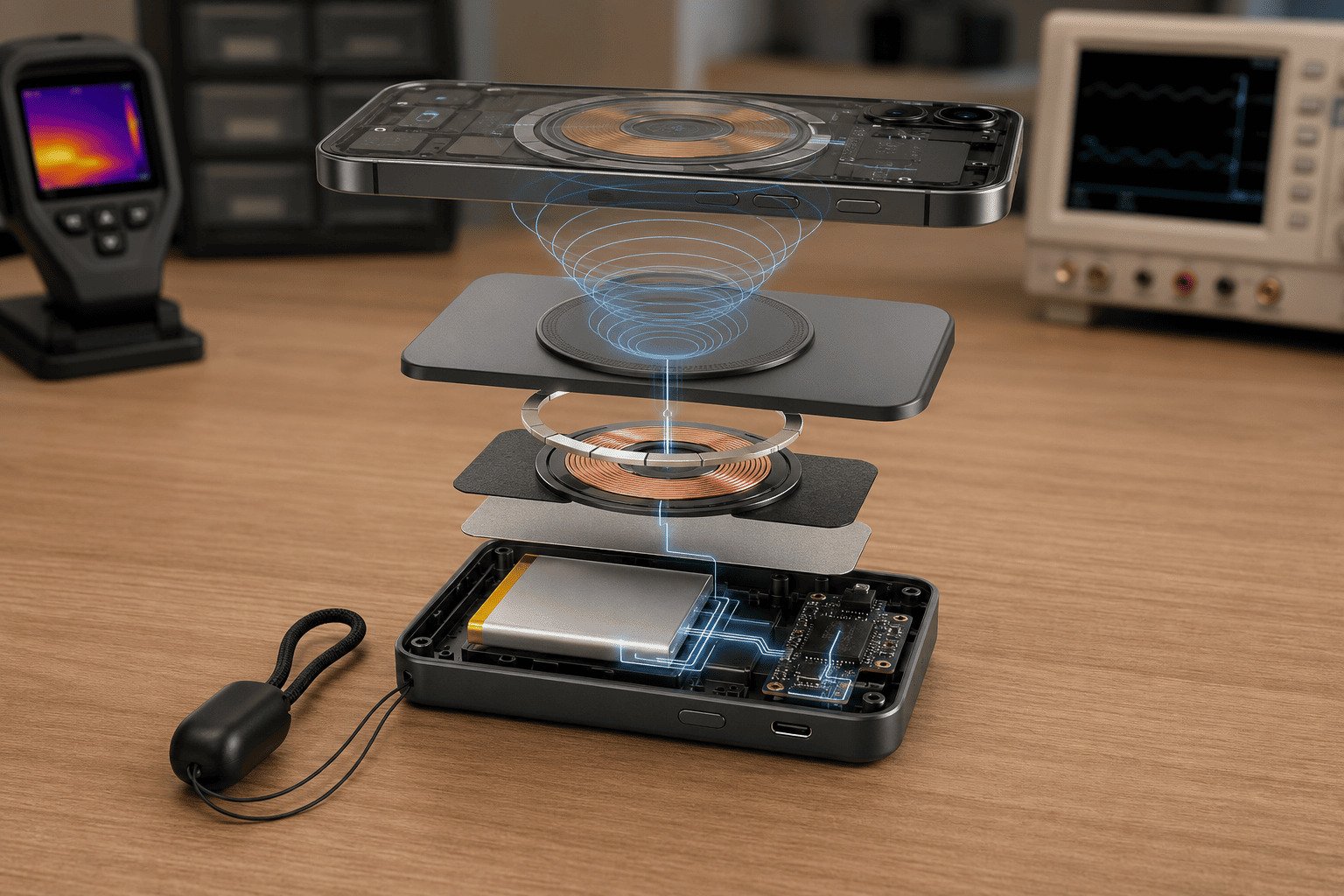
A good wireless model is not only a battery with a coil inside. It is a controlled power system. The battery cell, BMS, transmitter coil, firmware, heat design, and phone-side charging behavior all affect the final result.
What Is a Wireless Power Bank Compared With Other Chargers?
Many users compare a wireless power bank with wired power banks, plug-in wireless chargers, and magnetic battery packs. The terms look similar, but the products work differently. If we do not separate them, we may expect the wrong charging speed or compatibility.
A wireless power bank is a portable battery plus a wireless charging transmitter. A wired power bank outputs power through USB-C or USB-A. A plug-in wireless charger needs wall power. A magnetic power bank adds magnets for alignment, but magnets alone do not prove Qi2 certification or faster charging.
| Product type | Has battery? | Needs cable to phone? | Needs wall power while charging phone? | Key point |
|---|---|---|---|---|
| Wired power bank | Yes | Yes | No | Usually higher efficiency |
| Wireless power bank | Yes | No | No | More convenient, more conversion loss |
| Plug-in wireless charger | No | No | Yes | Stable desktop use |
| Magnetic power bank | Yes | Usually no | No | Magnets help alignment |
A magnetic wireless model can be very convenient, especially for iPhone models with MagSafe-style alignment. However, we always tell buyers that magnetism is a mechanical alignment feature first2. It does not automatically mean:
- Qi2 certification
- 15W charging on every phone
- better efficiency in all conditions
- lower heat
- universal Android magnetic compatibility
For Android phones, magnetic use often depends on a magnetic case, magnetic ring, or accessory. The phone may still charge wirelessly, but the magnetic position may not match perfectly. Case thickness also matters. Thick cases, metal plates, pop sockets, card holders, and uneven surfaces can reduce charging stability or stop charging.
From a sourcing view, we check the product name carefully. If packaging says “Qi2 magnetic wireless power bank,” the certificate, test report, coil design, firmware behavior, and mass-production label should match that claim.
How Does a Wireless Power Bank Work Inside?
A wireless power bank works through a controlled energy path, not through “electricity in the air” in a loose sense. If any part of the path is weak, the user sees slower charging, more heat, or charging interruptions.
The internal battery supplies DC power. A control circuit converts and drives power into a transmitter coil. The coil creates a changing magnetic field. The phone’s receiver coil captures that energy, then the phone converts and regulates it to charge its internal battery safely.
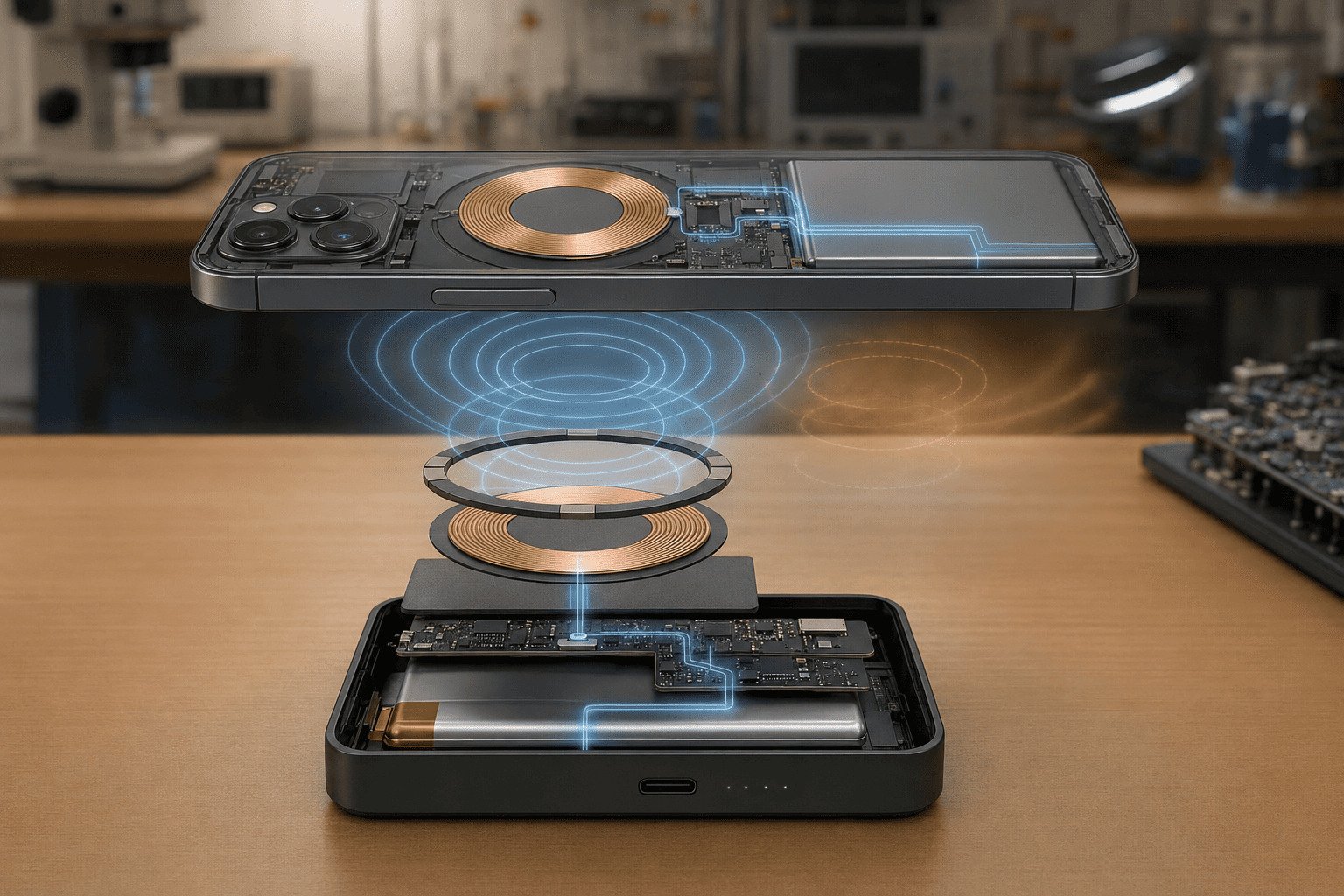
The basic path looks like this:
-
Battery cell stores energy
Most models use lithium-ion or lithium-polymer cells3. The advertised 5,000mAh or 10,000mAh rating usually refers to the internal cell capacity at the cell voltage, often around 3.7V nominal.4 -
BMS protects the battery
A battery management system should cover overcharge, over-discharge, overcurrent, short circuit, and temperature-related protection. -
Boost and control circuit prepares output
The circuit changes the battery voltage into the level needed by the wireless transmitter or USB output. -
Transmitter coil creates a magnetic field
The controller drives the coil at a controlled frequency and power level. -
Phone receiver coil receives energy
The phone captures part of the magnetic energy and converts it back into electrical power. -
Phone charging IC manages the battery
The phone decides how much power to accept based on battery level, temperature, protocol, and battery health strategy.
Modern wireless charging also includes communication. The phone and transmitter exchange information5 so the power bank knows whether to start, stop, reduce power, or adjust output. This is why protocol compatibility matters.
Important control functions include:
- Coil alignment detection for better coupling
- Foreign-object detection, or FOD, to reduce risk when metal objects are present
- Temperature monitoring through NTC sensors and firmware limits
- Automatic power adjustment when the phone heats up or the battery nears full
- Standby and restart logic when the phone is removed or misaligned
In factory validation, we do not only check whether the phone shows the charging icon. We check charging stability over time, surface temperature, coil temperature, abnormal object response, restart behavior, and charging curves on real devices.
Why Does Real Wireless Power Bank Performance Differ From Marketing Claims?
This is where many misunderstandings happen. A wireless power bank may say 10,000mAh and 15W, but the phone will not receive exactly 10,000mAh of usable battery energy6, and it may not hold 15W during the full session.
The mAh rating describes internal cell capacity, not the exact energy delivered to the phone. Real output is reduced by voltage conversion, wireless transfer loss, heat, misalignment, phone cases, and the phone’s own charging control. Advertised wattage is usually a maximum, not always sustained power.
A simple way to think about capacity is energy, not only mAh.
| Label | What it usually means | What users should understand |
|---|---|---|
| 5,000mAh | Internal cell capacity | Good for compact daily backup |
| 10,000mAh | Larger internal cell capacity | Longer use, heavier body |
| 15W wireless | Peak or supported wireless output | Sustained power may be lower7 |
| 20W USB-C | Wired output capability | Usually more efficient than wireless |
Wireless charging creates more heat than wired charging because energy crosses an air gap8. Misalignment increases loss. A thick case makes the gap larger. Phone usage during charging also adds heat because the processor, screen, modem, and battery charging system work at the same time.
In our testing approach, we usually compare:
- same room temperature, such as around 23°C to 25°C
- same phone model and battery starting percentage
- same case condition
- same charging position
- full charging curve, not only the first 5 minutes
- surface temperature and internal sensor trend
- restart behavior after thermal reduction
A product that briefly reaches a high peak can look strong in a short marketing test. However, a stable product that holds controlled power, limits temperature, and avoids repeated stop-start cycles may deliver a better user experience. We prefer to evaluate sustained charging power over time, not only the highest number shown on a meter.
One practical factory case is common in ODM work. A sample may pass basic charging, but show higher temperature near the coil after 20–30 minutes with a thick phone case. The improvement path is usually not one magic part. We review coil position, ferrite sheet, firmware power curve, NTC placement, housing material, and FOD threshold. After adjustment, the target is not “zero heat.” The target is controlled temperature, stable charging, and compliance with the required standard.
How Should Buyers Choose a Wireless Power Bank?
Choosing a wireless power bank should start with real use, not only capacity and wattage. A commuter, a traveler, a gamer, and a distributor buying 50,000 units do not have the same priorities.
For consumers, 5,000mAh models are lighter and easier to carry. 10,000mAh models provide more backup time but add weight and thickness. Wired output is useful when speed and efficiency matter. Wireless output is useful when convenience matters.
Check these points before buying:
- Phone compatibility: Confirm Qi, Qi2, MagSafe-style alignment, or Android wireless charging support.
- Case condition: Avoid thick, metal, wallet, or ring-stand cases during wireless charging.
- Heat behavior: Warm is normal. Excessive heat, repeated stopping, or swelling is not normal.
- Wired plus wireless output: USB-C output may charge faster and waste less energy.
- Pass-through charging: If supported, verify how heat and priority are controlled.
- Travel documents: For air shipping and travel, battery capacity and UN38.3 data matter9.
For B2B buyers, the checklist should be stricter. We recommend verifying:
-
Battery cell specification and supplier control
Cell grade, capacity tolerance, cycle aging, and safety data should be clear. -
BMS protection design
Overcurrent, overvoltage, undervoltage, short-circuit, and temperature protection should be tested. -
FOD and temperature test records
The product should react properly to metal objects and overheating conditions. -
Qi or Qi2 status
A product should not claim Qi2 unless its certification status supports that claim. -
Sustained-power data
Ask for 30-minute, 60-minute, and high-temperature condition data, not only peak wattage. -
Compliance files
Common documents include UN38.3, MSDS, CE, FCC, RoHS, UKCA, PSE, KC, UL-related reports or other regional files depending on the sales market. -
Consistency checks
Sample units, certificates, packaging claims, user manuals, labels, and mass-production units should match.
As a manufacturer, we also care about aging tests. Battery cycle tests, drop tests, high-low temperature storage, plug-in/out tests, button life tests, and real-device compatibility tests help reduce after-sales risk. These tests do not guarantee the same result for every user, but they reduce avoidable quality problems.
Frequently Asked Questions
Is a wireless power bank less efficient than a wired power bank?
Yes, usually. Wireless charging has extra losses from coil transfer, alignment, heat, and case distance. Wired charging often delivers more usable energy to the phone. Wireless charging is mainly chosen for convenience, while wired charging is better when speed and efficiency are priorities.
Does a magnetic wireless power bank always charge faster?
No. Magnets mainly improve alignment and ease of use. They do not automatically mean Qi2 certification, 15W charging, or higher efficiency. The actual result depends on the phone, protocol, coil design, firmware, case, and temperature control.
Why does my phone get warm on a wireless power bank?
Heat comes from voltage conversion, wireless energy transfer, battery charging, and phone use during charging. Some warmth is normal. If charging stops often or the phone becomes unusually hot, remove the case, stop heavy phone use, and check product quality.
Should I choose 5,000mAh or 10,000mAh?
Choose 5,000mAh if you want a slim daily backup. Choose 10,000mAh if you need longer runtime and accept more weight. The rated capacity is internal cell capacity, so the phone will receive less usable energy after conversion and wireless losses.
Conclusion
A wireless power bank is a portable battery with a wireless transmitter, but its real value depends on much more than mAh and peak wattage. Buyers should look at power path design, protocol support, alignment, FOD, thermal control, sustained charging data, battery quality, and compliance documents. If you need OEM or ODM wireless power bank development, Fabucharger can support product design, testing, certification coordination, and stable mass production for global markets.
"Qi (standard)", https://en.wikipedia.org/wiki/Qi_(standard). Wireless Power Consortium materials describe Qi and Qi2 as inductive wireless charging standards that coordinate power transfer between a transmitter and a compatible receiver, supporting the article’s definition of wireless power bank operation. Evidence role: definition; source type: institution. Supports: Qi and Qi2 are wireless charging standards based on inductive power transfer between transmitter and receiver coils.. ↩
"Qi (standard)", https://en.wikipedia.org/wiki/Qi_(standard). Wireless Power Consortium descriptions of Qi2 identify magnetic alignment as a positioning mechanism within a certified charging profile, indicating that magnets alone do not establish certification or sustained charging power. Evidence role: mechanism; source type: institution. Supports: Magnets are used for alignment in magnetic wireless charging, while charging power and certification depend on the applicable standard and device implementation.. Scope note: This supports the distinction between alignment and certification in general, but it does not evaluate any individual magnetic power bank. ↩
"PackSafe - Lithium Batteries", https://www.faa.gov/hazmat/packsafe/lithium-batteries. Government battery-safety and transport guidance commonly classifies power banks and portable chargers as lithium-ion battery devices, supporting the article’s statement that these products generally use lithium-based rechargeable cells. Evidence role: general_support; source type: government. Supports: Portable chargers and power banks are typically treated as lithium-ion battery products in safety and transport guidance.. Scope note: Such guidance does not prove the chemistry of every model, and some products may use different lithium cell formats or chemistries. ↩
"Lithium-ion battery", https://en.wikipedia.org/wiki/Lithium-ion_battery. Battery education references describe single-cell lithium-ion batteries as having nominal voltages around 3.6–3.7 V, supporting the article’s explanation that mAh labels often refer to internal cell capacity rather than USB output energy. Evidence role: definition; source type: education. Supports: Single-cell lithium-ion and lithium-polymer batteries are commonly specified with nominal voltages around 3.6–3.7 V.. Scope note: Nominal voltage varies by exact chemistry and manufacturer specification. ↩
"Wireless Power Consortium", https://en.wikipedia.org/wiki/Wireless_Power_Consortium. Wireless Power Consortium technical descriptions of Qi charging include communication between receiver and transmitter for power negotiation and control, supporting the article’s statement that charging behavior is protocol-managed. Evidence role: mechanism; source type: institution. Supports: Qi wireless charging uses receiver-to-transmitter communication for identification and power control.. ↩
"The Comprehensive Guide to Converting Wh to mAh", https://www.anker.com/blogs/others/wh-to-mah. Battery education sources explain that capacity ratings in mAh must be interpreted with voltage and conversion efficiency, supporting the article’s statement that a phone receives less usable energy than the label’s nominal cell capacity. Evidence role: mechanism; source type: education. Supports: Power bank mAh ratings are tied to internal battery voltage, while usable output energy is reduced by voltage conversion and system losses.. Scope note: The exact delivered energy depends on the particular power bank, phone, cable or wireless path, temperature, and charging protocol. ↩
"Thermal Design and Optimization of High-Power Wireless ...", https://www.osti.gov/servlets/purl/1871896. Studies of smartphone wireless charging report that delivered power can vary over a charging session as thermal conditions and battery-management controls change, supporting the article’s distinction between peak and sustained wattage. Evidence role: mechanism; source type: paper. Supports: Wireless charging systems can reduce charging power during operation because of temperature, battery state, or control algorithms.. Scope note: The evidence is contextual and may not quantify the sustained power of every commercial wireless power bank. ↩
"Thermal Design and Optimization of High-Power Wireless ...", https://www.osti.gov/servlets/purl/1871896. Technical literature on inductive power transfer identifies air-gap coupling losses and power-conversion losses as contributors to lower efficiency and heat generation, supporting the article’s comparison with wired charging. Evidence role: mechanism; source type: paper. Supports: Inductive wireless charging has additional coupling and conversion losses compared with direct wired charging, which can contribute to heat generation.. Scope note: Actual heat depends on device design, alignment, ambient temperature, charging protocol, and phone workload. ↩
"PackSafe - Lithium Batteries", https://www.faa.gov/hazmat/packsafe/lithium-batteries. Official dangerous-goods transport guidance requires lithium batteries to meet UN Manual of Tests and Criteria section 38.3 and applies capacity-based limits to spare lithium batteries, supporting the article’s emphasis on capacity and UN38.3 documentation for travel and shipping. Evidence role: historical_context; source type: government. Supports: Lithium batteries and power banks are subject to transport rules involving watt-hour capacity limits and UN Manual of Tests and Criteria section 38.3 testing.. Scope note: Specific airline, country, and shipment-mode rules can add requirements beyond the general UN transport framework. ↩