
A Chinese wireless charger supplier may send many certificate files, but that does not always answer the real compliance question. Buyers can still face [customs delays, retailer rejection, or redesign costs](https://ec.europa.eu/docsroom/documents/4207/attachments/3/translations/en/renditions/pdf)1. The practical solution is to match certifications with the destination market, full product configuration, and sales channel.
The most important certifications for importing wireless chargers depend on where the product will be sold, what functions it includes, and who will sell it. Buyers should separate legal market-access compliance, safety and EMC testing, and interoperability certifications such as Qi or Qi2. No single certificate replaces all others.
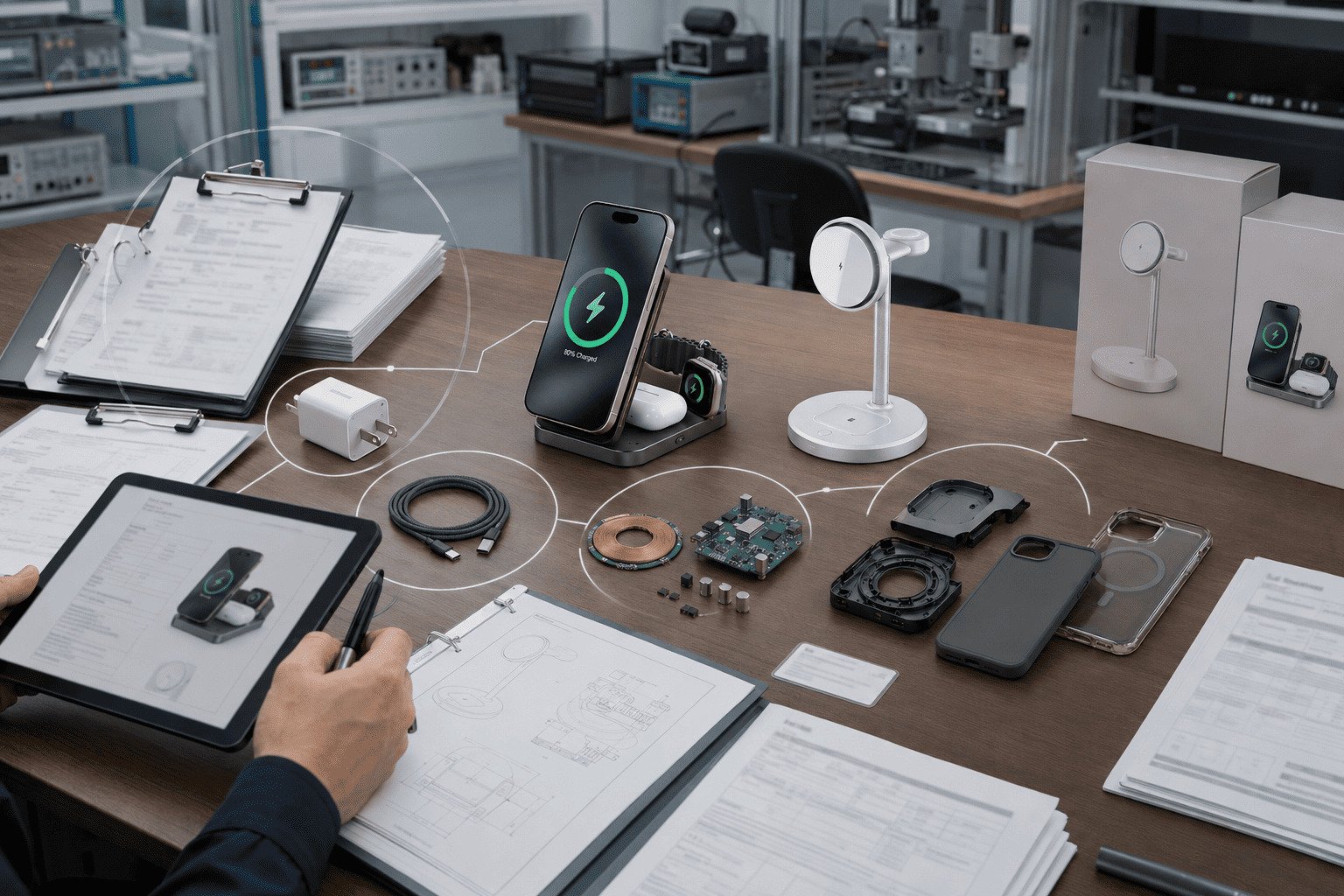
Wireless charger compliance becomes more complex when the product is not a simple charging pad. A Qi2 25W2 charger, 3-in-1 wireless charging station, power bank, car charger, or Bluetooth speaker charger may trigger different tests. So we look at compliance as a product-control system, not a PDF collection.
Which certifications should a Chinese wireless charger supplier prepare for each market?
Importers often ask for “all certificates,” but this request is too broad. It can waste time and still miss the needed document. The risk becomes higher when buyers sell through retailers, marketplaces, distributors, or commercial projects with different approval expectations.
The right certification set depends on the target region. CE, RoHS, and applicable EU directives are central for Europe.3 FCC is important for electromagnetic or radio-frequency compliance in the United States, but it is not electrical safety approval.4 UL or ETL may be required by retailers or insurers in North America.5
Market-access requirements are not universal
Buyers should first separate three compliance areas:
-
Legal market-access requirements
These relate to whether the product can be placed on the market. -
Electrical safety and EMC testing
These address electric shock, overheating, electromagnetic interference, and related risks. -
Industry interoperability certifications
These include Qi and Qi2, which focus on wireless charging performance and compatibility.
For example, CE-related compliance in Europe usually involves applicable EU directives and standards. RoHS is also important because it restricts hazardous substances in electrical and electronic products.6 If the charger includes a radio module, additional radio-related requirements may apply.
In the United States, FCC mainly addresses electromagnetic emissions or radio-frequency compliance. Buyers should not treat FCC as proof of electrical safety. For North American retail channels, UL or ETL may be requested by major retailers, distributors, insurers, or commercial customers to satisfy strict marketplace and workplace safety guidelines defined by national testing laboratories. These marks may not be automatically mandatory for every wireless charger and every sales channel, but they often affect market acceptance.
Other regional marks may also matter:
| Market | Common compliance area to confirm | Notes |
|---|---|---|
| EU | CE, RoHS, applicable directives | Product configuration affects scope |
| U.S. | FCC, possible UL/ETL expectations | FCC is not electrical safety approval |
| Japan | PSE and related rules | Confirm based on adapter and product type |
| South Korea | KC | Electrical and radio rules may apply |
| Australia/New Zealand | RCM | Supplier and importer duties should be checked |
| UK | UK requirements | Confirm current post-Brexit requirements |
Qi and Qi2 do not replace legal compliance
Qi or Qi2 certification helps show alignment with Wireless Power Consortium requirements and wireless charging interoperability. This is valuable for buyer confidence, especially for Qi2 25W magnetic alignment and newer high-power products that deliver faster wireless charging within leading consumer device ecosystems.
However, Qi or Qi2 does not replace:
- CE
- FCC
- RoHS
- UL or ETL
- PSE
- KC
- RCM
- Other national compliance requirements
We usually advise buyers to confirm the latest requirements with a qualified laboratory or local compliance consultant before mass production. Rules can change, and final responsibility often depends on the importer, brand owner, and sales channel.
Why do Qi2 25W and 3-in-1 products from a Chinese wireless charger supplier need extra checks?
A basic low-power wireless charging pad is usually easier to assess. A Qi2 25W magnetic charger or 3-in-1 wireless charging station has more power, more components, and more use cases. More functions mean more possible compliance gaps.
Qi2 25W and 3-in-1 wireless chargers need extra checks because the complete system must be tested, not only the charging coil. Simultaneous phone, watch, and earbud charging can affect input power, heat, EMC, power distribution, firmware behavior, and adapter compatibility.7
The complete configuration changes the compliance scope
Certification requirements may change when a wireless charger includes:
- External AC adapter
- USB-C PD or PPS input
- Rechargeable battery
- Bluetooth module
- LED lamp
- Car-power input
- Watch-charging module
- Multiple wireless charging outputs
- Magnetic alignment structure
- Built-in cable or detachable cable
A 3-in-1 charger is not only “one phone charger plus two small modules.” The product must be reviewed as a complete system. If the phone, watch, and earbuds charge at the same time, the internal temperature, current distribution, and protection circuits may behave differently from single-output use.
Important checks include:
| Item | Why it matters |
|---|---|
| Total input power | Prevents overload and unstable operation |
| Power distribution | Confirms each output receives safe power |
| Surface temperature | Affects user safety and comfort |
| Internal temperature | Protects PCB, coils, magnets, and battery parts |
| [Foreign-object detection](https://chrismi.sdsu.edu/publications/170.pdf)8 | Reduces heating risk from metal objects |
| Coil alignment | Affects efficiency and heat |
| Insulation and spacing | Supports electrical safety |
| Cable reliability | Prevents intermittent power and overheating |
| Firmware behavior | Controls charging logic and protection |
| Adapter compatibility | Confirms PD/PPS power source performance |
Battery-powered products need extra transport documents
For wireless charging power banks or battery-powered models, buyers may need battery-related documents. These can include:
- UN38.39
- SDS or MSDS10
- Battery safety test reports
- Transportation documents
- Air or sea shipping declarations, where applicable
These documents support battery safety and shipping compliance. They should not be described as substitutes for complete product certification. A power bank still needs to meet the applicable market-access, EMC, safety, and material requirements for the destination market.
Adapter inclusion can change responsibility
Many importers focus on the wireless charger body and forget the adapter. This is a common mistake. If the supplier includes a USB-C PD or PPS adapter in the retail package, [the adapter may need its own compliance documents](https://www.eac.gov/sites/default/files/2024-08/PRVV0001-R1_UL%2062368-1%202019.pdf)11 and specific regulatory markings under unified audio/video and ICT safety standards to pass customs smoothly.
Buyers should confirm:
- Does the adapter match the tested configuration?
- Is the adapter brand and model fixed?
- Does the charger pass testing with that exact adapter?
- Will mass production use the same cable and adapter?
- Does the packaging claim a charging speed that the system can safely support?
For Qi2 25W and 3-in-1 chargers, we prefer to review the charger, adapter, cable, firmware, and loading conditions together. This approach reduces the risk of approving one sample and shipping a slightly different mass-production product.
How should buyers verify certificates from a Chinese wireless charger supplier?
A PDF certificate is only useful when it matches the exact product. Buyers who only collect files may miss model differences, outdated standards, or incomplete test coverage. This creates risk during customs clearance, retailer review, or after-sales investigation.
Buyers should compare the certificate, test report, product photos, model number, applicant, manufacturer, electrical ratings, tested configuration, standard, and report number against the actual product. The document must cover the exact model or clearly explain the approved model series.
What buyers should compare before approval
We recommend checking each certificate and report against the physical sample and purchase specification. The goal is simple: prove that the tested product is the same product being bought.
Key points to compare include:
- Product model number
- Applicant name
- Manufacturer name
- Factory address
- Product photographs
- Input and output ratings
- Adapter model, if included
- Cable type and rating
- PCB version
- Coil specification
- Power-management chip
- Magnetic structure
- Enclosure material
- Firmware version
- Report number and issue date
- Applicable standard version
- Model series explanation
A certificate for a similar product is not enough if the PCB, coil, adapter, firmware, or enclosure material has changed.
Common warning signs
Buyers should slow down when they see these issues:
- The report shows a different product photo.
- The model number does not match the quotation or sample.
- The supplier says one certificate covers every country.
- A component certificate is presented as complete-product approval.
- The standard is outdated and not accepted by the sales channel (such as failing to align with the latest mandatory regional updates or directive frameworks).
- The certificate covers a single-output charger, but the quote is for a 3-in-1 charger.
- The tested sample used a different adapter or cable.
- The supplier cannot explain model-series coverage.
- The customized version has changed materials, magnets, logo structure, PCB layout, or firmware.
Factory control matters after certification
Reliable compliance does not stop after testing. Mass production must stay consistent with the approved sample. This is especially important for OEM and ODM projects, because small changes can affect heat, EMC, charging efficiency, or safety protection.
A capable supplier should support certification with production-control procedures such as:
- BOM control
- Locked PCB versions
- Approved coil and chip specifications
- Approved magnet specifications
- Golden sample management
- First-article approval
- Engineering change control
- Firmware version control
- Material traceability
- Production sampling inspections
Factory testing should also support daily quality control. Useful tests include:
- Input and output power checks
- Temperature-rise testing
- Foreign-object detection testing
- Short-circuit protection testing
- Overvoltage and overcurrent protection testing
- Device compatibility testing
- Charging through different case thicknesses
- Coil-misalignment testing
- EMC pre-scanning
- Ageing testing
- Drop and structural reliability testing
- Connector durability testing
- Simultaneous multi-device charging tests
As a manufacturer, we have seen that certificate review and factory process review must work together. The document shows what passed. The process helps ensure the shipped product remains consistent.
Who should pay for certification and who should own the certificate?
Certification cost is often discussed too late. Buyers may assume the supplier should pay for everything. Suppliers may assume customized testing is the buyer’s responsibility. This misunderstanding can delay launch plans and raise sourcing tension.
There is no single rule for who must pay. Certification cost depends on target markets, product functions, battery or adapter inclusion, Qi or Qi2 requirements, model quantity, lab selection, and possible redesign or retesting. Certificate ownership should be agreed before testing begins.
What affects certification cost?
Costs can increase when the product includes:
- Qi2 25W wireless charging
- 3-in-1 simultaneous charging
- Built-in battery
- Bluetooth speaker
- LED lamp
- Car charger input
- Custom enclosure
- New PCB design
- Exclusive adapter
- Multiple regional certifications
- Multiple model numbers or SKUs
Testing can also become more expensive if the first sample fails and requires redesign. For example, temperature-rise issues may require coil changes, firmware changes, housing material changes, or adapter changes. EMC problems may require PCB layout changes or shielding improvements.
Practical payment arrangements
Based on Fabucharger's extensive manufacturing experience for global brands, here are the practical arrangements:
| Situation | Common approach |
|---|---|
| Supplier standard model | Supplier maintains existing compliance documents |
| Minor logo customization | Supplier shares available documents if model is unchanged |
| Major ODM design change | Cost is negotiated |
| Exclusive market requirement | Buyer may share or cover testing cost |
| Brand-owned certificate | Buyer often pays and controls applicant details |
| Factory-owned platform certificate | Supplier usually maintains it |
Certificate ownership also matters. The applicant may be the factory, exporter, overseas brand, or importer. This choice affects control. If a buyer needs to keep certificate control when changing manufacturers, buyer-owned certification may be better. If the buyer uses the supplier’s standard platform, factory-held documentation may be more practical.
Frequently Asked Questions
Is FCC certification enough for importing wireless chargers into the United States?
No. FCC mainly addresses electromagnetic or radio-frequency compliance. It should not be treated as electrical safety approval. Some retailers, distributors, insurers, or commercial buyers may also request UL, ETL, or other safety-related documentation depending on the product and sales channel.
Does Qi2 certification mean a wireless charger is fully compliant?
No. Qi2 certification supports wireless charging interoperability and alignment with Wireless Power Consortium requirements. It does not replace CE, FCC, RoHS, UL, ETL, PSE, KC, RCM, or other legal market-access obligations.
Do 3-in-1 wireless chargers need different testing from basic charging pads?
Usually yes. A 3-in-1 charger should be assessed as a complete system, especially during simultaneous charging. Buyers should review total input power, heat, power distribution, adapter compatibility, firmware, coil alignment, and protection functions.
What documents are needed for wireless charging power banks?
Battery-powered products may require UN38.3, SDS or MSDS, battery safety reports, and transport documents. These support shipping and battery safety compliance, but they do not replace complete product testing for the destination market.
How can buyers detect unreliable certificates?
Buyers should compare the report with the actual product. Warning signs include mismatched model numbers, different product photos, outdated standards, unclear series coverage, component-only certificates, and claims that one certificate applies to every country and every customized design.
Conclusion
The most important certifications when buying from a Chinese wireless charger supplier are not decided by a universal checklist. They depend on the destination market, product configuration, and sales channel. Reliable compliance comes from choosing the right requirements, testing the complete product, verifying every document against the actual model, and keeping mass production consistent with the approved sample. Before importation, buyers should confirm current requirements with qualified laboratories or local compliance professionals. If you need OEM or ODM wireless charger support, Fabucharger can help review product configuration, documentation, and production control before mass production.
"MARKET SURVEILLANCE PROGRAMME - European Commission", https://ec.europa.eu/docsroom/documents/4207/attachments/3/translations/en/renditions/pdf. Government market-surveillance and consumer-safety guidance shows that electrical products lacking required compliance or presenting safety hazards may be subject to import controls, recalls, or corrective action, which provides contextual support for the risk of delays, rejection, and redesign. Evidence role: general_support; source type: government. Supports: Government import, market-surveillance, or consumer-safety sources can support that unsafe or noncompliant electrical products may be detained, refused, recalled, or require corrective action.. Scope note: Such sources may not address wireless chargers specifically in every case, so the support is contextual rather than direct proof for all sales channels. ↩
"Qi (standard)", https://en.wikipedia.org/wiki/Qi_(standard). Wireless Power Consortium materials identify Qi2 as a magnetic wireless charging standard and describe higher-power Qi2 specifications, supporting the article’s reference to Qi2 25W as a distinct certification and performance category. Evidence role: definition; source type: institution. Supports: Wireless Power Consortium or standards-related materials should support the existence and basic purpose of Qi2 25W as a wireless charging specification or certification category.. Scope note: Public WPC materials may summarize the standard and may not disclose all technical test requirements. ↩
"EU WEEE_RoHS - International Trade Administration", https://www.trade.gov/eu-weeerohs. European Commission guidance on CE marking and the RoHS Directive explains that covered electrical and electronic equipment placed on the EU market must satisfy applicable EU legislation, including conformity assessment and hazardous-substance restrictions. Evidence role: definition; source type: government. Supports: Official EU sources should define CE marking obligations and RoHS restrictions for electrical and electronic equipment placed on the EU market.. Scope note: The exact directives applicable to a particular wireless charger depend on its functions and configuration. ↩
"Equipment Authorization – RF Device | Federal Communications ...", https://www.fcc.gov/oet/ea/rfdevice. FCC equipment-authorization guidance concerns radio-frequency devices and electromagnetic compliance, while OSHA’s Nationally Recognized Testing Laboratory program addresses independent testing and certification for product safety, supporting the distinction between FCC compliance and electrical safety approval. Evidence role: definition; source type: government. Supports: FCC materials can support that FCC equipment authorization concerns radio-frequency devices and electromagnetic emissions, while OSHA NRTL materials can support the separate role of safety testing laboratories.. Scope note: The sources establish the regulatory distinction; they may not state this comparison specifically for wireless chargers. ↩
"OSHA's Nationally Recognized Testing Laboratory (NRTL) Program", http://www.osha.gov/nationally-recognized-testing-laboratory-program. OSHA describes the Nationally Recognized Testing Laboratory program as a framework for independent testing and certification of products to safety standards, providing contextual support for why UL, ETL, or similar marks are used in North American safety acceptance decisions. Evidence role: general_support; source type: government. Supports: OSHA NRTL documentation can support that UL, ETL, and similar marks indicate third-party safety testing and certification by recognized laboratories.. Scope note: OSHA does not determine every retailer or insurer requirement, so the source supports the role of NRTL marks rather than proving that all retailers require them. ↩
"RoHS - Wikipedia", https://en.wikipedia.org/wiki/RoHS. Directive 2011/65/EU on the restriction of hazardous substances establishes limits on specified hazardous substances in covered electrical and electronic equipment placed on the EU market. Evidence role: definition; source type: government. Supports: The EU RoHS Directive should support that certain hazardous substances are restricted in electrical and electronic equipment.. Scope note: Whether a particular charger is within scope and which exemptions apply require product-specific assessment. ↩
"Wireless power transfer - Wikipedia", https://en.wikipedia.org/wiki/Wireless_power_transfer. Studies of wireless power transfer systems show that load conditions, coil coupling, efficiency, and control strategy influence heat generation and electromagnetic behavior, providing technical context for assessing multi-device wireless chargers as complete systems. Evidence role: mechanism; source type: paper. Supports: Engineering literature should support that wireless power transfer performance, temperature, efficiency, and electromagnetic behavior depend on load conditions, coil coupling, and system design.. Scope note: Research papers may analyze representative wireless power systems rather than the exact phone-watch-earbud configuration discussed in the article. ↩
"[PDF] A review of foreign object detection (FOD) for inductive ... - Chris Mi", https://chrismi.sdsu.edu/publications/170.pdf. Wireless power transfer literature describes metallic foreign objects as potential sources of parasitic heating and identifies foreign-object detection as a safety mechanism used to reduce that hazard. Evidence role: mechanism; source type: paper. Supports: A technical paper or standards overview should support that metallic foreign objects in wireless power fields can heat and that detection methods are used to mitigate this risk.. Scope note: The cited literature may explain the mechanism generally and may not validate a specific charger’s foreign-object detection performance. ↩
"Lithium Battery Test Summaries (TS) | PHMSA", https://www.phmsa.dot.gov/training/hazmat/new-un-requirement-test-summaries. The UN Manual of Tests and Criteria includes subsection 38.3 for lithium cells and batteries, which is widely used in dangerous-goods transport compliance for battery-containing products. Evidence role: definition; source type: institution. Supports: UN or international transport guidance should support that lithium cells and batteries are subject to UN Manual of Tests and Criteria subsection 38.3 for transport.. Scope note: UN38.3 concerns battery transport safety and does not replace market-access, EMC, or complete-product safety certification. ↩
"[PDF] Hazard Communication Standard: Safety Data Sheets - OSHA", https://www.osha.gov/Publications/OSHA3514.html. Hazard-communication guidance describes safety data sheets as standardized documents for communicating chemical hazards, handling, and emergency information, supporting their use as part of documentation for battery-containing products. Evidence role: definition; source type: government. Supports: Government hazard-communication guidance should support that safety data sheets communicate chemical hazards and handling information for hazardous materials.. Scope note: Whether an SDS is required for a specific finished product or shipment depends on classification, jurisdiction, and carrier requirements. ↩
"[PDF] PRVV0001-R1_UL 62368-1 2019.pdf", https://www.eac.gov/sites/default/files/2024-08/PRVV0001-R1_UL%2062368-1%202019.pdf. IEC 62368-1 is used as a safety standard for audio/video and information and communication technology equipment, including many external power-supply applications, supporting the need to verify adapter compliance separately when an adapter is supplied with the product. Evidence role: general_support; source type: institution. Supports: Standards or regulatory guidance should support that external power supplies are assessed under applicable safety and regulatory requirements, commonly including IEC 62368-1 for audio/video and ICT equipment.. Scope note: The applicable standard and marking obligations vary by jurisdiction, adapter design, and sales channel. ↩